periodical issue
Freedom First
By S. V. Raju
Edited, printed & published for the Democratic Research Service by V. B. Karnik at The Kanada Press, 109 Parsi Bazar Street, Bombay 1. · Bombay · 1958
12 pages
Freedom First
Summary
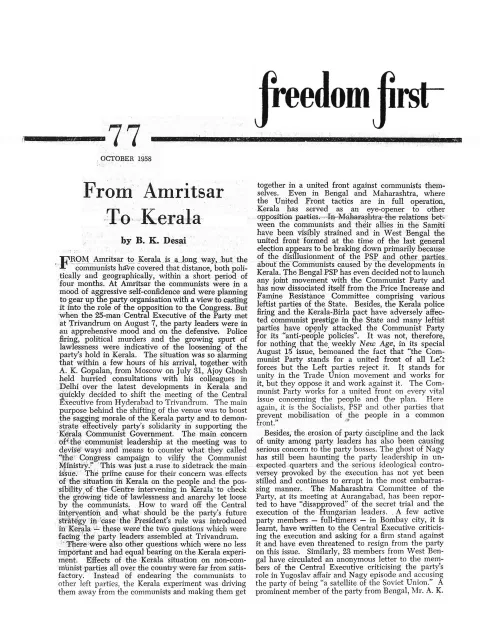
This is issue No. 77 (October 1958) of Freedom First, the monthly journal of the Democratic Research Service / Indian Committee for Cultural Freedom, published from Bombay. In the rendered pages it carries a mix of political commentary and cultural-cold-war journalism: a lead piece tracing the Indian Communist Party’s ideological confusion from its Amritsar congress to its handling of the Kerala communist government; an editorial “Notes” section on parliamentary manoeuvring over a Kerala debate and on Dr. Charles Malik’s election to the UN General Assembly presidency; a report on unrest in Chinese-occupied Tibet; an analysis of the July-August 1958 Khrushchev-Mao summit in Peking; an essay by Michael Polanyi on the historical failure of scientific rationalism to humanize politics; a book review of Massimo Salvador’s Liberal Democracy; a documentary account, built from an open letter and a published booklet, of alleged repression and lawlessness under the Communist ministry in Kerala; and a closing page of quoted political soundbites (“With Many Voices”) plus subscription and I.C.C.F. society notices. The volume’s argumentative center is anti-communist: nearly every piece — on India’s CPI, on Tibet, on the Sino-Soviet summit, on Kerala governance — is marshalled to expose the gap between communist rhetoric and communist practice, framed within a broader liberal-democratic and Cold War perspective.
Key points
-
B. K. Desai’s “From Amritsar To Kerala” traces the CPI’s shift from confidence at Amritsar to a defensive mood by August 1958, citing police firings and the Kerala-Birla pact, and outlines a three-part strategy: deflecting blame for Kerala unrest, building anti-Congress fronts nationally, and fusing both narratives.
-
Notes recount a Parliamentary standoff that scuttled a promised debate on Kerala, with Acharya Kripalani charging the government is being “bullied” by the Communist Party, and praise Dr. Charles Malik’s election as UN General Assembly President.
-
S. V. Raju’s “Revolt In Occupied Tibet” documents sustained Tibetan rebellion against Chinese land reform in the Kanze Chou region since 1956, and reports a petition from the Dalai Lama’s brother alleging the bombing of Litang village and over 4,000 deaths.
-
Roderick Macfarquhar’s “Khrushchev-Mao Tse-tung Meeting” reads the July-August 1958 Peking summit as Khrushchev securing Chinese backing for disarmament overtures in exchange for abandoning conciliation toward Tito, amid China’s harder line on the Lebanon-Jordan crisis.
-
Michael Polanyi’s “The Impact Of Science” argues applying scientific exactitude to human affairs strips grounds for respecting one’s fellow men, tracing a line from Bentham through Marx to Nietzsche that helped generate twentieth-century totalitarian violence.
-
Adam Adil reviews Massimo Salvador’s Liberal Democracy as a defence of liberal ideas against the charge they are outdated “bourgeois” relics, highlighting Salvador’s claim that intellectuals, not masses, direct history’s “doers.”
-
“Kerala Under Communism” reproduces an open letter from N. Sreekantan Nair of the Revolutionary Socialist Party detailing the killing of RSP members at Chandanathope, government favouritism toward an American company over an RSP cooperative, and a pattern of withdrawn prosecutions against communists.
Essays
From Amritsar To Kerala
By B. K. Desai
B. K. Desai’s “From Amritsar To Kerala” surveys the Communist Party of India’s internal disarray between its Amritsar congress and the Kerala communist government’s difficulties by mid-1958. The piece argues that police firings, political murders, and the Kerala-Birla pact eroded the party’s standing even among sympathetic left parties (PSP, Samiti allies in Maharashtra and Bengal), while internal rifts — over the Hungarian executions, over Dange’s “demagogic” statements, over creeping “right-wing revisionism” versus rigid Marxism-Leninism — left the leadership exposed. The author contends these factional quarrels have little real effect on the party’s discipline or capacity to mobilise, since ultimate strategic control rests with Moscow, and closes by describing the party’s three-pronged strategy in Kerala (denying Congress culpability for unrest, forging anti-Congress united fronts elsewhere, and merging both into a narrative that the Congress alone is the obstacle to popular government), asking whether Andhra/Telangana will see a repeat of the pattern.
- Traces CPI’s shift from aggressive confidence at Amritsar to a defensive, apprehensive mood by the August 1958 Trivandrum Central Executive meeting
- Cites Kerala police firings, the Kerala-Birla pact, and rising lawlessness as damaging communist prestige even among leftist allies like the PSP
- Documents internal party dissent over the secret trial and execution of Hungarian (Nagy-era) leaders, including a Maharashtra committee’s disapproval and an anonymous letter from West Bengal members
- Notes Dange’s censure by the Party Executive for indiscreet public statements
- Argues that despite visible factionalism, ultimate policy direction is set by Moscow, limiting the practical significance of internal party rivalries
- Outlines a three-part CPI strategy: deflect blame for Kerala unrest onto Congress, build anti-Congress united fronts nationally, and fuse both into the narrative that Kerala is a ‘new outpost of democratic forces’
Notes
The unsigned “Notes” section covers two items in the rendered pages. “‘Bullies’ And Appeasement” criticises the Government of India for evasive parliamentary tactics that prevented a promised debate on the Kerala situation, recounting Acharya Kripalani’s charge that the government is being intimidated by the Communist Party and the Home Minister Pandit Pant’s rebuttal, and suggesting the government has been shielding the Communist ministry of Kerala. “Dr. Charles Malik” praises the election of the Lebanese Foreign Minister as President of the 13th UN General Assembly session as recognition of a committed liberal diplomat who has championed democratic values amid Middle Eastern chauvinism.
- Details a procedural standoff in Parliament that scuttled a promised debate on the Kerala situation
- Recounts Acharya Kripalani’s charge that the government of India is being ‘bullied’ by the Communist Party
- Quotes Home Minister Pandit Pant’s denial of any communist understanding, deemed insufficient given government inaction
- Frames Dr. Charles Malik’s UN General Assembly presidency as a win for liberal, democratic internationalism against chauvinism and racialism
Khrushchev-Mao Tse-tung Meeting
By Roderick Macfarquhar
Roderick Macfarquhar’s “Khrushchev-Mao Tse-tung Meeting” analyses the July 31-August 3, 1958 Peking summit as a major world-affairs event marking Communist China’s entry as a full participant in East-West diplomacy. The author argues Khrushchev travelled to Peking chiefly to prevent China from sabotaging any agreement he might reach with the West during the Middle East crisis (following the U.S. move into Lebanon and Britain into Jordan), given growing Sino-Soviet policy divergence — China’s harder line versus Khrushchev’s more conciliatory posture and eagerness for a summit. The piece concludes the two leaders struck a bargain in which Khrushchev secured Chinese backing for peace overtures (disarmament, ending atomic tests) in exchange for concessions including a tougher joint communique tone and abandoning any softening toward Tito.
- Frames the Khrushchev-Mao Peking summit (July 31-August 3, 1958) as ranking with the first Soviet atom bomb test and the Korean War’s outbreak in significance
- Argues divergent Chinese and Soviet responses to the Lebanon/Jordan crisis forced Khrushchev to secure Chinese backing before any Western negotiations
- Cites the hard-line July 20 People’s Daily editorial dismissing summit talks as ‘unnecessary and weak-kneed’ as evidence of China’s more bellicose posture
- Concludes Khrushchev extracted a joint commitment to disarmament and ending nuclear tests in exchange for concessions, including abandoning conciliation toward Tito’s Yugoslavia
- Speculates Khrushchev’s ultimate leverage was assuring Mao that Russia would declare neutrality in the event of a China-triggered war
Revolt In Occupied Tibet
By S. V. Raju
S. V. Raju’s “Revolt In Occupied Tibet” recounts the 1950 Chinese invasion of Tibet and the Panchsheel agreement that formalised Indian acquiescence to it, then documents evidence — drawn from a Chinese Communist “Work Report” published in the Kangtung Kanze Pao and covering December 1955 to March 1958 — of sustained Tibetan rebellion against Chinese land reform and rule in the Kanze Chou region of Szechwan, including sieges, destroyed government stores, and violent Communist reprisals. The piece frames the Chinese authorities’ claims of assured Tibetan autonomy (via a P.T.I. interview with a Communist Tibetan governor) as broken promises, and closes with a petition from a group of Tibetans led by the Dalai Lama’s brother alleging the bombing of the village of Litang and thousands of Tibetan deaths.
- Recounts the 1950 Chinese Communist invasion of Tibet and India’s ‘Panchsheel’ agreement acquiescing to it despite a mild protest via Sardar Patel
- Cites a Chinese Communist ‘Work Report’ from the Kangtung Kanze Pao admitting continuous rebellion in the Kanze Chou region since 1956
- Attributes the rebellion’s spark to the Party’s December 1955 decision to introduce land reform in Tibetan areas
- Notes Chinese Buddhist Association chairman Hsi Jao Chia Tso’s explanation that Tibetans are ‘conservative’ and resistant to ‘unripe’ change
- Reports a petition to Nehru from a group led by the Dalai Lama’s brother alleging the bombing of Litang village and over 4,000 Tibetan deaths
The Impact Of Science
By Michael Polanyi
Michael Polanyi’s “The Impact of Science” (reproduced from Quest) argues that the Enlightenment-era hope that science could guide and reform human affairs has produced a tragic paradox: applying the exactitude of physical science to the study of man strips away grounds for respecting one’s fellow men, and in its more radical forms — from Bentham’s utilitarianism through Marx to Nietzsche — this naturalistic reduction of morality helped generate the fanaticism and mechanised violence of twentieth-century totalitarianism. Polanyi contends that modern nihilism and Bolshevik and Nazi savagery are not simple selfishness but a ‘venomous protest’ born of moral passions that, once denied any legitimate outlet by scientific scepticism about genuine moral motives, became embodied in the machinery of party, police, and army. He closes hopeful that the post-Stalin thaw and the moral witness of dissidents (implicitly the Hungarian rebels) may open a door away from ‘scientific enslavement.’
- Argues that applying inanimate-science’s methods of ‘exactitude and conclusiveness’ to human affairs strips grounds for respecting one’s fellow men
- Traces the naturalistic conception of man from 18th-century Bentham utilitarianism (a philanthropic, reforming force) to Marx’s class-morality doctrine and Nietzsche’s nihilism
- Identifies ‘fanaticism’ — a moral passion denied legitimate outlets by scientific scepticism — as the root of 20th-century totalitarian cruelty
- Argues Nazism paradoxically mirrors Bolshevism in structure: both channel genuine moral fervor into a mechanised apparatus of violence
- Reads the post-Stalin ‘humanization’ of the Soviet regime and the Hungarian uprising as a ‘leaking out’ of morally serious passions suppressed under Bolshevism
Review: Liberal Democracy (by Massimo Salvador)
By Adam Adil
A review, signed Adam Adil, of Massimo Salvador’s Liberal Democracy (Pall Mall Press, London), which the reviewer praises as a ‘refreshing and brilliant exposition’ defending liberal democracy against the fashionable view that it is an outdated, ‘decadent bourgeois’ relic. The review summarises Salvador’s argument that liberty is best understood as a method (with democracy as the institutional set that method gives rise to) rather than a fixed goal, surveys his treatment of thinkers from Bacon and Voltaire to J. S. Mill, and highlights his claim that intellectuals bear special responsibility for directing the ‘doers’ of history, alongside his view that liberal ideas must be a ‘dynamic’ concept continually reformulated for new times.
- Reviews Massimo Salvador’s Liberal Democracy as a defence of liberal-democratic ideas against the charge that they are outdated ‘bourgeois’ relics
- Summarises Salvador’s definition of liberty as a method (not merely a goal) with democracy as its resulting institutional set
- Notes Salvador’s survey of liberal thinkers including Bacon, Voltaire, Montesquieu, Jefferson, Paine, Pestalozzi, and J. S. Mill
- Highlights Salvador’s claim that intellectuals, not masses, provide the ideas that direct the ‘doers’ of history
- Notes the reviewer’s approval of Salvador’s view that liberal ideas must evolve dynamically with changing times
Kerala Under Communism
“Kerala Under Communism” documents escalating conflict between the state’s Communist ministry and non-communist parties and workers, opening with the Kerala Pradesh Congress Committee’s September 9 resolution warning of a ‘complete dissruption of society’ absent policy change. The bulk of the piece reproduces excerpts from an open letter by N. Sreekantan Nair of the Revolutionary Socialist Party (RSP) and from the booklet Interference with Justice in Kerala, detailing specific cases: violent police suppression of a cashewnut-factory strike at Chandanathope resulting in deaths, the fatal shooting of RSP members, government favoritism toward an American company over an RSP-led workers’ cooperative, forcible eviction of fisherman squatters at Chavara, and a pattern of the Communist government withdrawing prosecutions and remitting sentences against communist party members and labourers accused of violence, trespass, and dacoity.
- Opens with the Kerala Pradesh Congress Committee’s September 9, 1958 resolution warning of societal breakdown under the Communist state government
- Reproduces an open letter from N. Sreekantan Nair (RSP) describing the killing of RSP members at Chandanathope and police brutality against strikers and picketers
- Details a cashew-factory labour dispute in which women picketers were allegedly assaulted by Reserve Constables, with one worker fatally stabbed
- Documents government favoritism toward the American company ‘The National Lead Ltd.’ over an RSP-led Mineral Workers’ Cooperative Society bid
- Describes the eviction and prosecution of fishermen squatters at Chavara after they occupied leftover government waste land
- Cites the booklet Interference with Justice in Kerala for a pattern of government withdrawal of prosecutions and remission of sentences against communists accused of violence and dacoity
With Many Voices
No summary was extracted for this article. Listed for completeness.
Generated by the v1.5 extraction pipeline. Awaiting editorial review.
Metadata and summary are AI-extracted from the source PDF and reviewed for editorial accuracy. The original work is available via the Read PDF tab above (where present); paragraph-level citation inside the PDF is deferred to a future engagement.