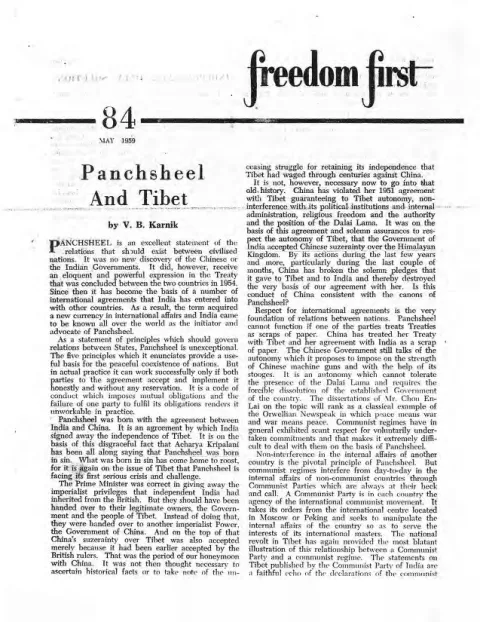
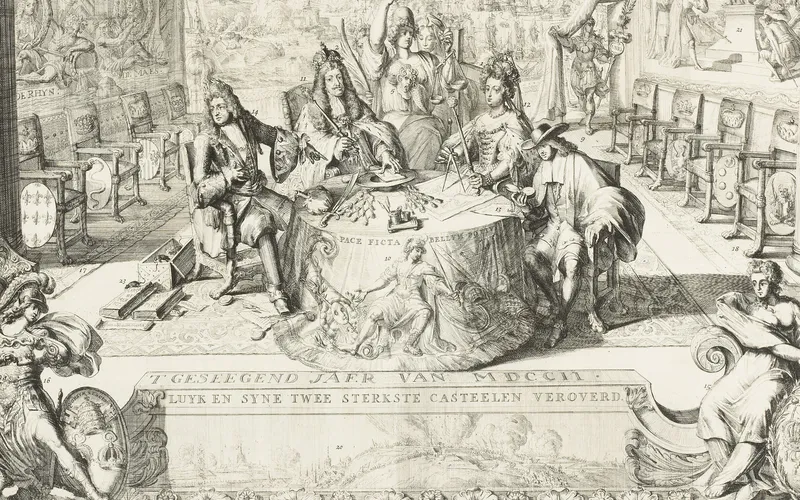
periodical issue
Freedom First
By S. V. Raju
Edited, printed & published for the Democratic Research Service by V. B. Karnik at The Kanada Press, 109 Parsi Bazar Street, Bombay 1. · Bombay · 1959
12 pages
Freedom First
Summary
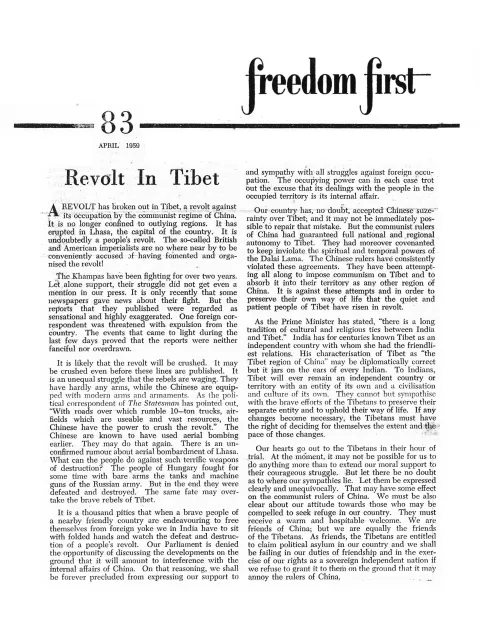
This is issue No. 83 (April 1959) of Freedom First, the monthly periodical edited, printed and published for the Democratic Research Service by V. B. Karnik in Bombay. In the rendered pages the issue opens with an unsigned editorial and a signed follow-up analysis on the Tibetan uprising against Chinese rule and India’s muted official response, followed by a domestic critique of Nehru’s cooperative-farming push after the Congress’s Nagpur resolution, a report on the fracture between Arab nationalism and communism in Iraq and Egypt, a critical dispatch on rising crime and politicised policing under Kerala’s Communist ministry, a notice on the formation of a Bombay-based Committee for Solidarity with Tibet, a long essay-review of the newly published Trotsky’s Diary in Exile, a book review of a poetry anthology from behind the Iron Curtain, and a closing miscellany column of quoted press opinion under the recurring title ‘With Many Voices.’ Across these pieces the volume’s argumentative centre is anti-communist and pro-liberal-democratic: skepticism of Nehru’s dirigiste and conciliatory tendencies, solidarity with anti-communist national movements abroad (Tibet, Iraq), and alarm at what contributors saw as the Communist Party’s manipulation of state power in Kerala.
Key points
-
An unsigned lead editorial, “Revolt In Tibet,” argues the uprising against Chinese rule is a genuine, nationwide people’s revolt, criticising Indian officialdom for suppressing early reports and Nehru’s phrase “the Tibet region of China” as diplomatically evasive.
-
S. V. Raju’s “Tibetan Crisis And Indian Policy” cites George N. Patterson’s estimate of 200,000 guerrilla fighters against a 300,000-strong Chinese army, predicts the revolt will likely be crushed, and criticises India’s refusal to let Parliament debate the issue.
-
S. R. Mohan Das’s “The Cudgels For Co-operative Farming” argues criticism of the Nagpur resolution targets Nehru’s sudden personal championing of joint farming, reading it as compensation for Congress’s organisational weakness relative to the Communists after the loss of Kerala.
-
Adam Adil’s “Communism In The Arab World” reports the failed Mosul revolt against General Kassim, noting Islamic clerical fatwas condemning communism and that Iraqi communists, though lacking broad popular support, are purging nationalists from the civil service and army.
-
Ravi Prasad’s “Letter From Kerala” uses the state Police Department’s own report to show murder cases rose from 173 in 1956 to 273 in 1958 and detection rates fell from 41% to 27%, tying this to the Communist ministry’s liberal prisoner releases and withdrawal of 236 criminal cases in 1957 alone.
-
A companion report describes an Expert Committee under Kuruvilla Jacob finding hastily revised, religiously and socially offensive passages in Kerala’s nationalised textbooks, and Jacob’s subsequent resignation as the government’s Honorary Educational Adviser.
-
A notice reports the formation of a Bombay Committee for Solidarity with Tibet on 27 March, chaired by Asoka Mehta with Frank Moraes as Chairman, calling for asylum for Tibetan refugees.
-
Bertram D. Wolfe’s essay-review of Trotsky’s Diary in Exile highlights Trotsky’s admission that he and Lenin, not Stalin, ordered the execution of the Tsar’s family, and his unchanged revolutionary certitude despite Stalin’s persecution of his own family.
-
John Wain reviews Robert Conquest’s anthology Poems from Behind the Iron Curtain, singling out Adam Wazyk’s “Poem for Adults” and Gyula Illyes’s “One Sentence on Tyranny” as surviving translation as considerable literary art.
Essays
Revolt In Tibet
This unsigned lead editorial, ‘Revolt In Tibet,’ argues that the uprising against Chinese communist rule is a genuine, nationwide people’s revolt rather than a localised Khampa disturbance, and criticizes the Indian government and press for suppressing or downplaying early reports. It faults Nehru’s description of Tibet as merely ‘the Tibet region of China’ as diplomatically evasive, insists India has special historic and cultural ties to Tibet, and calls on the government to extend moral support and guarantee asylum to Tibetan refugees despite the risk of angering China.
- The Tibetan revolt is characterized as a genuine, broad-based people’s uprising, not confined to the Khampas or to outlying regions.
- Indian press and officialdom are accused of having suppressed or dismissed early reports of the revolt as exaggerated.
- The Chinese are described as having violated covenants guaranteeing Tibet’s autonomy and the Dalai Lama’s spiritual and temporal powers.
- Nehru’s phrase describing Tibet as ‘the Tibet region of China’ is criticized as diplomatically correct but discomforting to Indian sentiment.
- The piece calls for India to unequivocally express sympathy for Tibet and to grant political asylum to refugees despite China’s likely displeasure.
Tibetan Crisis And Indian Policy
By S. V. Raju
S. V. Raju’s ‘Tibetan Crisis And Indian Policy’ argues that India’s official ‘see no evil, hear no evil’ stance on Tibet amounts to apologia for Chinese aggression. It surveys evidence of a genuinely national revolt (citing George N. Patterson’s guerrilla-strength estimates), reports of Chinese pressure on the Dalai Lama and his bodyguards, Bhutan’s anxious road-building diplomacy with India, and warnings issued to correspondents like Patterson for ‘exaggerated’ reporting. The essay predicts the revolt will likely be crushed given the disparity in arms, criticizes the Nehru government’s suppression of parliamentary debate on the issue, and details Chinese colonisation and indoctrination efforts in Tibet, concluding that the Government of India’s policy will remain one of treating the revolt as China’s internal affair under the Panchsheel framework.
- Indian officials reportedly discouraged Tibetan refugees at Kalimpong from spreading ‘rumours’ and ‘exaggerated reports.’
- Nehru’s hurried visit to Bhutan and a road-building agreement are read as evidence of anxiety about the Tibetan crisis’s regional spillover.
- George N. Patterson’s reporting (200,000 guerrilla fighters against a 300,000-strong Chinese army) is cited as evidence of a genuinely national revolt including Lamas alongside Khampas.
- China is reported to have demanded the Dalai Lama’s personal bodyguards be sent to Eastern Tibet and summoned the Dalai Lama to Peking.
- The essay predicts the revolt will ultimately be crushed given Chinese superiority in arms, aided by a colonisation programme settling tens of thousands of Chinese youths in Tibetan-bordering regions.
- The essay criticizes India’s refusal to let Parliament debate the issue on grounds it would constitute interference in China’s internal affairs.
- It concludes India’s policy will remain to treat the revolt as China’s internal affair, respecting the ‘territorial integrity’ of China’s ‘Tibetan Region’ per the Panchsheel principles.
The Cudgels For Co-operative Farming
By S. R. Mohan Das
S. R. Mohan Das’s ‘The Cudgels For Co-operative Farming’ analyses the controversy that followed the Congress’s Nagpur resolution on cooperative joint farming and land ceilings, arguing that criticism of the policy is not opposition to cooperatives as such but to Nehru’s abrupt and unprecedented personal championing of joint farming. The essay contends that Nehru single-handedly drives new Congress policy direction, notes the near-total absence of credible successors within the party besides Indira Gandhi, and interprets Nehru’s newfound passion for cooperative farming as compensating for the Congress’s organisational weakness relative to the Communist Party, especially after the loss of Kerala. It closes by framing the real controversy as a dispute over ‘whose dreams’ should shape India’s future, with critics insisting a large section of the population is entitled to its own vision without being branded ‘reactionary.’
- The essay argues critics of the Nagpur resolution do not oppose cooperatives in principle but object to the emphasis on cooperative joint farming and its sudden, unexplained rise to a ‘passion.’
- It attributes the initiative for new Congress policy directions consistently and uniformly to Nehru personally, with the party merely ‘accepting’ his line.
- It notes the paucity of credible successors to Congress president Dhebar within the ruling party, with Indira Gandhi emerging as the sole viable figure.
- The essay reads Nehru’s passion for cooperative farming as a response to Congress’s organisational weakness compared to the Communists, intensified by the loss of Kerala.
- It criticizes Nehru for labelling critics ‘vested interests’ and argues the real controversy is over ‘an India of whose dreams’ should be pursued.
Communism In The Arab World
By Adam Adil
Adam Adil’s ‘Communism In The Arab World’ reports on the deepening rift between Arab nationalism, led by Colonel Nasser, and Iraqi communists backed by General Kassim and Moscow, following the failed Mosul revolt led by Colonel Abdul Wahab Shawaf. The essay details Nasser’s and Cairo’s religious framing of the anti-communist struggle, Islamic clerical condemnations of communism, the political context and failure of Shawaf’s uprising against Kassim, and speculates that Soviet backing gives Iraqi communists confidence despite limited popular support, concluding Arab nationalists are wise to combat the communist threat before it is too late.
- A clear cleavage has emerged between Arab nationalism (led by Nasser) and communism, intensified by General Kassim’s reliance on Iraqi communists.
- Religious leaders, including the Rector of Al-Azhar University, issued fatwas condemning communism and calling for a jihad against ‘atheistic communism.’
- The Mosul revolt led by Colonel Abdul Wahab Shawaf against Kassim’s regime is analysed in detail, including Shawaf’s eight-point justification and the revolt’s ultimate failure due to lack of support from fellow commanders and faulty organisation.
- Communists in Iraq are said to enjoy limited genuine popular support but are emboldened by Soviet backing and are purging nationalists from the civil service and army.
- The essay concludes that Arab nationalism, given proper organisation, is positioned to present a formidable front against Soviet-backed communist expansion in West Asia.
Letter From Kerala
By Ravi Prasad
Ravi Prasad’s ‘Letter From Kerala’ argues, using the state Police Department’s own annual report, that opposition claims of rising ‘lawlessness’ and ‘insecurity’ under Kerala’s Communist ministry are substantiated by data showing sharply increased murder, dacoity, robbery and theft rates alongside a falling detection rate. The essay details the Communist government’s liberal remission and release of prisoners upon taking office, the withdrawal of hundreds of criminal cases (many involving Party members or fellow-travellers), and a new police policy discouraging intervention in ‘working people’s struggles,’ concluding these policies directly enabled the crime increase the government now downplays.
- The state Police Department’s official report for the period confirms opposition claims of rising lawlessness under the Communist ministry, showing a fall in detection rates from 41% to about 27%.
- Murder cases rose from 173 in 1956 to 254 in 1957 (the year the Communists took power) and 273 in 1958; dacoity, robbery and theft figures show similar increases.
- Upon taking power the Communist ministry granted liberal remission to 1,366 prisoners, releasing 425 immediately, including 34 political prisoners, celebrated with garlands and processions.
- At least 236 criminal cases, mostly involving communists or fellow-travellers, were withdrawn in 1957 alone, including some murder cases withdrawn on grounds of preserving industrial or political peace.
- A new police policy directive told officers that settling industrial and agrarian disputes was ‘not the job of the police,’ which the essay argues encouraged the crime increase the government now attributes to other causes.
Essay 6
This unsigned continuation of the Kerala report describes the controversy over the Communist government’s Education Bill and the nationalisation of textbooks, in which an Expert Committee chaired by Mr. Kuruvilla Jacob found rushed syllabus revision, poor production quality, and passages in Malayalam and social-studies textbooks that offended religious sentiment and belittled India’s post-Independence achievements relative to China and Russia. The piece contrasts the government’s minimising ‘brief summary’ of the findings with Jacob’s own public statements, and notes his subsequent resignation as the government’s Honorary Educational Adviser.
- The Communist government’s Education Bill and nationalisation of textbooks drew warnings from opposition parties and the independent press about possible communist indoctrination.
- An Expert Committee under Mr. Kuruvilla Jacob, Headmaster of Madras Christian College High School, was appointed to examine allegations against the new textbooks.
- The government’s press release (‘brief summary’) of the Committee’s findings claimed no ‘planned attempt’ at indoctrination was found, while conceding ‘a little too much haste’ in syllabus preparation.
- Jacob’s own public statement, issued after the summary’s publication, detailed serious defects: hastily revised syllabuses, no criteria given to textbook-writing committees, and passages offending social, religious and political sentiment, particularly in social studies texts that belittled India’s achievements relative to China.
- Jacob subsequently resigned his position as the government’s Honorary Educational Adviser after seeing the education policy’s implementation up close.
Solidarity With Tibet
This unsigned notice, ‘Solidarity With Tibet,’ reports the formation in Bombay on March 27 of a Committee for Solidarity with Tibet, chaired by Mr. Asoka Mehta, M.P., with Mr. Frank Moraes (Editor of the Indian Express) elected Chairman and Mr. R. V. Murthy and Mr. Adam Adil as Secretaries. It reproduces the Committee’s statement characterizing the Tibetan revolt as a genuine people’s uprising against Chinese violation of Tibet’s autonomy, expressing India’s special concern given historic ties, and calling for public opinion in support of Tibet and for asylum for refugees.
- A Committee for Solidarity with Tibet was formed in Bombay on March 27 under the presidentship of Asoka Mehta, M.P.
- Frank Moraes, Editor of the Indian Express, was elected Chairman; R. V. Murthy and Adam Adil were elected Secretaries.
- The Committee’s statement frames the Tibetan revolt as a genuine people’s revolt against Chinese violation of commitments to Tibet’s national and regional autonomy.
- The statement expresses concern that Tibetan resistance cannot withstand fully-armed Chinese troops and hopes the Government of India would grant asylum to refugees.
- The Committee calls on the public to join and support its work organising opinion in solidarity with Tibet.
Leon Trotsky as Diarist
By Bertram D. Wolfe
Bertram D. Wolfe’s essay-review ‘Leon Trotsky as Diarist’ examines the newly published Trotsky’s Diary in Exile (Harvard), covering the sporadic entries Trotsky kept in 1935 while isolated in France after Daladier granted him refuge, plus a Testament written five years later in Mexico shortly before his death. Wolfe describes the diary as melancholy yet psychologically revealing, documenting Trotsky’s continued self-certainty and ‘infallibility’ even in defeat, his mistaken predictions about imminent fascist takeovers in France and Scandinavia, his grief over Stalin’s persecution and killing of his family and former collaborators, his startling admission that he and Lenin (not Stalin) ordered the execution of the Tsar’s family, and his often contemptuous private judgments of Western socialist and democratic figures like Léon Blum, Ramsay MacDonald and the Webbs. Wolfe concludes that despite personal tragedy, nothing in the diary suggests Trotsky rethought his revolutionary certitudes or the ethic of ‘stopping at nothing.’
- The 1935 diary was written faute de mieux during Trotsky’s isolated, lonely exile in France, consisting of sporadic entries, newspaper-clipping commentary, reading lists, and reminiscences.
- Trotsky’s 1935 predictions were largely wrong: he expected France to go fascist ‘within the year’ and believed this would topple England and Scandinavia in turn.
- The diary records Stalin’s escalating persecution of Trotsky’s family and former collaborators, including the suicide of his daughter Zinaida and the eventual killing of his son Lyova.
- Trotsky reveals for the first time in the diary that it was he and Lenin, not Stalin, who ordered the execution of Tsar Nicholas and his family, justifying it as ‘necessary’ for morale and to signal there was no turning back.
- The diary contains scornful, often contemptuous assessments of Western left figures: Léon Blum is a ‘has-been,’ Ramsay MacDonald ‘more contemptible than Mussolini,’ and Trotsky feels closer kinship with Roehm than with Blum.
- Wolfe judges that a five-years-later Testament, written after Trotsky’s health collapsed, shows no reconsideration whatsoever of his Marxist certitudes despite the personal and political tragedies recorded in the diary.
Review: Back to Life (Poems from Behind the Iron Curtain, ed. Robert Conquest)
By John Wain
John Wain’s review ‘Back to Life’ assesses Poems from Behind the Iron Curtain, edited by Robert Conquest (Hutchinson), a collection of poems written and published in Russia and Eastern Europe compiled from open literary magazines rather than smuggled manuscripts. Wain praises Conquest’s political expertise and the moving quality of the collection while cautioning that literary and translation quality are not, for the moment, the central issue; he singles out Adam Ważyk’s ‘Poem for Adults’ and Gyula Illyés’s ‘One Sentence on Tyranny’ as works that survive translation as considerable literary art, and closes by quoting Boris Pasternak’s remark that ‘the essential thing in our age is that a new freedom is being born.’
- The reviewed anthology, edited by Robert Conquest, gathers poems from Soviet and Eastern European literary magazines rather than smuggled or covertly obtained manuscripts.
- Wain frames the collection as evidence that ‘humanity is not yet finished’ and that the impulse toward poetic freedom persists under authoritarian conditions.
- He avoids quoting individual poems, noting the collection’s chief value lies in its impression of desperate sincerity rather than polished literary form.
- Adam Ważyk’s ‘Poem for Adults’ and Gyula Illyés’s ‘One Sentence on Tyranny’ are singled out as poems that succeed as considerable literary art even in translation.
- The review closes by invoking Boris Pasternak’s statement that a new freedom is being born, linking the anthology to Pasternak’s own persecution and the suppression of his Nobel Prize.
With Many Voices
The closing ‘With Many Voices’ column compiles brief quotations from contemporary Indian and international press and public figures on the political controversies of the month, spanning criticism of Nehru’s neutrality between Congress and the Communist Party, his economic thinking, cooperative farming, Krishna Menon’s socialism, Arab nationalism versus communism, and Cardinal Gracius’s remarks on Soviet peace rhetoric.
- The column collects short press quotations under the recurring title ‘With Many Voices,’ epigraphed with lines from Tennyson.
- Quoted figures include Krishnalal Shridharani, Jaipal Singh M.P., M. R. Masani M.P., C. Rajagopalachari, President Nasser, and Cardinal Valerian Gracius, Archbishop of Bombay.
- Several quotes criticize Nehru’s economic thinking as outdated (‘belongs to Laski and the London School of Economics of the thirties’) and his stance on cooperative farming.
- One quote from Nehru himself embraces the risk of collectivisation resulting from cooperative joint farming: ‘if it leads to that, let it. I am not frightened.’
- The column closes with commentary on Arab nationalism’s independence from Western instigation in opposing communism, and warns of new ‘vested interests’ arising among land-holders and industrial stakeholders created by Nehru’s policies.
Generated by the v1.5 extraction pipeline. Awaiting editorial review.
Essay 10
No summary was extracted for this article. Listed for completeness.
Metadata and summary are AI-extracted from the source PDF and reviewed for editorial accuracy. The original work is available via the Read PDF tab above (where present); paragraph-level citation inside the PDF is deferred to a future engagement.