periodical issue
Freedom First
By K. S. Chetty, A. V. Sherman, S. R. Mohan Das, F. R. Allemann
Edited by V. B. Karnik and printed at Inland Printers, 55 Gamdevi Road, Bombay 7 and published for the Democratic Research Service by B. K. Desai at 127 Mahatma Gandhi Road, Bombay 1. · Bombay · 1959
12 pages
Freedom First
Summary
This is issue No. 88 (September 1959) of Freedom First, the monthly journal of the Democratic Research Service, Bombay, edited by V. B. Karnik. The issue opens with Karnik’s own editorial-style piece analyzing the 1959 Kerala crisis, in which the Centre dismissed the Communist state ministry, using Prime Minister Nehru’s Rajya Sabha remarks to argue that the Communist Party is not a normal national party and poses a structural danger to democratic institutions. K. S. Chetty profiles the newly formed Swatantra Party, presenting it as India’s first non-socialist opposition force built on a Gandhian rather than Marxist philosophy of individual freedom, decentralisation, and trusteeship, and defends it against charges of being a capitalist front or laissez-faire dogma. A. V. Sherman surveys Britain’s intellectual ‘new left’, tracing its post-1956 break from the Communist Party and assessing its strengths (serious research on concentrated economic power and the welfare state) and weaknesses (nostalgia, self-righteousness, doctrinal fluidity). S. R. Mohan Das gives a first-hand, critical account of working conditions at the Bhilai Steel Project, contrasting official Five-Year-Plan publicity with the alienation, poor housing, and arbitrary management he observed among workers, including a comparison of trade union roles across Soviet-aided, ‘imperialist-aided,’ and private-sector plants. F. R. Allemann, reprinted from the New Leader, reports from a visit to East Germany, describing modest material improvements under the Ulbricht regime alongside undiminished, if resigned and fatalistic, popular hostility to the SED and continuing anxiety over Berlin and reunification. The issue closes with ‘With Many Voices,’ a compilation column of quoted remarks on Kerala, China, and Cold War diplomacy drawn from Nehru, S. A. Dange, M. C. Chagla, Khrushchev, Nixon, and others, plus subscription and advertising matter.
Key points
-
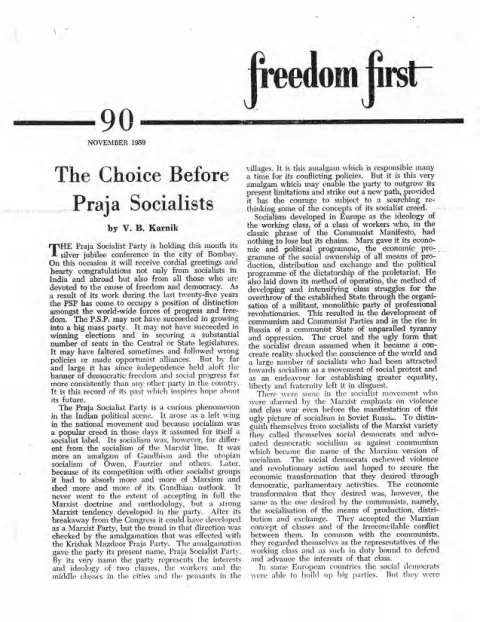
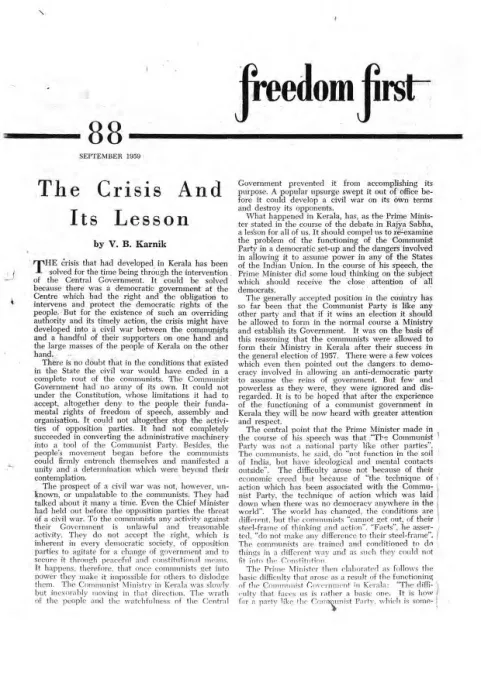
V. B. Karnik’s “The Crisis And Its Lesson” reviews the Centre’s dismissal of Kerala’s Communist ministry, quoting Nehru’s Rajya Sabha remark that the Communist Party “does not function in the soil of India” but has “ideological and mental contacts outside,” and urges public vigilance rather than outright prohibition of the Party.
-
K. S. Chetty’s profile of the Swatantra Party presents it as India’s first party built on an original, non-Marxist philosophy, quoting Masani’s attack on Congress’s joint-farming and grain-monopoly policies and Sir Homi Mody’s retort that even if Swatantra extended the Forum of Free Enterprise, “so what?”
-
A. V. Sherman’s “The New Left In Britain” traces the post-1956 intellectual current formed by Communist Party members shocked by Hungary and Khrushchev’s revelations, crediting its research on concentrated economic power while criticising its nostalgia and self-righteousness.
-
S. R. Mohan Das’s account of the Bhilai Steel Project contrasts official publicity with skilled technicians housed in tents through extreme heat, describing AITUC’s deliberate avoidance of organising there to protect the image of a Soviet-aided plant.
-
F. R. Allemann’s “Visit To East Germany” reports a real if modest improvement in consumer goods alongside a purge of “politically unreliable” academics, finding rising living standards paradoxically sharpen resentment of the regime’s continuing claims on private life.
-
The closing “With Many Voices” juxtaposes contradictory Nehru statements on Kerala’s Communists and a satirical Khrushchev-Nixon exchange from Life Magazine.
Essays
The Crisis And Its Lesson
By V. B. Karnik
V. B. Karnik reviews the 1959 Kerala crisis, in which the central government intervened against the Communist state ministry, and draws out its lesson for Indian democracy. He argues the civil-war threat that loomed in Kerala was averted only because a democratic Centre had the constitutional right and will to intervene, and warns that Communist parties, unlike other parties, are conditioned by an anti-democratic ‘steel-frame’ of thinking that makes them incompatible with normal democratic competition once in power. The piece leans heavily on Prime Minister Nehru’s Rajya Sabha speech, quoting his description of the Communist Party as lacking the character of ‘a national party like other parties’ because of its ideological ties outside India, and closes by urging that the Communist Party be clearly demarcated from other parties so the public remains alert to the anti-democratic aims Karnik attributes to it.
- The Kerala Communist ministry (elected 1957) was dismissed by central intervention amid a mass popular upsurge against it.
- Karnik argues a civil war was averted only because of a democratic Centre willing to protect citizens’ fundamental rights.
- Nehru’s Rajya Sabha speech is quoted as the article’s central authority: the Communist Party ‘does not function in the soil of India’ but has ‘ideological and mental contacts outside.’
- The article frames the core danger as the Party’s undemocratic internal technique of action, not merely its economic creed.
- It considers and largely rejects outright legal prohibition of the Communist Party as impractical, favoring instead public vigilance and clear demarcation of the Party from normal democratic competitors.
- The author holds that the Kerala episode will have served a useful purpose if it makes the public and political leaders permanently alert to this danger.
Swatantra Party
By K. S. Chetty
K. S. Chetty presents the newly formed Swatantra Party as a historic break from post-Independence politics: the first party built on an original, non-Marxist philosophy rather than borrowed 19th-century European socialist dogma. He credits C. Rajagopalachari (‘Rajaji’) and M. R. Masani with articulating a Gandhian vision of individual freedom, decentralisation, and trusteeship of wealth against what the party portrays as Congress’s drift toward centralised, coercive ‘socialistic’ planning, quoting Masani’s critique of Congress joint-farming and food-trade monopoly policies. The essay defends Swatantra against the charge that it is merely a front for the Forum of Free Enterprise or big business, arguing its Statement of Principles protects small traders and artisans as much as capitalists, and reproduces a skeptical Hindustan Times editorial questioning whether the party can hold together without firmer positions on foreign policy and other major issues. It closes by praising the party’s August convention in Bombay as informed and dignified compared to what the author calls the monotonous, self-congratulatory style of Congress speech-making, and (continuing on page 11) rebuts the laissez-faire and Forum-front criticisms directly, noting Sir Homi Mody’s retort that even if Swatantra were an extension of the Forum, ‘so what?’
- Swatantra is presented as India’s first party since Independence with an original philosophy rather than a Marxist-socialist-communist derivative.
- Its programme is framed as reviving Gandhian ideals of individual freedom, decentralisation, and trusteeship against Congress’s ‘artha’-worshipping planning state.
- Masani’s convention speech is quoted attacking Congress joint-farming, State grain monopoly, and licence-driven official interference as demoralising and economically damaging.
- The party’s Statement of Principles guarantees members freedom of opinion on all matters outside core principles, a clause the author says is a source of strength, not weakness as critics claim.
- A Hindustan Times editorial is reproduced questioning whether the party can remain an effective opposition without clearer positions on foreign policy and other major issues.
- The essay rebuts claims Swatantra is merely a Forum of Free Enterprise front or committed to unworkable laissez-faire, insisting it protects small traders and artisans as well as big business.
- The August 1-2 Bombay convention is praised as well-organised and substantively impressive compared to Congress gatherings.
The New Left In Britain
By A. V. Sherman
A. V. Sherman surveys Britain’s ‘new left,’ a post-1956 intellectual current formed largely by young academics and ex-Communist Party sympathisers disillusioned by the events of Hungary and Khrushchev’s Twentieth Congress revelations. He distinguishes it from earlier left-wing ‘revivals’ by its ‘post-Budapest’ character, its working- and lower-middle-class university-educated membership, and its focus on publishing and educating rather than building formal organisation, centred on its journal Universities and Left Review and the Partisan Coffee House club. Sherman credits the group’s serious research on concentrated economic power, interlocking directorates, the ‘submerged fifth’ of the poor, and its role in organising the Aldermaston nuclear disarmament marches, while criticising its nostalgia for 1930s-style anti-fascist clarity, its self-righteous certainty that critics of left-wing socialism cannot be honest, and its unresolved doctrinal fluidity, predicting it will remain a transitional phenomenon whose members will eventually disperse into Labour’s mainstream, academia, or perpetual ‘revivalism.’
- The ‘new left’ emerged from Communist Party members and sympathisers shocked by the 1956 Khrushchev revelations and the invasion of Hungary.
- Unlike earlier revivalist groups, it draws largely from working-class and lower-middle-class intellectuals at provincial universities rather than the traditional upper-class left.
- It prioritises publishing (Universities and Left Review, soon merging with The New Reasoner) and lecture activity over formal party organisation.
- Its research achievements include studies of interlocking directorates and concentrated economic power in Britain, and of poverty among pensioners and the chronically ill.
- It co-organised the Aldermaston anti-nuclear marches with pacifist groups, gaining its first wide public prominence there.
- Sherman criticises the group’s nostalgia for older, starker ideological battles, its self-righteousness, and ‘ill-disguised’ romanticisation of working-class culture.
- He predicts the new left is a transitional phenomenon that will eventually disperse into Labour’s mainstream or academic life, remaining closer to British values than the Communist Party it replaced.
Bhilai Steel Project
By S. R. Mohan Das
S. R. Mohan Das gives a critical, first-hand account of the Bhilai Steel Project, contrasting the official Five-Year-Plan publicity and the impressive aerial view of the plant with the alienating experience of ordinary workers he met through Bombay trade-union training. He describes the plant’s ‘frosty impersonality,’ the recruitment of highly skilled technicians with false promises of good pay who were instead housed in tents through 110-degree heat, denied timely audiences with management, and paid less than semi-literate directly recruited operatives, alongside inadequate medical facilities (one hospital five miles from most workers’ quarters) for a workforce of 60,000. He surveys the weak, compromised INTUC union at Bhilai, contrasts it with the AITUC’s deliberate decision not to organise there so as to avoid embarrassing a Soviet-aided project (concentrating instead on ‘imperialist-aided’ Rourkela and Durgapur and the ‘capitalist’ Tata plant at Jamshedpur), and describes the reserved, correct, but distant behaviour of Soviet personnel and the privileged, air-conditioned ‘New Class’ of the socialist project’s own managers in Sector X, concluding that technocrat bosses without real independence leave workers with no glamour, only a ‘worm’s-eye view’ of the plant.
- Mohan Das visited Bhilai as a guest of ordinary young workers he had trained with in Bombay trade unions, not as an official visitor.
- Skilled technicians were recruited nationwide with false promises of a ‘bright future’ but were housed in tents in extreme heat with no transport or food arrangements.
- Directly recruited, often barely literate, workers were paid more than diploma-holding trained technicians, causing resentment.
- Medical care for 60,000 workers depended on a single hospital in Sector X, five miles from most workers’ housing.
- INTUC’s union at Bhilai is described as weak and compromised by favours to its General Secretary; AITUC (communist-led) deliberately avoids organising at Bhilai to protect the image of a Soviet-aided plant.
- Soviet personnel at Bhilai are described as reserved, correct, and largely unintegrated with Indian workers.
- The plant’s privileged managerial ‘New Class’ in Sector X enjoys air-conditioning and transport unavailable to ordinary workers.
- The author frames construction priorities (plant before township) as the source of the poor living conditions for workers.
Visit To East Germany
By F. R. Allemann
F. R. Allemann, in a piece reprinted from the New Leader, recounts a visit to East Germany after a decade of divided German life, describing a real if modest improvement in the supply and variety of consumer goods and a partial relaxation of economic pressure, alongside persistent shortages, bureaucratic distribution failures, and a purge of academics deemed ‘politically unreliable’ under Socialist Unity Party (SED) tightening of school and university life. He reports that popular hostility to the Ulbricht regime remains undiminished and is, if anything, intensified as rising living standards make East Germans resent the regime’s continuing totalitarian claims on their private time and choices, even as most have abandoned hope of near-term reunification or of a ‘military solution,’ settling instead into a resigned, unsentimental pessimism about the future. Allemann finds East Germans immunised against propaganda slogans yet still consumed by anxiety over Berlin’s status and the threatened ‘separate peace treaty,’ concluding that East Germany is no longer the visible slum it once was but remains a society under unrelieved psychological and political strain.
- Consumer goods supply in East Germany has genuinely improved over the prior decade, though shortages of basics like potatoes and butter still recur.
- Two East German scientist acquaintances lost university posts for ‘political unreliability,’ one fleeing West, illustrating an intensifying academic purge tied to SED intervention in schools and colleges.
- Espionage and arrests for ‘critical remarks’ by the State Security Service (SSD) have reportedly increased over the past year.
- Rising living standards paradoxically sharpen resentment of the regime, since citizens now want leisure and autonomy the totalitarian state resists granting.
- Belief in eventual German reunification has largely given way among East Germans to resigned acceptance that the division is permanent.
- Despite hostility to the regime, virtually no one Allemann spoke with responded to mentions of the ‘Peace Treaty’ propaganda campaign; anxiety instead centres entirely on Berlin’s status.
- The report concludes East Germany is no longer the stark ‘slum’ it once appeared, but real comfort and prosperity remain limited.
With Many Voices
‘With Many Voices’ is the issue’s closing compilation column of quoted remarks on current affairs, epigraphed by Tennyson, gathering statements from Prime Minister Nehru, S. A. Dange, M. C. Chagla, and Western and Soviet-bloc press and officials on the Kerala crisis, the Sino-Indian border, and Cold War diplomacy, several selected to expose perceived contradictions or ironies (e.g., Nehru’s shifting characterisations of Kerala’s Communists, and a satirical Khrushchev-Nixon-Gromyko exchange from Life Magazine). It also carries a subscription coupon for Freedom First and closing publication/printing details for the Democratic Research Service.
- The column juxtaposes contradictory Nehru statements on the Kerala Communists to highlight perceived inconsistency.
- S. A. Dange is quoted twice on the Kerala situation and on democracy as ‘a toilers’ democracy’.
- M. C. Chagla, as Indian Ambassador in the US, is quoted downplaying Chinese aggressive intent toward India, juxtaposed against Nehru’s own firm statement on the McMohan line.
- A satirical exchange among Khrushchev, Nixon, and Couve de Murville from Life Magazine closes the column with Cold War humor.
- East German broadcaster Karl Edward von Schnitzler is quoted comparing Western reactions to Kerala with Western criticism of East German elections.
- The column ends with the journal’s subscription form and printing/publishing colophon (Democratic Research Service, Bombay).
Generated by the v1.5 extraction pipeline. Awaiting editorial review.
Metadata and summary are AI-extracted from the source PDF and reviewed for editorial accuracy. The original work is available via the Read PDF tab above (where present); paragraph-level citation inside the PDF is deferred to a future engagement.