periodical issue
Freedom First
published for the Democratic Research Service by B. K. Desai at 127 Mahatma Gandhi Road, Bombay 1; printed at Inland Printers, 55 Gamdevi Road, Bombay 7 · Bombay · 1960
12 pages
Freedom First
Summary
This is issue No. 99 (August 1960) of Freedom First, the Bombay-based monthly published by the Forum of Free Enterprise and edited by V. B. Karnik. The issue is a mix of current-affairs commentary and book reviews written from a classical-liberal, anti-communist standpoint. V. B. Karnik opens with “A Leap In The Dark,” a post-mortem of the July 1960 all-India central-government employees’ strike, arguing the strike was ill-conceived, driven by rival trade-union leaders (P.S.P. figures S. M. Joshi, Nath Pai and Peter Alvares) competing to appear uncompromising, and blaming the Government equally for failing to negotiate in good faith. C. L. Gheevala’s “Reflections On The Third Five Year Plan” critiques the draft Third Plan’s bias toward capital-intensive heavy industry, its vague resource-mobilisation assumptions, and its expansion of the public sector, which he argues threatens democratic socialism’s own stated goals by concentrating economic power in bureaucratic hands. T. R. Fyvel reports from the Congress for Cultural Freedom’s Berlin gathering on the theme “Progress in Freedom,” describing sessions with Raymond Aron, Jayaprakash Narayan, J. K. Galbraith, Robert Oppenheimer and others on political democracy, culture, and Cold War ideological competition. An unsigned “Contributed” piece, “Sino-Soviet Differences,” surveys the widening ideological rift between Moscow and Peking over Khrushchev’s doctrine of peaceful coexistence versus Chinese insistence on the inevitability of war under imperialism. The Review section carries M. Devadas Kini on Issac Don Levine’s “The Mind of an Assassin” (about Trotsky’s assassin Ramon Mercader) and Phiroze J. Shroff on S. R. Patel’s “Recognition in the Law of Nations.” The issue closes with “With Many Voices,” a column of quoted press excerpts on Cold War and domestic themes.
Key points
-
V. B. Karnik’s “A Leap In The Dark” judges the July 1960 all-India Central Government employees’ strike ill-conceived, blaming P.S.P. leaders S. M. Joshi, Nath Pai, and Peter Alvares for rejecting a reasonable government offer.
-
C. L. Gheevala’s “Reflections On The Third Five Year Plan” criticises the draft Plan’s bias toward heavy industry, its vague resource-mobilisation assumptions, and its expansion of the public sector as a threat to democratic freedom.
-
T. R. Fyvel’s “Cultural Freedom In Berlin” reports on the Congress for Cultural Freedom’s largest-ever Berlin gathering, with sessions led by Raymond Aron and Edward Shils attended by Jayaprakash Narayan and J. K. Galbraith.
-
An unsigned “Sino-Soviet Differences” piece traces the widening rift between Khrushchev’s doctrine of peaceful coexistence and China’s insistence that war remains inevitable under imperialism.
-
M. Devadas Kini reviews Issac Don Levine’s “The Mind of an Assassin”, on Ramon Mercader’s 1940 assassination of Trotsky, framing Mercader as an indifferent “philosophical executioner.”
-
Phiroze J. Shroff reviews S. R. Patel’s “Recognition in the Law of Nations”, commending its treatment of the Declaratory and Constitutive theories of international recognition.
-
“With Many Voices” compiles press quotations, including Nehru’s expressed belief in Soviet devotion to peace and D. D. Kosambi’s criticism of India’s solar-cooker research programme.
Essays
A Leap In The Dark
By V. B. Karnik
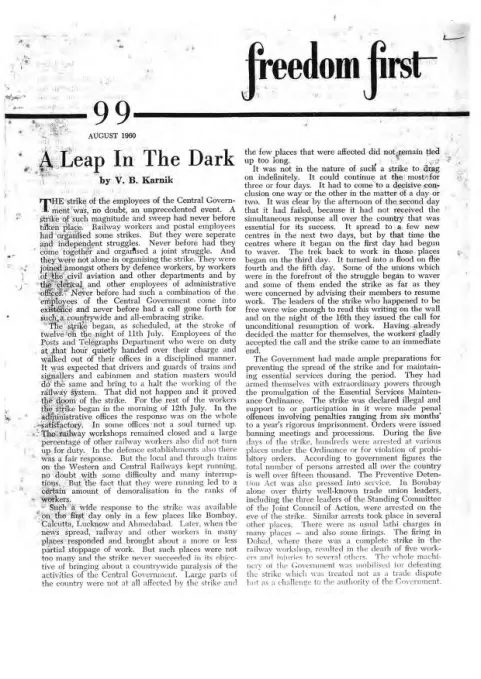
V. B. Karnik’s lead article assesses the countrywide strike by Central Government employees that began on the night of 11 July 1960. He describes its unprecedented scale — uniting railway, postal, defence, civil aviation and clerical workers for the first time — but argues it collapsed within days because it lacked the coordinated, simultaneous response needed to succeed, and because the Government had prepared in advance with the Essential Services Maintenance Ordinance, mass arrests, and the Preventive Detention Act. Karnik places responsibility for calling the strike squarely on the three top P.S.P.-aligned leaders of the Joint Council of Action — S. M. Joshi, Nath Pai and Peter Alvares — accusing them of converting a negotiable wage dispute into an uncompromising “fight for principles” out of fear of seeming to compromise, rather than accepting a reasonable government offer linking wages to prices. He closes (in the continuation on page 11) by holding the Government equally responsible for provoking the strike through years of eroding real incomes and delayed Pay Commission implementation, while warning that the strike’s aftermath — mass disciplinary action, union de-recognition, and prosecutions — will damage the trade union movement’s strength for years.
- The July 1960 strike was the first time railway, postal, defence, civil aviation and clerical government employees struck together.
- The strike failed because response was uneven across the country and collapsed within four to five days.
- The Government used the Essential Services Maintenance Ordinance, mass arrests (over 15,000), and the Preventive Detention Act to break the strike.
- Karnik blames the three P.S.P. leaders of the Joint Council of Action (Joshi, Nath Pai, Alvares) for rejecting a compromise offer and turning the dispute into a matter of principle.
- Communists in the trade union movement played what Karnik calls a ‘sinister role,’ letting P.S.P. leaders take the risk of calling the strike while positioning to claim credit or gain recruits either way.
- Karnik also faults the Government for failing to hold the price line, delaying Pay Commission recommendations, and providing no dispute-resolution machinery.
- The strike’s aftermath includes terminations, prosecutions, and withdrawal of union recognition, which Karnik says will set back the trade union movement broadly.
Reflections On The Third Five Year Plan
By C. L. Gheevala
C. L. Gheevala critiques the Planning Commission’s draft outline of the Third Five Year Plan, which proposed a total investment of Rs. 10,200 crores. He argues the plan is ‘singularly vague and uncertain’ about how it will mobilise the Rs. 1650 crores expected from additional taxation and the large sums expected from external assistance, and warns that if these targets are missed, deficit financing will have to be relaxed well beyond the stated Rs. 550 crore floor. Gheevala criticizes the plan’s continued bias toward capital-intensive heavy industry at the expense of employment generation (only 13.5 million new jobs projected) and small-scale rural projects, quoting Congress leader U. N. Dhebar’s own admission that ‘inordinate emphasis on industrial bias’ had overshadowed agricultural development in the Second Plan. His central argument is that expanding the public sector, as the draft plan proposes, is not a necessary feature of democratic socialism and risks creating a bureaucratic despotism that endangers individual freedom; he ends (continued on page 10) by insisting that efficiency alone, not ideological doctrine, should determine the boundary between public and private sectors, quoting approvingly from a text called Twentieth Century Socialism on the private sector’s legitimate role.
- The Third Plan draft proposes total investment of Rs. 10,200 crores (Rs. 6200 crores public sector outlay of Rs. 7250 crores, Rs. 4000 crores private sector).
- Gheevala argues the plan’s resource-mobilisation assumptions — Rs. 1650 crores from additional taxation and Rs. 2200 crores from external assistance — are not credibly supported.
- Foreign exchange requirements are estimated at Rs. 2600 crores with a total balance-of-payments deficit of Rs. 3200 crores, and external resources of this order are not assured.
- The plan continues the Second Plan’s bias toward capital-intensive heavy industry, drawing criticism that this neglects consumer goods industries and rural work-opportunities.
- Only 13.5 million additional jobs are projected despite the scale of investment, reflecting the concentration of capital in capital-intensive sectors rather than employment generation.
- Gheevala argues expanding the public sector as an ideological goal (rather than for efficiency) risks bureaucratic despotism that threatens individual and democratic freedom.
- He calls for a fair, non-discriminatory test of efficiency to govern the division of labour between public and private sectors.
Cultural Freedom In Berlin
By T. R. Fyvel
T. R. Fyvel reports on the Congress for Cultural Freedom’s Berlin gathering, the largest yet held, on the theme ‘Progress in Freedom.’ He describes arriving to a mass commemoration of the 17 June 1953 East Berlin workers’ uprising addressed by West Berlin’s Socialist mayor Willy Brandt, then details four study groups: one led by Raymond Aron on adapting democratic institutions to fast-changing societies (with Jayaprakash Narayan among the participants); one led by Edward Shils on culture and tradition amid technological change; one led by Nicolas Nabokov on the arts and patronage; and one led by Michael Polanyi on the ‘Progress of Ideas.’ Fyvel concentrates on the culture-and-tradition group, noting contributions from Robert Oppenheimer, J. K. Galbraith, Ignazio Silone, Bertrand de Jouvenel, and African/Asian delegates including Nigeria’s Ayo Ogunsheye and India’s B. Venkatappiah, who argued that Western industry and technology could not simply be transplanted into India without accounting for its own social realities. He summarizes six conclusions from the discussions, including Western delegates’ consensus that underdeveloped countries’ problems were partly the West’s own responsibility, and a debate (Schlesinger vs. Busia) over the dangers of authoritarian methods even among leaders professing democratic aims.
- The Berlin Congress for Cultural Freedom gathering was the largest yet held, with roughly 200 participants across four study groups on the theme ‘Progress in Freedom.’
- Fyvel focuses on the group on culture and tradition in modern society, led by American sociologist Edward Shils.
- Indian participants included Jayaprakash Narayan (in Raymond Aron’s political-democracy group) and B. Venkatappiah, who argued Western technology and outlook could not be imported into India without accounting for Indian society’s own realities.
- American historian Arthur Schlesinger Jr. criticized the U.S. government’s inability to act constructively amid checks and balances; Ghanaian delegate Busia countered by warning of the dangers when democratic leaders adopt authoritarian methods.
- Fyvel’s six summarized conclusions include that underdeveloped countries’ problems were seen as intimately the West’s own responsibility, and that intellectuals from Africa and Asia were notably more sober and practical than in earlier such gatherings.
- The conference opened with a mass rally of 80,000 West Berliners commemorating the 17 June 1953 uprising, addressed by Mayor Willy Brandt.
Sino-Soviet Differences
By (Contributed)
This unsigned ‘Contributed’ piece traces the widening ideological rift between Moscow and Peking through 1959-1960. It contrasts Khrushchev’s doctrine of ‘peaceful coexistence’ — his claim that nuclear-age conditions make war no longer inevitable and that communists can come to power by peaceful means — with the Chinese position, articulated in Red Flag articles around Lenin’s April 1960 birth anniversary, that imperialism remains inherently warlike and that war is inevitable as long as imperialism exists. The piece recounts the 1958 Formosa brinksmanship crisis, Soviet silence over Chinese communes, Soviet withholding of support during the August 1959 Sino-Indian border dispute, Khrushchev’s rebuke of Chinese ‘left-sectarian’ attitudes via Pravda, and the culmination at the Bucharest Communist Party Congress (continued to page 12), where a compromise communique papered over but did not resolve the dispute over the inevitability of war under imperialism.
- Khrushchev’s doctrine of peaceful coexistence, first advanced at the 20th and 21st Party Congresses, holds that war is no longer inevitable and communists can gain power by peaceful means.
- China’s Red Flag articles insist that as long as the imperialist system exists, war remains possible and revolutionary vigilance must not lapse.
- The 1958 Formosa brinksmanship crisis and Soviet silence over Chinese communes in 1959 were early signs of strain.
- The Soviet Union withheld full support for China during the August 1959 Sino-Indian frontier dispute, straining the alliance further.
- Pravda (12 June 1960) publicly denounced Chinese critics of peaceful coexistence as ‘Left-wing extremists’ and ‘Left-wing doctrinaires.’
- The dispute reached a climax at the Bucharest Communist Party Congress in mid-1960, producing a compromise communique that left the core disagreement over the inevitability of war unresolved.
Review: The Mind of an Assassin (by Issac Don Levine)
By M. Devadas Kini
M. Devadas Kini reviews Issac Don Levine’s ‘The Mind of an Assassin’ (Farrar, Straus and Cudahy, $4.50), an account of Ramon Mercader, the Stalin-agent who assassinated Leon Trotsky in Mexico in August 1940. The review recounts Trotsky’s political trajectory after his exile by Stalin in 1929, his asylum in Mexico under Diego Rivera’s protection, the elaborate plot in which Mercader was introduced to Trotsky’s circle via Sylvia Ageloff under the false identity ‘Jacques Mornard,’ and the killing itself with an ice-axe. Kini’s review frames Mercader not as an idealist or visionary but as an indifferent ‘philosophical executioner,’ and closes by reflecting on how communists resolve the problem of means and ends by treating nothing as immoral except what fails to help the cause.
- The book reviewed is Issac Don Levine’s ‘The Mind of an Assassin,’ on Ramon Mercader’s assassination of Trotsky.
- Trotsky was exiled from the USSR in 1929, stripped of citizenship in 1932, and eventually found asylum in Mexico with Diego Rivera’s help.
- Mercader was introduced to Trotsky’s circle through Sylvia Ageloff under the alias ‘Jacques Mornard,’ posing as the son of a wealthy Belgian diplomat.
- Trotsky was killed with an ice-axe (piolet) on 20 August 1940.
- Kini characterizes Mercader as an indifferent executioner rather than an ideological zealot, and reflects on communists’ disregard for conventional distinctions between moral and immoral means.
Review: Recognition in the Law of Nations (by S. R. Patel)
By Phiroze J. Shroff
Phiroze J. Shroff reviews S. R. Patel’s short study ‘Recognition in the Law of Nations’ (N. M. Tripathi Private Ltd., Rs. 15), praising it as a commendable attempt to cover the doctrine of Recognition in international law within roughly 125 pages. The review notes the book examines the Declaratory and Constitutive theories of Recognition alongside related topics such as recognition of belligerency and insurgency, and situates Patel’s discussion within the broader context that international law lacks the effective enforcement sanctions of domestic law, while arguing that the increasing pace of decolonization makes the study of recognition doctrine increasingly relevant.
- The book reviewed is S. R. Patel’s ‘Recognition in the Law of Nations,’ roughly 125 pages, priced at Rs. 15.
- The review highlights Patel’s critical exposition of the Declaratory and Constitutive Theories of Recognition.
- The book also covers Recognition of Belligerency, Recognition of Insurgency, and Withdrawal of Recognition.
- Shroff frames international law as lacking effective enforcement sanctions compared to domestic law, though rules of conduct among nations have accumulated over roughly 150 years.
- The reviewer connects the topic’s relevance to the growing number of newly independent nations requiring recognition.
With Many Voices
“With Many Voices” is the issue’s recurring column of quoted excerpts from the contemporary press and public figures, framed by an epigraph from Tennyson. The quotes touch on Cold War themes (Nehru on Soviet devotion to peace, a Manchester Guardian Weekly item on Russia seeking Cuba as a Latin American bridgehead, a Times of London item on the China-Cuba trade agreement) as well as domestic Indian commentary (D. D. Kosambi on the failure of India’s solar cooker research, Sanjiva Reddy on public distrust of Congressmen, and a Link item on India’s linguistic diversity as a ‘leaning Tower of Babel’).
- The column collects short quoted excerpts from a range of contemporary publications and public figures, under a Tennyson epigraph.
- Nehru is quoted (Times of India, 18 July) expressing belief that the Soviet Union is more devoted to peace than any other country.
- Manchester Guardian Weekly and the Times (London) items comment on Soviet and Chinese strategic moves toward Cuba.
- D. D. Kosambi is quoted criticizing India’s solar-cooker research programme as a case of publicity outrunning useful results.
- Congress President Sanjiva Reddy is quoted on public distrust of Congressmen ‘until the contrary is proved.’
Generated by the v1.5 extraction pipeline. Awaiting editorial review.
Metadata and summary are AI-extracted from the source PDF and reviewed for editorial accuracy. The original work is available via the Read PDF tab above (where present); paragraph-level citation inside the PDF is deferred to a future engagement.