periodical issue
Freedom First
Edited by V. B. Karnik and printed at Inland Printers, 55 Gamdevi Road, Bombay 7 and published for the Democratic Research Service by B. K. D... at 12? Mahatma Gandhi Road, Bombay 1. · Bombay · 1961
12 pages
Freedom First
Summary
This is the January 1961 issue (No. 104) of Freedom First, the Bombay-based classical-liberal periodical. The issue opens with V. B. Karnik’s “The Party or the People?”, which uses the Uttar Pradesh Congress crisis (the removal of Chief Minister Dr. Sampurnanand in favour of Mr. C. B. Gupta at the dictation of the party organisational wing) to argue that the parliamentary wing, being directly elected by the people, must take precedence over the party machine, and warns that subordinating elected representatives to party officials is the road to dictatorship. A tribute to Ellen Roy, wife and collaborator of M. N. Roy, follows her murder in Dehra Dun, describing her life, her work sustaining Radical Humanism after Roy’s death, and the suspicious circumstances of her killing. The “Notes” section covers the poorly attended Afro-Asian Solidarity Conference (criticised as a communist-front propaganda exercise co-opted by Congress leaders) and the Ex-Communists’ Convention in Kerala, alongside a report on the Democratic National Conference’s dissolution in Kashmir. M. A. Venkata Rao’s essay “Towards A New Liberalism” sets out a philosophical case for a “positive liberalism” (drawing on T. H. Green, Bosanquet, and Aristotle) that rejects both unregulated laissez faire capitalism and socialist statism, arguing the state should regulate economic activity for the common good without directly running the economy. Aziz Madni’s “Whither Cuba?” traces the Cuban revolution’s drift from anti-Batista liberation movement toward a Soviet-aligned dictatorship under Fidel Castro, and urges the incoming U.S. administration to seek reapproachment with Cuba rather than confrontation. A contributed piece analyses the December 1960 Moscow Conference of 81 communist parties, reading its ambiguous joint Declaration as evidence of an unresolved Sino-Soviet rivalry for leadership of the world communist movement. The issue closes with “Democracy—U.P. Style,” an extended, sardonic chronicle of the internal Uttar Pradesh Congress power struggle (continuing the Karnik piece), and “With Many Voices,” a page of quoted extracts from contemporary commentators on politics, neutrality, and foreign affairs.
Key points
-
V. B. Karnik’s “The Party or the People?” uses the Uttar Pradesh Congress crisis over Dr. Sampurnanand’s removal to argue that elected representatives must take precedence over party officials.
-
An unsigned tribute to Ellen Roy, wife and collaborator of M. N. Roy, follows her murder in Dehra Dun and recounts her decades sustaining Radical Humanism.
-
Notes cover the poorly attended Afro-Asian Solidarity Conference as communist-front propaganda, the Ex-Communists’ Convention in Kerala inaugurated by Stephen Spender, and the dissolution of Kashmir’s Democratic National Conference.
-
M. A. Venkata Rao’s “Towards A New Liberalism” sets out a “positive liberalism,” drawing on T. H. Green and Aristotle, that regulates economic activity for the common good without state ownership.
-
Aziz Madni’s “Whither Cuba?” traces the Cuban revolution’s drift from anti-Batista liberation into a new, Soviet-aligned tyranny under Castro, urging U.S. reapproachment.
-
A contributed piece analyses the December 1960 Moscow Conference of 81 communist parties as an unstable compromise masking real Sino-Soviet rivalry for leadership.
-
“Democracy—U.P. Style” narrates the internal Uttar Pradesh Congress power struggle in sardonic detail, closing with the installation of Mr. C. B. Gupta as Chief Minister.
-
“With Many Voices” closes with quotations on neutrality and India’s drift toward the Soviet camp.
Essays
The Party or the People?
By V. B. Karnik
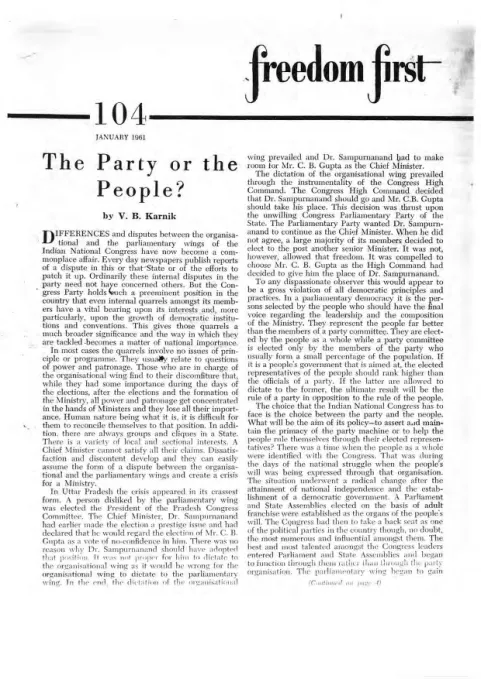
V. B. Karnik’s lead article uses the Uttar Pradesh Congress crisis, in which the organisational wing forced out Chief Minister Dr. Sampurnanand in favour of Mr. C. B. Gupta against the wishes of the Congress Parliamentary Party, as a case study in a broader argument: that disputes between a party’s organisational and parliamentary wings are becoming a national problem because the Congress so dominates Indian politics. Karnik argues that in a parliamentary democracy the elected representatives of the people must take precedence over unelected party officials, since only the former are chosen by the whole electorate. He frames the choice facing the Congress as one between asserting the primacy of the party machine or letting the people rule through their elected representatives, and warns that allowing the organisational wing to dictate to the parliamentary wing points toward dictatorship and totalitarianism.
- Uses the Uttar Pradesh episode (removal of Dr. Sampurnanand, installation of C. B. Gupta) as the occasion for the essay.
- Frames internal party disputes as a matter of national importance given Congress’s dominant position.
- Argues elected representatives should have primacy over party committees because they are chosen by the whole electorate, not a small party membership.
- Describes the historical shift after independence, whereby the parliamentary wing (Parliament and state assemblies) gained precedence over the party organisation.
- Concludes that subordinating the people (via their elected representatives) to the party machine is the path toward dictatorship and totalitarianism.
Ellen Roy
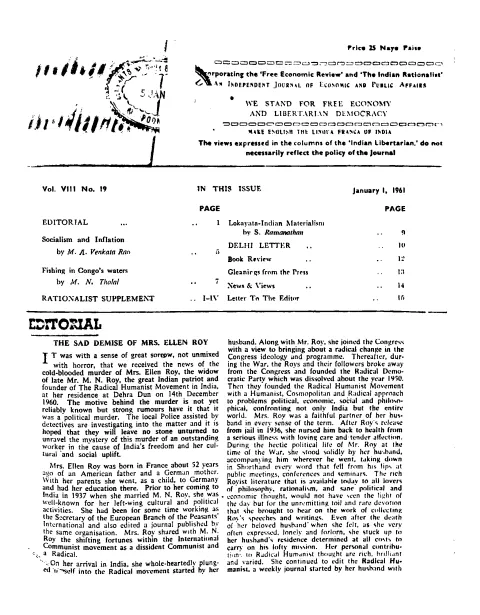
An unsigned editorial tribute to Ellen Roy, wife and close collaborator of M. N. Roy, following her murder at her Dehra Dun residence on the night of 13 December. It recounts her German-American origins, her early involvement in the international communist movement where she met and came to admire Roy, her sustained support of him through his imprisonment in India, and her decades of work for Radical Humanism, including editing the weekly Radical Humanist and running the Indian Renaissance Institute’s study camps after Roy’s death. The piece raises suspicion that the murder may have been politically motivated, possibly connected to her prior warnings to the Government of India about suspicious fires destroying Himalayan border-area maps at the Survey of India office in Dehra Dun, and calls on the government to bring the killer to justice.
- Ellen Roy was murdered at her Dehra Dun home on the night of 13 December; circumstances (a gag, a wrap over her eyes, an attempted fire) raise suspicion it was not a simple robbery.
- She had earlier suspected that fires at the Survey of India office in Dehra Dun, which destroyed Himalayan border-area maps, were not accidental, and had alerted the government.
- Born Ellen Gottschalk in Germany/France to an American official’s family; met M. N. Roy through the communist movement and married him after his release from Indian imprisonment in 1937.
- After Roy’s death she stayed in India rather than return to the West, editing the Radical Humanist and serving as Secretary of the Indian Renaissance Institute.
- The piece frames her death as an irreparable loss to the Radical Humanist movement and calls for a full government inquiry.
Notes (Afro-Asian Solidarity Conference; Ex-Communists’ Convention In Kerala; Developments In Kashmir)
An unsigned “Notes” column covering three items. First, a report on the third annual conference of the Indian Association for Afro-Asian Solidarity, held in Bombay, judged a poor showing despite being organised by communist front organisations and lent respectability by eminent Congress leaders and the Governor of Bombay; it criticises the Congress leadership and the Governor for lending credibility to what it calls a communist propaganda exercise that stayed silent on Chinese aggression against India. Second, a report on the Ex-Communists’ Convention in Kerala, attended by about 300 ex-communists and inaugurated by Stephen Spender with participation from Wolfgang Leonhard, which resolved to cooperate with existing democratic parties rather than form a new one and to counter communal and communist trends in politics. Third, a short piece on the dissolution of the Democratic National Conference in Kashmir and the return of its leader Mr. Sadiq’s group to the ruling National Conference, read as reflecting Sadiq’s own communist sympathies and the opportunism of Kashmir politics.
- The Afro-Asian Solidarity Conference in Bombay is judged an “extra-ordinarily poor” showing despite organisers’ hopes of two thousand delegates.
- Criticises Congress leaders (S. K. Patil, V. N. Desai) and Governor Prakasha for associating with the conference, calling it a communist front event that stayed silent on Chinese aggression against India.
- The Ex-Communists’ Convention in Kerala drew about 300 participants, inaugurated by Stephen Spender with Wolfgang Leonhard also attending.
- The Convention resolved to cooperate with existing democratic parties rather than found a new party, and to fight communalism in politics.
- The Democratic National Conference in Kashmir dissolved, with Mr. Sadiq’s group rejoining the ruling National Conference under Bakshi, seen as reflecting Sadiq’s own communist associations and Kashmir’s political opportunism.
Towards A New Liberalism
By M. A. Venkata Rao
M. A. Venkata Rao argues that the present moment is propitious for a restatement of liberalism as an economic and social philosophy that can absorb the legitimate aspirations behind socialism without embracing statism or communism. He contends liberalism and socialism are converging (citing Britain’s Labour Party moving away from doctrinaire nationalisation), and that the flaw in orthodox laissez-faire capitalism was not private ownership as such but the capitalist class’s usurpation of political sovereignty, which the new liberalism should end by confining capital strictly to the economic sphere while letting the state regulate all economic activity for the common good. Drawing on T. H. Green, Bosanquet, and Aristotle, Venkata Rao argues the state should legislate to maintain fair competition and restrain monopoly, provide leadership in underfunded essential industries, and support social overheads like health, education, and infrastructure, while never using force to compel individual morality or belief. The new liberalism, he says, must extend the freedoms once reserved for the entrepreneurial class to all classes, encouraging property-owning democracy and social security through voluntary and trusteeship principles rather than state compulsion.
- Argues liberalism and socialism are converging, citing the British Labour Party’s retreat from doctrinaire nationalisation.
- Insists communism and capitalism are not the only alternatives, and that a workable liberal alternative to both must be demonstrated.
- Locates the flaw of orthodox laissez-faire capitalism in the capitalist class’s usurpation of political sovereignty, not in private ownership itself.
- Draws on T. H. Green, Bosanquet, and Aristotle to argue the state’s role is to secure conditions for the good life without directly running trade, industry, or belief.
- Calls for state regulation of economic activity to maintain competition and restrain monopoly, state leadership only where private capital is lacking (e.g. housing, medicine, agriculture), and support for social overheads (health, roads, education).
- Proposes extending freedom and property ownership (e.g. worker share ownership, land for tillers) to all classes, not just the traditional entrepreneurial class.
- Frames the state’s proper role as supplementing and supporting the free market as a “pioneer,” not supplanting private and voluntary effort.
Whither Cuba?
By Aziz Madni
Aziz Madni traces the Cuban revolution’s arc from a hopeful movement of liberation against the Batista dictatorship to what he sees as a new tyranny under Fidel Castro. He credits the revolution with breaking the landholding and American business monopoly, but argues it went on to imitate Batista’s repression of the press and individual freedom, while its foreign policy grew increasingly anti-American and aligned with the Soviet bloc following Mikoyan’s 1960 visit and subsequent trade deals. Madni assesses Castro himself as not personally a committed communist but surrounded by henchmen (his brother Raul and “Che” Guevara) who are, arguing Castro is “playing the Red game” for pragmatic reasons. The essay closes by urging the incoming U.S. administration to seek reapproachment with Cuba, recognising the revolution and lifting the sugar embargo, rather than risk pushing Cuba fully behind the Iron Curtain.
- Frames the Cuban revolution as repeating the pattern (from Silone’s Bread and Wine) of liberation movements ending in tyranny.
- Credits the revolution with ending Batista’s dictatorship, redistributing land, and breaking the American business monopoly over the Cuban economy.
- Describes the revolutionary government’s own repression of the press and imprisonment of former supporters as betraying its liberatory origins.
- Traces growing Soviet-bloc alignment after Mikoyan’s 1960 visit, the $100 million credit, and subsequent US-Cuban tit-for-tat embargoes and expropriations.
- Judges that while Castro himself may not be a committed communist, his government is filled with communists and fellow-travellers, including his brother Raul and Ernesto “Che” Guevara.
- Concludes by urging the U.S. to seek reapproachment with Cuba (lifting the sugar embargo, recognising the revolution) rather than risk driving it fully into the Soviet orbit.
Moscow Conference of Communist Parties
By (Contributed)
A contributed analytical piece examines the December 1960 Moscow Conference of representatives of 81 communist parties, based on the Soviet press’s belated “information report” and the subsequent “Declaration of the Representatives of the Communist and Workers’ Parties.” The author reads the unusual protocol of the conference (all 189 participants photographed seated together, with Khrushchev and Liu Shao-chi placed at the exact centre) as a deliberate performance of unity masking a real Sino-Soviet struggle for leadership of the world communist movement. Analysing the Declaration’s language, the piece concludes that the conference produced only an unstable compromise: the Soviets retain nominal leading position while the Declaration’s substance concedes to Chinese demands for more aggressive anti-Western policy, and that Sino-Soviet disagreements have already spread from theory to state interests, with communist policy likely to grow more aggressive and the future pointing toward re-creation of a Comintern-like coordinating body.
- Analyses the December 1960 Moscow Conference of 81 communist parties (189 delegates), the largest such gathering since the Comintern congresses.
- Reads the deliberate protocol of photographing all delegates seated together, with Khrushchev and Liu Shao-chi at the centre, as a staged display of “unity” masking real Sino-Soviet rivalry.
- Analyses the subsequent Declaration’s language as revival of the idea of world revolution, naming Indochina, Algeria, Cuba, Latin America, the Congo, Berlin and Germany as centres of anti-imperialist struggle.
- Concludes the conference represents only an unstable, temporary compromise between Moscow and Peking, with the Soviets keeping nominal leadership but substantive theses reflecting Chinese demands.
- Predicts communist policy will grow more aggressive and that the conference’s format point toward the re-creation of a Comintern-like body.
Democracy—U. P. Style
An unsigned, sardonic chronicle titled “Democracy—U.P. Style” (continuing from the opening Karnik article) narrates in detail the internal Uttar Pradesh Congress power struggle: the 1958 dispute over reconstituting the PCC executive council, the 1959 revolt of 98 dissident MLAs, the bitter organisational-wing elections, and the eventual defeat of Dr. Sampurnanand’s preferred successor in the PCC presidency election, which triggers his resignation and a prolonged, opportunistic contest (invoking Mahatma Gandhi’s name and Harijan candidacy) over the chief ministership, ultimately resolved in favour of Mr. C. B. Gupta with Nehru’s and Pandit Pant’s involvement. The piece closes by describing the affair as revealing that the “traditional form of democracy” (constitution, legislature, opposition) still nominally survives but is being reshaped to fit a new pattern of Congress-managed democracy.
- Recounts the 1958 dispute over reconstituting the UP PCC executive council and the 1959 revolt of 98 dissident MLAs charging maladministration, nepotism and corruption.
- Details Dr. Sampurnanand’s principle that his government would resign if his PCC nominee lost the presidency election, and the subsequent unfolding of that crisis.
- Describes the invocation of Mahatma Gandhi’s name and Harijan identity in support of a candidate, calling it a new and improper injection of sectarian appeal into parliamentary democracy.
- Notes Jawaharlal Nehru’s, Pandit Govind Vallabh Pant’s, and Lal Bahadur Shastri’s involvement in resolving the leadership question in favour of Mr. C. B. Gupta.
- Frames the whole affair as “a new brand of democracy” being written by the UP Congress and Delhi High Command that other states and parties might come to emulate.
With Many Voices
“With Many Voices” is a closing column of quoted extracts from contemporary press and public figures on politics, neutrality, and foreign affairs, framed by an epigraph from Tennyson. It includes Michael Polanyi on the fanaticism of unbelievers, Stephen Spender on the dangers of the politics of non-politicals, Argus in the Eastern Economist on India’s drift toward the Soviet camp, V. K. Krishna Menon defending non-alignment as consistent with patriotism, Asoka Mehta on the case for India remaining unaligned given Chinese aggression, a Chinese Communist Party directive dismissing Tolstoy’s works as a waste of time for communists, and an Indian Express item on India’s changed feelings toward China after the border experience.
- Quotes Michael Polanyi’s presidential address on the fanaticism of unbelievers.
- Quotes Stephen Spender warning that the politics of non-politicals are dangerous.
- Quotes Argus (Eastern Economist) and V. K. Krishna Menon on India’s neutrality and foreign policy amid Cold War pressures.
- Quotes Asoka Mehta (Praja Socialist Party chairman) arguing India should remain unaligned despite Chinese aggressive posture.
- Includes a Chinese Communist Party directive declaring study of Tolstoy’s works a waste of time for communists.
Generated by the v1.5 extraction pipeline. Awaiting editorial review.
Metadata and summary are AI-extracted from the source PDF and reviewed for editorial accuracy. The original work is available via the Read PDF tab above (where present); paragraph-level citation inside the PDF is deferred to a future engagement.