periodical issue
Freedom First
By Adam Adil, P. Spratt, A Democrat, S. P. Aiyar, M. Devadas Kini, V B. K.
published for the Democratic Research Service by B. K. Desai at 127 Mahatma Gandhi Road, Bombay 1; printed at Inland Printers, 55 Gamdevi Road, Bombay 7 · Bombay · 1961
12 pages
Freedom First
Summary
Freedom First issue 109 (June 1961) is dominated by anti-communist analysis at home and abroad, framed around the Cold War contest for South and South-East Asia. Adam Adil’s lead essay warns the Indian National Congress against communist infiltration tactics being pursued through a manufactured Left-Right split inside the party. P. Spratt, A Democrat, and an unsigned contributed piece extend the same argument to Vietnam and Laos, cataloguing communist subversion methods as a template applicable to India’s own vulnerabilities. S. P. Aiyar’s essay strikes a different register, offering a stock-taking assessment of Indian democracy’s first decade since Independence, weighing British constitutional inheritance, Nehru’s democratic temperament, and the fissiparous strains of federalism and administrative opacity. The issue closes with its regular “Without Comment” digest of press clippings on communist activity, two book reviews (on Chinese communism and on Rajaji), and a “With Many Voices” page of quoted opinion, including from Fidel Castro and E. M. S. Namboodiripad, that the editors let speak for itself.
Key points
-
Adam Adil’s “Choice Before the Congress” warns that a manufactured Left-Right split within Congress is being exploited by the CPI’s strategy of forming a “united front” to capture the party from within.
-
P. Spratt’s “Communist Infiltration Tactics” surveys communist expansion through infiltration of nationalist movements, warning a similar method may already be in progress at India’s borders.
-
An unsigned piece traces six years of communist subversion in South Vietnam following the 1954 Geneva partition, describing Ho Chi Minh’s Viet Minh disguising its communist core behind nationalist framing.
-
“A Democrat“‘s “The Tragedy of Laos” describes two-thirds of Laos under Pathet Lao control despite U.S. aid and SEATO guarantees.
-
S. P. Aiyar’s “Prospects of Democracy in India” credits British constitutional gradualism and Nehru’s temperament for India’s democratic stability while flagging weak parliamentary oversight.
-
The “Without Comment” digest reprints press clippings on Soviet livestock deaths, Communist Party defections to Congress in Punjab, and Moscow Radio’s criticism of Nehru’s Cuba stance.
-
M. Devadas Kini reviews S. Chandrasekhar’s “Communist China Today” on the communisation of land, labour, and family life under Mao’s communes.
-
“V B. K.” reviews Khasa Subba Rau’s “Sidelights on Rajaji,” framing Rajaji’s dissent from Congress as having grown into the Swatantra Party.
Essays
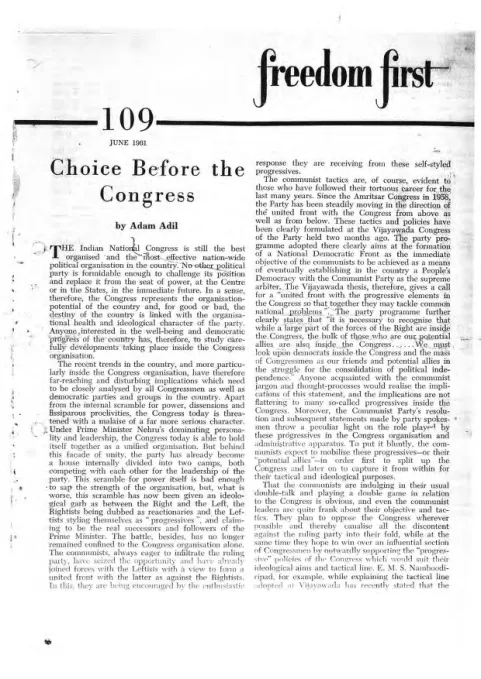
Choice Before the Congress
By Adam Adil
Adam Adil argues that the Indian National Congress remains the country’s dominant political organisation but is being destabilised from within by a manufactured battle between self-styled “Rightists” and “Leftists.” He contends this cleavage is being deliberately exploited by the Communist Party of India, which since its 1958 Amritsar Congress and the more recent Vijayawada Congress has pursued a strategy of forming a “united front” with Congress progressives in order to first split the party and later capture it from within. The essay cites Jagjivan Ram’s public remarks about “anti-socialism elements” and the contested election for Deputy Leader of the Congress Parliamentary Party (where Leftists worked to block Morarji Desai) as evidence the strategy is already succeeding, and closes by describing communist efforts to exploit the recent Jabalpur communal riots to woo Congress into an anti-communalism alliance with the communists themselves — a trap the author says the Congress must refuse.
- Congress is described as the only organisation capable of holding or contesting national power, making its internal health a matter of national concern.
- The Left-Right split within Congress is presented as substantially manufactured by Communist Party of India tactics rather than organic ideology.
- The CPI’s Vijayawada Congress programme is cited as explicitly aiming at a National Democratic Front with progressive elements inside Congress.
- Jagjivan Ram’s warning about ‘anti-socialism elements’ in the Congress is read as evidence the communist strategy is already working on senior leaders.
- The contest over the Deputy Leader post (Morarji Desai’s candidacy) is presented as a Leftist attempt to frame succession politics against him.
- Left-leaning press outlets like Link and Blitz are accused of serving as communist mouthpieces attacking senior Congress leaders.
- The essay’s second half (page 11) argues that using communists as allies against communalism would be a fatal strategic error, since communism is itself the greater and more organised threat.
Communist Infiltration Tactics
By P. Spratt
P. Spratt surveys communist expansionist strategy since the Second World War, arguing that direct invasion has given way to infiltration of nationalist and democratic movements in economically backward states, with Iraq, Congo, and Cuba cited as successes and Laos and South Vietnam as active fronts. He estimates the communist bloc spends three to four billion dollars a year on this campaign, a hundred times what opponents spend countering it, and warns that a similar infiltration model — distinct from both the Czechoslovakia 1948 and Cuba 1959-60 templates — may already be in progress at India’s own borders, a danger the country has no right to assume cannot happen here.
- Communist expansion after 1950 shifted from direct military conquest to infiltration of nationalist/democratic movements in backward states.
- Iraq, Congo, and Cuba are cited as near-complete or complete infiltration successes; Laos and South Vietnam are cited as active, ongoing fronts.
- The communist bloc’s campaign spending is estimated at three to four billion dollars a year, roughly a hundred times what opponents spend countering it.
- The essay explicitly warns that a border-infiltration method modeled on Czechoslovakia (1948) or Cuba (1959-60) ‘seems to be in progress’ at India’s own borders.
- Economic aid alone is argued to be insufficient against communist subversion since the method does not depend primarily on economic discontent.
Communist Strategy in South Vietnam
By (Contributed)
This unsigned contributed piece traces the six-year record of communist subversion in South Vietnam following the 1954 Geneva partition, arguing that Ho Chi Minh’s Viet Minh disguised itself as an anti-colonial nationalist movement to win foreign sympathy while eliminating non-communist rivals internally. It describes the 1946 ‘National Assembly’ becoming a communist puppet legislature, the renaming of the Viet Minh as the Lao Dong (Workers’ Party), and the roughly 12,000-strong clandestine communist apparatus (a fourfold increase since 1959) built around ‘sleeper’ agents left behind after the 1954-55 population exchange, concluding with an account of Ngo Dinh Diem’s rural resettlement programme as a countermeasure against communist infiltration corridors.
- The Geneva Agreement of 1954 split Vietnam at the 17th Parallel, with Ngo Dinh Diem establishing a non-communist government in the south.
- The Viet Minh is described as having disguised its communist core behind nationalist anti-colonial framing to win foreign support.
- The 1946 ‘National Assembly’ elections are described as becoming a communist puppet legislature after non-communist deputies were eliminated.
- Communist infiltration in South Vietnam is estimated at about 12,000 agents by 1961, a fourfold increase over the 1959 figure.
- The clandestine apparatus is described as built around ‘sleeper’ agents who remained behind after the 1954-55 population exchange.
- Diem’s administration is reported to have launched a large-scale rural resettlement programme, modeled partly on a similar Malayan counter-guerilla approach, to counter infiltration.
The Tragedy of Laos
By A Democrat
Writing under the byline ‘A Democrat,’ this essay describes Laos as tottering on the brink of communist takeover six years after the 1954 Geneva Agreement, with two-thirds of its territory already under Pathet Lao control. It traces the failure of repeated Laotian government attempts at coalition and peace with the communists — including a failed 1958 disarmament and integration scheme — and argues that neither U.S. aid (at $30 crore a year) nor SEATO guarantees have been sufficient to check the Pathet Lao’s steady expansion, aided by Vietminh training, Soviet air-lift support, and jungle terrain. The essay concludes that the choice before India and other Asian democracies is stark: a divided Vietnam, a divided Laos, or a Laos wholly lost to communist domination, framing all three outcomes as a common threat to the rest of South-East Asia.
- Laos is described as having two-thirds of its territory under Pathet Lao control despite its 1954 recognition as neutral and independent.
- A 1958 disarmament and integration scheme, in which the Pathet Lao agreed to disband forces in exchange for cabinet posts, is described as a failed attempt at peaceful accommodation.
- U.S. aid to Laos is put at $30 crore per year, with SEATO obligated by protocol to guarantee Laotian independence.
- The August 1960 coup by Captain Kong Le is cited as further destabilising the anti-communist regime installed after the French withdrawal.
- The essay frames the contemporaneous Geneva Conference negotiations as occurring from a position of communist strength given Pathet Lao’s territorial gains.
- The conclusion presents India’s strategic choice as between a divided Vietnam-style outcome, a divided Laos, or complete communist domination of Laos.
Prospects of Democracy in India
By S. P. Aiyar
S. P. Aiyar assesses the prospects for Indian democracy roughly a decade after Independence, arguing that Britain’s gradual constitutional training under the Montagu-Chelmsford reforms gave India’s governing elite an advantage over comparable post-colonial states like Indonesia or the Belgian Congo. He credits Nehru’s democratic temperament, two general elections (1951-52 and 1957), and the Constitution’s durability as evidence of stability, while acknowledging persistent criticisms: weak parliamentary control over administration, inadequate public reporting on government performance, and fissiparous state-level pulls on the Planning Commission’s National Development Council. Aiyar concludes that democracy’s prospects depend less on opposition party weakness than on whether the Congress, as ruling party, sustains democratic norms and whether its leadership perpetuates the constitutional temper Nehru established.
- The essay credits British Montagu-Chelmsford-era gradualism with giving India’s governing elite constitutional training absent in comparable post-colonial states.
- Two general elections (1951-52, producing a 190-million-strong electorate, and 1957) are cited as evidence of growing institutional confidence.
- Weaknesses cited include poor systematic public reporting on government administration and the difficulty of accessing critical reports like the Gorwala Report on Mysore.
- The Rau Committee’s report on the Damodar Valley Corporation is cited, via Prof. Morris-Jones, as an example of inaccuracies traced to poor government-supplied data.
- State-level pulls on the Planning Commission’s National Development Council are cited as an ongoing fissiparous strain on federal governance.
- The essay argues that democracy’s prospects hinge less on opposition weakness than on whether the ruling Congress party sustains democratic norms and constitutional temper.
Without Comment (news digest column: Thousands of Sheep Dying in Russia; Reds Join Congress Party; Escape from Red Paradise; Moscow Assails Nehru’s View on Cuba; Reds’ Defection)
The regular ‘Without Comment’ feature reprints, without editorial gloss, a set of press clippings from May 1961 documenting communist-adjacent news: food shortages and livestock deaths in the USSR (Statesman), defections of Communist Party workers to the Congress in Punjab (Free Press Journal, Indian Express), East German efforts to stem defections to West Germany with village-level incentive rewards (Time), and a Moscow Radio broadcast attacking Nehru’s stated neutrality on the Cuban situation (Hindustan Times).
- A Statesman clipping (May 17) reports thousands of sheep dying of starvation in the Chita region due to inefficient Soviet collective-farm practices.
- Free Press Journal and Indian Express clippings (May 12, 18) report Communist Party workers in Punjab defecting to the Congress over the Sino-Indian border dispute stance.
- A Time Magazine clipping (May 5) describes East Germany offering village-level rewards for zero defections amid a continuing outflow to West Germany.
- A Hindustan Times clipping (May 6) reports Moscow Radio criticizing Nehru’s ‘ignorance’ regarding the Cuban crisis and questioning his neutrality.
Review: Communist China Today (by S. Chandrasekhar, Asia Publishing House)
By M. Devadas Kini
M. Devadas Kini reviews S. Chandrasekhar’s ‘Communist China Today’ (Asia Publishing House, Bombay), praising the book’s detailed portrait of Mao-era China’s communisation of land, labour, and family life through people’s communes. The review highlights the book’s account of land reform (with up to twenty million landlords executed by external estimates versus an official three million), the erosion of family loyalty in favour of loyalty to the commune, and the regime’s slogan of ‘20 years compressed in one day,’ closing with a call for economically underdeveloped countries to demonstrate that industrialisation is possible without destroying social values.
- The review credits the book with vividly portraying communist China’s radical departure from its Confucian, Taoist, and Buddhist past.
- It cites a claim that external observers estimate up to twenty million landlords were executed during land reform, versus an official figure of three million.
- The review highlights the book’s account of communes eroding family loyalty in favour of loyalty to the collective, down to the ‘commune becomes a labour battalion’ formulation.
- It notes the regime’s self-description of aiming for ‘20 years compressed in one day’ of development.
- The review closes by arguing economically backward countries must show industrialisation is achievable without destroying social values, implicitly contrasting India’s path with China’s.
Sidelights On Rajaji (review of Khasa Subba Rau’s book, Vyas Publications, Madras)
By V B. K.
V. B. K. reviews Khasa Subba Rau’s ‘Sidelights on Rajaji’ (Vyas Publications, Madras), calling it a deserved tribute to C. Rajagopalachari that surveys his intelligence, courage of conviction, and the opposition role he has taken on in post-Independence India through founding the Swatantra Party. The review recalls Rajaji’s early prescient dissent from Congress and Gandhi on the Pakistan/Partition question, and frames his later one-man opposition — now grown into the Swatantra Party — as a deliberate, Socratic mission to challenge the drift toward state-capitalism.
- The review praises the book’s collection of essays (written 1956-1960) as illuminating Rajaji’s motives without requiring full agreement with the author’s assessments.
- It recalls Rajaji’s early dissent from Gandhi and the Congress leadership on the question of Pakistan, expressed in the article ‘Leave India to her Fate.’
- Rajaji’s one-man opposition is described as having grown into the Swatantra Party, aimed at reversing India’s post-Independence drift toward state-capitalism.
- The review frames Rajaji’s public dissent using a Socratic analogy — ‘aware of the risks of voicing unpalatable truths but persisting in it.‘
With Many Voices (press-quotes digest column)
The ‘With Many Voices’ page reprints a set of quoted opinions from the contemporary press without editorial commentary, ranging from Suslov’s praise of the CPI’s Sixth Congress to Indian commentators (D. V. Gundappa, Dr. Harekrishna Mehtab) criticising Congress’s own monopolistic and socialist drift, to E. M. S. Namboodiripad’s and Brij Mohan’s statements preferring communists over the Jan Sangh as political partners, and closes with Fidel Castro’s professed admiration for Lenin and Kingsley Martin’s prediction that Cuba will become fully communist.
- Suslov is quoted from New Age praising the CPI’s Sixth Congress as a landmark for Indian independence, peace and international friendship.
- D. V. Gundappa (Times of India) is quoted criticising the Congress for becoming a political monopolist despite denouncing economic monopolism.
- Dr. Harekrishna Mehtab, former Orissa Chief Minister, is quoted twice criticising Nehru’s reputation as a finite political asset and criticising the growing role of wealth within the Congress.
- E. M. S. Namboodiripad and Delhi Congress President Brij Mohan are both quoted preferring cooperation with communists over the Jan Sangh.
- Fidel Castro is quoted (New Statesman) expressing deepening admiration for Lenin, and Kingsley Martin is quoted predicting Cuba will become ‘completely communist.’
Generated by the v1.5 extraction pipeline. Awaiting editorial review.
Metadata and summary are AI-extracted from the source PDF and reviewed for editorial accuracy. The original work is available via the Read PDF tab above (where present); paragraph-level citation inside the PDF is deferred to a future engagement.