periodical issue
Freedom First
By Willy Brandt, MA Venkata Rao
Edited by V. B. Karnik, printed at Indraprastha Printers, 55 Gamdevi Road, Bombay [illegible number] and published for the Democratic Research Service by B. K. Desai at 127 Mahatma Gandhi Road, Bombay 1. · Bombay · 1961
12 pages
Freedom First
Summary
Freedom First No. 112 (September 1961) is a monthly issue of the Bombay-based classical-liberal periodical published by the Forum of Free Enterprise / Democratic Research Service. Its dominant concern is the confrontation between Soviet-style planning and communist doctrine on one side and liberal, market-oriented critique on the other: V. B. Karnik dissects the new CPSU draft programme as propagandistic utopianism, and M. R. Masani (in a Parliament speech reprinted here) attacks India’s own Third Five Year Plan as an imitation of Soviet-style forced industrialisation that will produce inflation, unemployment and misery rather than growth. The issue also carries substantial international commentary: Willy Brandt’s essay on the Berlin crisis (reprinted from The New Leader), Anand Mohan’s skeptical notes on the forthcoming non-aligned ‘neutral summit,’ and news items under ‘Without Comment’ on Cold War defections and East German militarisation. A lighter register appears in M. A. Venkata Rao’s essay on Auguste Comte’s ‘Religion of Humanity’ as an alternative to Marxist class-war ideology, and in the closing ‘With Many Voices’ page of quotations from world leaders and commentators. Unsigned ‘Notes’ cover Indian domestic controversies (the Blitz tabloid’s parliamentary censure, and Jomo Kenyatta’s release in Kenya).
Key points
-
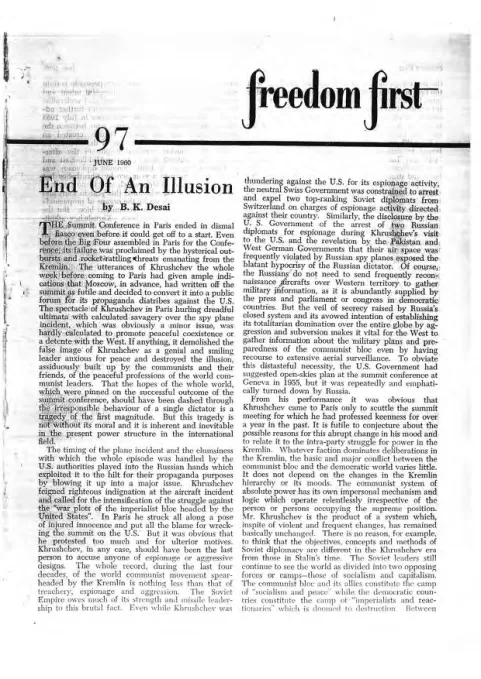
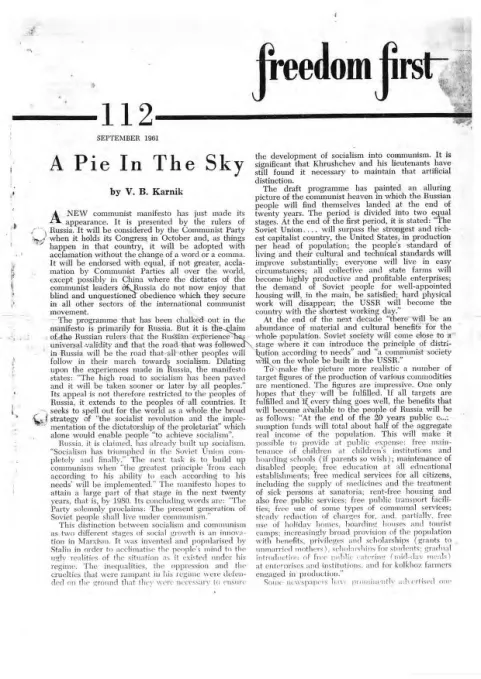
V. B. Karnik’s “A Pie In The Sky” dissects the new Soviet Communist Party draft programme as propagandistic utopianism promising abundance by 1980 while reaffirming one-party dictatorship.
-
Notes cover the Blitz tabloid’s parliamentary censure for its attack on Acharya Kripalani and welcome Jomo Kenyatta’s release in Kenya.
-
M. A. Venkata Rao’s essay contrasts Auguste Comte’s “Religion of Humanity” with Marx’s class-war dialectic, proposing humanist associations to widen Indian national sympathy beyond caste and creed.
-
M. R. Masani’s “Planning For Poverty Or Plenty?” attacks the Third Five Year Plan as pursuing Soviet-style “State Capitalism,” predicting inflation, unemployment, and threats to fundamental rights.
-
Willy Brandt’s “Warning For East & West,” reprinted from The New Leader, warns that a Soviet-East German separate peace treaty would entrench the German border and must not be accepted by the West.
-
Anand Mohan’s “The Neutral Summit” offers a skeptical preview of the Belgrade non-aligned conference, questioning Nasser’s leadership credentials and Cuba’s genuine neutrality.
-
A “Without Comment” digest reprints items on German militarisation, Soviet scientists granted asylum, and Cuban students facing execution.
-
“With Many Voices” includes Kennedy’s remark that the source of world trouble is Moscow, not Berlin, alongside a continuation of Karnik’s critique of the Soviet draft programme’s silence on personal liberty.
Essays
A Pie In The Sky
By V. B. Karnik
V. B. Karnik’s lead essay, ‘A Pie In The Sky,’ analyses the new Soviet Communist Party draft programme due for adoption at the October Party Congress. He argues the manifesto claims universal validity for the Russian experience and paints an ‘alluring picture’ of abundance to be achieved by 1980, complete with free housing, transport, medicine, and a vanishing working day. Karnik is deeply skeptical: he notes the plan’s targets even if fulfilled would not impress citizens of already-prosperous industrial nations, and that the programme offers nothing new ideologically — the same denunciations of capitalism, the same insistence on proletarian dictatorship and one-party rule, the same ‘vulgar abuse’ of social-democratic rivals. He concludes the only encouraging element is the reaffirmed rhetoric of peaceful coexistence, though Soviet practice belies it, and that ordinary Russians are being asked to accept present hardship for a distant, uncertain ‘pie in the sky.’
- The new draft programme divides the USSR’s advance into two 20-year stages: surpassing US per-capita production, then achieving distribution ‘according to needs’ and free public goods by 1980.
- Karnik argues the promised abundance would be unremarkable to citizens of already-developed Western nations.
- The programme reaffirms Marxism-Leninism, the dictatorship of the proletariat, and denounces social-democratic parties as ‘ideological props of the bourgeoisie.’
- Only the restated commitment to ‘peaceful co-existence’ is seen as a positive element, though undermined by continued Soviet pressure tactics over Berlin and elsewhere.
- Karnik frames the promised material benefits as deferred indefinitely — ‘jam tomorrow, jam the day after, but never jam today’ — with no relaxation of political dictatorship in the interim.
Notes: Yellow and Red Journalism / Kenyatta’s Release
The unsigned ‘Notes’ section carries two items. ‘Yellow and Red Journalism’ reports that Blitz, described as a ‘crypto-communist tabloid,’ was found guilty by the Lok Sabha Privileges Committee of a gross breach of privilege for a vicious April 1961 attack on Acharya Kripalani over his criticism of Defence Minister Krishna Menon; the editor was summoned and reprimanded, a first in Indian parliamentary history. The piece criticises Congress leaders, including Nehru, for lending prestige to the magazine despite its record of scurrilous journalism. ‘Kenyatta’s Release’ welcomes Jomo Kenyatta’s release after eight years’ imprisonment as removing a major obstacle to Kenyan constitutional progress, while urging that the remaining legal bar on his participation in formal politics (a rule excluding anyone imprisoned more than two years from the Legislative Assembly) be lifted so he can fully assume national leadership.
- Blitz was censured by the Lok Sabha for its April 1961 attack on Acharya Kripalani, marking the first time an Indian journalist was called to the bar of the House.
- The piece calls Blitz an ‘unscrupulous mixture of yellow and red journalism’ serving international communist propaganda.
- Nehru is criticised for giving Blitz’s editor interviews and prestige despite condemning the Kripalani attack as ‘exceedingly vulgar.’
- Kenyatta’s release after eight years’ imprisonment is welcomed as inevitable and likely to improve Kenya’s prospects for orderly independence.
- The note calls for removal of the colonial-era constitutional bar preventing Kenyatta, as a former prisoner, from formal participation in Kenya’s Legislative Assembly.
Auguste Comte’s Religion Of Humanity
By MA Venkata Rao
M. A. Venkata Rao’s essay contrasts two divergent nineteenth-century responses to the scientific and social upheavals of modernity: Marx’s militant class-war dialectic and Auguste Comte’s humanist ‘Religion of Humanity.’ Rao presents Comte’s vision — built on a theory of three historical stages (theological, metaphysical, positivistic) — as a psychological and emotional project aimed at cultivating universal sympathy rather than Marx’s institutional and economic class struggle. He describes Comte’s proposed rituals of weekly worship honouring humanity’s ‘heroes’ (drawing on figures from the Buddha to Lincoln and Gandhi) and argues India today needs analogous means of widening national sympathy beyond caste, creed and region. Rao proposes founding voluntary ‘humanist associations’ that hold devotional meetings modelled on Comte’s religion of humanity, arguing that legal punishment of communal or casteist behaviour is necessary but not sufficient, and must be supplemented by the cultivation of positive, affectionate national sentiment.
- Rao frames Comte’s Religion of Humanity as the humanist counterpart to Marx’s dialectical-materialist class war, both being outgrowths of nineteenth-century scientific ferment.
- Comte’s three-stage theory of ideas (theological, metaphysical, positivistic) culminated in a religion of humanity without revelation or personal godhead.
- Comte designed rituals — weekly meetings, portraits, talks, poems — to contemplate ‘heroes’ of human achievement across all traditions, not just one faith’s saints.
- Rao applies this to contemporary India, arguing the country needs to widen national sympathy beyond tribe and caste, and that legal anti-communal measures alone are insufficient.
- He proposes founding humanist associations holding weekly devotional meetings to particular ‘great personalities or heroes’ as a practical implementation of Comte’s idea in India.
Planning For Poverty Or Plenty?
By M. R. Masani
M. R. Masani’s essay, condensed from a Parliament speech, is a sweeping attack on India’s Third Five Year Plan. He opens by cataloguing three ‘facts of life’ at the end of the Second Plan: persistent rising prices, stagnant or declining incomes for landless labourers, industrial workers and the lower middle class, and a foreign-exchange crisis with mounting external debt (Rs. 1750 crores already owed, with a further Rs. 2200 crores proposed). He argues the Plan will fail its own stated objectives — more saving and investment, efficient production, and exports — because of five defects: excessive taxation, deficit financing of Rs. 550 crores, an obsession with heavy industrialisation regardless of cost, domination by the State sector even where private enterprise has outperformed targets, and continued pursuit of land collectivisation. He quotes a 1939 letter from Gandhi to Rajkumari Amrit Kaur dismissing Nehru’s planning as ‘a waste of effort.’ Masani contends the Plan is not really a plan for economic development but the pursuit of Soviet-style ‘State Capitalism’ driven by an unwarranted ideology of national self-sufficiency (‘autarchy’), imported from a Soviet context of hostile encirclement that does not apply to India. He warns the Plan will produce further inflation, unemployment, high-cost production (illustrated by the gap between world and Indian penicillin prices, fostering smuggling), over-centralisation threatening states’ rights, and ultimately endangerment of Fundamental Rights, including the right to strike.
- Masani cites Reserve Bank data showing wholesale prices rose 7.2% in 1960-61 after a 5.8% rise the year before, with roughly 30% cumulative inflation over the Plan period.
- He cites a 1960 parliamentary statement that real wages for industrial workers, having recovered 1939-1955 losses, have since been wiped out again by renewed price rises since 1956.
- India’s foreign credits total about Rs. 1750 crores with a further Rs. 2200 crores of indebtedness proposed, which Masani calls mortgaging the country’s future.
- He identifies five defects that will subvert the Plan’s own goals: excessive taxation, Rs. 550 crore deficit financing, reckless obsession with heavy industrialisation, sabotaging of the outperforming private sector in favour of the State sector, and continued land collectivisation.
- Masani argues the Plan is not a socialist plan for raising living standards but a pursuit of Soviet-style ‘State Capitalism’ driven by an imported and inapplicable ideology of autarchy/self-sufficiency.
- He predicts further inflation, additional unemployment (an extra half a million on top of 9 million already unemployed), high-cost production illustrated by the gap between world and Indian penicillin prices fueling smuggling, and threats to Fundamental Rights including the right to strike.
- He quotes Gandhi’s 1939 letter to Rajkumari Amrit Kaur dismissing Nehru’s planning as ‘a waste of effort.‘
Warning For East & West
By Willy Brandt
Willy Brandt’s essay, reprinted from The New Leader, is a warning addressed to both East and West about the Berlin crisis. Writing as Mayor of West Berlin, Brandt argues that Berlin’s resistance is no frivolous posture: its residents, who would be the first casualties of any European conflagration, appeal for solidarity only after weighing risks carefully. He argues the true danger is not an isolated ‘solution’ to Berlin, since tension will persist as long as the whole city sits inside Communist-controlled territory, but rather Khrushchev’s threatened separate peace treaty with East Germany, which would entrench the inter-German border as an international frontier and criminalise as ‘revisionist’ any demand for reunification. Brandt insists West Germany and West Berlin cannot accept such a border as legitimate, and that Bonn’s rights and obligations toward Berlin — currency union, economic integration, Allied troop presence — must be defended vigorously by the Western powers, or the Berlin resistance and West German confidence alike will collapse.
- Brandt frames his essay explicitly as a warning, not a threat, from a city that would be struck first in any European war.
- He argues no isolated ‘solution’ can remove the Berlin problem’s tension so long as the city sits surrounded by Communist territory.
- He warns that a Soviet-East German separate peace treaty would entrench the inter-German border as an international frontier, branding advocates of reunification as ‘dangerous revisionists.’
- Brandt insists German democrats will not repeat the failures of Weimar-era democrats and will actively resist any partition treated as final.
- He stresses that West Berlin’s economic and psychological survival depends on unbroken currency and economic union with West Germany, and on continued Allied resolve including troop presence.
- He warns that Soviet proposals for a ‘free city’ status are designed to sever West Berlin’s ties to its Western protectors and divide the Allied alliance.
The Neutral Summit
By Anand Mohan
Anand Mohan’s ‘The Neutral Summit’ offers a skeptical preview of the forthcoming neutral-nations conference (the Belgrade non-aligned summit). He questions the credentials of Egypt’s President Nasser, the summit’s leading advocate, arguing Nasser’s earlier bids for leadership of the Middle East and then Africa both failed and that his current push to lead the ‘neutrals’ follows the same pattern of self-serving ambition. Mohan is troubled that Cuba is also prominently involved, suspecting Castro’s neutralism is a thin disguise for aligning with the Soviet Union, and criticises the conspicuous absence of Israel from the summit despite its arguable claim to neutral-nation status, attributing this to India’s and others’ unwillingness to offend Arab opinion. He surveys the ideologically disparate membership of the ‘neutral club’ — ranging from communist to anti-communist states — and predicts the summit will produce only platitudes on disarmament and colonialism while remaining conspicuously silent on neo-colonialism, concluding that genuine political wisdom sometimes requires being ‘uncompromisingly unneutral.’
- Mohan portrays Nasser’s push for leadership of the neutral bloc as the latest in a series of personal ambitions, following failed bids to lead the Middle East and then Africa.
- He suspects Cuba’s presence at the summit reflects a thin veneer of neutralism disguising alignment with the Soviet Union.
- He criticises the absence of Israel from the summit given India’s own professed criteria for neutrality, attributing the omission to appeasement of Arab opinion.
- He notes President Tito of Yugoslavia as an elder statesman with influence over both Nasser and Nehru.
- Mohan predicts the summit will produce only platitudes on disarmament and colonialism while staying silent on neo-colonialism.
- He concludes that some things in life require being ‘uncompromisingly unneutral,’ even if that means the end of neutrality as a political stance.
Without Comment (German Militarism: Facts & Fiction / Soviet Scientist Given Asylum / Another Scientist Seeks Asylum / 44 Students Face Execution In Cuba)
‘Without Comment’ is an unsigned compilation of short news excerpts reprinted from various publications. ‘German Militarism: Facts & Fiction’ (from U.S. News & World Report) rebuts the claim that the West is remilitarising Germany, laying out a timeline showing East Germany built a ‘People’s Police’ militia into a full army years before any West German rearmament. Other items report a prominent Soviet chemist, Dr. Mikhail Klotchko, granted political asylum in Canada; a young Ukrainian scientist, Nikolai Sereda, defecting to the West in Vienna; and forty-four Cuban students and two priests facing execution in Havana for organizing resistance to the Castro regime.
- The ‘German Militarism’ item argues East Germany built an army of over 100,000 men disguised as ‘People’s Police’ starting in 1948, years before West Germany’s first serviceman donned a uniform in November 1955.
- It notes East Germany’s ‘People’s Army’ now numbers 110,000 with 200,000 in reserve, versus West Germany’s roughly 225,000 built solely within NATO’s framework.
- Dr. Mikhail Antonovich Klotchko, a Stalin Prize-winning Soviet chemist, was granted political asylum by Canada after attending a Montreal conference.
- Nikolai Ivanovitch Sereda, a young Ukrainian electronics scientist, defected to the West in Vienna, citing resentment at Muscovite pressure on Ukrainian liberty and culture.
- Forty-four Cuban students and two Roman Catholic priests were reported facing a firing squad in Havana for organizing student resistance to the Castro regime.
With Many Voices
‘With Many Voices’ is the issue’s closing page of quotations gathered from world leaders, statesmen and commentators on the Berlin/Cold War crisis and other current affairs, presented under an epigraph from Tennyson. It juxtaposes remarks from President Kennedy, Nikita Khrushchev, Nehru, Willy Brandt-adjacent commentary, Dag Hammarskjold, and others on the sources of world tension, alongside a continuation of Karnik’s ‘A Pie In The Sky’ essay from page 2 discussing the draft Soviet programme’s silence on personal liberties and the continuing ‘stranglehold’ of the Communist Party.
- Includes President Kennedy’s remark (quoted from The Economist) that the source of world trouble is Moscow, not Berlin.
- Includes Nikita Khrushchev’s statement (from Statesman) framing the German peace-treaty struggle as one for ‘acknowledgement of our greatness.’
- Includes Nehru’s remark that people do not leave their hearths and homes ‘for glamour and shop windows,’ regarding East German emigration.
- Includes Dag Hammarskjold’s statement of optimism ‘because in this world you have to be optimistic.’
- The continuation of Karnik’s essay from page 2 argues the Soviet draft programme says nothing about personal liberty, freedom of opinion, or the right to change government, while explicitly reaffirming the Communist Party’s permanent ‘leading and guiding’ role.
Generated by the v1.5 extraction pipeline. Awaiting editorial review.
Metadata and summary are AI-extracted from the source PDF and reviewed for editorial accuracy. The original work is available via the Read PDF tab above (where present); paragraph-level citation inside the PDF is deferred to a future engagement.