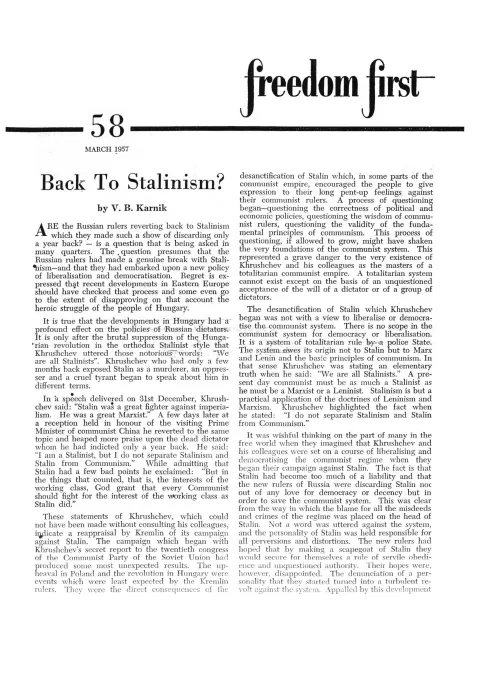
periodical issue
Freedom First
published for the Democratic Research Service by B. K. Desai at 127 Mahatma Gandhi Road, Bombay 1; printed at Inland Printers, 55 Gamdevi Road, Bombay 7 · Bombay · 1961
12 pages
Freedom First
Summary
Freedom First No. 115 (December 1961) is dominated by Cold War anxiety on two fronts: the credibility of India’s non-alignment and the immediate menace of Chinese incursions in Ladakh. S. Sharangpani’s lead essay defends Nehru’s U.S. visit as having repaired the damage done by Krishna Menon’s pro-Soviet posturing at the U.N., while a boxed item on Nehru and Menon (reprinted from the Times of India) details Menon’s reversed instructions on the anti-nuclear-test resolution. Adam Adil and G. F. Hudson contribute companion pieces arguing that de-Stalinisation is cosmetic — Stalinism survives Stalin because its Marxist-Leninist foundations remain intact — and that Khrushchev’s peace rhetoric echoes Hitler’s pre-war appeasement-baiting tactics. M. A. Venkata Rao traces how communist regimes (Soviet, Chinese, and by extension Indian) have tactically tolerated and then liquidated the ‘national bourgeoisie.’ A substantial editorial digest, ‘Nation Against Aggression,’ compiles newspaper reactions (Times of India, Hindustan Times, Free Press Journal, Indian Express) excoriating the Nehru government’s secretive, ineffectual response to Chinese occupation of Ladakh and singling out Krishna Menon’s soft line on China versus his hard line on Goa. The issue closes with a ‘Without Comment’ miscellany on Soviet consumer shortages, jokes about de-Stalinisation, and a CND(USSR) appeal letter, and a ‘With Many Voices’ quotations page assembling remarks from Nehru, Kennedy, Nixon, Indira Gandhi, and others on non-alignment and the Sino-Soviet-Indian situation.
Key points
-
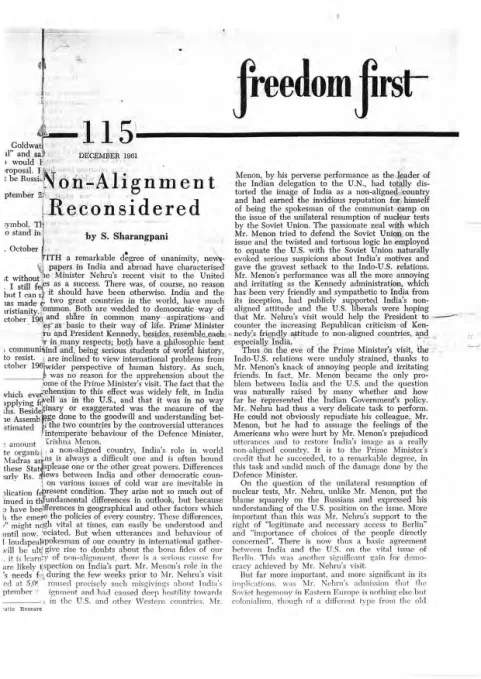
S. Sharangpani’s “Non-Alignment Reconsidered” credits Nehru’s U.S. visit with repairing damage from Krishna Menon’s pro-Soviet UN posturing, especially Nehru’s admission that Soviet Eastern Europe involves a form of colonialism.
-
Adam Adil’s “De-Stalinisation Versus Communism” argues Khrushchev’s de-Stalinisation is cosmetic, since Stalinism was Leninism’s logical extension and can only end by repudiating Marxism-Leninism itself.
-
G. F. Hudson’s “Hitler And Khrushchev” draws an extended parallel between Hitler’s pre-war peace rhetoric and Khrushchev’s Berlin diplomacy, warning against a repeat of Munich-style capitulation.
-
M. A. Venkata Rao’s “The National Bourgeoisie Under Attack” traces how communist regimes tactically tolerate and then liquidate the “national bourgeoisie,” applying the pattern to a 1960 Moscow-directed shift in CPI strategy toward India’s own bourgeoisie.
-
“Nation Against Aggression” compiles Indian editorial excerpts condemning the government’s secretive handling of Chinese encroachment in Ladakh and Krishna Menon’s double standard toward Goa versus China.
-
A “Without Comment” miscellany covers chronic Soviet consumer shortages and Warsaw jokes mocking de-Stalinisation.
-
“With Many Voices” closes with Nehru’s remark on Eastern European colonialism and Kennedy’s comparison of Soviet versus Western nuclear test megatonnage.
Essays
Non-Alignment Reconsidered
By S. Sharangpani
S. Sharangpani argues that Nehru’s recent U.S. visit, widely called a success, repaired ground lost to Krishna Menon’s inflammatory, pro-Soviet performance at the U.N., which had needlessly strained Indo-U.S. relations. The essay credits Nehru with restoring India’s image as genuinely non-aligned, and singles out as especially significant Nehru’s admission, in a televised interview with Adlai Stevenson, that Soviet domination of Eastern Europe amounts to a form of colonialism — a concession the author reads as an overdue correction to the one-sided anti-colonialism of non-aligned rhetoric. It closes by praising the U.S.-India agreement on Berlin as a concrete gain from the visit, while faulting Krishna Menon as unsuited, ideologically and temperamentally, to represent India abroad.
- Nehru’s U.S. visit is judged a success despite prior friction caused by Krishna Menon’s conduct at the U.N.
- Menon’s defense of the Soviet Union on the unilateral nuclear test issue is described as having distorted India’s non-aligned image
- Nehru’s Stevenson-interview admission that Soviet Eastern Europe involves a form of colonialism is treated as a major, overdue concession
- The essay frames non-alignment as inherently difficult, prone to accusations of double standards from both blocs
- Nehru and Kennedy are said to share a ‘philosophic bent’ that aided a productive summit
- The U.S. and India reach basic agreement on ‘legitimate and necessary access to Berlin’
De-Stalinisation Versus Communism
By Adam Adil
Adam Adil contends that Khrushchev’s de-Stalinisation drive, launched at the 20th Party Congress in 1956, is a cosmetic exercise that leaves the substance of Stalinism untouched. He argues that removing Stalin’s body from Lenin’s Mausoleum and renaming Stalin-named cities are symbolic acts that mask the survival of the Stalinist apparatus of one-party dictatorship, terror, and personality cult in new guise. Tracing the ideological lineage from Marx through Lenin to Stalin, the essay argues Stalinism was the logical extension of Leninism’s forcible seizure and dictatorship of the proletariat, not an aberration, and concludes that Stalinism can only be eradicated by repudiating Marxism-Leninism itself — something Khrushchev is not prepared to do, making current Soviet leaders no different in kind from Stalinists.
- De-Stalinisation is presented as removing Stalin’s name while retaining Stalinism’s apparatus and ideology
- The 22nd Party Congress is framed as exposing splits in the ‘monolithic’ communist world (Soviet vs. Chinese camps)
- The essay traces a direct ideological line from Marx’s concept of class struggle through Lenin’s ‘professional revolutionaries’ to Stalin’s totalitarianism
- Lenin, not just Stalin, is blamed for building the coercive apparatus of one-party rule
- The Pasternak affair and continued eulogies to Stalin are cited as evidence de-Stalinisation is superficial
- The essay reprints a 1949 Khrushchev tribute to Stalin as evidence of his complicity
- Conclusion: Stalinism can only end if Marxism-Leninism’s basic principles are repudiated
Hitler And Khrushchev
By G. F. Hudson
G. F. Hudson, in a piece condensed from The New Leader (New York), draws an extended parallel between Adolf Hitler’s pre-war peace rhetoric and Nikita Khrushchev’s contemporary disarmament diplomacy over Berlin. Hudson recounts how Hitler repeatedly offered ‘fresh guarantees’ after each broken agreement — withdrawing from the Geneva Disarmament Conference and the League of Nations while professing peaceful intent, reintroducing conscription while promising no further territorial demands, and ultimately using the promise of a ‘golden future’ to extract concessions on Czechoslovakia. He argues Khrushchev is using an identical method over Berlin: creating a crisis, then offering the West a vision of relaxed tensions and disarmament if only this ‘one difficulty’ (Berlin) is resolved on Soviet terms. Hudson warns that yielding to this pattern, as the West did at Munich, would only invite further nuclear blackmail.
- Hitler’s 1933-1938 peace and disarmament rhetoric is presented as a tactical device to buy time for German rearmament
- Hitler’s withdrawal from the Disarmament Conference and League of Nations is compared to Soviet unilateral positioning on arms control
- Hudson argues Khrushchev’s Berlin diplomacy mirrors Hitler’s Czechoslovakia playbook: manufacture a crisis, then promise a ‘golden future’ if the West yields
- The essay explicitly invokes Munich and Neville Chamberlain as the cautionary historical analogy
- Warns that capitulation in Berlin would embolden further Soviet nuclear blackmail against Western ‘hostage’ nations
The National Bourgeoisie Under Attack
By M. A. Venkata Rao
M. A. Venkata Rao surveys how communist regimes have tactically tolerated, and then liquidated, the ‘national bourgeoisie’ as a stage on the road to full proletarian dictatorship. He traces the pattern from Soviet Russia’s War Communism and NEP, through the 1945-48 East European ‘People’s Democracies,’ to Mao’s New Democracy in China, arguing that coalition governments with communist minorities were always transitional devices pending forced collectivisation and full nationalisation. The essay (continued on page 11, which reports the Indian application: the CPI’s shifting stance from hostility to ‘responsive cooperation’ with the Nehru government, and a 1960 Moscow-directed shift back toward criticism and attack on the national bourgeoisie in India) situates India within this global pattern.
- Classical communist doctrine treats toleration of the national bourgeoisie as strictly transitional, pending readiness for full proletarian takeover
- Cites the Soviet 1917 nationalisation of banks, factories, and land redistribution followed by Lenin’s NEP retreat as historical precedent
- East European ‘People’s Democracies’ (1945-48) are described as coalition-government facades before full communist takeover
- Mao Zedong’s ‘New Democracy’ since 1949 is presented as following the same pattern, distinguishing the ‘comprador’ international bourgeoisie from the tolerated ‘national bourgeoisie’
- The essay (continuing on p.11) applies the pattern to India: the CPI’s post-1956 ‘responsive cooperation’ with the Nehru government followed by a 1960 Moscow directive to resume attacks on the Indian national bourgeoisie
Nation Against Aggression (editorial excerpts on Chinese aggression in Ladakh)
This feature compiles editorial excerpts from leading Indian dailies (Times of India, Hindustan Times, Free Press Journal, Indian Express, Statesman) responding to revelations of Chinese military encroachment in Ladakh. The excerpts uniformly condemn the government’s secretive, complacent handling of the border question, note the government’s admission that an additional 2,000 square miles of Ladakh have been occupied, and challenge the double standard by which Krishna Menon takes a hard line against Portuguese Goa (under 2,000 square miles) while being conspicuously soft toward Chinese incursions covering some 14,000 square miles of Indian territory. Several pieces argue Menon’s temperament and ideological sympathies make him unfit to serve as Defence Minister given the scale of the Chinese threat.
- Times of India (‘Not an Inch’) criticizes the government’s evasive description of Chinese incursions as mere ‘mis-behaviour’
- Hindustan Times (‘A Shocking State of Affairs’) recounts years of official denial before Parliament forced acknowledgment of Chinese incursions
- Free Press Journal (‘Chinese Menace’) argues the government has failed its primary duty of border defence and should resign over the failure
- Indian Express (‘Two Voices’) contrasts Menon’s tough language on Goa with his soft description of Chinese incursions as mere lack of ‘active hostility’
- Indian Express further argues Chinese proximity and communist expansionism make China a far greater strategic threat than Portugal in Goa
- Statesman (‘Protests to Peking’, continued p.11) notes India’s response has been limited to paper protests while China backs claims with military moves and check-posts
- Cumulative figures cited: roughly 14,000 square miles under Chinese occupation versus under 2,000 square miles of Portuguese possessions (Goa, Diu, Damaun)
Without Comment
A miscellany column, ‘Without Comment,’ reprints unattributed or lightly-sourced items without editorial gloss. It includes a New York Times report on chronic Soviet consumer shortages (using the ‘typical’ Bochkov family’s budget to illustrate years-long waiting lists for cars, televisions, and apartments, and endemic corruption in housing allocation); a Hindustan Times item collecting Warsaw-circulating jokes mocking Soviet-bloc de-Stalinisation, including anecdotes about Gomulka, Cyrankiewicz, and Stalin’s statue in Prague; and an open letter from Desmond Donnelly, President-Elect of the Campaign for Nuclear Disarmament (USSR), reprinted from The Spectator (London), proposing a demonstration in Red Square timed to the November 1961 anniversary march-past, paired with a matching demonstration in Trafalgar Square.
- Soviet consumer waiting lists reach up to seven years for a car and six months for a private tailor appointment
- Only 529,000 refrigerators were produced in the USSR in the prior year against 218,000,000 consumers
- Housing allocation is a government monopoly influenced partly by an applicant’s ‘contribution to society’ and partly by corruption
- Warsaw jokes mock Gomulka dreaming of the 23rd Party Congress and propose ‘expulsion from the grave’ as a new punishment for erring Party members
- Desmond Donnelly’s CND(USSR) letter invites Lord Bertrand Russell and the Committee of 100 to stage a matching Red Square demonstration, describing Khrushchev as ‘personally a murderer’
With Many Voices
The closing ‘With Many Voices’ page, framed by an epigraph from Tennyson, assembles short unconnected quotations from public figures on non-alignment, the Sino-Soviet-Indian situation, and nuclear testing, each credited to its original press source. Contributors quoted include Nehru (on Eastern European colonialism), a Kerala Communist leader offering Stalin’s body to the Kerala Communist Party, Acharya Kripalani and Richard Nixon criticizing Krishna Menon and Indian neutralism, Indira Gandhi’s ambivalent defense of Menon’s intellect, President Kennedy comparing nuclear test megatonnage and calling Albania ‘Khrushchev’s Cuba,’ and President Leopold Senghor of Senegal criticizing non-aligned nations’ own ‘miniature imperialism.’
- Nehru reiterates in a Times of India interview that Soviet-style colonialism in Eastern Europe may be worse ‘from the human point of view’ than the old colonialism
- A Kerala Communist leader offers to accord Stalin’s body ‘the respect and reverence it deserves’ if the Soviet Union does not want it
- Acharya Kripalani and Richard Nixon both criticize India’s Defence Minister and neutralism as a ‘luxury’ that requires others’ strength to defend
- President Kennedy states Soviet nuclear tests totalled about 170 megatons versus 125 for the US/Britain combined and under one for France
- Indira Gandhi offers a qualified defense of Krishna Menon’s intellect while conceding she doesn’t think he could explain himself
- President Senghor of Senegal accuses non-aligned nations of practicing a ‘miniature imperialism’ toward their own neighbours
- The issue’s masthead records it was edited by V. B. Karnik, printed at Inland Printers (Bombay), and published for the Democratic Research Service by B. K. Desai
Generated by the v1.5 extraction pipeline. Awaiting editorial review.
Metadata and summary are AI-extracted from the source PDF and reviewed for editorial accuracy. The original work is available via the Read PDF tab above (where present); paragraph-level citation inside the PDF is deferred to a future engagement.