periodical issue
Freedom First
Edited by V. B. Kirsur and printed at Jeevan Printers, 55 Gamdevi Road, Bombay 7 and published for the Democratic Research Service by B. K. Diwan at 121 Mahatma Gandhi Road, Bombay · Bombay · 1962
12 pages
Freedom First
Summary
This is the February 1962 issue (No. 117) of Freedom First, the Bombay-based fortnightly/monthly of the Democratic Research Service, edited by V. B. Kesava. The issue is dominated by anti-communist analysis of Cold War flashpoints: the collapse of Soviet influence in Guinea after the expulsion of Ambassador Solod, the hardening Sino-Indian border dispute, a scathing retrospective on Khrushchev’s own complicity in Stalin’s purges, and James Burnham’s essay on the West’s strategic dilemma between the danger of nuclear war and the danger of communist conquest. Domestically, the issue carries Acharya J. B. Kripalani’s personal statement on why he is contesting the Bombay-North Lok Sabha seat against the Congress candidate associated with Defence Minister V. K. Krishna Menon, and M. A. Venkata Rao’s suspicious, pro-communist-influence reading of Nehru’s decision to order military action in Goa. A profile of the British magazine Encounter by John Rosselli and a miscellany column, ‘Without Comment’, rounds out the issue with short unsigned items on Eastern Bloc agriculture, Chinese and Soviet influence-buying in East Africa, and West Bengal communists cancelling Stalin Day celebrations.
Key points
-
Fritz Schatten’s “A Lesson From Guinea” narrates Soviet ambassador Solod’s 1961 expulsion from Conakry as a diplomatic failure, cataloguing bungled Eastern-bloc aid projects that disillusioned Guineans.
-
Acharya J. B. Kripalani explains his North Bombay candidacy as a stand against government policy trends associated with Krishna Menon, citing concealment of Chinese border incursions from Parliament.
-
James Burnham’s “On The Horns Of Our Dilemma” argues the West must choose nuclear war or communist conquest as its “main enemy,” criticising Kennedy for refusing to choose and thereby producing an incoherent policy.
-
An unsigned contributed piece surveys China’s hardening frontier disputes with India even as it settles boundary agreements favourable to itself with Nepal and Burma.
-
An unsigned piece, condensed from Le Figaro, indicts Khrushchev’s own fulsome praise of Stalin during the 1930s purges and his role in exterminating Ukraine’s Communist Party leadership.
-
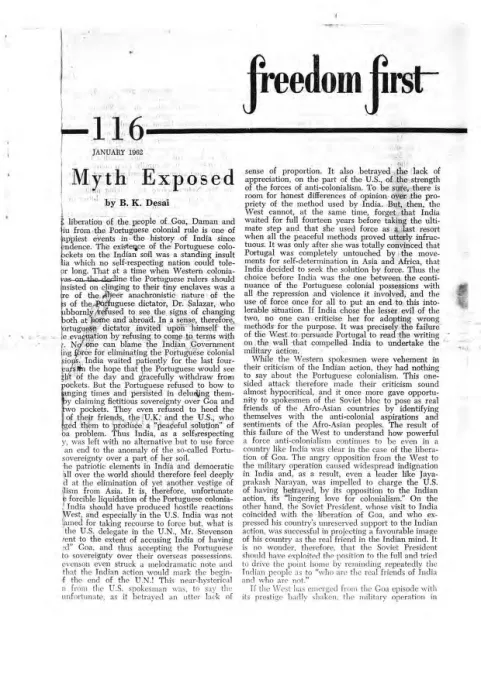
M. A. Venkata Rao’s “The Mystery Of Nehru’s Action On Goa” suspects a communist-aligned “ginger group” pushed Nehru toward force in Goa to rehabilitate Krishna Menon’s prestige.
-
John Rosselli profiles the British magazine Encounter on its hundredth issue, praising its vigour on ideas while diagnosing a “narcissism” about British intellectual society.
-
A “Without Comment” digest covers Polish private farming, alleged Chinese and Soviet funding of Kenyan politician Oginga Odinga, and West Bengal communists cancelling Stalin Day.
Essays
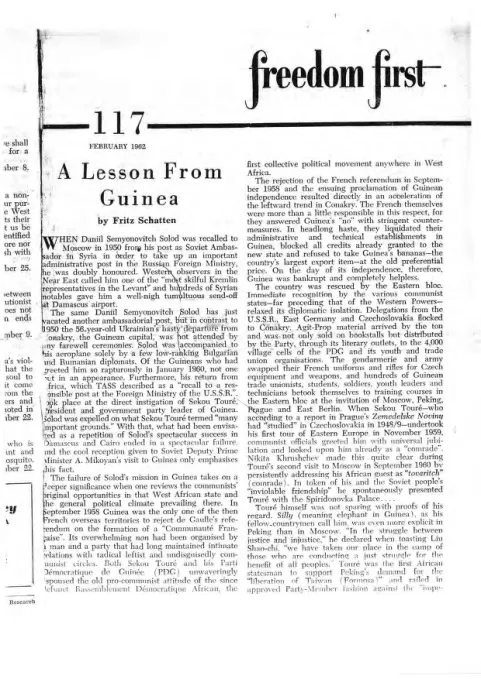
A Lesson From Guinea
By Fritz Schatten
Fritz Schatten narrates the recall of Soviet ambassador Daniil Semyonovitch Solod from Guinea in late 1961 as a spectacular diplomatic failure, contrasting it with his celebrated 1950 departure from Damascus. The essay traces how Guinea’s 1958 rejection of de Gaulle’s referendum, followed by French economic retaliation, drove Sekou Touré’s government into dependence on Eastern-bloc aid, credits, technicians and propaganda. It then catalogues a string of Soviet and satellite failures on the ground — abandoned economic projects, a shuttered East German printing works, failed water and power repairs, spoiled grain shipments, unsuitable airport equipment, and open grumbling among Guineans about the quality of Eastern goods and expertise — culminating in the December 1961 trial and imprisonment of Guinean Teachers Union members for an alleged ‘Communist-inspired conspiracy,’ student and worker protests, and Solod’s expulsion on Touré’s orders despite Khrushchev’s efforts to smooth things over via a special mission to Moscow.
- Solod’s 1961 expulsion from Conakry is framed as the mirror opposite of his triumphant 1950 exit from Damascus.
- Guinea’s 1958 break with France (rejecting the referendum on the Communaute Francaise) triggered French economic retaliation and pushed Conakry toward the Eastern bloc.
- Communist aid took the form of credits, Agit-Prop material, Czech/East German equipment, and thousands of Guinean students and technicians trained in Moscow, Peking, Prague and East Berlin.
- A litany of failures is listed: bungled credit projects, a closed East German printing works, unsuitable airport installations, rotten grain shipments, and water/power shortages Eastern bloc technicians could not fix.
- A November 1961 trial sentencing five Guinean Teachers Union members for a ‘Communist-inspired conspiracy’ triggered school closures and youth protests, forcing Sekou Toure to send a minister to Moscow.
- Solod’s recall is presented officially as a promotion, but the article reads it as an expulsion signalling Guinea’s disillusionment with Soviet patronage.
Issues In North Bombay Contest
By Acharya J. B. Kripalani
Acharya J. B. Kripalani explains his decision to contest the Bombay-North Lok Sabha seat against the sitting Congress member, in order to force public scrutiny of what he calls dangerous trends in government policy associated with Defence Minister V. K. Krishna Menon. He argues that India’s non-alignment has, in practice, tilted toward tolerance of Chinese aggression and Soviet-aligned positions, citing the government’s prolonged concealment of Chinese border incursions from Parliament and the public, India’s silence on Tibet and Hungary, and its embrace of the ‘panchsheel’ preamble to the India-China treaty on Tibet as complicit in legitimising China’s absorption of Tibet. He contends that Krishna Menon consistently pairs any admission of Chinese aggression with a reference to Pakistani-held Kashmir, and that the government has no real intention of recovering Chinese-held Indian territory, exposing the incoherence of India’s declared non-alignment as war with China looms as a live possibility.
- Kripalani frames his Bombay-North candidacy as a stand against ‘dangerous trends’ of government policy identified with Defence Minister V. K. Krishna Menon rather than as a purely partisan act.
- He argues non-alignment has been distorted into de facto sympathy for the Chinese and Soviet positions, citing India’s conduct at the UN and on Hungary and Tibet.
- He criticises the government for concealing Chinese border aggression from Parliament and the public for years, disclosed only after press pressure.
- He accuses Krishna Menon of deflecting Chinese-aggression questions by pairing them with references to Pakistani-occupied Kashmir, implying no serious intent to recover Chinese-held territory.
- He situates his campaign within a lifelong commitment going back to the national movement and Gandhi’s constructive programme.
On The Horns Of Our Dilemma
By James Burnham
James Burnham lays out what he calls the West’s central strategic dilemma: ‘Type W’ arguments, which treat nuclear war as the paramount danger and prioritize disarmament, versus ‘Type C’ arguments, which treat communist world conquest as paramount and prioritize resisting communist expansion. He argues the two dangers are both real and inescapable — the West cannot avoid one horn of the dilemma by grasping the other — and that a policy-maker must nonetheless choose which danger is the ‘main enemy’ to organize action around, since treating both as equally primary produces an incoherent, self-cancelling policy. He singles out President Kennedy’s rhetoric, especially his UN speech and statements on Cuba, Laos, and Berlin, as an example of a leader who has refused to choose his main enemy and has therefore failed to produce a credible policy, a failing Khrushchev may exploit.
- Burnham distinguishes ‘Type W’ arguments (nuclear war as the primary danger, favouring disarmament) from ‘Type C’ arguments (communist conquest as the primary danger, favouring resistance).
- He argues both dangers are simultaneously real and that policy cannot escape one horn of the dilemma by seizing the other.
- He contends that in practice a nation must choose one main enemy to organize its programme and attitude around, even if theoretically it should oppose both equally.
- He cites SANE vs. National Review, and Bertrand Russell vs. Barry Goldwater, as examples of the opposed ‘main enemy’ choices.
- He criticises President Kennedy for not deciding which of war or communism he is ‘more against’, citing his UN speech and his handling of Cuba, Laos and Berlin as evidence of an incoherent posture.
China’s Frontiers In Dispute
By (Contributed)
This unsigned ‘Contributed’ piece surveys China’s frontier disputes as of late 1961/early 1962, arguing that China has hardened its position with India even while settling boundary agreements with Nepal and Burma on terms favourable to itself. It reviews the 1950 Chinese military entry into Tibet, the growth of Sino-Indian border incidents culminating in the 1959 Tibetan rebellion, and the Indian government’s 1959-61 exchanges of notes with Peking, alongside a sustained Chinese propaganda campaign accusing India of being an ‘imperialist’ and pro-American client state. It contrasts China’s comparatively generous treatment of Nepalese and Burmese boundary claims with its intransigence toward India, and closes by noting unresolved or undemarcated Chinese frontiers with Mongolia, the USSR (including latent claims to the Ussuri Provinces and Vladivostok in Eastern Siberia), and Korea.
- China signed a boundary agreement with Nepal and a protocol with Burma in late 1961, even as its position toward India hardened.
- The 1959 Tibetan rebellion made border tensions with India acute, with Chinese forces operating up to and beyond the Himalayan frontier and a military road driven across Ladakh.
- Indian officials, including Nehru and Deputy Minister Lakshmi Menon, are quoted rejecting Chinese charges that India’s foreign policy is influenced by ‘imperialists and reactionary elements’.
- China is accused of a propaganda campaign portraying India as aligned with the ‘imperialist camp’ of the USA, citing India’s Belgrade conference conduct and Nehru’s US visit.
- China’s frontiers with the USSR, Mongolia, and Korea remain undemarcated or disputed on Chinese maps, including latent claims to Russia’s Ussuri Provinces and the port of Vladivostok.
What Khrushchev Did Under Stalin?
This unsigned piece, condensed from Le Figaro, uses back issues of Izvestia and Pravda to indict Khrushchev’s own role during Stalin’s 1934-38 purges, contrasting his 1956 and 1961 denunciations of the ‘anti-Party’ group with his documented record of fulsome, sycophantic praise of Stalin at the time of the terror. It quotes Khrushchev’s 1937 Pravda speech demanding the destruction of the Radek-Piatakov defendants, his 1934 and 1938 hymns of praise to Stalin at Party congresses, and his complicity in the extermination of the Ukrainian Communist Party leadership (Kossior, Postyshev, Lyubchenko and others) while he served as Ukraine’s Party leader. It closes with the anecdote of General Yakir’s son asking Khrushchev about his father’s fate, pointing out the irony that Khrushchev had both ordered Yakir’s death and slandered him as a ‘traitor’ before rehabilitating his memory decades later.
- The piece contrasts Khrushchev’s 1956 and 1961 congress speeches denouncing the ‘anti-Party’ group’s role in the Stalinist terror with his own simultaneous silence about his personal role in it.
- It quotes Khrushchev’s 1937 Pravda speech calling for the Radek-Piatakov defendants to be ‘unmasked’ and ‘reduced to dust’.
- It documents Khrushchev’s fulsome public praise of Stalin at the 1934 and 1939 Party Congresses and on Stalin’s 70th birthday.
- As Ukraine’s Party leader, Khrushchev is described as having overseen the extermination of the old Ukrainian Communist leadership — Kossior, Postyshev, Lyubchenko, Zatonsky — calling them ‘riff-raff’ preparing to open the door to Fascists.
- The piece notes only Khrushchev and Mikoyan remained, of the 1934 Congress speakers who praised Stalin as ‘genial’, still on the Party Presidium by 1961.
- It closes on the story of General Yakir’s son asking Khrushchev, decades later, about his father’s death, an irony given Khrushchev’s own role in denouncing and executing Yakir.
The Mystery Of Nehru’s Action On Goa
By MA Venkata Rao
M. A. Venkata Rao argues that Nehru’s decision to order military action in Goa contradicts his lifelong image as a man of peace, and probes for a hidden explanation. He suggests pressure came from a communist-organized ‘ginger group’ within Parliament and the Congress, keen to rehabilitate Defence Minister V. K. Krishna Menon’s prestige after his handling of the Chinese border crisis, and cites Mrs. Aruna Asaf Ali’s border agitation and reported Soviet backing (including talks with Soviet President Brezhnev in Delhi) as evidence that pro-communist elements around Nehru pushed him toward force in Goa while simultaneously counselling restraint against China. He contrasts this with Nehru’s refusal to resist Chinese aggression militarily, framing the Goa decision as troubling evidence that a supreme ruler can be moved to act against his own declared principles under communist or pro-communist pressure.
- Venkata Rao frames Nehru’s Goa action as inexplicable given his established reputation and past record as a man of peace.
- He argues a communist-aligned ‘ginger group’ in Parliament sought to rehabilitate V. K. Krishna Menon’s damaged prestige after Chinese border setbacks, and used the Goa question to do so.
- He cites Mrs. Aruna Asaf Ali’s agitation at the Goa border and claims of Soviet encouragement, including a reported Brezhnev meeting with Nehru in Delhi shortly before the Goa action.
- He contrasts Nehru’s decisiveness on Goa with his reluctance to resist Chinese aggression militarily, reading this asymmetry as evidence of pro-communist influence around the Prime Minister.
- He warns of the danger of a supreme ruler acting on impulse under pressure, contrary to his declared principles, citing Nehru’s earlier acquiescence to Lord Wavell’s invitation to the Muslim League as a precedent.
An Encounter With Narcissus
By John Rosselli
John Rosselli profiles the British intellectual monthly Encounter on the occasion of its hundredth issue, tracing its growth from 1953 launch to a circulation of nearly thirty thousand. He situates the magazine as an offshoot of the Congress for Cultural Freedom, funded chiefly by the Ford Foundation, with editors Stephen Spender and Melvin J. Lasky and honorary presidents including Reinhold Niebuhr, Salvador de Madariaga, and Jayaprakash Narayan. Rosselli assesses Encounter’s strengths (vigorous discussion of ideas and current affairs, an international readership spanning India, Japan and the US) against its weaknesses (a bias toward dissection over creative literature, and a strong tinge of narcissistic self-absorption about its own society, which gives the essay its title).
- Encounter, launched October 1953, has trebled its circulation in eight years and reaches nearly thirty thousand copies at its hundredth issue.
- It is an offshoot of the Congress for Cultural Freedom, funded chiefly by the Ford Foundation, with editors Stephen Spender and Melvin J. Lasky.
- Its honorary presidents include Reinhold Niebuhr, Salvador de Madariaga, and Jayaprakash Narayan.
- Rosselli judges the magazine as only ‘stutteringly international’ but ‘fully and usefully Anglo-American’, strong on ideas and current affairs but weak on literature and the arts.
- He diagnoses a ‘strong tinge of narcissism’ in the magazine’s preoccupation with British intellectual society, giving the piece its title.
Without Comment
The ‘Without Comment’ column reprints short unsigned news items, mostly sourced from other publications, without editorial commentary. Items cover the growth of private farming in Poland versus stalled collectivization in Hungary and disappointing harvests in Czechoslovakia and Rumania; allegations of Chinese and Soviet money funding Kenyan politician Oginga Odinga and broader communist infiltration efforts in East Africa competing with growing Chinese influence; West Bengal communists cancelling Stalin Day celebrations following central Communist Party disapproval and Nehru’s Bolpur speech condemning the state party; and the resignation of Cuba’s ambassador to Pakistan in protest against the ideological direction of the Cuban regime.
- Poland shows increasing private farm registration and declining collective-farm numbers, contrasted with near-complete Hungarian collectivization and disappointing Czechoslovak and Rumanian harvests.
- A London Daily Express allegation claims Kenyan politician Oginga Odinga received GBP 10,000 monthly instalments and a further GBP 150,000 from China, which Odinga denies.
- Chinese influence-building in East Africa (Kenya, Tanganyika, Somaliland, Zanzibar) is described as smaller-scale than the Soviet effort in Guinea but growing via scholarships, visits and diplomatic overtures.
- West Bengal’s communist party cancelled planned Stalin Day celebrations after central CPI disapproval and Nehru’s Bolpur speech criticising the state party’s ‘anti-national role’.
- Cuba’s ambassador to Pakistan resigned in protest against the new ideological direction of the Cuban regime, stating he did not regard himself committed to the communist line proclaimed by the Cuban government.
Generated by the v1.5 extraction pipeline. Awaiting editorial review.
Metadata and summary are AI-extracted from the source PDF and reviewed for editorial accuracy. The original work is available via the Read PDF tab above (where present); paragraph-level citation inside the PDF is deferred to a future engagement.