periodical issue
Freedom First
published for the Democratic Research Service, 127, Mahatma Gandhi Road, Bombay 1 · Bombay · 1962
12 pages
Freedom First
Summary
Freedom First No. 122 (July 1962) is a Bombay-based classical-liberal monthly whose editorial core is anti-communist and anti-planning. The lead piece, by Adam Adil, attacks the Anti-Nuclear Arms Convention held in Delhi in June 1962 as naively non-partisan in effect if not in intent, arguing that unilateral disarmament proposals unmatched by inspection regimes would only benefit the Soviet Union’s opaque, undemocratic war machine. The unsigned ‘Notes’ section covers domestic and foreign-policy controversies of the moment: the Kashmir Security Council resolution, the Congress-P.S.P. coalition crisis in Kerala, India’s foreign-exchange travel ban as an infringement of individual liberty, and a strong objection (via extracts from A. D. Gorwala’s Opinion) to India acquiring Soviet MIG aircraft. V. B. Karnik’s essay on Chinese refugees flooding into Hong Kong indicts Communist agricultural failure and the credulity of Western fellow-travellers like Lord Boyd Orr and Lord Attlee who praised Mao’s Great Leap Forward. M. A. Venkata Rao contributes a theoretical essay on national integration, criticizing caste- and community-based preferential treatment as corrosive of a unified Indian national consciousness. A reader’s letter recounts the mistreatment of the Indian business community in China after 1949 and criticizes Ambassador K. M. Panikkar’s passivity. N. C. Zamindar offers a philosophical critique of Marxist materialism as a ‘basic fallacy’ that reduces the plurality of human motive to economics alone. The issue closes with a compilation of world press items (‘Without Comment’), a book review of a collection of communist statements on Gandhi, and ‘With Many Voices,’ a page of topical quotations.
Key points
-
Adam Adil’s “Constructive Path To Disarmament” criticises the Delhi Anti-Nuclear Arms Convention as a de facto propaganda boost to the Soviet side, arguing disarmament without inspection would let the USSR rearm covertly.
-
Notes address disproportionate outrage over the UN’s Kashmir resolution, Kerala’s Congress-P.S.P. coalition crisis, India’s foreign-travel currency restrictions, and opposition to India acquiring Soviet MIG aircraft.
-
V. B. Karnik’s “Refugees From China” describes roughly 80,000 refugees fleeing into Hong Kong in May 1962, indicting Communist agricultural failure under the Great Leap Forward and the credulity of Western sympathisers like Lord Boyd Orr.
-
M. A. Venkata Rao’s “Principles Of National Integration” argues India’s independence struggle produced only negative unity against British rule, and criticises Congress for intensifying caste and communal preferential treatment.
-
A reader’s letter, “Who Betrayed Indians In China,” recounts the persecution of India’s business community in China after 1949 and blames Ambassador K. M. Panikkar’s passivity.
-
N. C. Zamindar’s “A Basic Fallacy Of Socialism” argues Marxist materialism wrongly reduces the plurality of human motive to economics alone, citing altruism as counter-evidence.
-
A “Without Comment” digest reports Cuban labour leader David Salvador’s 30-year sentence and Portugal’s forced-labour system in Angola.
-
A review of “Mahatma in the Marxist Mirror” notes communist statements on Gandhi consistently branding him a reactionary friend of capitalists.
Essays
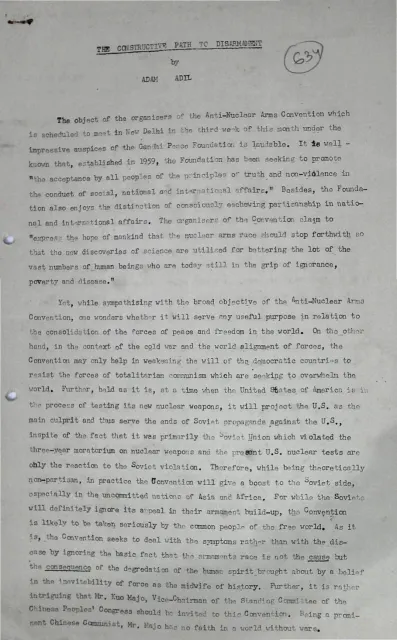
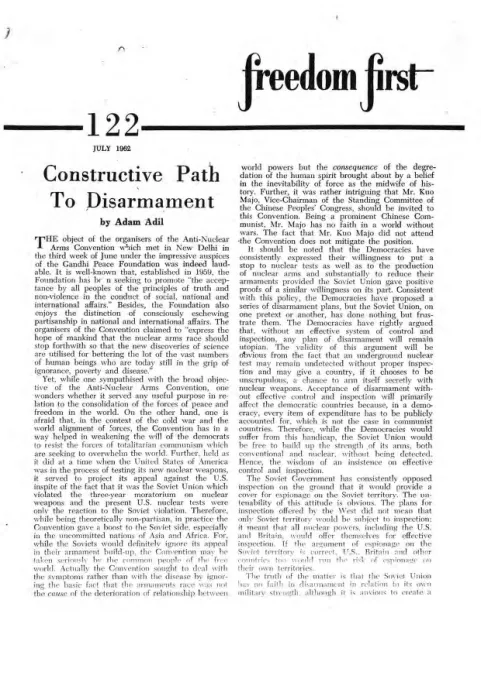
Constructive Path To Disarmament
By Adam Adil
Adam Adil’s editorial-style lead article criticizes the Anti-Nuclear Arms Convention that met in New Delhi in June 1962 under the Gandhi Peace Foundation’s auspices. While acknowledging the Convention’s stated humanitarian aims, the piece argues it was one-sided in practice: convened while the U.S. was testing weapons in response to a prior Soviet violation of the nuclear moratorium, it gave a propaganda boost to the Soviet side, especially among uncommitted Asian and African nations. The author, quoting Zurich commentator Lorenz Stucki, argues the Soviet dictatorship has more to fear from genuine disarmament than the democracies, since its power rests on demonstrations of force, and that its call for disarmament without effective inspection is doctrinally consistent with Leninist strategy of ‘unmasking’ bourgeois pacifists rather than genuine intent, citing Lenin’s own writings and the Great Soviet Encyclopaedia. The piece concludes (in the continuation on page 11) that history shows arms are laid down only when a stronger guaranteeing authority emerges, and that the true problem today is arms control, not disarmament, invoking Gaitskell’s insistence on verifiable agreement and closing with Gandhi’s and Aristotle’s reflections on what makes life worth living.
- The Anti-Nuclear Arms Convention (Delhi, June 1962), though nominally non-partisan, functioned in practice as a propaganda boost to the Soviet side.
- Soviet dictatorship depends on the demonstration of force at home and abroad; genuine disarmament would threaten its foundations more than it would threaten Western democracies.
- Soviet secrecy (no public accounting of expenditure) makes verification essential; without inspection, disarmament plans would let the USSR rearm covertly while democracies remain constrained by public accountability.
- The USSR is reported to be sharply increasing military spending (a 44.9% year-on-year rise, totalling 13,409 million roubles) even as it publicly professes support for disarmament.
- Leninist doctrine (per the Great Soviet Encyclopaedia and Lenin’s own writings) treats disarmament advocacy as useful ‘unmasking’ propaganda rather than a genuine goal while capitalism exists.
- The real problem is arms control, not full disarmament, since historically actors disarm only once a stronger guaranteeing authority exists (villages, city-states, nation-states, and now potentially a world authority).
Notes (Needless Hysteria / Kerala Coalition Crisis / Thou Shalt not Travel / M.I.G. Folly)
The unsigned ‘Notes’ section runs several short editorial items. ‘Needless Hysteria’ argues that public and political outrage in India over a UN Security Council resolution urging India-Pakistan negotiations on Kashmir is disproportionate, since the resolution is non-binding and merely reiterates what India has always claimed to want; it warns against alienating the U.S. and U.K. over the vote and inadvertently pushing India toward alignment with the Soviet bloc, the only powers besides India that opposed the resolution. ‘Kerala Coalition Crisis’ analyzes tensions within the Congress-P.S.P. coalition government of Kerala, precipitated by a dispute over private versus government primary schools, and the fragile position of Chief Minister Pattom Thanu Pillai. ‘Thou Shalt not Travel’ condemns the Reserve Bank of India’s restrictions on foreign travel by Indian nationals as a symptom of excessive economic controls truncating individual liberty, contrasting the trivial foreign-exchange savings against India’s overall reserve gap. ‘M.I.G. Folly’ (continued from page 4 onto page 6) reprints extracts from A. D. Gorwala’s journal Opinion opposing Indian acquisition of Soviet MIG aircraft, arguing that closer defence ties with a totalitarian communist power constitute the height of folly regardless of Pakistan’s acquisition of superior jets from the United States.
- India’s outrage over the UN Security Council’s Kashmir resolution is called disproportionate since the resolution is harmless and non-binding.
- Only the Soviet Union and Romania supported India’s position on the resolution among all voting nations, a fact the piece frames as cause for concern rather than pride.
- Kerala’s Congress-P.S.P. coalition faces a crisis over a Congress-backed demand to allow private primary schools, which Chief Minister Pattom Thanu Pillai rejected without cabinet consultation.
- The ban on foreign travel via Reserve Bank of India permission is criticized as authoritarian and its foreign-exchange savings called a ‘mere bagatelle’ compared to India’s overall reserve deficit.
- Extracts from A. D. Gorwala’s Opinion oppose India acquiring Soviet MIG aircraft or jointly manufacturing them, arguing this would tie India’s defence establishment to Soviet interests and serve the Communist goal of ‘liberating’ India.
Refugees From China
By V. B. Karnik
V. B. Karnik’s essay describes a flood of roughly eighty thousand refugees who fled from Kwangtung province in mainland China into Hong Kong over a fortnight in May 1962, only for most to be rounded up and forced back across the border once Hong Kong reached capacity. Karnik uses the episode to indict the failure of Communist agricultural policy under the Great Leap Forward and the Communes, contrasting the regime’s inflated production claims (accepted uncritically by visiting Western dignitaries such as Lord Boyd Orr and Lord Attlee) with the famine that surfaced by late 1960, when the Chinese government itself admitted its earlier figures were exaggerated. He argues hunger, not political motive, drove the refugees, and situates the exodus within a broader pattern of flight from communist rule worldwide — citing figures for refugees from Eastern Europe, North to South Korea, North to South Vietnam, East to West Germany (until the Berlin Wall), Cuba, and Tibet — concluding that only communist regimes produce such mass flight and that the episode has discredited China-enthusiast illusions in the free world.
- About 80,000 refugees fled Kwangtung province into Hong Kong over a fortnight in May 1962 before being repatriated once the colony reached capacity.
- The Chinese government’s own admission in late 1960 that its earlier production figures (from the Great Leap Forward and Communes) were ‘wrong and highly exaggerated’ undercut Western commentators who had praised Chinese agricultural progress.
- Prominent Western visitors including Lord Boyd Orr and Lord Attlee lent their authority to now-discredited claims of Chinese agricultural success.
- The article situates the Hong Kong refugee flood within a global pattern: roughly 2.5 million fled Eastern Europe, 1 million North to South Korea, 1 million North Korea to Vietnam, 4 million East to West Germany before the Berlin Wall, 200,000 from Cuba, and 75,000 Tibetans into India.
- Karnik argues that only communist countries produce this scale of flight from their own populations, framing it as a moral indictment of communist rule as a human institution.
Principles Of National Integration
By MA Venkata Rao
M. A. Venkata Rao’s essay frames national integration as the next stage in a natural evolutionary progression of social consciousness, from clan and tribe toward an all-India ‘we-consciousness’ spanning from Kashmir to the Cape and Gujarat to Assam. He argues the independence struggle under Gandhi’s leadership produced a largely negative form of national unity — forged against British rule — that did not develop into a deep positive social cohesion. Since 1947, he contends, competitive energies among political leaders have exploited caste, communal, and linguistic groupings for factional advantage, with Congress leadership and government singled out for failing to overcome this heritage and instead intensifying caste exclusiveness and communal rivalry through preferential treatment schemes. His proposed remedies include ending preferential treatment for students on communal grounds in favour of poverty- and merit-based criteria, enforcing merit strictly in administrative service recruitment, refusing to weigh community in the administration of justice, and generally discouraging patronage based on caste, religion, or regional loyalty so that a larger national consciousness can emerge as the dominant disposition.
- National consciousness is presented as a natural stage in social evolution, from clan/tribe to nation, with India needing to complete its transition to an all-India national ‘we-consciousness’.
- The anti-colonial struggle under Gandhi produced a mostly negative form of unity (against British rule) rather than a deep, positive social cohesion.
- Post-1947 politics has seen caste, communal, and linguistic groupings exploited by leaders for factional advantage, worsening rather than healing social divisions.
- Congress leadership is specifically blamed for intensifying caste exclusiveness and communal rivalry ‘to the ninth degree’ through the granting of preferential treatment.
- Proposed remedies: end community-based preferences in education, enforce merit in administrative recruitment, apply the law without regard to community, and discourage smaller-group patronage generally, including reconsidering Kashmir’s law barring non-Kashmiri Indians from owning property there.
Letter to Editor: Who Betrayed Indians In China
By PILOC
A reader’s letter signed ‘PILOC,’ titled ‘Who Betrayed Indians in China,’ recounts the decline of a once-prosperous Indian business community in China after the Communist takeover in 1949. The writer describes escalating pressure on Indian-owned businesses and individuals — taxation, confiscation, surveillance, and denial of exit permits to wealthier residents — and criticizes the Indian Consulate and Ambassador Sardar K. M. Panikkar in Peking for failing to intervene, alleging he was preoccupied with social engagements rather than the welfare of the Indian community. The letter singles out the forced exhumation and relocation of an Indian cemetery in Shanghai as emblematic of the disregard shown, and concludes that India’s official silence, sustained by faith in the ‘Hindi Chini Bhai-Bhai’ slogan, left Indians in China ruined while China gained a strategic foothold on India’s northern frontier via Tibet.
- Indian businesses and individuals in China faced escalating taxation, confiscation, and surveillance following the 1949 Communist takeover.
- Wealthier Indians (‘the Gakonis,’ or ‘black devils’ as the Chinese called them) were denied exit permits and had their assets bled before being allowed to leave.
- An Indian cemetery at Foochow Road in Shanghai was exhumed and its land handed to the Chinese authorities, over community objection.
- The letter blames Ambassador Sardar Panikkar for prioritizing social engagements over the welfare of the Indian community in China.
- The writer connects the episode to India’s later strategic vulnerability, arguing the ‘Hindi Chini Bhai-Bhai’ policy left China positioned to threaten India via the Himalayan region.
A Basic Fallacy Of Socialism
By N. C. Zamindar
N. C. Zamindar’s essay argues that Marxian socialism’s basic fallacy is treating life as a set of rigid compartments — above all the economic compartment — rather than as a plurality of irreducible ‘modes of life.’ He contends the theory of dictatorship of the proletariat inevitably produces a totalitarian hierarchy resembling a monarchy, with the party apex functioning like a raja whose swadharma is tyranny, regardless of Harold Laski’s attempted distinctions between dictatorship ‘of’ and ‘for’ the proletariat. Zamindar challenges the materialist interpretation of history by pointing to the existence of altruism and charity in human affairs, and by asking whether even committed communists like Lenin and Khrushchev were purely motivated by personal economic considerations — arguing they were not, and that this shows history is driven by diverse, individual ‘modes of life’ rather than a single economic determinant. He extends this to compare Lenin with figures ‘from Chanakya to Rajaji and Jawaharlal Nehru,’ and closes by rejecting the Hegelian dialectical triad (thesis-antithesis-synthesis) as an oversimplified and ‘entirely fantastic’ account of history, while clarifying that rejecting Marxist materialism does not mean rejecting social welfare or social justice as such.
- Marxian socialism’s core fallacy, per Zamindar, is treating human life as economic ‘compartments’ rather than as diverse, irreducible ‘modes of life’.
- The dictatorship of the proletariat is argued to inevitably produce a totalitarian ‘pyramid’ resembling monarchy, with Harold Laski’s distinctions between dictatorship ‘of’ and ‘for’ the proletariat dismissed as merely notional.
- The existence of altruism and charity in human history is cited as evidence against a strictly materialist interpretation of history.
- Lenin, Khrushchev, and other historical figures (including Chanakya, Rajaji, and Nehru) are argued to have been driven by individual modes of life rather than solely personal economic motives.
- The Hegelian dialectical triad of thesis-antithesis-synthesis is rejected as an ‘entirely fantastic’ oversimplification of history that cannot account for the diversity of human reactions and motives.
- The essay clarifies that rejecting Marxist materialist philosophy does not mean rejecting social service, welfare, or justice as goals.
Without Comment
The unsigned ‘Without Comment’ column reprints, without editorial commentary, a set of press items documenting communist and colonial abuses: a Newsletter item on Cuban labour leader David Salvador’s 30-year sentence under Castro after resigning in protest of the Communist takeover of the Cuban Workers’ Confederation; a Newsletter item on Portuguese forced-labour (‘contrato’) practices in Angola, including dire health statistics; and an extract from K. P. S. Menon’s piece in The Illustrated Weekly of India describing the regimented, propagandistic content of Moscow Radio’s daily broadcasts. A boxed advertisement for the pamphlet ‘How Communists Destroy Democracy: A Lesson from Czechoslovakia’ appears alongside.
- David Salvador, first elected leader of Cuba’s revolutionary labour confederation (CTC-R), was sentenced to 30 years by Castro after resigning in 1960 in protest at Communist control of the union.
- Portugal’s ‘contrato’ system in Angola is described as a form of legalized slave labour, contracting out 100,000-120,000 Angolans annually to South Africa and the Rhodesia/Nyasaland Federation.
- Angola’s colonial health infrastructure is described as extremely deficient: one doctor per 500,000 natives and 45-50% infant mortality.
- K. P. S. Menon’s extract describes Moscow Radio’s tightly scheduled programming of exercise, news, music, and etiquette lessons as instruments of ideological conditioning.
Review: Mahatma in the Marxist Mirror (by Satindra Singh, Siddharth Publications)
An unsigned book review covers ‘Mahatma in the Marxist Mirror’ by Satindra Singh (Siddharth Publications, Rs. 1.50), a collection of communist declarations about Mahatma Gandhi and his role in the national movement, spanning sources from 1921 to 1961. The reviewer notes the collection’s consistent verdict across decades — that Gandhi was a friend of capitalists and imperialists and essentially a reactionary — while observing that more recent, softer-toned assessments reflect a tactical desire to draw India into the Communist fold rather than any genuine change of view, and commends Satindra Singh’s compilation and the publisher’s production quality.
- The reviewed book collects communist statements on Mahatma Gandhi from 1921 to 1961 across a range of sources.
- Despite variation in tone, the reviewer notes the collection’s consistent conclusion: Gandhi is characterized as a friend of capitalists and imperialists and, ultimately, a reactionary.
- Recent softer assessments are read by the reviewer as tactical, aimed at luring India into the communist orbit, not a genuine reassessment.
- The reviewer praises Satindra Singh’s editorial work and Siddharth Publications’ production quality.
With Many Voices
‘With Many Voices,’ an unsigned compilation opening with a Tennyson epigraph, gathers brief quotations on Cold War and domestic political themes from a range of contemporary figures and publications, including P. Y. Tang on Hong Kong as the ‘West Berlin of the Far East,’ Sebastian Haffner on American foreign policy’s paradoxical friendliness to neutrals, Milovan Djilas on Stalin’s enduring influence, Time magazine on the Hong Kong border fence, Frank Moraes criticizing Nehru’s political rhetoric as outdated, President Macapagal on neutralism as ‘the gateway to Communism,’ Andre Malraux and Hugh Gaitskell on the moral posture of free nations, and K. P. S. Menon’s wry observation on Soviet consumer-goods shortcomings. A subscription coupon and an advertisement for G. P. Bhattacharya’s book ‘M. N. Roy and Radical Humanism’ close the issue.
- The page compiles short, mostly Cold War-themed quotations from global commentators and leaders, framed by an epigraph from Tennyson.
- P. Y. Tang is quoted comparing Hong Kong to ‘the West Berlin of the Far East’ amid the refugee crisis covered elsewhere in the issue.
- Frank Moraes is quoted in The Indian Express criticizing Nehru and his followers as behind the times politically.
- Philippine President Macapagal is quoted calling neutralism ‘the gateway to Communism.’
- The issue closes with a Freedom First subscription form and an advertisement for G. P. Bhattacharya’s ‘M. N. Roy and Radical Humanism’ (Rs. 3, Strand Book Shop).
Generated by the v1.5 extraction pipeline. Awaiting editorial review.
Metadata and summary are AI-extracted from the source PDF and reviewed for editorial accuracy. The original work is available via the Read PDF tab above (where present); paragraph-level citation inside the PDF is deferred to a future engagement.