periodical issue
Freedom First
Published for the Democratic Research Service by B. G. Deb at 127 Mahatma Gandhi Road, Bombay 1; printed at Indoco Printers, Bombay · Bombay · 1962
12 pages
Freedom First
Summary
Freedom First No. 123 (August 1962) is a monthly issue of the Bombay-based classical-liberal magazine published for the Democratic Research Service. The issue opens with an analysis of the leadership transition in West Bengal following the death of Dr. B. C. Roy, and moves through a run of commentary pieces on international and domestic politics: the economics and politics of Britain’s possible entry into the European Common Market, a survey of the communist dictatorship under Kim Il Sung in North Korea, a report on the loosening of the taboo against teaching about communism in American schools, correspondence on the office of the Lok Sabha Speaker, an open letter of solidarity with the imprisoned Yugoslav dissident Milovan Djilas, a polemical rebuttal of an economist’s defence of prohibition policy, an essay on Dravidian separatism in Madras state, and a closing page of quoted excerpts from other commentators (‘With Many Voices’). Across these pieces the magazine’s recurring stance is classical-liberal and anti-communist: sympathetic to free enterprise and free trade, sceptical of central planning and prohibition-style state control, and hostile to communist regimes and totalitarian methods wherever found, from Pyongyang to East Berlin.
Key points
-
K. K. Sinha’s “West Bengal Opens A New Chapter” examines the succession after Dr. B. C. Roy’s death, mapping the coming rivalry between new Chief Minister P. C. Sen and P.C.C. president Atulya Ghosh.
-
Raman K. Desai surveys the European Common Market’s origins and estimates a net annual loss to India of roughly Rs. 17 crores if Britain joins on the terms then discussed.
-
Rama Swarup Sabherwal’s “Communist Dictatorship In North Korea” describes Kim Il Sung’s regime as consolidated through violent internal purges, sham elections, and militarised farm collectivisation.
-
Adam Adil reports a shift in American education toward teaching about communism in schools, following decades of restriction under laws such as Georgia’s “Americanism” statute.
-
A letter praises Speaker Hukum Singh’s even-handed conduct, and Jasha M. Levi’s “A Tribute to Djilas” honours the imprisoned Yugoslav dissident’s courage in standing trial again.
-
John S. Connor’s “Despirited Economics” rebuts an economist’s defence of prohibition, arguing it ignores worker-disincentive effects and squeezes the investable surplus.
-
M. A. Venkata Rao’s essay on Dravidian separatism traces DK/DMK politics to Brahmin-dominance resentment, invoking Jung’s collective-neurosis theory and urging sympathetic engagement over force.
-
“With Many Voices” closes with Clinton Rossiter calling Nehru “cranky, preachy and imperious” and Wilhelm Roepke citing the Berlin Wall as proof of communism’s true character.
Essays
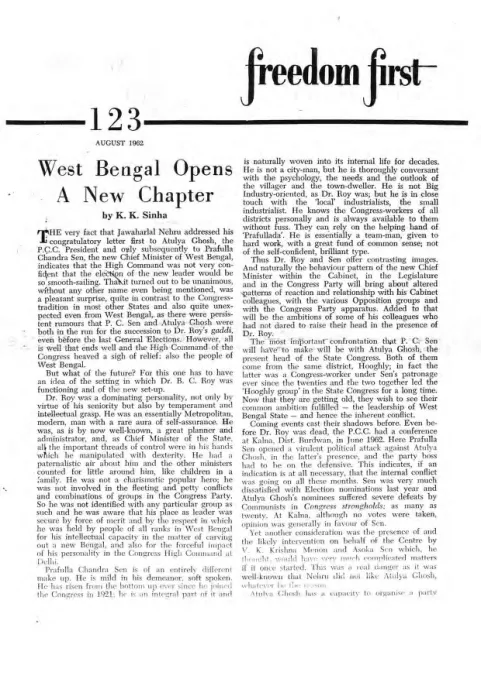
West Bengal Opens A New Chapter
By K. K. Sinha
K. K. Sinha’s opening piece examines the succession in West Bengal after the death of the long-dominant Chief Minister Dr. B. C. Roy, contrasting Roy’s autocratic, self-assured style with the mild, consensus-seeking manner of his successor Prafulla Chandra Sen. The essay reads the news that Nehru’s congratulatory letter went first to P.C.C. president Atulya Ghosh, and only later to Sen, as a sign that the Congress high command was not confident the succession would be smooth, and it maps out the personal and factional rivalry between Sen and Ghosh (both from Hooghly district) as the central fault line to watch. It closes by predicting continued instability — rising prices, unemployment, and opportunistic manoeuvring by Bengal’s Communists — now that Roy’s personal authority with the Centre and with Communist leader Jyoti Basu is gone.
- Nehru addressed his congratulatory letter first to Atulya Ghosh (P.C.C. President) and only afterward to new Chief Minister Prafulla Chandra Sen, read as a sign of high-command unease about the succession.
- Dr. B. C. Roy is described as a dominating, self-assured, planner-administrator type; Sen is described as mild, team-oriented, and reliant on colleagues.
- The central coming conflict identified is between Sen and Atulya Ghosh, both Hooghly-district Congress figures, over control of party machinery.
- The essay notes a prior public clash between Sen and Ghosh at a P.C.C. conference in Kalna, Burdwan district, in June 1962.
- It claims Roy had maintained a ‘secret understanding’ with CPI leader Jyoti Basu that kept Communist-led agitations from escalating, and predicts this restraint will end under Sen.
- The piece forecasts rising prices, unemployment, and unsettled conditions spilling over from East Pakistan as destabilising pressures on the new government.
- It notes Roy’s personal pull with the Centre (especially Nehru) as an asset Sen will lack, closing with a cautious, qualified hope that Sen might yet prove a ‘stabilising pillar’ of Bengal politics.
The European Common Market
By Raman K. Desai
Raman K. Desai surveys the European Economic Community (Common Market) from its origins in the 1952 European Coal and Steel Community through the 1957 Treaty establishing the EEC, framing it as a deliberate political integration project driven by France and Germany’s postwar reconciliation over the Ruhr and Lorraine. The essay describes Britain’s reluctant move toward EEC membership given its Commonwealth trade commitments, and then pivots to assess the costs and benefits for India: it works through rough figures on India’s tea, cotton-yarn, textile and jute exports to Britain and estimates a net annual loss to India of roughly Rs. 17 crores if Britain joins on the terms then being discussed. Desai closes with a broader argument that India’s rulers have failed to appreciate the scale of Europe’s integration project, and that India’s only real path to competing internationally is to lower domestic prices through higher agricultural productivity rather than continued reliance on foreign aid.
- Traces EEC’s institutional lineage from the 1952 European Coal and Steel Community (France, Germany, Italy, Belgium, Netherlands, Luxembourg) to the 1957 Treaty founding the European Common Market.
- Frames Franco-German economic integration over the Ruhr/Lorraine coal-and-iron dispute as the political core of the project, crediting General de Gaulle with accelerating integration despite France’s domestic economic troubles.
- Notes Britain initially refused to join and formed a rival seven-power grouping (EFTA), but is now compelled to seek EEC membership given the risk of a common external tariff wall against its exports.
- Estimates that a 15% EEC tariff on India’s roughly Rs. 200 crore of exports to Britain (dominated by tea, cotton-yarn and textiles, jute goods) would cost India about Rs. 18 crores annually, partly offset by an EEC rebate, for a net loss of about Rs. 17 crores a year.
- Argues India should lobby for tea to be admitted duty-free and should diversify into new export lines such as oilseeds and animal/vegetable oils.
- Criticises Indian ministers (naming Asoka Mehta and Morarji Desai) for seeking tariff relief rather than confronting the underlying need for reform, and criticises reliance on foreign aid (citing over Rs. 2,000 crores received from the U.S. in 15 years) as unsustainable.
- Concludes that India’s route to genuine economic independence is lowering internal prices via higher agricultural output, not continued aid-seeking.
Communist Dictatorship In North Korea
By Rama Swarup Sabherwal
Rama Swarup Sabherwal offers a survey of North Korea under Kim Il Sung, framing the regime as a personalist communist dictatorship consolidated through violent internal purges of rival factions rather than through any democratic process. The essay describes the ruling Korean Labour (Communist) Party’s total control of cabinet posts, an electoral system with only one permitted candidate per constituency and open ballot boxes that intimidate voters, and a legislature (the People’s Supreme Council) that meets only days a year and merely rubber-stamps decisions already made by the party. It goes on to describe the regime’s command economy — prioritising heavy and armament industry, running a stalled seven-year economic plan, imposing collectivized farm labour under militarised discipline, and requiring compulsory manual and factory labour of students — concluding that the entire system exists to serve Kim’s personal grip on power and produces widespread poverty.
- Frames the North Korean regime as built on bloody internal power struggles rather than elections, citing a purge in which only 25 of 85 Central Committee members from the third Party Congress survived to the next Congress.
- Describes the cabinet and Supreme People’s Council as effectively powerless rubber-stamp bodies dominated entirely by the Korean Labour Party.
- Details the sham electoral system: one candidate per 50,000-person constituency, and open white/black ballot boxes at polling stations that make votes effectively public.
- Reports economic monopoly under Kim: heavy/armament industry prioritized, a seven-year economic plan whose grain and textile targets have repeatedly slipped, and per-capita wages of 17 to 79 won per day.
- Describes agricultural collectivization run through committees under militarized daily routines (roll calls, marches, indoctrination sessions) for farmers treated ‘as militiamen.’
- Details compulsory manual/factory labour requirements for students (up to 80+ days a year at technical institutes) as part of communist indoctrination in schools.
- Concludes the economic hardship and poverty in the North stems directly from the regime’s heavy military spending and the consolidation of Kim’s personal dictatorship.
Latest Trend In American Education
By Adam Adil
Adam Adil reports on a shift in American education: after decades in which teaching about communism in U.S. schools was legally restricted (citing a Georgia law barring instruction inconsistent with ‘the fundamental principles of patriotism and high ideals of Americanism’), a number of states — Virginia, Florida, Louisiana, and later California — have introduced courses on the theory, history, and practice of communism, spurred by a 1957 American Legion resolution and joined by the National Education Association. The essay surveys varying pedagogical approaches across school districts (Atlanta, San Francisco, Boston, Dallas, Louisiana) ranging from strictly factual, non-indoctrinating instruction to explicitly framing communism’s ‘fallacies’ in contrast with American democratic ideals, and closes by praising the trend as evidence that McCarthy-era taboos have been shed from American public life.
- Contrasts totalitarian societies, where students only learn distorted facts about other systems, with democracies, where objective study of rival ideologies is held to produce a well-informed, tolerant citizenry.
- Notes a Georgia law once barred teachers from instruction ‘inconsistent with the fundamental principles of patriotism and high ideals of Americanism,’ effectively banning any teaching of communism.
- Credits a 1957 American Legion resolution, later joined by the National Education Association, with beginning the shift toward teaching about communism in U.S. schools.
- Cites Virginia (1961), and more recently Florida and Louisiana, as having authorised courses on communism, with California appointing a committee to design curriculum.
- Surveys differing local approaches: Atlanta’s Board of Education frames the classroom as a forum rather than a venue for indoctrination; Dallas and Florida schools explicitly frame courses to contrast American freedom with communist ‘tyranny.’
- Quotes a Boston high school history department head questioning whether students have enough historical grounding to actually refute Marxist arguments.
- Concludes the trend shows that ‘Maccarthyism is completely rooted out from American public life,’ contrasting it favourably with regimented communist-country education.
Letter to Editor: The Speaker’s Office
This page carries two short items. A ‘Letter to Editor’ under the heading ‘The Speaker’s Office’ praises Sardar Hukum Singh’s conduct as Lok Sabha Speaker for even-handedness toward the opposition, but criticises a lapse in protocol during ceremonies at Punjabi University where he was denied a seat befitting his office, quoting the late Speaker Mavalankar’s dictum that the Speaker ‘must continue to be a politician, though with very extensive limitations on his activities.’ The second item, ‘A Tribute to Djilas’ by Jasha M. Levi (a former editor of the Yugoslav paper Borba), reproduces an open letter of solidarity to imprisoned Yugoslav dissident Milovan Djilas, framing his willingness to stand trial under a regime he once helped build as the era’s highest form of moral courage.
- The letter to the editor commends Sardar Hukum Singh’s even-handed conduct as Speaker, contrasting it with his predecessor-era norms, while criticising a protocol slight against him at Punjabi University ceremonies.
- It quotes the late Speaker Mavalankar’s view that the Indian Speaker, unlike the British Speaker, must remain a party member ‘though with very extensive limitations on his activities.’
- The Djilas tribute is written by Jasha M. Levi, described as a close friend of Milovan Djilas and former editor of the official Yugoslav newspaper Borba, reprinted from The New Leader (New York).
- The letter frames Djilas’s standing trial again under ‘another Yugoslav court of oppression’ as an act of courage and a betrayal of the idealism of his generation.
- It situates Djilas’s persecution within a broader Balkan history of struggle for liberty, calling his stance ‘the noblest decoration, the greatest honour’ available under current conditions.
A Tribute to Djilas
By Jasha M. Levi
No summary was extracted for this article. Listed for completeness.
Despirited Economics
By MA Venkata Rao
John S. Connor’s ‘Despirited Economics’ is a polemical rebuttal of a YOJANA article by Dr. V. V. Borkar of Marathwada University defending the economics of prohibition. Connor accuses Borkar of smuggling in ‘neo-classical’ assumptions he claims to reject, faults him for dismissing the importance of financial resources relative to real resources for development, and — continuing on page 11 — for ignoring the ‘worker disincentive’ effects of prohibition on productivity while conceding that prohibition would raise consumption of basic wage goods (thereby squeezing the investable surplus). Connor’s central charge, repeated in punning form throughout, is that Borkar’s economics is ‘despirited’ — both lacking argumentative rigor (‘spirit’ in the sense of vigor) and blind to the loss of workers’ spirits (morale/alcohol) under prohibition — and that Borkar’s proposed compensations (redirecting displaced liquor-industry labour, fiscal controls on consumption) are vague, bureaucratic, and evasive of the real costs of enforcement.
- Connor charges Dr. V. V. Borkar with attributing ‘neo-classical’ assumptions to anti-prohibitionist economists while himself relying on similar assumptions to justify prohibition’s fiscal costs.
- Faults Borkar for treating financial resources as a mere ‘camp follower’ to real resources in development, calling this a demonstration of ‘lack of awareness of the importance of spirit.’
- Continuing on page 11: argues Borkar concedes prohibition will raise consumption of basic wage goods (since displaced drinking money goes elsewhere), which by Borkar’s own logic reduces the investable surplus — a contradiction Connor says undercuts Borkar’s own case.
- Criticises Borkar’s proposal to redirect liquor-industry labour and capital into ‘socially more desirable’ production as vague and unaccompanied by any specific enterprise plan.
- Notes Borkar pays only ‘limited respect’ to the financial costs of prohibition enforcement and ignores the administrative/enforcement drain entirely.
- Concludes with a punning verdict that Borkar has ‘made out an excellent case for the proponents of the loss of the free and the prohibitors of its spirit’ — i.e. inadvertently strengthened the anti-prohibition argument.
Separatist Activities In Madras
By M. A. Venkata Rao
M. A. Venkata Rao examines the rise of Dravidian separatist politics in Madras — the Dravida Kazagam and Dravida Munnetra Kazagam under E. V. Ramaswami Naicker and C. N. Annadurai — tracing the movement’s roots to the non-Brahmin self-respect movement’s resentment of Brahmin dominance of colonial-era professions and administration. He argues the movement evolved, after Independence removed its original grievance (constitutional equality), into a broader ideology asserting a separate ‘Dravidian race,’ language, and mythology modeled loosely on European racial nationalism, and invokes Jung’s theory of collective neurosis to frame the phenomenon as a psychological response to status anxiety rather than a movement to be met with force. Venkata Rao criticises the Government’s long neglect of the issue — 15 years without ideological or practical countermeasures — and closes with a set of proposed remedies: impartial scholarly study of Dravidian claims, student and teacher exchange programmes between Tamilnad and other regions, public opinion polling, university extension lecture camps, and cultural/documentary programming to promote national integration.
- Traces DK/DMK separatism to the earlier non-Brahmin self-respect and Justice Party movements’ resentment of Brahmin professional and administrative dominance under British rule.
- Argues that post-Independence constitutional equality removed the movement’s original grievance, but that a broader theory of Dravidian racial/cultural distinctness (echoing European racial nationalism) has since developed to sustain it.
- Invokes Carl Jung’s idea of a whole people suffering collective neurosis under national frustration and humiliation as an interpretive lens, and urges the Kazagams be ‘treated with sympathy and insight’ rather than threats of force.
- Criticises the Government and Congress Party for 15 years of neglect of the separatist movement on both ideological and practical planes.
- Reports the 19 July 1962 DMK picketing and unrest in Madras, with tear gas, lathi charges, and roughly 5,000 arrests, as evidence of inadequate government response.
- Notes recent central government moves — appointing Subramanyam of Madras to the Cabinet as Steel and Heavy Industries Minister, and posting Dr. Subbarayan as Governor of Bombay — as attempts to placate Dravidian/Madrasi sentiment.
- Proposes remedies: impartial scholarly study of Dravidian claims, student/teacher exchange with other Indian regions, opinion polling, extension lecture camps, and cultural programming to build national integration.
With Many Voices,
The closing page, ‘With Many Voices,’ is a compilation of short quoted excerpts from other writers and public figures on Cold War politics, communism, and related themes, framed by an epigraph from Tennyson. Sources quoted include Frank J. Johnson’s ‘No Substitute for Victory,’ Professor Clinton Rossiter on Nehru in the New York Times, Wm. F. Buckley on J. K. Galbraith, a refugee from East Germany quoted in Time, Dr. Wilhelm Roepke’s Mont Pelerin Society presidential address on Berlin and communism, Lord Hailsham in the Times (London), C. Rajagopalachari writing in Swarajya about India’s Delhi Anti-Nuclear Convention, and the U.S. News & World Report. The page closes with the continuation of the West Bengal succession essay from page 2.
- A curated set of short quotations on Cold War politics and communism from varied sources, prefaced with an epigraph from Tennyson.
- Includes Wm. F. Buckley’s quip contrasting his horror at Americans with tail-finned cars to his horror at those taking J. K. Galbraith’s proposals seriously.
- Includes Professor Clinton Rossiter’s New York Times characterization of Nehru as ‘cranky, preachy and imperious’ and ‘an arrested socialist of the twenties.’
- Includes a Mont Pelerin Society presidential address excerpt from Dr. Wilhelm Roepke on the Berlin Wall as proof of communism’s true character.
- Includes C. Rajagopalachari writing in Swarajya criticizing the hypocrisy of India’s Delhi Anti-Nuclear Convention.
- The page also carries the continuation of the lead West Bengal essay (toc_index 1).
Generated by the v1.5 extraction pipeline. Awaiting editorial review.
Metadata and summary are AI-extracted from the source PDF and reviewed for editorial accuracy. The original work is available via the Read PDF tab above (where present); paragraph-level citation inside the PDF is deferred to a future engagement.