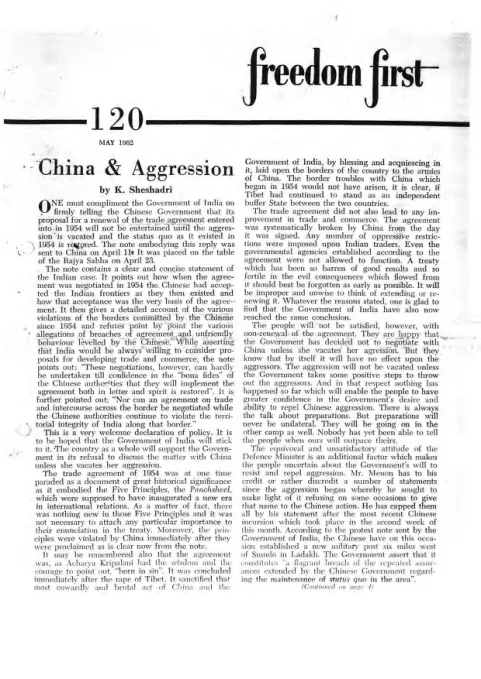
periodical issue
Freedom First
Edited by V. B. Ka[rnik?] and printed by [illegible] Printers, Gamdevi [Road], Bombay 7 and published for the Democratic Research Service by B. K. [Desai?] at 127 Mahatma Gandhi Road, Bombay 1. · Bombay · 1962
12 pages
Freedom First
Summary
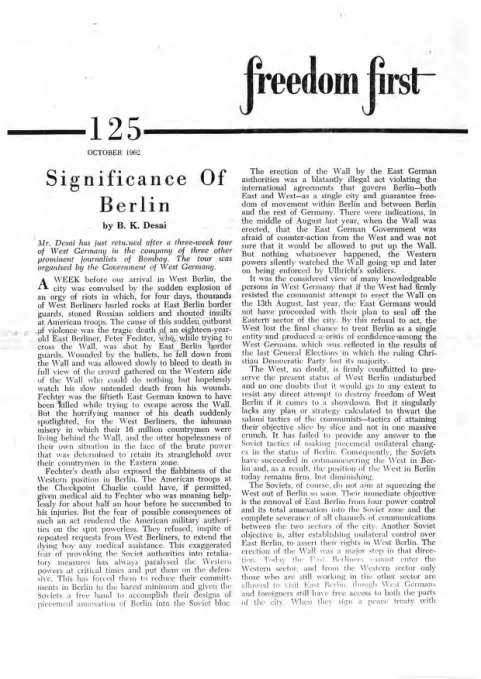
Issue No. 125 of Freedom First (October 1962) opens with B. K. Desai’s first-hand account of a West German government-sponsored tour of Berlin, using the recent shooting of Peter Fechter at the Wall to argue that the West has been too passive in the face of Soviet ‘salami tactics’ in the divided city. The unsigned ‘Notes’ section takes Prime Minister Nehru to task for treating Soviet expansionism as benign while condemning Chinese aggression, calls for a firmer China policy after the border incursions, and comments on the Sondhi/Djakarta Asian Games incident as exposing thin diplomatic friendships secured through appeasement. A report on the Liberal International’s Hague Council meeting reproduces resolutions on the EEC, South Africa, and a general liberal ‘Freedom For All’ declaration. Adam Adil surveys the disarray of pan-Arab politics after the Algeria settlement and amid Arab League disunity. M. A. Venkata Rao contrasts the pluralist, vocation-based social ethics of Indian tradition (dharma, varna) with the monolithic classlessness sought by Marxist socialism. Raman Desai reviews Milovan Djilas’s Conversations with Stalin, and Aziz Madni reviews Ram Gopal’s The Trials of Nehru. Humphrey Evans’s ‘Trade Unions In China’ argues that Chinese Communist trade unions serve the Party and international propaganda rather than workers. The issue closes with ‘With Many Voices,’ a page of press quotations on Cold War and India-China themes, and a subscription form.
Key points
-
B. K. Desai’s “Significance Of Berlin” uses the shooting of Peter Fechter at the Wall to argue the West has been too passive against Soviet “salami tactics” in the divided city.
-
Notes criticise Nehru for treating Soviet expansionism as benign while condemning Chinese aggression, and discuss the Djakarta Asian Games “Sondhi Affair.”
-
A report on the Liberal International’s Hague Council meeting reproduces resolutions on the EEC, apartheid South Africa, and a “Freedom For All” declaration rejecting appeasement of communism.
-
Adam Adil surveys the disarray of pan-Arab politics after the Algeria settlement, noting the fractured Arab League and a hopeful Saudi-Jordanian semi-union.
-
M. A. Venkata Rao’s “Tradition And Socialism” contrasts the pluralist, vocation-based ethics of Indian dharma with Marxism’s drive toward an imagined single classless society.
-
Raman Desai reviews Milovan Djilas’s “Conversations with Stalin”, recounting Stalin’s court atmosphere and Soviet economic bullying of Albania and Yugoslavia.
-
Aziz Madni reviews Ram Gopal’s “The Trials of Nehru”, documenting nine trials in which Nehru, defiant, refused to recognise British court legitimacy.
-
Humphrey Evans’s “Trade Unions In China” argues Chinese Communist unions function as instruments of Party control and foreign propaganda rather than worker advocacy.
Essays
Significance Of Berlin
By B. K. Desai
B. K. Desai, just returned from a three-week government-organised tour of West Germany with three other Bombay journalists, opens with the killing of eighteen-year-old Peter Fechter, shot while trying to cross the Berlin Wall and left to bleed to death as Western troops stood by for fear of provoking Soviet retaliation. Desai uses the episode to indict Western passivity: the Wall’s construction in August 1961 went unchallenged, and the West has since ‘failed to show sufficient daring and imagination’ even as it holds Berlin non-negotiable in principle. The essay narrates crossing into East Berlin, contrasting its ‘dead and dilapidated’ streets and expressionless populace with the prosperous, defiant mood of West Berlin, and profiles an escaped East German refugee interviewed at a rehabilitation camp. It closes by framing Berlin as a moral rather than merely political problem, and the ultimate test of whether the free world’s will to resist can hold the whole totalitarian project at bay.
- Peter Fechter, the fiftieth East German killed trying to escape, was allowed to bleed to death within view of both sides because Western troops feared provoking Soviet retaliation.
- The Wall’s 1961 construction met no Western counter-action, which the author argues emboldened further Soviet unilateral moves (‘salami tactics’).
- Soviet strategy is described as incremental annexation of East Berlin and severance of East-West communication rather than an immediate bid to expel the West.
- More than 10,000 East Germans escaped to West Berlin in the year to date despite the Wall, per the author’s visit to a refugee rehabilitation camp.
- West Berlin is described as militarily indefensible (15,000 Western troops vs. half a million Soviet-bloc troops in East Germany) yet sustained by the population’s will to resist.
- The essay closes by casting Berlin’s fate as consequential for the entire free world, not just Germany.
Arab Politics At Crossroads
By Adam Adil
This unsigned Notes section (the magazine’s recurring editorial column) covers three topics. ‘Russia and China’ criticises Nehru for calling Russia peaceful and non-expansionist while condemning Chinese expansionism, arguing that both are communist states bound by the same totalitarian logic and that Nehru only recognises aggression when it touches India directly. ‘Firm Policy’ laments the absence of a clear government policy on the India-China border crisis, quoting the Indian Express on the government’s shifting public narrative about the extent of Chinese incursions. ‘Djakarta Affair’ discusses the controversy around a Mr. Sondhi (apparently an Indian sports official at the Asian Games in Djakarta) whose principled, apolitical stance drew hostile crowds incited by Chinese propaganda, and argues the Indian government bears no responsibility for his personal treatment.
- Nehru is accused of a double standard: treating Soviet expansionism as benign while decrying Chinese expansionism, despite both being communist regimes with the same underlying totalitarian logic.
- The column argues that all communist states are bound by an ‘absolutist doctrine’ that cannot tolerate coexistence, so a peaceful, non-expansionist communist regime is a naive fiction.
- India is criticised for lacking a ‘firm China policy,’ with contradictory official statements about the scale of Chinese incursions on the northern border.
- The Djakarta Affair section defends Mr. Sondhi’s apolitical conduct at the Asian Games and blames the surrounding atmosphere of suspicion, partly stoked by Chinese agitation, for the backlash against him and, by extension, against the Government of India.
Tradition And Socialism
By M. A. Venkata Rao
A report on the Council of the Liberal International, meeting at the Hague from September 11-15, attended by liberal party leaders from Italy, Spain, India (M. R. Masani), France, Poland, Germany, the UK, Holland, Denmark, Israel, Belgium, Canada, Norway and Switzerland. The piece reproduces the text of three adopted resolutions: on the EEC as a step toward a wider democratic community and the need for continued political development alongside economic integration; a condemnation of apartheid South Africa and support for those fighting it; and a ‘Freedom For All’ declaration proclaiming liberal principles as the prerequisite for a free society, rejecting appeasement of communism, and endorsing continued military defence against totalitarian challenge pending genuine disarmament.
- The Liberal International Council met at the Hague, September 11-15, with M. R. Masani representing India among an international roster of liberal party leaders.
- Resolution I on the EEC frames European economic integration as a step toward a wider democratic world community and urges parallel political development.
- Resolution II condemns South African apartheid policy and pledges support to those working to secure the rule of law and freedoms there.
- Resolution III, ‘Freedom For All,’ asserts liberalism as prerequisite for a free, prosperous, classless society; rejects appeasement of communism as ‘an invitation to aggression’; and endorses military defence as necessary pending genuine, controlled disarmament.
- A companion memorandum on ‘Winning the Cold War’ by Liberal International Secretary-General Richard Moore is announced for publication in a future issue.
Djilas, A Unique Personality
By Raman Desai
Adam Adil surveys the disarray of Arab politics: Algeria, newly independent, has yet to consolidate its factions under Ben Bella, while the seventeen-year-old Arab League faces disintegration after a rancorous Shtura meeting marked by mutual invective between Syria and the UAR/Egypt over accusations of subversion. Amid this, King Saud of Saudi Arabia and King Hussein of Jordan have moved toward a semi-union integrating armed forces, economic policy, and trade, offering a possible model for wider Arab unity. Adil argues genuine Arab brotherhood requires a mutually agreed code of conduct barring interference in other states’ internal affairs, alongside cultural and diplomatic exchange, and flags Iraq’s claim over Kuwait as a particularly intractable sticking point unless Iraq adopts a more realistic posture.
- Algeria under Ben Bella has achieved only a partial, fragile peace among its warring internal factions after independence.
- The Arab League’s Shtura meeting exposed deep disunity, with Syria and the UAR trading accusations and insults; the League session was postponed indefinitely.
- Saudi Arabia and Jordan moved toward a semi-union integrating military and economic policy, seen as a hopeful counter-model to Arab disunity.
- The author proposes a formal code of conduct among Arab states (non-interference, arbitration of disputes) as the path to genuine unity.
- Iraq’s claim over Kuwait is singled out as a problem requiring a more realistic Iraqi attitude to resolve.
Review: The Trials of Nehru (by Ram Gopal, The Book Centre Private Ltd., Bombay 28)
By AZIZ MADNI (reviewer)
M. A. Venkata Rao argues that India’s official ideology of ‘democratic socialism’ rests on a vague ethical veneer that obscures a harder Marxist programme of class war, one-party dictatorship, and total state control over economic and mental life. He contends that Indian tradition’s own idea of dharma, while superficially resembling socialist appeals to common good, is actually pluralist: it recognises a society of distinct vocational groups (varna) each self-regulating through evolved custom, in contrast to Marxism’s drive toward an imagined single, undifferentiated classless society. Venkata Rao credits this pluralist tradition with underwriting India’s practical tolerance of religious and social difference, and warns that Marxist-style socialism, if pursued to its logical end, would require India to discard its democratic facade and its inherited ethos of toleration in favour of centralized, one-party control.
- The essay distinguishes democratic socialism’s vague ethical claims from the specific, harder Marxist doctrine of class war and one-party dictatorship that critics increasingly sense underlies government policy.
- It cites recent land legislation and Five-Year Plan state expansion into industry as evidence the public is beginning to sense the doctrine is ‘more than a set of ethical exhortations.’
- Indian tradition (dharma, svadharma, varna) is characterised as inherently pluralist — a ‘society of sub-societies’ — unlike Marxism’s monolithic vision of classlessness.
- Even Marx’s own writings, the author notes, treat self-employment as conducive to happiness and employment under others as conducive to misery, a point he uses against contemporary Marxist policy.
- The essay invokes Hegel as the philosophical source of Marx’s idea of classlessness, arguing Marx reduced it to a ‘mechanical,’ sociologically impossible one-class society.
- The author distinguishes a desirable caste-less society from an undesirable and impossible classless society.
Trade Unions In China
By Humphrey Evans
Raman Desai reviews Milovan Djilas’s Conversations with Stalin (Rupert Hart-Davis), drawing on Djilas’s memoir of three wartime and postwar missions to Moscow as a senior Yugoslav Partisan and Communist Party official. The review recounts Djilas’s disillusioning first-hand observations of Stalin’s court — its coarse late-night drinking sessions, its indifference to Red Army atrocities against Yugoslav civilians, and its readiness to browbeat smaller communist states like Albania and Yugoslavia into economically exploitative arrangements. Desai frames the book as exposing how even a devoted, philosophically serious communist like Djilas, once Tito’s number two, came to see Stalinist Russia’s behaviour as more comparable to Mughal court intrigue than to any promised ‘brotherhood of man,’ and treats this disillusionment as an implicit vindication of liberal, humanist values over communist ideology.
- Djilas travelled to Moscow three times between 1944-48 as a top Yugoslav Communist and recorded detailed encounters with Stalin and other Soviet leaders.
- The review highlights Djilas’s account of Red Army soldiers’ violence and rape in Yugoslavia being dismissed by Stalin as understandable given wartime hardship.
- Stalin’s court atmosphere is compared by the reviewer to the Mughal courts of Shah Jehan and Aurangzeb.
- The book documents Soviet economic bullying of Albania and Yugoslavia, including Stalin’s remark urging Yugoslavia to simply ‘swallow’ Albania.
- Unlike other Eastern European resistance movements that ceded control to Moscow-directed regimes, Tito and Djilas sought to adapt rather than adopt Soviet-style communism, eventually breaking with Moscow.
- The review treats the book as a document of a committed communist’s disillusionment, framing it as validating liberal and humanist critiques of Soviet communism.
Notes (Russia and China; Firm Policy; Djakarta Affair)
Aziz Madni reviews Ram Gopal’s The Trials of Nehru (The Book Centre Private Ltd., Bombay), which documents nine trials of Jawaharlal Nehru under British rule, showing him as a defiant young rebel who refused to recognise the legitimacy of British courts. Madni highlights the book’s preface by Rafiq Zakaria, which argues the trying magistrates went through proceedings mechanically toward foregone convictions, and notes the book’s account of Nehru declaring the courts a ‘farce.’ The review calls the book worthwhile as a document of the freedom struggle and the injustices of colonial judicial process, even while acknowledging the magistrates were far from British justice’s best traditions.
- Ram Gopal’s book documents nine trials in which Nehru was prosecuted under British colonial rule, drawing on court proceedings and background material.
- Nehru is shown declaring at his first trial that he did not recognise the British Government in India and treated the court proceedings as ‘a farce or show.’
- The book’s foreword by Rafiq Zakaria observes that none of the trying magistrates were judges of stature and that none decided any real point of law.
- The review notes touches of unconscious humour in the proceedings, including a magistrate’s exasperated question about whether Nehru was entitled to make ‘another seditious speech.’
- The reviewer concludes the trying magistrates’ judicial pronouncements were far removed from the best traditions of British justice, making the book a useful record of the era’s colonial judicial shortcomings.
The Voice Of World Liberalism (Council of the Liberal International, The Hague, Sept 11-15)
Humphrey Evans argues that Chinese Communist trade unions, organised under the All-China Federation of Trade Unions (ACFTU), function primarily as instruments of foreign propaganda and Communist Party control rather than as advocates for workers. He traces the ACFTU’s origins to 1920s infiltration of nascent Chinese labour organisations by Communist agents trained and directed from Moscow, the 1949 forced dissolution of independent unions after the Communist takeover, and subsequent reorganisation under Party-approved leadership. Evans notes that industrial workers form a small minority of China’s overwhelmingly agricultural labour force and that ACFTU membership, at roughly five percent of the total workforce, actually lags unionisation rates in Japan, Yugoslavia, Italy, West Germany, Britain, the USSR, and Austria, undercutting the ACFTU’s international claims to represent Chinese labour.
- Chinese Communist officials devote disproportionate attention and travel to cultivating foreign trade union contacts rather than domestic labour concerns.
- Modern Chinese labour organisations emerged in the early 1920s and were infiltrated by Communist agents trained and directed from Moscow, who gained majority leadership within unions by 1925.
- The 1949 Communist government dissolved existing independent unions and replaced them with the Party-controlled ACFTU under Soviet guidance.
- Roughly five percent of China’s total labour force belongs to ACFTU-recognised unions, a lower unionisation rate than Japan, Yugoslavia, Italy, West Germany, Britain, the USSR, or Austria.
- The ‘Common Programme’ of 1949 promised worker participation in management, minimum wages, insurance, and an eight-to-ten-hour day, but the author frames these as propaganda benefits rather than substantive gains, since independent unions were simultaneously abolished.
With Many Voices (press-quotation column)
The closing page, ‘With Many Voices,’ is a compilation of short press and public-figure quotations on Cold War topics — Soviet secrecy about space failures, U.S. reticence on the same, the Cuban missile buildup after the Bay of Pigs, the Sino-Soviet doctrinal rift, Chinese strategy on India’s northern border, and a Soviet military manual’s definition of world war — drawn from The New York Times, Time, Indian Express, The Statesman, The Hindu, Winnipeg Free Press, and a televised Kennedy interview, framed by an epigraph from Tennyson. The page also carries the magazine’s subscription form and the printer/publisher’s registration details (Registered No. B-6354; edited by M. R. Masani; published for the Democratic Research Service).
- Quotes span Soviet and U.S. secrecy about space-programme failures, the post-Bay-of-Pigs buildup of Soviet support to Castro’s Cuba, and the Sino-Soviet doctrinal rift.
- Krishna Bhatia (The Statesman) and Indian Express commentary describe China’s India border strategy as a long-planned, deviously incremental ‘grand strategy.’
- Acharya Vinoba Bhave is quoted arguing communism is ‘an antithesis and not a synthesis’ relative to a properly humane, non-dogmatic approach.
- President Kennedy is quoted, from a television programme, on the difficulty of dislodging a communist regime once it consolidates police power.
- A. Sitaramiah (The Hindu) is quoted flagging India’s persistently low national and per capita income growth over the preceding decade.
- The page includes the magazine’s subscription form and closing masthead/registration details.
Generated by the v1.5 extraction pipeline. Awaiting editorial review.
Metadata and summary are AI-extracted from the source PDF and reviewed for editorial accuracy. The original work is available via the Read PDF tab above (where present); paragraph-level citation inside the PDF is deferred to a future engagement.