periodical issue
Freedom First
By V. B. Karnik, S. Natarajan, Roman O. Zybenko, A. B. Shah, M. D. Kini, Rama Swarup Sabherwal, Kamalashanker Pandya, S. P. Aiyar
Edited by RAMAN DESAI and printed at Inland Printers, 55 Gamdevi Road, Bombay 7 and published for the Democratic Research Service by Adam Adil at 127 Mahatma Gandhi Road, Bombay 1. · Bombay · 1963
12 pages
Freedom First
Summary
Freedom First No. 132 (May 1963) is a monthly issue of the Bombay-based liberal magazine, opening with V. B. Karnik’s defence of excluding Communists from sensitive government posts in the wake of a controversial Bihar security circular, and following with S. Natarajan on the mishandling of civil-liberties questions (the Fernandes-Upadhye taxi-union detentions) by the Congress government under the Defence of India Rules. Roman O. Zybenko surveys Soviet press reports on black-market gold trading to argue that Soviet gold control has failed in practice. A. B. Shah’s essay marking Lincoln’s 154th birth anniversary reads Lincoln’s opposition to slavery as a model of principled ‘containment’ of evil applicable to India’s confrontation with Communist China. M. D. Kini reviews the 1961 CPSU programme to expose the gap between Communist rhetoric of peaceful coexistence and its retained commitment to non-parliamentary and violent methods of revolution. Rama Swarup Sabherwal warns that Ceylon, despite the poor showing of Communists at the ballot box, faces a serious risk of communist infiltration into trade unions, the civil service, and front organisations. Kamalashanker Pandya reports approvingly on a Swatantra Party by-election win at Dohad in Gujarat as a rebuke to Congress’s authoritarian drift. The issue closes with a review of A. Doak Barnett’s ‘Communist China and Asia’ (by S. P. Aiyar) and the recurring ‘With Many Voices’ column of press quotations.
Key points
-
V. B. Karnik’s “Security And Public Services” defends a Bihar circular barring Communists from rifle training, citing Britain’s 1962 Radcliffe Commission on Communist penetration of civil-service unions to argue India, now “at war with a communist Power,” should screen Communists from security-sensitive posts.
-
S. Natarajan’s “Individual Liberty And The Law” criticises the Home Ministry’s handling of the Defence of India Rules detentions of taxi-union leaders George Fernandes and Janardhan Upadhye, and Home Minister Lal Bahadur Sastri’s practice of settling civil-liberties disputes in private rather than before Parliament.
-
Roman O. Zybenko’s “Failure Of Gold Control In Russia” draws on Soviet press reports of gold-theft rings and black-market networks to argue the Soviet state’s gold monopoly is riddled with corruption despite the death penalty for currency speculation.
-
A. B. Shah’s “The Spirit Of Lincoln” reads Lincoln’s containment of slavery, and his refusal to suspend civil liberties or elections during the Civil War, as a model applicable to India’s confrontation with Communist China.
-
A piece on the 1961 CPSU programme argues that despite its rhetoric of peaceful coexistence, the programme still commits Communist parties to “all forms of struggle, peaceful and non-peaceful,” and that the Khrushchev-Mao split is tactical rather than a real break with the goal of world revolution.
-
Rama Swarup Sabherwal’s survey of Ceylon argues that despite Communists’ poor electoral record there, the real danger lies in infiltration of trade unions, the civil service and front organisations.
-
Kamalashanker Pandya’s report on the Dohad by-election credits the Swatantra Party’s tripled winning margin in Gujarat’s Dohad by-election to a broad anti-Congress alliance and rising awareness of Chinese aggression.
-
S. P. Aiyar reviews A. Doak Barnett’s “Communist China and Asia,” praising its account of Chinese strategic thinking and its argument that Peking’s 1962 attack on India aimed partly to show South-East Asia that Indian non-alignment was, in practice, aligned with the West.
Essays
Essay 1
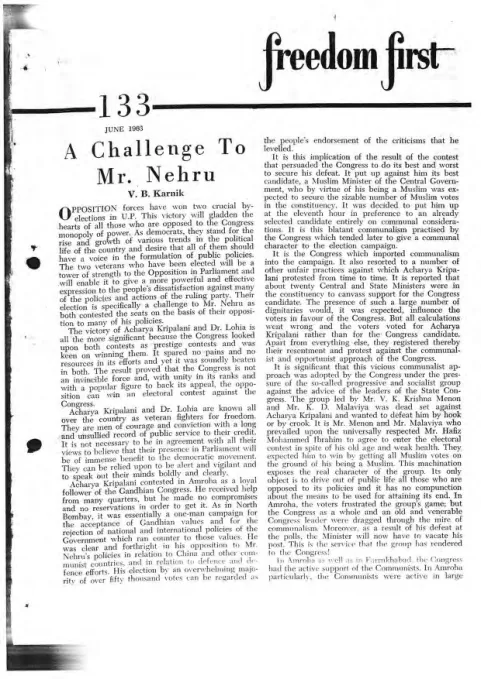
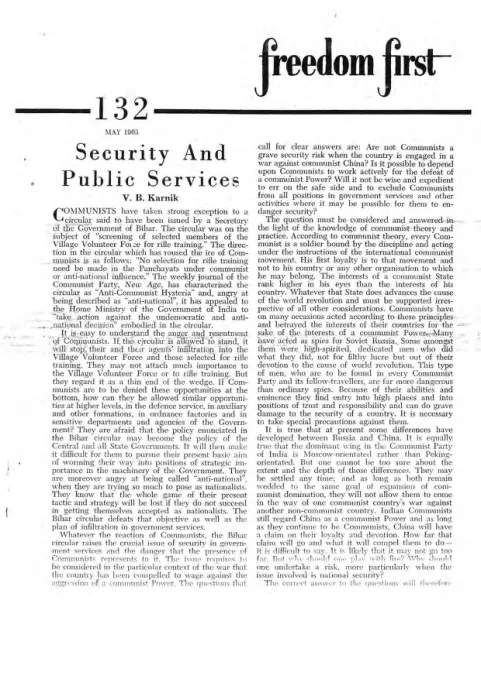
V. B. Karnik defends a Bihar government circular barring Communists from rifle training in the Village Volunteer Force, arguing that Communist Party membership itself constitutes a security risk because Communist loyalty runs to the international movement and, currently, to a hostile communist China rather than to India. He cites the 1962 Radcliffe Commission report on Britain’s civil service security, which found ‘disproportionately high’ Communist penetration of civil service unions, to argue India should adopt comparably strict screening of Communists from all security-sensitive posts now that India is ‘at war with a communist Power.’
- A Bihar government circular excluding Communist-influenced Panchayat members from rifle training for the Village Volunteer Force drew protest from the Communist Party and the CPI weekly New Age.
- Karnik argues Communist loyalty is to the international communist movement and to whichever communist state it currently favours, not to the individual’s own country.
- He invokes the 1962 Radcliffe Commission report on Britain, which found alarming Communist penetration of civil service trade unions.
- Karnik argues India, being ‘at war with a communist Power’ (China), has more reason than Britain to restrict Communists from security-sensitive posts.
- He anticipates the charge of ‘McCarthyism’ and rejects it, saying the policy applies only to posts sensitive to national security during an actual war footing.
Security And Public Services
By V. B. Karnik
S. Natarajan criticizes the Home Ministry’s handling of two civil-liberties controversies: the mysterious detention and release of three persons early in the Emergency, and the more recent arrest under the Defence of India Rules of taxi-union leaders George Fernandes and Janardhan Upadhye in Bombay. He argues that Home Minister Lal Bahadur Sastri’s practice of settling disputes in private ‘huddles’ with opposition leaders, rather than being accountable to Parliament, sets a dangerous precedent, and that Maharashtra Home Minister P. K. Savant’s vague justification of the Fernandes arrest as being ‘in the public interest’ left the matter more confused rather than clarified.
- Three persons detained early in the Emergency were released quietly, with the fact only surfacing after questions in the Lok Sabha.
- Home Minister Lal Bahadur Sastri privately resolved, rather than publicly clarified, a controversy over an alleged threat against the Prime Minister attributed to an unnamed P.S.P. politician.
- Natarajan criticizes the pattern of ministers settling public issues in private with opposition leaders rather than being answerable to Parliament as a whole.
- George Fernandes and Janardhan Upadhye, leaders of the Bombay Taximen’s Union, were detained under the Defence of India Rules on April 5, prompting a one-day taxi strike.
- Maharashtra Home Minister P. K. Savant’s public defense of the arrests, citing ‘public interest,’ is judged unpersuasive and likely to have made Fernandes a ‘martyr’.
Individual Liberty And The Law
By S. Natarajan
Roman O. Zybenko argues, drawing on articles in the Soviet press (Izvestia, Pravda Ukrainy, Radyanska Ukraina, Ekonomicheskaya gazeta), that the Soviet state’s gold monopoly is riddled with theft, smuggling, and black-market dealing despite severe laws, including the recently introduced death penalty for gold and currency speculation. He details specific cases — gold theft rings around the Ynykchan and Magadan mines, a Moscow currency-speculation network reselling stolen gold across Central Asia, and a Leningrad dealer found with a private hoard including tsarist coins and an Alexander II gold medallion — to conclude that ordinary Soviet citizens and officials alike turn to gold as a hedge given the absence of normal outlets like private property or investment.
- The USSR was the world’s second-largest gold producer (average 15 million ounces/year, 1946-1958) after South Africa.
- Soviet law requires artel (cooperative) gold miners to deliver all gold to the state, but Zybenko cites Soviet press admissions that this law is frequently violated.
- Multiple criminal cases are cited: gold theft at the Ynykchan mine near Magadan, a Moscow-based network moving stolen gold through Tashkent, Andizhan, Bukhara and Tiflis, and a Leningrad dealer, Zuikov, found with a hoard of tsarist coins, diamonds, and a gold medallion of Alexander II.
- A criminal network in Leningrad ran an electroplating workshop manufacturing fake gold ten-rouble tsarist coins.
- Zybenko attributes the black market to excess money among Soviet officials, military officers, and speculators who have no legitimate outlet (housing, cars, investment) for their earnings.
- The USSR’s introduction of the death penalty for gold/currency speculation is cited as evidence of the scale of the underlying problem.
Failure Of Gold Control In Russia
By Roman O. Zybenko
A. B. Shah, in an essay based on a February 12, 1963 speech marking the 154th anniversary of Lincoln’s birth, argues that Lincoln’s greatness lay in a clear-eyed policy of ‘containment’ rather than either isolationism or appeasement: Lincoln accepted slavery’s continued existence where it already existed under the ‘argument of necessity,’ but refused absolutely to permit its extension, trusting that ‘liberty, if not forced to contract, will, by its own nature, go on expanding’ while ‘slavery, if not allowed to expand, will… begin to contract.’ Shah extends this to contemporary India’s confrontation with Communist China, and closes by praising Lincoln’s refusal to suspend civil liberties or elections even during the Civil War, contrasting it with regimes — ancient and modern — less committed to the rule of law.
- Shah frames Lincoln’s historical significance around India’s own 20th-century choice between democracy and totalitarianism, noting India is among the few post-colonial states that chose and sustained democracy.
- Lincoln’s core insight, per Shah, was that ‘containment’ of evil (rather than ‘liberation’ or appeasement) works because liberty expands and evil contracts if evil is denied room to grow.
- Shah stresses that for Lincoln containment required willingness to make sacrifices, distinguishing it from isolationism, appeasement, or self-deception.
- Lincoln held that the ‘unalienable rights of man’ in the Declaration of Independence belonged to all people, ‘the white and the black, the yellow and the brown,’ not only white men.
- Even during the Civil War, Lincoln refused to suspend elections or civil liberties, which Shah presents as a model of principled governance under existential threat.
- Shah closes by universalizing Lincoln’s legacy beyond America, calling on ‘anyone who stands for freedom and democracy, anywhere in the world’ to claim kinship with his spirit.
The Spirit Of Lincoln
By A. B. Shah
A short satirical poem, ‘Tatar Triolet,’ mocking the Soviet leadership’s cult of Stalin-era loyalty and the theme of a beloved ruler undone by shadowy manipulation, using the triolet’s repeating refrain structure (‘Justly beloved lives our Tsar, / Our trust — alas, Rasputinized’).
- A triolet poem playing on the historical Rasputin/Tsar motif, likely as political satire of Soviet or Russian authoritarian leadership.
- Uses the traditional triolet form’s repeated refrain lines to build ironic emphasis.
A Brave New World
By M. D. Kini
M. D. Kini reviews the 1961 Communist Party of the Soviet Union programme (published with commentary by Herbert Ritvo as ‘The New Soviet Society’), arguing that despite its rhetoric of peaceful coexistence and ‘peaceful means’ of achieving socialist revolution, the programme still commits Communist parties to using ‘all forms of struggle — peaceful and non-peaceful, parliamentary and extra-parliamentary’ whenever expedient. He contends the real difference between Khrushchev and Mao is tactical rather than fundamental — over the use of nuclear weapons, not over the ultimate goal of world revolution — and dismisses the programme’s promise of material abundance by 1980 as likely to prove as unreliable as ‘pie crusts.’
- Kini defines dogmatism as ‘total commitment to a set of half-truths’ and argues Communism, despite its claims to scientific grounding, exhibits this trait through repeated ‘time-worn shibboleths.’
- The 1961 CPSU programme labels Yugoslavia ‘revisionist,’ which Kini calls hypocritical given Khrushchev’s later rapprochement with Tito.
- Despite proclaiming peaceful coexistence, the programme commits Communist parties to readiness for ‘any swift and sudden replacement of one form of struggle by another.’
- Kini argues the Khrushchev-Mao split is about tactics and the use of atomic weapons, not about the shared aim of world revolution — a ‘warning for all democrats.’
- He is skeptical of the programme’s promise that the Soviet Union will achieve material and cultural abundance for its population by 1980.
- Kini contrasts Marxism’s continued appeal in economically underdeveloped, non-democratic countries with its declining relevance in industrialized democracies where trade unionism has already delivered a fairer distribution of wealth.
Ceylon Faces Communist Challenge
By Rama Swarup Sabherwal
Rama Swarup Sabherwal surveys the state of communism in Ceylon, arguing that although the three rival Communist and Trotskyite factions there have repeatedly fared badly at the ballot box — unable to unseat the ruling Freedom Party even under a non-contest pact — the real danger lies in infiltration of trade unions, the civil service, front organisations (such as the Ceylon Democratic Lawyers’ Association and Ceylon Journalists’ Association), and a press landscape he describes as uniformly sympathetic to a ‘sameness’ of Soviet-friendly coverage. He concludes that a communist-backed military takeover is unlikely in the near term given electoral results, but warns the risk of a Czechoslovakia-style creeping takeover cannot be ruled out unless Ceylon’s right wing remains vigilant.
- Ceylon has three rival brands of Communists (Trotskyite LSSP under N. M. Perera, Trotskyite MEP under Philip Gunawardene, and the Ceylon Communist Party under S. A. Wickremesinghe) who compete on personality rather than doctrine.
- Sabherwal argues the rural Ceylonese peasantry has shown little real interest in communism, remaining tied to Buddhist and nationalist sentiment rather than Marxist ideology.
- Sabherwal suggests the left wing seized on the failed January 27 coup attempt to accuse rightists in government of plotting it, a charge he calls a ‘magic formula’ to exploit Buddhist resentment of educated elites in government posts.
- He describes Ceylon’s press as divided into only two groups that are effectively the same in orientation, with left-leaning sub-editors slipping in pro-Soviet or anti-Western material.
- The Communist Party won only four seats despite a non-contest agreement with the ruling Freedom Party under Mrs. Sirimavo Bandaranaike.
- Sabherwal identifies infiltration into trade unions, the public service, the armed forces, and international front organisations (Peace Council, International Union of Students, International Association of Democratic Lawyers) as the real communist strategy in Ceylon.
Dohad Parliamentary Bye-Election
By Kamalashanker Pandya
Kamalashanker Pandya reports on the Swatantra Party’s victory in the Dohad parliamentary by-election in Gujarat’s Panchmahals district — India’s first parliamentary by-election after the Chinese aggression and the declaration of national emergency — with the winning margin more than tripling despite a much lower turnout. He attributes the result to a broad anti-Congress alliance of PSP, Jana Sangh, and independents; the popularity of Swatantra’s local Assembly MLA, Maharaja Jaideepsinhjee of Devgarh Baria; lingering resentment from a 1960 police firing on striking government employees; and rising local awareness of the true nature of Chinese communist aggression.
- The Dohad by-election was the first parliamentary by-election in India held after the Chinese aggression and declaration of national emergency.
- The Swatantra candidate’s winning margin grew from 4,000 votes in the prior general election to over 14,000, despite turnout falling to only 37%.
- Pandya credits a grand opposition alliance (PSP, Swatantra, Jana Sangh, independents) against Congress’s perceived authoritarian drift.
- Maharaja Jaideepsinhjee of Devgarh Baria, the sitting Swatantra MLA who had won his Assembly seat with 90% of votes cast, is cited as a key local factor.
- A 1960 General Strike by Central Government employees, during which police shot five workers, is cited as having built lasting anti-Congress civil-liberties sentiment in the region.
- Pandya frames the result as a verdict against the ruling party’s foreign and domestic policies and evidence that Swatantra’s ‘Freedom First’ ideology has reached ordinary people.
Review: Communist China and Asia (by A. Doak Barnett)
By S. P. Aiyar
S. P. Aiyar reviews A. Doak Barnett’s ‘Communist China and Asia: A Challenge to American Foreign Policy’ (Vintage Books, third printing, May 1962), praising it as one of the most outstanding studies of Chinese communism’s impact on American foreign policy and on south and south-east Asia. Aiyar highlights Barnett’s account of Chinese Communist strategic thinking — indifferent to permanently ‘solving’ problems but focused on incrementally shifting the balance of power — and Barnett’s argument that Peking’s massive 1962 attack on India was intended partly to demonstrate to South-East Asia that India’s declared non-alignment was, in practice, aligned with the West.
- Barnett’s book, first published in 1960, is the product of a Council on Foreign Relations study group and remains, per Aiyar, largely valid despite subsequent developments in Sino-Indian relations.
- Aiyar quotes Barnett’s chapter on ‘The Roots of Mao’s Strategy’ describing Chinese Communist leaders as concerned with incrementally ‘enhancing their power’ rather than permanently resolving disputes.
- The review cites Mao Tse-tung’s 1949 declaration that ‘neutrality is merely a camouflage and a third road does not exist’ and the Peking Review’s December 1962 argument that India’s declared neutrality was in practice aligned with Western imperialism.
- Barnett outlines four broad U.S. policy alternatives toward China: full accommodation, a ‘liberation’ policy of all-out pressure, a policy of isolating and limiting pressure on Peking, and a ‘two-Chinas’ policy recognizing a divided China.
- Aiyar notes Barnett’s advocacy of a long-term, realistic policy aimed at building the economic and political defences of peace in underdeveloped South-East Asian countries, arguing an effective Asia policy matters more than a narrowly China-focused one.
With Many Voices
The recurring ‘With Many Voices’ column collects short quotations from contemporary press and public figures on themes of leadership, communism, civil liberties, and international affairs, framed by an epigraph from Tennyson. Quoted figures include Welles Hangen on Nehru’s indispensability, C. B. Gupta on communist attitudes toward peace, Lord Home on the true targets of communist aggression, President Kennedy on Cuba, President Sukarno on Indonesia and China, and Rajaji on the danger of leaders ‘with fixations,’ among others.
- The column is framed by an epigraph from Tennyson: ‘The deep / Moans round with many voices. Come, my friends, / ‘Tis not too late to seek a newer world.’
- Welles Hangen (Opinion) is quoted arguing Nehru’s indispensability reflects a ‘vacuum of recognition’ rather than a real vacuum of leadership.
- Lord Home, British Foreign Secretary, is quoted arguing communist aggression’s targets have mainly been unaligned nations, not SEATO members.
- President Kennedy is quoted on building ‘a wall of dedicated men’ around Cuba rather than a physical wall.
- Rajaji is quoted from Swarajya warning it is ‘dangerous for a nation to be governed by men with fixations.’
- President Sukarno is quoted equating the freedom of Indonesia with the freedom, and life, of China.
Generated by the v1.5 extraction pipeline. Awaiting editorial review.
Tatar Triolet (poem)
No summary was extracted for this article. Listed for completeness.
Metadata and summary are AI-extracted from the source PDF and reviewed for editorial accuracy. The original work is available via the Read PDF tab above (where present); paragraph-level citation inside the PDF is deferred to a future engagement.