periodical issue
Freedom First
By A. G. Mulgaonkar, G. L. Mehta, Adam Adil, N. S. Ranganath Rao, R. Srinivasan
Edited by RAMAN DESAI and printed at Jaibhau Printers, 11 Gaindeva Road, Bombay 7, and published for the Democratic Research Service, 127, Mahatma Gandhi Road, Bombay 1 · Bombay · 1963
12 pages
Freedom First
Summary
Freedom First No. 137 (October 1963) is a monthly issue of the Bombay-based classical-liberal periodical published by the Democratic Research Service. The issue leads with A. G. Mulgaonkar’s extended constitutional critique of the proposed Seventeenth Amendment, which sought to make compensation for compulsorily acquired ryotwari land non-justiciable; he frames it as a Congress-engineered evasion of judicial review following the Kerala Agrarian Relations Act being struck down by the Supreme Court, and warns of a drift toward Soviet- or Chinese-style collectivization of agriculture. G. L. Mehta contributes an edited transcript of a FICCI seminar address on the respective competencies and shortcomings of private and public enterprise. Adam Adil surveys the newly formed Federation of Malaysia’s demographics, economy, and the regional politics of Indonesian ‘confrontation.’ N. S. Ranganath Rao examines a Bombay book-importation obscenity conviction to argue that Section 292 of the Indian Penal Code wrongly dispenses with mens rea for importers. R. Srinivasan reviews Donald E. Smith’s book India as a Secular State, arguing that Indian secularism was imposed on a society that never developed secular values and that caste-based reservation policy undermines the secular ideal. The ‘Without Comment’ department reprints two press items without editorial commentary: an Organiser count debunking Communist Party claims about the size of a Delhi demonstration, and a Mainstream piece sharply critical of General B. M. Kaul’s conduct during the 1962 NEFA debacle. The issue closes with ‘With Many Voices,’ a column of quoted remarks from public figures (Nehru, Khrushchev, Mao Tse-tung, and others) presented without comment, alongside a subscription form and an editorial postscript on the Seventeenth Amendment invoking John Locke’s theory of government by consent.
Key points
-
A. G. Mulgaonkar’s lengthy critique of the “17th Amendment To The Constitution” argues it is a Congress-engineered evasion of judicial review following the Supreme Court’s striking down of the Kerala Agrarian Relations Act, warning it opens the door to Soviet- or Chinese-style agricultural collectivisation and threatens millions of ryotwari landholders.
-
G. L. Mehta’s “Private And Public Enterprise,” from a FICCI seminar address, argues both sectors have complementary strengths rooted in national character rather than inherent virtue, with the private sector teaching cost discipline and the public sector teaching social responsibility.
-
Adam Adil’s “Malaysia” surveys the newly formed Federation of Malaysia’s demographics and economy, attributing Indonesia’s “confrontation” policy against it to Chinese Communist pressure on the Indonesian Communist Party and Sukarno’s domestic political calculations.
-
N. S. Ranganath Rao’s “The Law Of Obscenity” argues a Bombay bookseller’s conviction for importing obscene books without knowledge wrongly dispensed with mens rea, and calls for a specialist board to assess obscenity before customs act.
-
R. Srinivasan’s review of Donald E. Smith’s “India as a Secular State” argues Indian government became secular before society developed secular values, citing Congress’s own communal compromises in Kerala, Rajkot and Amroha, and the unintended entrenchment of caste consciousness through reservation policy.
-
The “Without Comment” column reprints an Organiser head-count debunking Communist Party claims about a Delhi “Great March” demonstration’s size, and a Mainstream profile sharply critical of General B. M. Kaul’s conduct during the 1962 NEFA debacle.
-
The issue’s “With Many Voices” column and closing editorial postscript invoke John Locke’s theory of government by consent to argue the 17th Amendment should not pass without a clear electoral mandate.
Essays
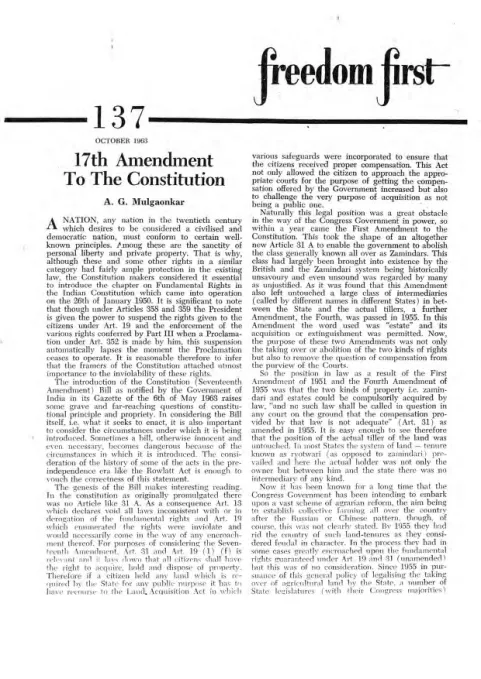
17th Amendment To The Constitution
By A. G. Mulgaonkar
A. G. Mulgaonkar lays out a detailed constitutional and political case against the proposed Seventeenth Amendment to the Constitution, gazetted on 6 May 1963. He traces the history of Articles 31 and 31A, the First Amendment (1951) and Fourth Amendment (1955), and the Supreme Court’s December 1961 ruling striking down the Kerala Agrarian Relations Act as violating Articles 14, 19, and 31 because it improperly extended the non-justiciable definition of ‘estate’ to ryotwari land. He argues the Seventeenth Amendment is a hasty Congress response designed to retroactively validate 124 similar state laws and to strip courts of the power to review compensation for the compulsory acquisition of ryotwari land. Mulgaonkar links this to the Congress Party’s 1959 Nagpur Resolution favoring collective/joint cooperative farming, comparing it unfavourably to agricultural collectivization failures in the Soviet Union and China, and warns of mass suffering among India’s landholding peasantry if such a policy is pursued. In the continuation on pages 11-12, he extends the argument to the constitutional propriety of frequent amendment under Article 368, contrasts India’s process with the British constitutional convention (citing the 1910 Asquith-George V peerages episode), and invokes John Locke’s theory that government rests on the consent of the governed to argue the Seventeenth Amendment should not be passed without a clear electoral mandate.
- The Seventeenth Amendment Bill (gazetted 6 May 1963) sought to redefine ‘estate’ in Article 31(2)(a) to include ryotwari-system land, removing judicial review of compensation adequacy.
- This followed the Supreme Court’s December 1961 decision striking down the Kerala Agrarian Relations Act (1961) as unconstitutional under Articles 14, 19, and 31.
- The First Amendment (1951) had already exempted ‘zamindari’ land and the Fourth Amendment (1955) exempted ‘estates’ from judicial review of compensation; the Seventeenth would extend this to ryotwari holdings.
- The author connects the amendment to the Congress Party’s 1959 Nagpur Resolution favoring state monopoly of foodgrains trade, land ceilings, and collective/cooperative farming.
- He cites Edward Crankshaw on the failures of Soviet and Chinese agricultural collectivization as a warning against India repeating the experiment.
- The article argues the amendment threatens to reduce millions of ryotwari landholders to penury, comparing them to Russian moujiks or Egyptian fellaheen.
- The continuation piece argues frequent constitutional amendment (sixteen amendments in twelve years) undermines the sanctity the Constituent Assembly intended for fundamental rights, and invokes Locke’s consent theory of government.
Private And Public Enterprise
By G. L. Mehta
G. L. Mehta’s piece is an edited extract of a speech delivered at a FICCI-organised seminar on ‘Problems of Private and Public Industrial Undertakings’ in New Delhi on 6 August 1963. He argues against dogmatic positions on planning, public versus private sectors, and nationalisation, insisting both sectors have complementary strengths and weaknesses shaped by shared national character rather than inherent virtue or vice. He contends the private sector can teach the public sector the discipline of cost accounting and specific objectives, while the public sector can teach the private sector a sense of social responsibility, and cites European state enterprise managers (naming Pierre Dreyfus of Renault) and a Soviet aircraft designer, O. K. Antonov, on the incentive value of profit even in state-run economies.
- Mehta criticizes treating ‘planning,’ ‘public sector,’ and ‘private sector’ as ideological dogmas rather than practical instruments.
- He argues both public and private enterprises share common organisational problems of hierarchy, initiative, and accountability rooted in national character, not sector.
- He cites Pierre Dreyfus (Renault) as an example of a state enterprise manager who insists nationalised industry must justify itself by not losing money.
- He references Khrushchev’s and Soviet aircraft designer O. K. Antonov’s remarks on the growing role of the profit motive as an efficiency indicator even in the USSR.
- He calls for institutionalising professionalism and efficiency incentives in the private sector while inculcating social responsibility in both sectors.
Malaysia
By Adam Adil
Adam Adil surveys the formation of the Federation of Malaysia (established 16 September 1963), covering the roles of Tunku Abdul Rahman, the demographic composition of the new federation (Malaya, Singapore, Sarawak, and Sabah), its economic profile (rubber and tin exports, industrialisation), and the geopolitical friction with Indonesia’s policy of ‘confrontation,’ which he attributes to Chinese Communist influence on the Indonesian Communist Party and President Sukarno’s domestic political calculations.
- The Federation of Malaysia came into existence on 16 September 1963, uniting Malaya, Singapore, Sarawak, and Sabah (formerly British North Borneo).
- Tunku Abdul Rahman is credited as the driving statesman behind Malaysia’s formation, praised by the British Prime Minister.
- The article details the ethnic balance (Malays, Chinese, Indians/Pakistanis, and tribal peoples) and Britain’s retained military bases in Singapore.
- Indonesia’s policy of ‘confrontation’ against Malaysia is attributed to Chinese Communist pressure on the Indonesian Communist Party (PKI) under Mr. Aidit and to Sukarno’s need to distract from domestic economic problems.
- Malaya is described as the world’s largest rubber producer and a major tin exporter, with Singapore as a free port and the Malaysian Constitution’s broad outlines summarised.
The Law Of Obscenity
By N. S. Ranganath Rao
N. S. Ranganath Rao analyses a Bombay case in which a book-stall proprietor was convicted under Section 292(b) of the Indian Penal Code for importing books later judged obscene, despite having no knowledge the books were obscene. He argues the court’s reasoning — that mens rea is unnecessary for the importer offence — is doubtful in light of Privy Council precedent and a contrary Calcutta High Court ruling, and that imposing strict liability on booksellers who import on customer request from reputable sources is an unreasonable restriction on trade. He recommends a specialist board of literary, legal, medical, and psychological experts to assess obscenity before customs authorities act, and calls for amendment of Section 292.
- A Bombay book-stall proprietor was convicted under IPC Section 292(b) for importing obscene books ordered by customers from a reputable foreign firm, despite no criminal knowledge.
- The author contrasts this with a Calcutta High Court ruling (C. T. Prim v. State, A.I.R. 1961 Cal. 177) holding that mens rea is required under Section 292.
- He argues absolute liability on importers, who cannot be presumed to know an unread book’s contents are obscene, unreasonably restricts trade and is of doubtful constitutional validity.
- He notes India is bound by the 1923 Geneva International Convention for the Suppression of the Circulation of and Traffic in Obscene Publications, which does not mandate absolute liability.
- He recommends a specialist multi-disciplinary board to evaluate a book’s literary and obscene character before customs authorities act, rather than leaving it to a single expert or executive officers.
Reflections On Indian Secularism
By R. Srinivasan
R. Srinivasan reviews Donald E. Smith’s India as a Secular State (Oxford University Press), reflecting on the difficulties of Indian secularism given that Indian society, unlike the state, never developed secular values and remains feudal, caste-ridden, and communal. He criticizes Congress for pandering to non-secular passions (citing its alliance with the Muslim League in Kerala and communal campaigning in Rajkot and Amroha), examines the contradiction of caste-based reservation policy within a professedly secular and egalitarian constitutional order, and questions whether personal-law reform (e.g., differing rules on Hindu versus Muslim polygamy) can be pursued evenhandedly. He praises Smith’s scholarship as the definitive work on Indian secularism and calls for empirical social-science research into how ordinary Indians actually understand secularism, so that public policy can be grounded in something more concrete than elite assumption.
- The review covers Donald E. Smith’s book India as a Secular State (OUP, 501pp + index, Rs. 30).
- Srinivasan argues Indian government became secular before Indian society developed secular values, creating a persistent gap.
- He criticizes the Congress Party’s own compromises with communal politics (Kerala alliance with the Muslim League, elections in Rajkot and Amroha).
- He discusses caste-based reservation in legislatures, colleges, and the civil service as an unintended consequence that entrenched caste consciousness rather than dissolving it, including the case of neo-Buddhist conversion by some Dalits to escape caste disability while retaining reservation benefits.
- He raises the unresolved question of uniform personal law, citing Acharya Kripalani’s demand that polygamy restrictions apply equally across religious communities.
- He calls for empirical, discipline-crossing social science research into public attitudes on secularism to guide future policy.
Without Comment (“The Great March” reprinted from Organiser; “The General Who Ran” reprinted from Mainstream, Delhi)
The ‘Without Comment’ department reprints, without editorial commentary, two press items. The first, from Organiser, recounts a special correspondent’s head-count of a Communist Party-organised demonstration (‘The Great March’) in Delhi in September 1963, showing that despite a three-month, Rs. 10 lakh campaign, the actual turnout (about 20,000, per detailed province-by-province and area-measurement calculations) fell well short of the Deputy Commissioner’s estimate and the Party’s claims, and notes unusual official facilitation of the demonstration (Talkotra Gardens tenting, government quarters for CPI leaders, loudspeakers). The second, from Mainstream, is a scathing account of Lt. Gen. B. M. Kaul’s conduct as Corps Commander during the 1962 NEFA debacle against China — his rapid, patronage-driven rise, his convenient illness during the initial Chinese onslaught, his retreat to Delhi instead of nearer field hospitals, and his subsequent quiet retirement into a well-paid private-sector posting in Japan despite the disgrace of the Se La and Bomdi La retreats.
- An Organiser correspondent’s precise count found a Communist Party ‘Great March’ demonstration in Delhi drew about 20,000 people, far below Party claims, despite an intensive three-month, Rs. 10 lakh campaign.
- Province-wise breakdown shows Punjab and U.P. supplied the bulk of demonstrators (4,215 and 5,785 respectively), with many bused in for what the piece calls a ‘free joy-ride.’
- The piece notes unusual official accommodations extended to the Communist demonstration, including government quarters for CPI leaders and use of Parliament Street loudspeakers.
- The second item is a harsh profile of General B. M. Kaul (‘Bijji’), tracing his rapid promotion under a ‘dynamic Defence Minister’ to Chief of the General Staff and then Corps Commander at the McMahon Line without prior combat command experience.
- It criticizes Kaul for reportedly falling ill with bronchitis at the start of the Chinese offensive, retreating to Delhi rather than nearer hospitals, and for the disorderly retreat at Se La and Bomdi La, followed by his quiet transition to a lucrative private-sector post in Japan.
With Many Voices
The closing ‘With Many Voices’ column collects brief quoted remarks, without editorial comment, from a range of contemporary figures including Nehru, Khrushchev, Mao Tse-tung, Averell Harriman, and others on subjects from Sino-Soviet relations to Communist tactics, alongside the magazine’s subscription form and a concluding editorial note that continues the Seventeenth Amendment argument, invoking John Locke’s theories of government by consent and warning Congress that future parties could similarly exploit an easy amendment process.
- The column juxtaposes quotations from Nehru, Khrushchev, Mao Tse-tung, Liu Shao-chi, Averell Harriman, and Indian commentators (Richard S. Childs, K. Rangaswami, H. V. Kamath, Nath Pai) on democracy, communism, and international relations.
- Mao Tse-tung and Khrushchev quotes emphasize Communism as an instrument of struggle rather than sentiment or love.
- Nehru is quoted acknowledging difficulty keeping pace with a changing world, and separately on Sino-Soviet ideological rivalry giving way to national interest.
- The page includes a Freedom First subscription form (annual subscription Rs. 3.00) addressed to Democratic Research Service, 127 Mahatma Gandhi Road, Bombay 1.
- The editorial postscript to the Seventeenth Amendment piece invokes John Locke’s constitutional theory of government by consent to argue that major constitutional changes require electoral sanction, and warns Congress that a future party could exploit the same easy amendment process against it.
Generated by the v1.5 extraction pipeline. Awaiting editorial review.
Metadata and summary are AI-extracted from the source PDF and reviewed for editorial accuracy. The original work is available via the Read PDF tab above (where present); paragraph-level citation inside the PDF is deferred to a future engagement.