periodical issue
Freedom First
By M. R. Pai
Edited by [name illegible] and printed at Jaico Printers, 35 Gamdevi Road, Bombay 7 and published for the Democratic Research Service by Adam Aqil at 127 Mahatma Gandhi Road, Bombay 1. · Bombay · 1963
12 pages
Freedom First
Summary
Issue 138 of Freedom First (November 1963) is a multi-contributor political and economic commentary magazine published from Bombay by the Democratic Research Service. In the rendered pages it carries six pieces: S. Natarajan’s lead essay questioning the Press Consultative Committee’s wartime-style press-restriction machinery amid an undeclared ‘emergency’; A. G. Mulgaonkar’s analysis of Lord Denning’s Profumo-affair inquiry report and its lessons for handling administrative-probity complaints in India; M. R. Pai’s critique of India’s ‘steel first’ industrial planning strategy as a costly diversion from agriculture and consumer goods; V. B. Karnik’s defence of the proposed Seventeenth Constitutional Amendment against an earlier critique by Mulgaonkar, arguing it validates existing state agrarian-reform laws rather than introducing collectivisation; Madhu Limaye’s rebuttal to Karnik’s account of the Bombay civic (municipal) workers’ strike, defending the strike’s conduct and blaming the state government’s partisanship; and an unsigned ‘From a Correspondent’ report on Formosa (Taiwan), assessing Nationalist Chinese guerrilla operations against the mainland and the Cold War calculus of a possible Nationalist-Communist civil war. The issue closes with ‘With Many Voices,’ a compiled column of press and public-figure quotations on contemporary affairs, plus a subscription coupon. The volume’s argumentative centre is classical-liberal scepticism of state power — whether exercised over the press, industrial planning, land, or labour disputes — paired with running commentary on international communism (Soviet and Chinese).
Key points
-
S. Natarajan’s “The Press and The Emergency” argues the wartime-era Press Consultative Committee code, revived amid an undeclared ‘emergency,’ conscripts editors into suppressing information the government deems prejudicial, and calls for relaxing rather than tightening press restrictions.
-
A. G. Mulgaonkar’s “The Denning Report And India” uses Lord Denning’s Profumo inquiry to propose that Indian Presidents and Governors be empowered to receive affidavit-based corruption complaints referred to sitting judges, rejecting both a Swedish Ombudsman and a Russian Procurator-General model as unsuited to India.
-
M. R. Pai’s “‘Sacred’ Steel?” argues India’s ‘steel first’ planning priority, copied from Soviet practice under P. C. Mahalanobis, is economically wasteful given Hindustan Steel’s massive cost overruns and losses, and calls for redirecting investment to agriculture and consumer goods.
-
V. B. Karnik’s “The Seventeenth Amendment” rebuts Mulgaonkar’s collectivisation fears from an earlier issue, showing the 124 Acts the amendment validates are popularly-mandated tenancy-reform and land-ceiling laws, not Soviet-style collective farming.
-
Madhu Limaye’s “The Civic Strike: Another View” rebuts Karnik’s account of the Bombay municipal strike, blaming the Maharashtra government’s refusal to negotiate and mass arrests for escalating the dispute, and disputing Karnik’s verdict that the strike was a failure.
-
An unsigned dispatch, “Formosa Today,” assesses Nationalist Chinese guerrilla operations against the mainland following the Great Leap Forward’s agricultural collapse, and warns that a Nationalist-Communist civil war risks drawing in Soviet intervention rather than restoring Chiang Kai-shek.
Essays
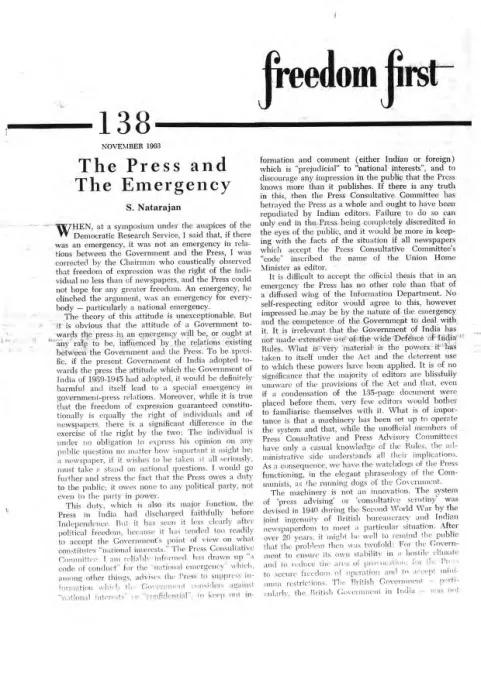
The Press and The Emergency
By S. Natarajan
S. Natarajan argues that what is being called a government-press ‘emergency’ in late 1963 is in fact a one-sided imposition on the press by the Government of India, exercised through the Press Consultative Committee’s ‘code of conduct’ devised in 1940 under the wartime British administration for very different purposes. He contends the code obliges editors to suppress information the Government deems prejudicial to ‘national interests,’ effectively conscripting the press into the Information Department, and warns that continuing this wartime machinery in peacetime democratic conditions threatens editorial independence. He calls for relaxing rather than tightening information and press laws, including dropping the constitutional amendment to Article 19 concerning ‘friendly relations with foreign States.’
- The ‘emergency’ invoked to justify press restrictions is not a government-press emergency but treated by government as a general national one.
- The Press Consultative Committee’s code, devised in 1940 during WWII, has been revived to restrict rather than enlarge press freedom.
- The code compels suppression of information branded ‘prejudicial to national interests’ or ‘confidential.’
- Very few editors are aware of the 135-page Defence of India Rules document underlying the restrictions.
- Natarajan calls the emergency one of ‘governmental inability to know its own mind’ and urges relaxation, not tightening, of press laws.
- He recommends dropping the constitutional amendment to Article 19 concerning ‘friendly relations with foreign States.‘
The Denning Report And India
By A. G. Mulgaonkar
A. G. Mulgaonkar examines Lord Denning’s report on the Profumo affair, praising the candour of witnesses before the inquiry and using it as a springboard to consider how India should handle rising complaints of administrative and ministerial impropriety. He weighs the Denning-style single-judge private inquiry against India’s Commission of Inquiry Act (1952), noting Indian tribunals (such as the one probing the Mundhra-LIC deal, chaired by M. C. Chagla) have been hampered by uncooperative witnesses. He rejects both a Swedish-style Ombudsman (unworkable given India’s scale) and a Russian-style Procurator-General (unsuited to a democracy), instead proposing that the President and State Governors be empowered to receive affidavit-based, legally accountable complaints referred to sitting judges for a prima facie determination before any public inquiry is held.
- Denning inquiry into the Profumo affair is praised for extracting unusually candid testimony without subpoenas.
- Truth-telling before Indian inquiry tribunals (e.g., the Mundhra-LIC inquiry before Chagla) has been comparatively poor.
- Mulgaonkar surveys British inquiry forms: Royal Commissions, Parliamentary Committees, Judicial Commissions, Tribunals of Inquiry (since 1921).
- India’s Commission of Inquiry Act (1952) mirrors the English Tribunals of Inquiry Act 1921 but its rules were not gazetted until 1960.
- He rejects a Swedish Ombudsman model (India too vast) and a Russian Procurator-General model (unsuited to democracy).
- He proposes empowering the President and Governors to receive affidavit-based complaints referred to a judge for a prima facie ruling before a public inquiry.
”Sacred” Steel?
By M. R. Pai
M. R. Pai argues that steel and heavy industry have become an unquestioned fetish in Indian planning circles, displacing the sacred cow as the object of uncritical reverence, when the historical pattern of industrialisation shows agriculture must be developed first to create the consumer demand that justifies heavy industry. He points to the Soviet Union’s neglect of agriculture and consumer goods — and its resulting need to import grain from capitalist countries — as a cautionary model that India has copied via the Second and Third Plans (drawn up on Soviet lines under P. C. Mahalanobis’s influence). Citing cost overruns and losses at Hindustan Steel’s three plants, comparative output/employment figures favouring agriculture and consumer goods, and shortages of ordinary consumer items despite the steel programme, Pai concludes India’s ‘steel first’ priority is economically wasteful, technologically premature, and socially unjust to the unorganised masses who go without basic amenities like drinking water.
- Steel/heavy industry has replaced the sacred cow as India’s untouchable article of faith, per Pai.
- Historical industrialisation pattern requires agriculture to be developed first to generate consumer demand.
- Soviet Russia’s neglect of agriculture for heavy industry forced it to import grain from the US, Canada and Australia despite Khrushchev’s earlier boasts.
- Hindustan Steel’s three plants cost Rs. 698 crores (against an original estimate of Rs. 353 crores) and incurred Rs. 61.5 crores in losses by March 1963.
- A crore of rupees invested in agriculture yields far more jobs (4,000) than the same investment in heavy industry (500), per the cited output/jobs table.
- China’s backyard-furnace steel drive is cited as an even more extreme failure of the same ‘steel first’ logic.
- Pai calls for consolidating existing steel capacity and redirecting investment to agriculture, consumer goods and basic rural amenities like drinking water.
The Seventeenth Amendment
By V. B. Karnik
V. B. Karnik responds to A. G. Mulgaonkar’s earlier attack (in the previous issue) on the proposed Seventeenth Constitutional Amendment, arguing that Mulgaonkar’s fear of collectivisation is misplaced. Karnik reviews the 124 state Acts the Amendment seeks to validate, showing them to be tenancy-reform and land-ceiling measures — passed by elected state legislatures since 1948 and endorsed through three subsequent general elections — rather than instruments of Soviet- or Chinese-style collective farming. He rebuts Mulgaonkar’s invocation of Locke’s defence of private property and sovereign self-government, arguing that fair compensation, not an absolute veto via ‘sanctity of property’ or justiciability, is the legitimate concern, and that the Amendment merely closes a legal loophole (the restrictive judicial definition of ‘estate’) threatening to void these popularly-mandated reforms.
- Karnik shares Mulgaonkar’s opposition to actual collective farming but denies the Seventeenth Amendment enables it.
- The 124 Acts under the Amendment’s schedule are agrarian-reform laws: abolishing feudal tenures, protecting tenant rights, imposing land ceilings, and redistributing surplus land.
- These Acts were passed by elected legislatures since 1948 and survived three general elections without any party campaigning for their repeal.
- Karnik argues private property is a useful institution but not sacrosanct, even in the United States, and that fair compensation — not a justiciable absolute right — is the correct standard.
- He turns Mulgaonkar’s own Locke quotation back on him, arguing the Amendment enables the people to govern themselves for the common good as Locke prescribed.
- The Amendment’s necessity stems from a restrictive judicial definition of “estate” threatening to strike down existing reform laws on a technicality.
The Civic Strike: Another View
By Madhu Limaye
Madhu Limaye rebuts V. B. Karnik’s September Freedom First article on the Bombay civic (municipal) workers’ strike, defending the strike’s origins and conduct. Limaye, who says he helped conceive the wider 20 August token general strike over the cost-of-living index dispute, dearness allowance and CDS, argues the state government — not the union — escalated the dispute into a political confrontation by refusing to negotiate, banning meetings and processions under the Defence of India Rules, and arresting over 1,700 workers. He disputes Karnik’s claim that the strike was a ‘colossal failure,’ crediting the workers’ discipline and the supporting actions of BEST, taxi and dock workers with forcing the Central government to rein in the Maharashtra state administration, and accuses Karnik of hypocrisy for having helped found the anti-Communist Bambai Mazdoor Sangharsha Samiti while now condemning others for political motives.
- Limaye says the 20 August token general strike, including the civic workers’ 25% D.A. demand, was conceived by his colleagues and himself as a mass protest against the index fraud, CDS and cost of living.
- He blames the Maharashtra state government and Chief Minister Y. B. Chavan for surrendering to local reactionary and INTUC interests and escalating the dispute politically.
- Union claimed 1,700-plus workers were arrested and the government banned processions and meetings under the Defence of India Rules.
- Limaye disputes attendance figures, claiming Municipal Commissioner reports of only 15% strike participation were fabricated and unverified.
- He argues the strike’s outcome was a hollow victory for the government, which had to retrace its steps after Central Ministers intervened.
- He accuses Karnik of inconsistency, noting Karnik’s own role in founding the Bambai Mazdoor Sangharsha Samiti to isolate Communists.
Formosa Today
By From a Correspondent
An unsigned dispatch ‘From a Correspondent’ assesses the Nationalist Chinese (Taiwanese) goal of reconquering mainland China, arguing it is more credible than outside observers assume. Drawing on reports of factory dismantlement, official Communist warnings about Nationalist ‘restoration’ activity, widespread rural and military discontent following the Great Leap Forward’s agricultural collapse (1958-62), and the strategic use of the Quemoy and Matsu island groups as guerrilla and psychological-warfare bases, the piece describes an active but uncoordinated Nationalist guerrilla network on the mainland and weighs the geopolitical risk that a Nationalist-Communist civil war could draw in both Washington and Moscow, potentially strengthening the Soviet Union’s hand against Mao’s regime rather than restoring Chiang Kai-shek.
- Communist China’s own warnings against Nationalist ‘restoration’ activity and factory dismantlement in coastal provinces are cited as evidence Peking takes the Nationalist threat seriously.
- Rural and military discontent is traced to the Great Leap Forward’s agricultural collapse of 1958-59 and 1960-62, though 1962 food output reportedly rose 8-10% over 1961.
- Quemoy (Kinmen, over 50 sq. miles, 51,000 people) and Matsu (10 sq. miles, 13,000 people) are described as key guerrilla and propaganda bases blockading the deep-water ports of Amoy and Foochow.
- Nationalist forces are estimated at six lakh troops versus a Communist standing army of about 2.6 million.
- The Nationalists claim thousands of active mainland commandos and effective control of some mainland areas, including contact with Khampa guerrillas in Tibet.
- The piece assesses that a Nationalist-Communist civil war risks Soviet intervention to install a pliant replacement for Mao rather than benefiting Chiang, complicating US support for the Nationalists.
With Many Voices
No summary was extracted for this article. Listed for completeness.
Generated by the v1.5 extraction pipeline. Awaiting editorial review.
Metadata and summary are AI-extracted from the source PDF and reviewed for editorial accuracy. The original work is available via the Read PDF tab above (where present); paragraph-level citation inside the PDF is deferred to a future engagement.