periodical issue
Freedom First
By K. Santhanam
Edited by RAMAN DESAI and printed at Inland Printers, 55 Gamdevi Road, Bombay 7 and published for the Democratic Research Service by Adam Adil at 127 Mahatma Gandhi Road, Bombay 1. · Bombay · 1964
12 pages
Freedom First
Summary
Freedom First No. 140 (January 1964) is a monthly issue of the Bombay classical-liberal periodical published by the Democratic Research Service. Its centerpiece is M. R. Masani’s Lok Sabha speech excoriating the mid-term appraisal of the Third Five Year Plan as a record of “abject failure” across food output, industrial production, and employment, and calling for the Plan to be scrapped in favour of a consumer-driven mixed economy. The issue is rounded out by shorter pieces on rural poverty and debt (Raman Desai), a critique of Indian obscenity law derived from the Hicklin test (N. S. Ranganatha Rao), a survey of Nehru’s faltering political and economic authority in the wake of the Chinese invasion and the Kamaraj Plan (“Atreya”), a warning about the 17th Constitutional Amendment’s effect on peasant proprietors (Arvind A. Deshpande), a reprinted newspaper column against the drift toward nationalization (K. Santhanam), a review of A. G. Noorani’s book on Indian complacency toward China, and the regular “With Many Voices” column of quoted public statements.
Key points
-
M. R. Masani’s Lok Sabha speech on the “Mid-term Appraisal of the Third Plan” quotes the government’s own admissions of shortfalls in national income, foodgrains and steel output, calls the Plan an “abject failure,” and proposes scrapping it for a consumer-driven mixed economy grounded in Gandhi’s talisman of testing policy against its benefit to “the poorest and weakest man.”
-
Raman Desai’s “Planning And The Poorest” argues the Planning Commission is merely an advisory body controlled by the Cabinet, and cites government data showing 64% of agricultural labour households were in debt by 1956-57, mostly to relatives and moneylenders rather than cooperatives.
-
N. S. Ranganatha Rao’s “The Law Of Obscenity” traces India’s obscenity law to the flawed English Hicklin test, faulting it for ignoring authorial intent and judging works by isolated passages, and calls for English-style reform admitting literary-merit evidence.
-
Writing as “Atreya,” “The Travails Of Mr. Nehru” surveys Nehru’s weakened standing after the Chinese invasion, describing the Kamaraj Plan as a failed “tail-dropping” tactic and accusing Nehru of opportunistically criticising the bureaucratic planning apparatus he himself built.
-
Arvind A. Deshpande’s piece on “The Constitution (17th Amendment) Bill” warns it will render the peasant proprietor class “almost legally extinct,” paralleling Article 6 of the Soviet constitution, and predicts a further amendment extending state land claims to industrial and residential property.
-
K. Santhanam’s reprinted “Without Comment” column warns against the “dangerous craze of nationalization” spreading across food, banking and transport, attributing much of the push to Communist strategy aimed at eliminating the independent middle class.
-
A review (signed V.B.K.) of A. G. Noorani’s “Our Credulity and Ignorance” summarises Noorani’s argument that Nehru’s government was credulous toward China from 1950 to 1959, first through appeasement over Tibet and then through personal reliance on Chou En-lai.
-
The closing “With Many Voices” column quotes Justice Brandeis warning that liberty’s greatest danger lies in “insidious encroachment by men of zeal,” and Dr. Lohia contrasting the pay of officers and labourers at the Rourkela Steel Factory.
Essays
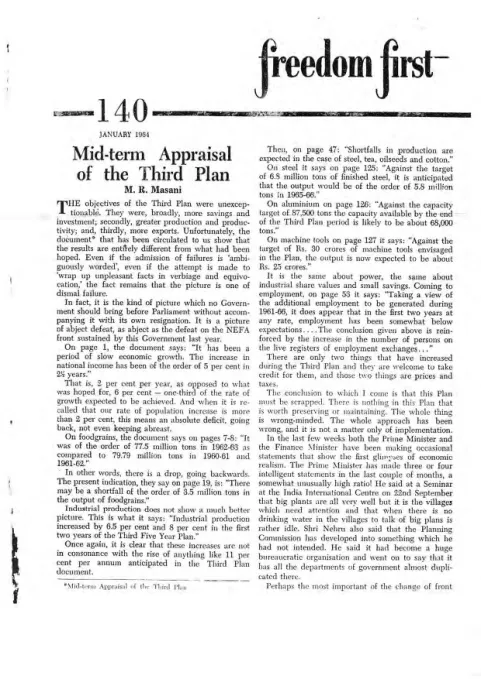
Mid-term Appraisal of the Third Plan
By M. R. Masani
M. R. Masani’s reprinted Lok Sabha speech (delivered 5 December 1963) dissects the government’s own mid-term appraisal document on the Third Five Year Plan, quoting its admissions of shortfalls in national income growth, foodgrains, steel, aluminium, machine tools, power, and employment. He argues the only things that have genuinely risen are prices and taxes, and concludes the Plan is fundamentally wrong-headed and should be scrapped rather than merely better implemented. He proposes an alternative built on Gandhiji’s talisman of testing policy against its benefit to “the poorest and weakest man,” invoking stark consumption-inequality statistics (the poorest 10% living on 27.5 paise a day) and urging a shift from state-capitalist, bureaucratic planning toward a mixed economy driven by consumer sovereignty. He cites John Kenneth Galbraith’s recent remarks in Bombay warning that overemphasis on savings and growth rates can reduce well-being in the short run, and points to the West German Social Democratic Party’s 1963 abandonment of economic planning as a precedent for what he wants Indian socialists to emulate.
- The government’s own mid-term appraisal admits national income grew only ~2% per year against a 6% target, with foodgrains, steel, aluminium, and machine tool output all falling short of Plan targets.
- Masani argues prices and taxes are the only things that rose as promised during the Third Plan.
- He calls for scrapping the Plan entirely, not merely revising its implementation, describing it as a picture of ‘abject failure’ comparable to the NEFA defeat.
- He invokes Gandhiji’s talisman — testing every policy against its effect on ‘the poorest and weakest man’ — as the standard by which the government should be judged.
- Cites stark consumption data: the poorest 10% of India’s population consume 27.5 paise a day, the richest 5% consume Rs. 2.37 a day.
- Proposes an alternative of ending ‘State Capitalist’ monopoly, restoring consumer sovereignty, and confining the state to infrastructure while private enterprise handles production.
- Quotes Galbraith’s warning (delivered in Bombay) that undue emphasis on savings and growth rate ‘can be dangerous policy’ if it reduces the well-being of the average person in the short run.
- Points to the West German Social Democratic Party’s 1963 Essen conference, where it renounced ‘economic planning’ and its Marxist manifesto, as a model of the socialist evolution Masani wants India’s socialists to follow.
Planning And The Poorest
By Raman Desai
Raman Desai argues that the Planning Commission is not an independent body but an advisory committee wholly controlled by the Prime Minister and Cabinet, making Nehru’s occasional expressions of surprise at its failures disingenuous. He introduces and endorses Masani’s mid-term appraisal speech, then presents his own statistics on rural poverty drawn from the government publication India 1963: as of 1956-57, 64% of agricultural labour households were in debt (up from 45% in 1950-51), with average debt nearly doubling from Rs. 47 to Rs. 88, and only 1% of loans coming from cooperatives versus 44% from relatives and 34% from moneylenders. He closes by invoking Tagore’s poem ‘Here Rest Thy Feet, among the Poorest and the Lowliest and the Lost’ as fitting these landless labourers.
- Argues the Planning Commission is not independent but an advisory body effectively controlled by the Prime Minister and Cabinet, making its ‘objective’ pronouncements a form of theatre.
- Cites India 1963 government data: 64% of agricultural labour households were indebted in 1956-57 versus 45% in 1950-51, with average debt rising from Rs. 47 to Rs. 88.
- Reports that of total agricultural debt, only 1% came from cooperatives, 44% from relatives, and 34% from moneylenders.
- Estimates 3.3 crore agricultural labourers (1.8 crore men, 1.2 crore women, 30 lakh children) as of 1956-57.
- Frames the piece as an introduction endorsing Masani’s mid-term appraisal speech printed elsewhere in the same issue.
The Law Of Obscenity
By N. S. Ranganatha Rao
N. S. Ranganatha Rao surveys the law of obscenity in India, arguing it inherited the flawed Hicklin test from English law (whether matter tends ‘to deprave and corrupt those whose minds are open to such immoral influences’) without adaptation to a more liberal era. He identifies several defects: the test ignores the author’s intent or purpose, judges works by isolated passages rather than as a whole, imposes an unrealistically low standard (a hypothetical ‘well brought up school girl of fourteen’), and creates near-strict liability for publishers and sellers regardless of knowledge or intent. He argues the object of obscenity law should be to suppress pornography, not censor literature, and that Indian courts should be allowed to weigh expert and literary opinion evidence on a work’s merit, as English law began doing under its 1959 Obscene Publications Act.
- Traces India’s obscenity law (IPC Sections 292-293) to the Hicklin test from English case law, adopted without adaptation to changed social standards.
- Faults the Hicklin test for ignoring the author’s or creator’s intent (mens rea), unlike most punishable criminal offences.
- Criticizes Indian courts for judging obscenity by isolated words or passages rather than a work’s entirety.
- Notes the test’s implied standard — safety for a ‘well brought up school girl of fourteen’ — is unrealistically restrictive and judge-dependent.
- Describes near-strict liability imposed on publishers, sellers, and importers regardless of their knowledge of a work’s alleged obscenity.
- Points to England’s Obscene Publications Act, 1959 as a model that made authorial purpose a relevant legal factor.
- Calls for Indian courts to admit expert and literary-merit evidence more freely, and promises a follow-up piece proposing specific reforms.
The Travails Of Mr. Nehru
By “Atreya”
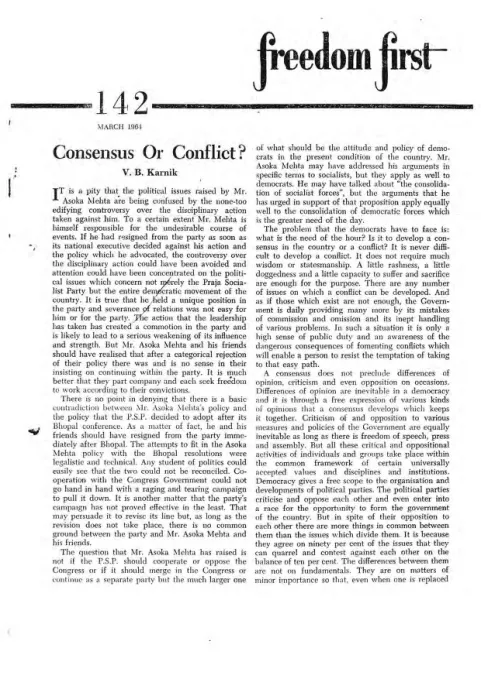
Writing under the pen name ‘Atreya,’ the author surveys Prime Minister Nehru’s weakened political and economic standing after the 1962 Chinese invasion, arguing the war exposed problems in party management, the Kamaraj Plan, and economic policy that had long been masked by Nehru’s personal authority. The Kamaraj Plan is depicted as a ‘tail-dropping’ tactic that failed to end factionalism within Congress state units. On economic policy, the author accuses Nehru of belatedly and opportunistically criticizing the very ‘bigness’ obsession and bureaucratic Planning Commission that he himself built, in order to steal ‘rightist’ rhetorical ground. The piece closes on Nehru’s handling of the Goa merger question and a controversial party resolution on religious conversion pushed through at an unusual 1 p.m. sitting, which the author reads as a sign of Nehru bowing to leftist pressure within Congress and losing his customary self-assurance.
- Argues the Chinese invasion of 1962 opened up a ‘Pandora’s box’ of pre-existing problems in India that Nehru’s personal authority had previously kept concealed.
- Frames the Kamaraj Plan as a ‘tail-dropping’ survival tactic (like a lizard shedding its tail) that failed to resolve intra-Congress factionalism in Gujarat, U.P., Madhya Pradesh, and Punjab.
- Accuses Nehru of opportunistically adopting ‘rightist’ criticisms of bureaucracy and bigness in planning that he himself was responsible for institutionalizing via the Planning Commission.
- Describes Nehru’s handling of the Goa-Maharashtra merger question as inconsistent and reminiscent of his earlier reversal on linguistic state reorganization.
- Reports that Nehru forced through a Congress Parliamentary Party resolution on the conversion issue at an unusual 1 p.m. sitting to appease ‘Progressive Socialist’ elements, calling it a dangerous precedent of overriding majority views by brute force of his position.
The Constitution (17th Amendment) Bill
By Arvind A. Deshpande
Arvind A. Deshpande warns that the Constitution (17th Amendment) Bill, by redefining ‘estate’ to cover ryotwari agricultural land and validating state land-ceiling legislation, will make the peasant proprietor class ‘almost legally extinct’ and bring India close to Article 6 of the Soviet constitution treating land as state property. He objects that the amendment permits deprivation of property without compensation or judicial examination, and predicts a further 18th Amendment extending ‘estate’ to cover industrial and residential land. He argues land ceilings will not solve landlessness (since the real problem is distribution, not the existence of large holdings) and that the amendment reflects a wrong-headed pursuit of ‘social justice’ that will neither help the landless nor increase agricultural production, while damaging farmers’ individuality, security, and incentive to invest.
- Argues the 17th Amendment’s redefinition of ‘estate’ to include ryotwari land will render the peasant proprietor class ‘almost legally extinct’ and parallels Article 6 of the USSR constitution.
- Warns of an anticipated 18th Amendment further extending ‘estate’ to industrial and residential land, effectively nationalizing all land.
- Objects that the amendment permits deprivation of property without compensation or judicial review, eroding constitutional sanctity and the rule of law.
- Contends that a former Chief Minister admitted the landless problem is not solved merely by imposing land ceilings, since it is a matter of land distribution and ownership concentration among the electorate’s landowning majority, not aggregate land availability.
- Argues that increasing production requires larger holdings, technical education, and free flow of capital and know-how — conditions ceilings actively undermine — and criticizes the ‘compartmentalisation’ of agriculture from industry.
- Predicts land ceiling laws applied to sugar-factory-held farmland will create ill-conceived ‘State Farms’ without addressing the true drivers of low productivity.
- Concludes that the amendment reflects a false sense of values, waging war on the wealth of a few prosperous farmers rather than on the poverty of the many.
Without Comment: The Dangerous Craze of Nationalization
By K. Santhanam
In this ‘Without Comment’ reprint from the Hindustan Times (24 December), K. Santhanam warns against the ‘dangerous craze’ of nationalization spreading across food and price policy, banking, and transport, driven partly by Communists seeking to eliminate the middle class and capture political power through landless labourers and nationalized-industry workers. He distinguishes nationalization from legitimate public participation via state agencies or cooperatives, and warns that unchecked nationalization concentrates monopoly power in an unaccountable bureaucracy, ultimately threatening to end in either Communist or Fascist totalitarianism.
- Identifies a growing demand for nationalization of food and grain trade, banking and credit, and road/rail transport as a ‘dangerous craze.’
- Attributes much of the push to Communist strategy aimed at eliminating the independent middle class and building political power via landless labourers and nationalized-sector workers.
- Notes with concern that many Congressmen, including MPs, support these demands without grasping their implications.
- Distinguishes nationalization from legitimate public participation in the economy via state agencies or cooperative societies, arguing the latter is often necessary and justified.
- Warns that nationalization concentrates monopoly power in an unaccountable bureaucracy and, if extended too far, risks ending in either Communist or Fascist totalitarianism.
Review: Our Credulity and Ignorance (on A. G. Noorani’s book)
By V.B.K.
This review, signed ‘V.B.K.,’ covers A. G. Noorani’s book Our Credulity and Ignorance (Ramdas G. Bhatkal, Bombay, Rs. 3), sponsored by Indians for Victory. The reviewer summarizes Noorani’s argument that Nehru and his government were credulous toward China between 1950 and 1959 — first hoping to avert Chinese claims through appeasement over Tibet, then relying on Nehru’s personal rapport with Chou En-lai — leaving India without an adequate policy when the 1962 conflict erupted. The reviewer credits the book with useful documentation via speeches and writings but notes it does not cover post-conflict developments such as the Colombo Proposals or the return of Indian forces to the McMahon Line.
- Reviews A. G. Noorani’s book Our Credulity and Ignorance, published by Ramdas G. Bhatkal, priced Rs. 3, sponsored by Indians for Victory.
- Cites Dr. Radhakrishnan’s post-front-visit remark that ‘our credulity and our negligence’ were responsible for China’s success, which gives the book its title theme.
- Summarizes Noorani’s periodization: 1950-54 spent trying to avert Chinese claims by appeasement over Tibet; 1954-59 Nehru relying on his personal relationship with Chou En-lai; both approaches leaving India without an adequate policy by the time of the 1962 conflict.
- Notes the book is essentially a threaded collection of Prime Ministerial and other official statements illustrating the ill-advised and harmful China policy.
- Points out the book’s limits: it does not address the Colombo Proposals or the return of Indian forces to the McMahon Line, matters left ‘beyond the purview’ of Noorani’s account.
With Many Voices
‘With Many Voices’ is the issue’s recurring column of quoted public statements from politicians, judges, and commentators, framed by an epigraph from Tennyson. Quoted figures include Home Minister Nanda on corruption, Dr. Lohia on wage disparities at the Rourkela Steel Factory, Prime Minister Nehru on self-reliant society and on China not quitting ‘of her own,’ Justice Brandeis on liberty’s greatest danger being encroachment by well-meaning zealots, Dr. K. M. Munshi, Albert Schweitzer, and an exchange in the House on the propriety of remarking on ‘a lady’s looks.’ The final column runs into an adjacent, partially cut-off feature titled ’…Bl… Its…’ whose content is not recoverable from the rendered page.
- Column collects short quotations from named public figures published in various newspapers during November-December 1963.
- Home Minister Nanda is quoted twice on the extent and perception of corruption in India.
- Dr. Lohia is quoted contrasting the roughly Rs. 20 lakh monthly pay of about a thousand officers at Rourkela Steel Factory against the roughly Rs. 30 lakh received by over thirty thousand labourers.
- Justice Brandeis is quoted warning that liberty’s greatest danger lies in ‘insidious encroachment by men of zeal, well meaning but without understanding.’
- Prime Minister Nehru is quoted on wanting a society where ‘each person looked after himself’ and, separately, asserting China ‘will not quit of her own.’
- The final page is a two-column layout whose right-hand column bleeds into a differently-titled item (visible fragment: ‘With Many Voices’ / ‘Bl…Its…’) that is cut off in the rendered scan and cannot be summarized.
Generated by the v1.5 extraction pipeline. Awaiting editorial review.
Metadata and summary are AI-extracted from the source PDF and reviewed for editorial accuracy. The original work is available via the Read PDF tab above (where present); paragraph-level citation inside the PDF is deferred to a future engagement.