periodical issue
Freedom First
By M. R. Pai
Printed at Inland Printers, 55 Gamdevi Road, Bombay 7 and Edited and published for the Democratic Research Service by V. B. Karnik at 127 Mahatma Gandhi Road, Bombay 1. · Bombay · 1969
12 pages
Freedom First
Summary
Freedom First issue 203 (April 1969) is a slim, twelve-page number of the Bombay-based classical-liberal monthly, opening with an extract from M. R. Masani’s Lok Sabha budget speech attacking the Finance Minister’s fertiliser and petrol taxes for punishing peasants and the urban lower middle class, and closing with a page of quoted press opinion (“With Many Voices”) plus the magazine’s subscription form. Between these, the issue’s editorial centre of gravity is the collapse of Ayub Khan’s regime in Pakistan and martial law under Yahya Khan (Adam Adil’s “Pakistan In Turmoil”), read alongside M. R. Pai’s essay on the internal threats facing Indian democracy (communist subversion, majoritarian constitutional amendment, inflation, civic apathy) and R. Muthuswamy’s roundup of Cold War flashpoints in Berlin, the Sino-Soviet border, and the Middle East. An unsigned “Notes” page criticises the Government of India’s appointment of S. S. Dhawan as Governor of West Bengal given his pro-Communist sympathies, and separately warns that Congress’s factionalism could cost it its position as the country’s dominant party. The issue also reprints, via the AFL-CIO Free Trade Union News and the Czechoslovak Writers’ Union weekly Literarni Listy, a harrowing extract from Josefa Slansky’s memoir of her husband Rudolf Slansky’s 1952 Prague purge trial and her family’s subsequent persecution — presented as a document of communist terror rather than an Indian-politics piece.
Key points
-
M. R. Masani’s “Plea for Courage and Sanity,” an extract from a Parliament budget speech, invokes Gandhi’s “talisman” test to attack fertiliser and petrol excise duties as hitting peasants and the urban poor, and calls Bokaro a “white elephant” while urging cuts to defence and non-plan expenditure.
-
Two unsigned “Notes” condemn the appointment of S. S. Dhawan, a documented pro-Communist sympathiser, as Governor of West Bengal, and warn that Congress’s factionalism could cost it its position as India’s dominant party.
-
Adam Adil’s “Pakistan In Turmoil” traces Ayub Khan’s fall and the imposition of martial law under Yahya Khan to regional resentments and East Bengal’s estrangement, concluding the opposition that displaced Ayub is more conservative and anti-Indian than his own regime.
-
M. R. Pai’s “Crisis In Indian Democracy” identifies four threats to Indian democracy — communist subversion, parliamentary amendment of fundamental rights, inflation from communist-style planning, and civic apathy — warning that easy constitutional amendment risks a Hitler-style path to totalitarianism.
-
R. Muthuswamy surveys simultaneous Cold War flashpoints in Berlin, the Sino-Soviet border at Damansky/Chen Pao island, and the Middle East as a single “tension belt” driven by Big Power politics.
-
Josefa Slansky’s reprinted memoir extract recounts her husband Rudolf Slansky’s arrest the night of a farewell dinner before his 1952 Prague purge trial, and her own years of forced factory labour and stonewalling by Soviet-bloc officials over promised restitution.
-
The closing “With Many Voices” page quotes Andre Malraux’s remark that both Nehru and Mao told him they had no successor, and Vinoba Bhave’s view that parliamentary democracy has not failed in India.
Essays
Plea for Courage and Sanity
By M. R. Masani, M.P.
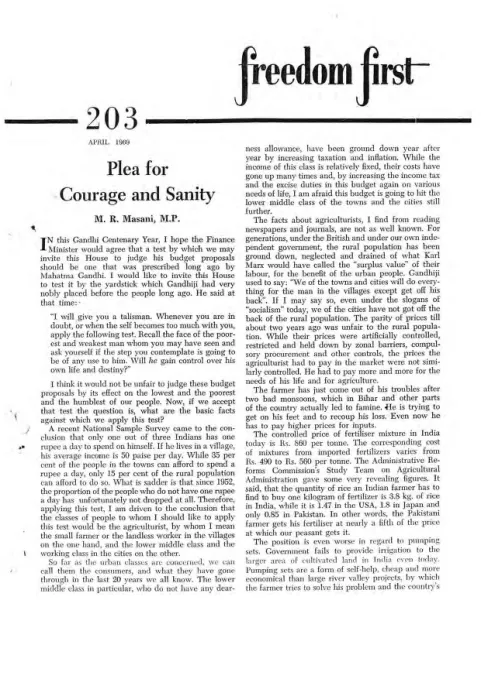
An extract from a Parliament speech by M. R. Masani, M.P., invoking Gandhi’s “talisman” test to judge the Finance Minister’s budget by its effect on the poorest. Masani argues that peasants and the urban lower middle class have borne the brunt of inflation and taxation, citing National Sample Survey data on rural poverty, comparative fertiliser prices in India versus Pakistan, Japan and the USA, and new excise duties on fertiliser and pumping sets. He criticises the Planning Commission’s continuing sway over the Finance Minister, disputes government claims that the Fourth Plan shifts emphasis to agriculture (citing Plan-outlay percentages), and identifies a continuous fall in the domestic savings ratio as the budget’s central failure, closing with an attack on defence and non-plan expenditure (Bokaro is named a “white elephant”) and a call for courage in cutting wasteful spending.
- Invokes Gandhi’s ‘talisman’ test (recall the poorest and weakest man) as the yardstick for judging the budget
- Cites a National Sample Survey finding that only one in three Indians has one rupee a day to spend, worse in villages
- Argues fertiliser and pumping-set excise duties are ‘wicked’ and hit peasants just recovering from two bad monsoons
- Compares Indian fertiliser costs (3.8 kg rice per kg fertiliser) unfavourably to USA (1.47), Japan (1.8) and Pakistan (0.85)
- Disputes the claimed Plan-era shift of outlay toward agriculture using Third and Fourth Plan percentage figures
- Identifies falling domestic savings ratio (10% in 1965-66 to 8% in 1967-68) as the budget’s core unaddressed problem
- Calls Bokaro a ‘white elephant’ costing Rs. 170 crores and argues Rs. 100 crores could be cut from defence without weakening it
Notes (Unwise and Irresponsible / Will Congress Survive?)
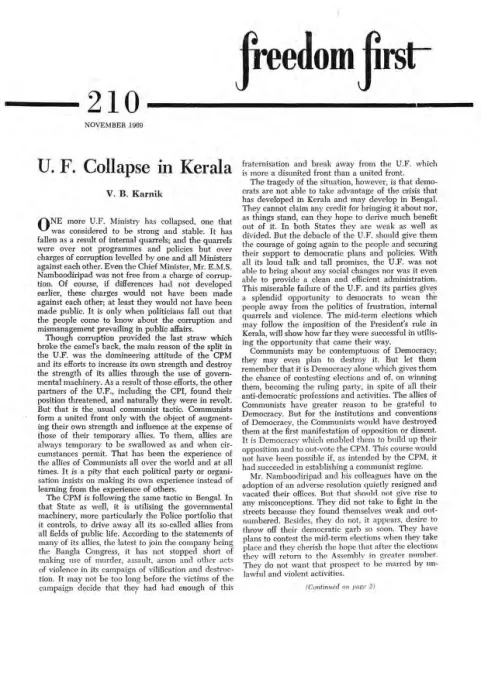
Two unsigned editorial notes. ‘Unwise and Irresponsible’ condemns the Government of India’s appointment of S. S. Dhawan as Governor of West Bengal, detailing his history as a fellow-traveller of the Communists (pseudonymous pro-Soviet, pro-Chinese writings as ‘Sanjay’ in National Herald, including a 1950 defense of the Chinese invasion of Tibet) and arguing he cannot be trusted to check the Communist-led United Front government of Bengal impartially; it frames the appointment as either poor judgement or a dangerous appeasement of the United Front. ‘Will Congress Survive?’ warns that Congress’s internal faction-fighting, at a moment when opposition parties are uniting against it, threatens its survival as a national force unless it abandons its claim to a political monopoly and seeks alliances with parties and groups closest to it.
- Criticises the appointment of S. S. Dhawan as Governor of Bengal given his documented pro-Communist sympathies
- Quotes Dhawan’s 1950 ‘Sanjay’ column in National Herald defending China’s invasion of Tibet as baseless propaganda
- Frames the appointment as appeasement of the Communist-led United Front government in Bengal
- Warns that Congress’s factionalism and mudslinging could cost it its position as premier national party
- Urges Congress to abandon claims to political monopoly and seek open alliances with sympathetic parties
Pakistan In Turmoil
By Adam Adil
Adam Adil surveys the political collapse that led to Ayub Khan’s resignation and the imposition of martial law under General Yahya Khan. The piece traces regional resentments across West Pakistan (Sindhis, Punjabis, Baluchis, Peshawaris), the deepening estrangement of East Bengal from a West Pakistan that took a disproportionate share of investment and administrative power despite East Bengal’s larger population and export earnings, and the rise of secessionist and autonomist sentiment there. It credits Zulfikar Ali Bhutto and Maulana Bhashani with fomenting anti-Ayub agitation from opposite ends (pro-Western versus pro-Chinese), notes Bhutto’s belligerent statements toward India over Kashmir, and concludes that while Ayub’s concessions (releasing Sheikh Mujibur Rehman, dropping the Agartala case) came too late, the opposition that has displaced him is more conservative, less liberal and more anti-Indian than Ayub’s own regime, leaving Pakistan’s turmoil deepened rather than resolved.
- Traces the fall of Ayub Khan’s ten-year rule to combined regional (Sindhi/Punjabi/Baluchi/Pashtun), student, and opposition-party agitation
- Describes East Bengal’s resentment at receiving a smaller share of investment and administrative/military posts despite its larger population (56:44 ratio) and export earnings
- Credits the Democratic Action Committee opposition front and figures like Bhutto and Bhashani (pro-Chinese) for driving anti-Ayub agitation
- Notes Bhutto’s threat to wage war against India ‘for a thousand years’ and his line to Swaran Singh, ‘Let Sardarji know that I am coming again’
- Concludes the successor opposition forces are more conservative, less liberal and more anti-Indian than Ayub’s government
- Ends by warning martial law under Yahya Khan will control law and order but not resolve political or economic grievances
Crisis In Indian Democracy
By M. R. Pai
M. R. Pai lays out the defining features of democracy (rule of law, guaranteed freedoms, limits on governmental power, mechanisms for peaceful transfer of power) and credits India’s constitutional founders and public good sense for the Republic’s survival since 1950. He then identifies four threats to Indian democracy: subversion by communist parties, which he argues are weak in ideology, dependent on foreign communist powers, hostile to freedoms, and organised to monopolise state power; well-meaning but misguided moves to let Parliament amend fundamental rights, which he says would open the door to totalitarianism (citing Hitler’s Enabling Act as precedent); inflation, blamed on communist-style planning and the misuse of the government’s money-supply monopoly; and civic apathy among the educated who abdicate public responsibilities to professional politicians. He closes with three reasons democracy must be made to succeed in India and calls for faith and determination among believers in liberal democracy.
- Defines four essential features of real democracy: rule of law, guaranteed freedoms, limits on state power, and peaceful transfer of power
- Credits India’s constitution and public good sense for the Republic’s survival since 1950 despite many new democracies collapsing
- Identifies communist parties as a major threat, arguing all such parties are weak in ideology, dependent on foreign communist backers, and organised as minority conspiracies to monopolise state power
- Warns that amending fundamental rights via ordinary parliamentary majority (not a people’s constituent assembly or referendum) risks a Hitler-style path to totalitarianism
- Blames the previous 13 years of inflation on communist-inspired planning and the government’s monopoly over money supply
- Criticises ‘death-wish for dictatorship’ sentiment among the intelligentsia favouring an ‘enlightened’ or ‘benevolent’ dictatorship, arguing no such thing exists
- Cites Sir Pherozshah Mehta’s line ‘we cannot import people’ against the view that Indians are unfit for democracy
Books Received
R. Muthuswamy surveys simultaneous Cold War flashpoints as a single ‘tension belt’ spanning Europe and Asia: the Soviet/East German blockade tactics around the West Berlin electoral college convened to elect West Germany’s president, timed opposite Viet Cong escalation in Vietnam as parallel tests of President Nixon’s resolve; the Sino-Soviet border clashes at Damansky/Chen Pao island on the Ussuri River and the diplomatic confrontation that followed; and Israel’s raid on Beirut airport and the Suez Zone artillery exchanges following Israeli reprisals and settlement construction in occupied territories, alongside continued mid-East crisis efforts by the ‘Big Four.’ The piece treats Pakistan’s internal turmoil as a distinct, purely domestic crisis, setting up the article that follows.
- Frames Berlin, Suez, Pakistan and China tensions as forming a single ‘tension belt’ driven by Big Power politics
- Describes Soviet/East German blockade tactics around the West Berlin presidential electoral college, resolved without incident
- Notes the coincidental timing of Viet Cong escalation in Vietnam with the Berlin crisis, both seen as tests of Nixon’s resolve
- Covers the Sino-Soviet clashes on Damansky/Chen Pao island on the Ussuri river and resulting diplomatic protests
- Details Israel’s Beirut airport raid, the Zurich airport commando attack on an Israeli plane, and Suez Zone artillery exchanges
- Distinguishes Pakistan’s crisis as an internal turmoil rather than part of the Big Power tension belt
Tensions In Europe And Asia
By R. Muthuswamy
A reprinted memoir extract by Josefa Slansky, widow of Rudolf Slansky, the former Czechoslovak Communist Party general secretary executed with ten co-defendants after the antisemitic 1952 Prague purge trial. Sourced via the Czechoslovak Writers’ Union weekly Literarni Listy and syndicated by the AFL-CIO Free Trade Union News, the excerpt recounts a farewell dinner at Premier Zapotocky’s the night before Klement Gottwald’s birthday in November 1951, followed by Rudolf’s arrest at their home that same night, and then a second extract describing Josefa’s internment, forced factory labour, and a 1953 audience with Deputy Premier Vaclav Kopecky in which she was patronised, promised restitution that never materialised, and left without a Prague apartment or work permit from December 1953 until 1958.
- Introductory framing establishes the Prague trial (Nov 20-27, 1952) in which 11 of 14 defendants, all high Communist dignitaries, were sentenced to death and hanged on Dec 3, 1952
- Notes the trial’s distinctive antisemitic character: 11 of 14 defendants’ indictments specified they were ‘of Jewish origin,’ intended as a stepping stone to a similar purge of Soviet Jews
- Describes a farewell dinner at Premier Zapotocky’s for departing Soviet economic advisors on the eve of Gottwald’s 55th birthday, shortly before Rudolf Slansky’s arrest
- Recounts the arrest itself: armed men lined the walls of their home as Rudolf was pressed against a partition, immediately after the dinner
- Describes Josefa’s subsequent internment, interrogation in Ruzyne jail, and years of forced factory labour near Ostrava
- Details a 1953 meeting with Deputy Premier Vaclav Kopecky, who called her ‘Little Starling,’ promised money and an apartment, then reneged, leaving her without housing or a work permit for over four years
Report On My Husband
By Josefa Slansky
The closing page, titled ‘With Many Voices’ after a Tennyson epigraph, is a compilation of short quoted opinions from the Indian and international press on the Pakistan crisis, the Berlin blockade, Sino-Soviet tensions, and Indian party politics, drawn from sources including Time, the Economist, Hindustan Times, Swarajya, Janata, Current, and remarks by Andre Malraux, Vinoba Bhave, and P. Govinda Menon. The page also carries the magazine’s registration notice, a subscription coupon (annual subscription Rs. 5.00) addressed to the Democratic Research Service, and the printer’s imprint naming V. B. Karnik as editor and publisher.
- Compiles short press quotations on Pakistan’s crisis, Berlin, Sino-Soviet border tensions, and Indian party politics
- Includes Andre Malraux’s remark that both Nehru and Mao told him they had no successor
- Includes Vinoba Bhave’s view that parliamentary democracy has not failed in India
- Carries the Freedom First subscription coupon (Rs. 5.00 annual) addressed to the Democratic Research Service, 127 Mahatma Gandhi Road, Bombay
- Names V. B. Karnik as editor/publisher and Inland Printers, Gamdevi Road, Bombay, as the printer
Generated by the v1.5 extraction pipeline. Awaiting editorial review.
Metadata and summary are AI-extracted from the source PDF and reviewed for editorial accuracy. The original work is available via the Read PDF tab above (where present); paragraph-level citation inside the PDF is deferred to a future engagement.