periodical issue
Freedom First
By M. R. Pai
Printed at Inland Printers, 55 Gamdevi Road, Bombay 7 and Edited and published for the Democratic Research Service by V. B. Karnik at 127 Mahatma Gandhi Road, Bombay 1. · Bombay · 1969
12 pages
Freedom First
Summary
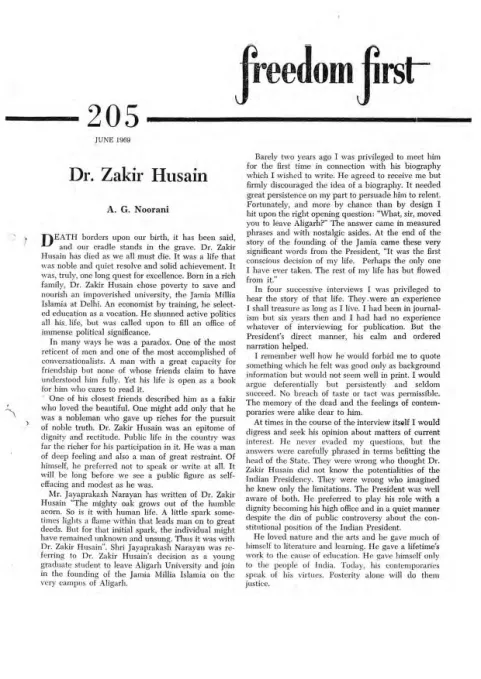
Freedom First issue 205 (June 1969) opens with A. G. Noorani’s tribute to Dr. Zakir Husain, the President of India who died in office, and moves through a run of political commentary characteristic of the magazine’s classical-liberal, anti-Congress-planning stance. M. R. Pai surveys India’s uneasy relationship with Nepal amid Chinese pressure, alongside a boxed obituary for the jurist Purshottam Trikamdas. S. R. Mohan Das profiles Harold Wilson’s fight to discipline Britain’s trade unions through an Industrial Relations Bill. M. R. Masani, in extracts from a Parliament speech, delivers a scathing critique of India’s draft Fourth Five Year Plan as unrealistic, unambitious, and a vindication of Swatantra Party warnings against state enterprise. Gafoor reviews Shriman Narayan’s edited volume of letters between Gandhi, Nehru, and Vinoba, using the correspondence to expose Nehru’s private irritation with pro-American and pro-Communist currents alike. R. Muthuswamy examines the fractured Indian left following V. K. Krishna Menon’s Midnapore win, and A. E. Smith surveys left-wing subversion within British university politics. The issue closes with ‘With Many Voices,’ a compiled column of quotations from the Indian and international press on Mrs. Gandhi, the Congress Party, and contemporary politics.
Key points
-
A. G. Noorani’s tribute to the recently deceased President Dr. Zakir Husain recalls his choice of academic vocation and self-effacing public service over inherited wealth, and Jayaprakash Narayan’s comparison of Husain’s rise to an oak grown from an acorn.
-
M. R. Pai’s “India And Nepal” argues India neglected relations with Nepal under Nehru, credits Lal Bahadur Shastri with recognising its strategic importance as a buffer against China, and warns that a Chinese-built road could open Nepal to Chinese influence.
-
S. R. Mohan Das’s “Harold Wilson’s Heartbreaks” praises the British Prime Minister for risking his own popularity to push an Industrial Relations Bill regulating collective bargaining, comparing his stance to Stafford Cripps’s earlier imposition of post-war austerity.
-
M. R. Masani’s “A Miserable Plan,” extracted from a Parliament speech, demolishes India’s draft Fourth Five Year Plan as built on unrealistic growth targets, and names P. C. Mahalanobis, Pitambar Pant, V. K. R. V. Rao and D. R. Gadgil as planners who will be remembered for having “destroyed the economic future” of the country.
-
Gafoor reviews Shriman Narayan’s edited Letters from Gandhi Nehru Vinoba, highlighting a 1955 Nehru letter attacking Freedom First as American-organised and linked to M. R. Masani.
-
R. Muthuswamy’s “The Mirage Of Leftist Unity” argues V. K. Krishna Menon’s Midnapore win does not signal genuine prospects for leftist unity, given the deep fragmentation between Communist and Socialist traditions and open clashes within the Kerala and West Bengal United Front ministries.
-
A. E. Smith’s “Subversion In British Universities” describes well-organised New Left and Trotskyist campaigns within British universities, including disrupted meetings addressed by Denis Healey and Enoch Powell.
Essays
Dr. Zakir Husain
By A. G. Noorani
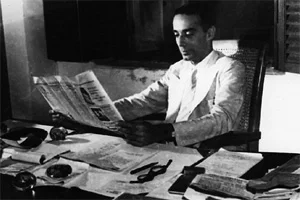
A. G. Noorani’s tribute to the recently deceased President Dr. Zakir Husain describes him as a man of quiet resolve who chose an academic vocation and self-effacing public service over the comforts of a wealthy upbringing, leaving Aligarh to help found the Jamia Millia Islamia. Noorani, who interviewed Husain four times for a planned biography, recalls his careful, restrained manner in conversation and his insistence that only material fit for print be quoted, alongside praise from Jayaprakash Narayan comparing Husain’s humble origins to an oak grown from an acorn.
- Dr. Zakir Husain, President of India, died shortly before this issue; the piece is a personal tribute by A. G. Noorani.
- Husain came from a wealthy family but chose poverty and academic service, leaving Aligarh to help found Jamia Millia Islamia.
- Noorani interviewed Husain four times in preparation for a planned biography Husain had initially discouraged.
- Husain is described as reticent yet an accomplished conversationalist, dignified and restrained even under public controversy.
- Jayaprakash Narayan is quoted comparing Husain’s rise from humble beginnings to an oak growing from an acorn.
India And Nepal
By M. R. Pai
M. R. Pai argues that India neglected its relationship with Nepal during the Nehru years, when foreign policy attention was consumed by great-power concerns, and that Lal Bahadur Shastri was the first to recognize Nepal’s importance as a buffer against China. The piece surveys King Mahendra’s consolidation of a non-partisan panchayat system after abolishing party politics, competing Soviet, American, and Chinese interest in Nepal, and simmering trade disputes, including allegations that Nepal is used as a smuggling conduit into India. Pai concludes that India must handle ties with Nepal carefully given shared religious and educational links and the risk of Chinese influence spreading via a planned international highway and the Chinese-built Kodari road. The section also carries a boxed tribute to the late jurist Purshottam Trikamdas, an ‘eminent lawyer and jurist’ and close friend of Freedom First, who took a prominent part in exposing Chinese conduct in Tibet.
- Nehru-era foreign policy neglected Nepal and other South Asian neighbours in favour of great-power concerns.
- Lal Bahadur Shastri is credited with first recognizing the strategic importance of good relations with Nepal.
- King Mahendra abolished party politics in Nepal in favour of indirect elections through village panchayats.
- The USSR, USA, and Communist China are all described as vying for influence in Nepal.
- A trade dispute (smuggling of stainless steel and synthetic fabrics) and a border dispute (the Susta affair) strain Indo-Nepalese relations.
- Pai warns that a planned international highway and the Chinese-built Kodari road could open Nepal to bypass India or to Chinese influence.
- A boxed obituary honours Purshottam Trikamdas, jurist and ‘dear and steadfast friend of Freedom First,’ for his work exposing Chinese actions in Tibet.
Harold Wilson’s Heartbreaks
By S. R. Mohan Das
S. R. Mohan Das praises Harold Wilson for risking his own popularity to push Britain’s Industrial Relations Bill, which would create a permanent Commission on Industrial Relations under George Woodcock to regulate collective bargaining and curb unofficial strikes, with conciliation periods modelled on the US Taft-Hartley Act. The piece details opposition to the Bill from within Wilson’s own party and the TUC, including Ray Gunther’s resignation and criticism from Michael Foot and other Labour militants, while noting the Conservatives are likely to abstain to watch Labour’s internal divisions play out. Mohan Das frames Wilson’s willingness to alienate his own base as evidence of statesmanship, comparing him to Stafford Cripps’s earlier imposition of painful but necessary austerity on Britain’s post-war economy.
- Harold Wilson’s Industrial Relations Bill would create a statutory Commission on Industrial Relations, headed by George Woodcock, to regulate bargaining and union recognition.
- The Bill allows penalties for unions that pressure employers, and can order strikers back to work for a 28-day conciliation period modelled on the US Taft-Hartley Act’s cooling-off provisions.
- Ray Gunther resigned as Minister for Labour rather than support the reform; Michael Foot and other Labour militants oppose Wilson.
- Barbara Castle proposes ploughing back strike-breach levies into a workers’ welfare and safety research fund.
- The Conservatives are expected to abstain on the Bill to watch Labour’s internal rifts play out rather than oppose it outright.
- Mohan Das compares Wilson’s political risk-taking to Stafford Cripps’s earlier imposition of austerity, arguing Wilson could still be vindicated even if his party loses power.
A Miserable Plan
By M. R. Masani, M.P.
In extracts from a Parliament speech, M. R. Masani, M.P., delivers a point-by-point demolition of India’s draft Fourth Five Year Plan, calling it a ‘contemptible petty Plan’ built on unrealistic targets for national income growth, birth-rate decline, agricultural output, and exports, and arguing the promised ‘shift to agriculture’ does not appear in the Plan’s own allocation tables. He attacks continued reliance on state enterprise and licence-permit controls, quoting Nirad Chaudhuri’s charge that much of the Indian intelligentsia are unproductive ‘parasites,’ and names the economists and planners he holds responsible — P. C. Mahalanobis, Pitambar Pant, V. K. R. V. Rao, and D. R. Gadgil — as men who will be remembered for having ‘destroyed the economic future’ of the country.
- Masani rejects the Plan’s excuses of ‘two wars and two droughts’ as inadequate explanation for planning failures.
- He disputes optimistic targets for national income growth (5.5%), birth-rate decline, agricultural growth (5% per annum), and export growth (7%) as unfounded.
- He argues the Plan’s own figures show no real shift in allocation from industry to agriculture despite claims of a new priority.
- State enterprises are criticized as ‘notorious laggards’ expected to generate Rs. 1,730 crores despite yielding only Rs. 435 crores in the Third Plan.
- Masani singles out P. C. Mahalanobis, Pitambar Pant, V. K. R. V. Rao, and D. R. Gadgil as planners who will be remembered for having harmed India’s economic prospects.
From The Great To A Great
By Gafoor
Gafoor reviews Shriman Narayan’s edited volume ‘Letters from Gandhi Nehru Vinoba,’ questioning the editorial fairness of the selection but praising the correspondence for revealing candid private exchanges. The review highlights a 1955 letter in which Nehru warns Narayan about the American-organised Indian Committee for Cultural Freedom and its ties to Freedom First and to P.S.P. figures including M. R. Masani, followed later by a shift in which Nehru instead worries about Ford and Rockefeller Foundation influence over Indian economic research, and about Jayaprakash Narayan’s own criticism of the Second Five Year Plan’s authors as men ‘from behind the Iron Curtain.’ Gafoor concludes that Narayan’s book does not deliver the promised ‘flood of light’ on its subjects’ character but does offer revealing glimpses of political manoeuvring worth remembering.
- The reviewed book collects letters between Shriman Narayan and Gandhi, Nehru, and Vinoba, described by its author as illuminating the ‘life and thought’ of these three leaders.
- Gafoor criticizes the book’s selective and sometimes one-sided editorial choices, noting some replies are omitted while others’ letters are excerpted without matching context.
- A 1955 Nehru letter attacks Freedom First as an American-organised publication linked to the Indian Committee for Cultural Freedom, naming M. R. Masani as a prominent member.
- Nehru later grew equally suspicious of Ford and Rockefeller Foundation funding of Indian economic research as ideologically biased toward private enterprise.
- Jayaprakash Narayan is quoted as having said the authors of Nehru’s Second Five Year Plan were ‘all men from behind the Iron Curtain.’
- Gandhiji is quoted praising Shriman Narayan’s character in two personal letters reproduced in the volume.
The Mirage Of Leftist Unity
By R. Muthuswamy
R. Muthuswamy examines whether V. K. Krishna Menon’s Midnapore win, backed by a coalition of leftist parties, signals genuine prospects for leftist unity in India, and concludes it does not. He surveys a leftist camp deeply fragmented between Communist and Socialist traditions, further split by Naxalite, Marxist-Leninist, and Right Communist factions, and describes internal crises within the United Front ministries of Kerala and West Bengal, where Marxist, Right Communist, and Revolutionary Socialist constituents openly clash. Muthuswamy concludes that leftist unity talk is ‘merely wishful thinking’ given personal rivalries between leaders and the absence of ideological discipline across the fragmented parties.
- V. K. Krishna Menon’s Midnapore win as an ultra-left candidate revived hopes of a unified socialist party, but Muthuswamy argues conditions do not support it.
- The leftist camp remains split between Communist and Socialist traditions with ‘no possibility of reconciliation.’
- Kanu Sanyal formed a new Communist Party (Marxist-Leninist) after a break with the Marxists; T. Nagi Reddi formed a rival Co-ordinating Committee.
- United Front ministries in Kerala and West Bengal show internal splits, including a near-collapse of the Kerala ministry and open clashes between Revolutionary Socialists and Marxists at Alipurduar.
- Muthuswamy concludes leftist unity is ‘a mirage,’ with parties organized around individual leader loyalty rather than ideology.
Subversion In British Universities
By A. E. Smith
A. E. Smith argues that British universities, while not facing outright anarcho-communist takeover, are nonetheless targets of well-organised and well-financed subversive campaigns rooted in New Left, Marcusean, and Trotskyist currents. He describes Communist Party efforts to cultivate cadres within universities, the disproportionate influence of Trotskyist groups within the National Association of Labour Student Organisations, and militant tactics of shouting down or physically confronting opposing speakers, including incidents involving Denis Healey and Enoch Powell. Smith closes by arguing that the actual aim of these self-styled revolutionaries is not personal freedom but the seizure of power to suppress the freedom of others, calling them ‘thorough-going reactionaries.’
- British universities face organised, well-financed subversive campaigns rather than open anarcho-communist takeover.
- Marcuse’s Hegelian-Marxist-Freudian ideas, Ernest Mandel’s revolutionary theory, and the cult of Che Guevara are cited as ideological influences on the ‘New Left.’
- Ten per cent of British university tutors are estimated to hold extreme-Left views, especially in the social sciences.
- Trotskyist-controlled NALSO (National Association of Labour Student Organisations) is described as influencing Labour clubs beyond openly Marxist or Communist groups.
- Militants have disrupted meetings addressed by Denis Healey, Enoch Powell, and an American Embassy speaker, including a paint-throwing incident at Sussex.
- Smith argues these self-described revolutionaries seek power to destroy others’ freedom rather than freedom for themselves, calling them ultimately reactionary.
- A follow-on passage (page 11) describes tactics such as rigged debates and manipulated Chairman rulings used to favour Communist speakers over opponents in staged university debates.
With Many Voices
The closing ‘With Many Voices’ column compiles short quotations from Indian and international press and public figures on contemporary politics, framed by an epigraph from Tennyson. Quoted commentators include Malcolm Muggeridge on Indira Gandhi, S. K. Patil and Morarji Desai criticizing Congress Party conduct, Shamlal on the risks of a Congress split, and press excerpts from The Economist, Hindustan Times, and The Indian Express on subjects ranging from the Samyukta Socialist Party’s confusion to Communist rhetoric in Kerala. The page also carries the magazine’s subscription form and imprint, naming V. B. Karnik as editor and publisher for the Democratic Research Service.
- The column compiles brief quotations from Indian and international commentators and publications on current political events.
- Malcolm Muggeridge is quoted comparing Indira Gandhi to Louis Napoleon on the fortune carried by her name.
- S. K. Patil and Morarji Desai are quoted criticizing the state of the Congress Party and campaigns against dissenting figures.
- The imprint identifies V. B. Karnik as editor and publisher for the Democratic Research Service, with an annual subscription of Rs. 5.00.
- The issue is registered under No. MH 272 and printed at Inland Printers, Bombay.
Generated by the v1.5 extraction pipeline. Awaiting editorial review.
Metadata and summary are AI-extracted from the source PDF and reviewed for editorial accuracy. The original work is available via the Read PDF tab above (where present); paragraph-level citation inside the PDF is deferred to a future engagement.