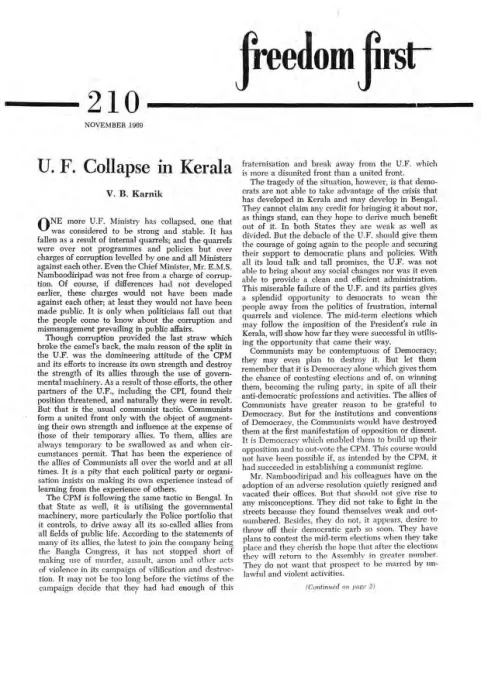
periodical issue
Freedom First
By M. R. Pai
Printed at Inland Printers, 55 Gamdevi Road, Bombay 7 and Edited and published for the Democratic Research Service by V. B. Karnik at 127 Mahatma Gandhi Road, Bombay 1. · Bombay · 1969
12 pages
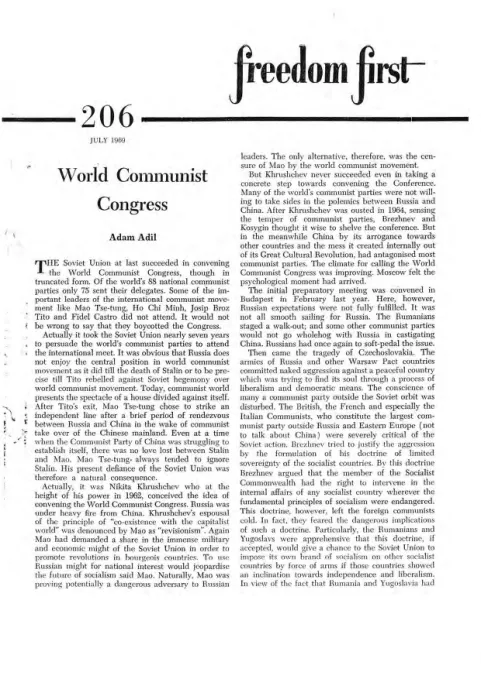
Freedom First
Summary
Freedom First No. 206 (July 1969), the monthly published by V. B. Karnik for the Democratic Research Service, Bombay, is dominated by Cold War communist affairs and the deteriorating political order in eastern India. Adam Adil surveys the fractious 1969 Moscow World Communist Congress as proof that international communism has lost its Soviet-centred monolithic unity; a companion note describes Brezhnev’s Asian ‘collective security’ scheme, and further wire items cover a purge of pro-Moscow officials in international communist front organisations and Yevgeny Yevtushenko’s veiled protest poem against renewed Stalinism. Domestic pieces turn to the breakdown of order under West Bengal’s United Front government: ‘An Analyst’ catalogues gheraos, police paralysis and inter-party (chiefly CPM-linked) violence, and a correspondent’s report, continued from page 4 to page 11, documents a season of bombings, stabbings and political murders around Calcutta’s Ballygunge constituency. M. R. Pai contrasts the integrity of past Indian leaders (Ram Mohun Roy, Tilak, Visvesvaraiya) with the self-interested, perquisite-seeking leadership he expects to define the 1970s. Feroza Seervai’s satirical dialogue has the ghosts of Socrates and Lenin debate whether Soviet communism delivers genuine equality or merely a new autocracy. R. S. Morkhandikar reviews S. P. Aiyar’s book on the Commonwealth in South Asia, and the Reviews section covers a report on communist infiltration in Himalayan border districts and an edited volume on secularism in India. The issue closes with an appeal by Soviet dissidents to the UN on civil rights, and the regular ‘With Many Voices’ page of press quotations.
Key points
-
Adam Adil’s “World Communist Congress” recounts the truncated 1969 Moscow gathering, boycotted by Mao, Ho Chi Minh, Tito and Castro, reading its difficulty in convening and its failure to censure China or address Czechoslovakia as proof that Moscow no longer commands a unified international Communist movement.
-
Writing as “An Analyst,” “Violence In Calcutta” catalogues two and a half months of West Bengal turmoil under the United Front government, citing at least 13 political murders and police increasingly ignoring CPM-linked actions.
-
M. R. Pai’s report on Ballygunge documents a season of bombings and stabbings by United Front “goondas” in the constituency of Information Minister Jyoti Bhattacharjee, who declared United Front youths would be armed.
-
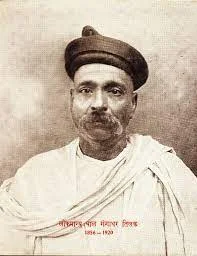
M. R. Pai’s “The Leadership Of 1970s” contrasts contemporary leaders’ pursuit of perquisites and party-switching with the integrity of past figures like Ram Mohun Roy, Tilak and Visvesvaraiya.
-
Feroza Seervai’s satirical dialogue has the ghosts of Socrates and Lenin debate Soviet equality, with Lenin eventually conceding his classless society is really “State-Capitalism” under a new autocracy.
-
R. S. Morkhandikar reviews S. P. Aiyar’s The Commonwealth in South Asia, crediting British rule with parliamentary institutions, English, and modernisation while noting Britain’s own waning Commonwealth commitment as it seeks EEC entry.
-
Reviews cover a Society for Research in Indian Communist Affairs report on communist infiltration of Tehri Garhwal and Uttarkashi districts, and a collection on secularism in India including essays by the late M. N. Roy.
Essays
World Communist Congress
By Adam Adil
Adam Adil recounts how the Soviet Union finally convened the World Communist Congress in 1969 after nearly seven years of effort, only in truncated form: of 88 national communist parties, just 75 sent delegates, and major figures (Mao Tse-tung, Ho Chi Minh, Tito, Castro) boycotted it. The piece traces the Sino-Soviet split from Khrushchev’s ‘co-existence’ doctrine through the Cultural Revolution, and argues that the 1968 invasion of Czechoslovakia further alienated foreign communist parties, with even sympathetic parties (British, French, Italian) critical of Brezhnev’s ‘limited sovereignty’ doctrine. Adil concludes that the Congress achieved little beyond denouncing ‘imperialism’ and that its difficulty in convening, and the walkouts and splits during it (Rumania, Poland’s anti-China stance despite pressure to avoid the topic), demonstrate that the international communist movement’s Moscow-centred unity has broken down for good.
- Only 75 of 88 national communist parties sent delegates; key leaders (Mao, Ho Chi Minh, Tito, Castro) boycotted the Congress
- Khrushchev conceived the idea of a World Communist Congress in 1962 to isolate China, but could never convene it before his 1964 ouster
- The 1968 Soviet invasion of Czechoslovakia badly damaged Soviet standing even among sympathetic foreign communist parties
- Brezhnev’s doctrine of ‘limited sovereignty’ of socialist states alarmed Rumania and Yugoslavia in particular
- The Congress failed to formally censure China and failed to substantively address the Czechoslovakia invasion
- Adil reads the whole episode as evidence that the communist movement has ceased to be monolithic and that Moscow no longer commands it
Bengal: Two Trends
By An Analyst
Writing pseudonymously as ‘An Analyst,’ the piece surveys two and a half months of political turmoil in West Bengal under the United Front government: rising lawlessness (gheraos of police thanas and factories, forcible seizure of land, inter-party murders) alongside factional splits within the fourteen-party United Front coalition, particularly friction with the CPM over control of local committees. The author lists specific abuses — police inaction, teachers and doctors gheraoed, at least 13 political murders, party-run ‘senas’ filling the vacuum of state authority — and closes by predicting that the situation more resembles Vietnam-style prolonged conflict than a quick resolution, with Chief Minister Jyoti Basu managing a ‘sober image’ for the rest of India while unable to contain the disorder.
- Anti-Centre tension eased after Ajoy Mukherjee and Jyoti Basu met with Chavan and Swaran Singh, but internal United Front tensions rose instead
- At least 13 political murders were reported in the press during the period covered
- Police increasingly ignore CPM-linked actions and are pressured to settle disputes via local MLAs rather than enforcement
- Inter-party conflict, especially around the CPM’s dominance of Home and other portfolios, produced violent clashes among United Front constituent parties
- The author predicts a Vietnam-like protracted conflict rather than an Indonesia-style resolution for Bengal
Violence In Calcutta
By (A Correspondent)
A correspondent’s report documents escalating political violence in Calcutta’s Ballygunge assembly constituency, where Information Minister Jyoti Bhattacharjee resides. It alleges the United Front’s armed ‘goondas’ have terrorised the area with daily bombing, stabbing and shooting since Bhattacharjee’s 1969 election, citing the assault of a rival Congress worker (Sankar Ghatak) and Bhattacharjee’s open declaration that United Front youths would be armed with guns and ammunition. The report (continuing from page 4 onto page 11) gives a chronological log of specific incidents from February through April 1969 — bombings, gheraos, assaults on Congress workers — and concludes that the same goondas the police once opposed are now the United Front’s ‘best friends and workers.’
- The report centres on Ballygunge, the Calcutta constituency of Information Minister Jyoti Bhattacharjee
- Congress worker Sankar Ghatak was assaulted and hospitalised by United Front goondas after a rival mid-term election contest
- Bhattacharjee is quoted as having declared United Front youths would be armed with guns and ammunition to ‘maintain peace’
- A dated log of incidents from February to April 1969 records bombings, a killing (Ranjit Ray), and gheraos across the constituency
- The piece concludes that violent goondas once opposed by the state are now embedded as United Front party workers
The Leadership Of 1970s
By M. R. Pai
M. R. Pai argues that India’s crisis of leadership stems from a decline in the qualities that once defined figures like Ram Mohun Roy, Tilak, Gokhale, Ranade and Visvesvaraiya: integrity, the ability to win genuine loyalty rather than buy it, transparency with the public, and being well-informed. He illustrates each quality with historical anecdotes — Ram Mohun Roy submitting to inquiry over a false theft allegation, Tilak’s care for a convict-attendant in a Burmese jail, Visvesvaraiya’s public vindication of his irrigation reforms in Poona — and contrasts these with contemporary leaders who accumulate perquisites, defect between parties (14% of legislators after the 1967 elections), and read little. Pai closes cautiously optimistic, citing business and industry’s efforts to train a new generation of leadership for the 1970s and 1980s.
- Pai identifies four qualities of good leadership missing today: integrity, winning genuine loyalty, transparency, and being well-informed
- Uses historical exemplars — Ram Mohun Roy, Tilak, Visvesvaraiya, Gokhale, Ranade, Dadabhoy Naoroji — to illustrate each quality
- Cites the statistic that about 14% of legislators defected after the 1967 elections, one as many as 7 times
- Criticises contemporary ministers for drawing modest salaries while enjoying an estimated Rs. 17,000/month in perquisites
- Quotes Robert McNamara on management’s fundamental task being to manage change
- Ends on cautious optimism about new leadership training emerging from business and industry for the 1970s
Rebel Poet writes his ‘Obituary’
No summary was extracted for this article. Listed for completeness.
A Dialogue Between Socrates And Lenin
By Feroza Seervai
Feroza Seervai’s satirical dialogue imagines the souls of Socrates and Lenin meeting after death to debate justice and equality. Lenin claims to have realised Socrates’s ideal republic through the classless communist state, but Socrates’s Socratic questioning progressively exposes contradictions in Lenin’s position: that equal ‘satisfaction of material needs’ would put humans on par with animals, that rewarding men ‘according to his labour’ implies unequal excellence, and that a state which forces men to labour and controls them via leaders is really autocracy, not equality. The dialogue ends with Lenin, unable to answer, declaring he believes ‘in action, not words’ and that intellectuals like Socrates would be sent to concentration camps in his state.
- Lenin claims to have realised Socrates’s ideal republic through Marxist class abolition and the rule of the proletariat
- Socrates uses a Socratic method to expose contradictions between Lenin’s claimed equality and the hierarchy of ‘leaders and led’ within his system
- Lenin ultimately concedes there are ‘degrees of excellence among men’ and that rewards must differ, undermining his equality claim
- Socrates concludes that Lenin’s classless society is in fact ‘State-Capitalism’ with different classes of men under a new autocracy
- Lenin ends the dialogue by declaring bourgeois intellectuals would be sent to concentration camps in his state
Appeal for Civil Rights
No summary was extracted for this article. Listed for completeness.
South Asia And The Commonwealth
By R. S. Morkhandikar
R. S. Morkhandikar reviews Dr. S. P. Aiyar’s book ‘The Commonwealth in South Asia,’ which traces the Commonwealth’s evolution and its significance for India, Pakistan and Ceylon. The review credits the British empire with contributing parliamentary institutions, the English language, and modernisation to South Asia, while noting the irony that British officials themselves often doubted the wisdom of transplanting these institutions. Morkhandikar highlights Aiyar’s pessimism about whether the subcontinent’s democratic institutions and use of English will survive amid mass violence, parochialism and communalism, and (in the portion continued on page 11) notes that Britain’s own commitment to the Commonwealth has waned as it seeks entry into the EEC and retrenches its global commitments.
- The review covers Dr. S. P. Aiyar’s book ‘The Commonwealth in South Asia’ (Lalvani Publishing House, Bombay, Rs. 30)
- Credits British rule with three legacies to South Asia: parliamentary institutions, English language, and modernisation
- Notes the irony that British officials (e.g., the Simon Commission’s A. B. Keith) themselves doubted the propriety of transplanting these institutions to India
- Aiyar is described as pessimistic about whether democratic institutions will survive rising mass violence and communalism in the subcontinent
- The review (continued on page 11) notes Britain’s Commonwealth commitment is waning as it seeks EEC entry and retrenches its global role
Reviews: Indian Communist, December 1968 Issue
By V. B. Karnik
The Reviews section covers two books. V. B. Karnik reviews a Society for Research in Indian Communist Affairs report (the December 1968 issue of ‘Indian Communist’) detailing communist infiltration of two northern U.P. border districts, Tehri Garhwal and Uttarkashi, describing how Maoist-aligned ‘Right Communists’ have penetrated cooperative banks and labour unions there, and urging the government to take both defensive and ameliorative measures. A second (initialled ‘V.B.K.’) reviews ‘Secularism in India,’ an edited essay collection including two pieces by the late M. N. Roy, which argues India is not fully secular in the strict Western sense but has adopted a distinctive non-discriminatory model, distinct from Pakistan’s explicitly Islamic state.
- First review covers the Society for Research in Indian Communist Affairs’ December 1968 ‘Indian Communist’ report on the Tehri Garhwal and Uttarkashi border districts
- The investigation, led by J. G. Tiwari, found communists (self-described ‘Right Communists’) controlling cooperative banks and labour unions in the two districts
- The reviewer urges both defensive measures and positive amelioration of the poor and backward populations targeted by communist propaganda
- Second review covers ‘Secularism in India’ (ed. V. K. Sinha), a collection from a 1966 Bombay seminar of the Indian Committee for Cultural Freedom
- The review notes M. N. Roy’s contribution arguing India is not a secular state in the strict sense, since state and religion are not fully separated
- Concludes India’s use of ‘secular’ has effectively become synonymous with non-communal rather than strict church-state separation
Reviews: Secularism in India
By V. B. K.
No summary was extracted for this article. Listed for completeness.
Generated by the v1.5 extraction pipeline. Awaiting editorial review.
Metadata and summary are AI-extracted from the source PDF and reviewed for editorial accuracy. The original work is available via the Read PDF tab above (where present); paragraph-level citation inside the PDF is deferred to a future engagement.