periodical issue
Freedom First
By Arvind A. Deshpande, A. G. Mulgaonkar, Analyst, U.S. News & World Report, V. B. Karnik
Edited and published for the Democratic Research Service by V. B. Karnik at 127 Mahatma Gandhi Road, Bombay 1, and printed by him at Inland Printers, 55 Gamdevi Road, Bombay 7. · Bombay · 1969
12 pages
Freedom First
Summary
Freedom First No. 209 (October 1969) opens with the Gandhi centenary still dominating the magazine’s attention: Arvind A. Deshpande contributes a personal appreciation and tribute to Mahatma Gandhi, followed by a note on the British Parliament’s resolution honouring Gandhiji, and V. B. Karnik reviews J. Bandyopadhyaya’s ‘Social and Political Thought of Gandhi’, summarising its critical, social-scientific assessment of satyagraha’s limits against dictatorial regimes. Alongside the Gandhi material, this issue is heavily preoccupied with contemporary politics: A. G. Mulgaonkar’s constitutional essay ‘P.M. And Party President’ argues against the Congress organisation’s claim to control the parliamentary wing and Prime Minister Indira Gandhi, drawing on British parliamentary precedents (Asquith, Baldwin, Churchill); a ‘Bengal Report’ column by ‘Analyst’ covers Indira Gandhi’s Calcutta visit, CPI-CPM factional conflict, and the Ranjit Gupta report on police vandalism in the West Bengal Assembly; a reprinted memorandum from women political workers and a separate Congressmen’s memorandum (‘Trends In Bengal’) catalogue the breakdown of law and order under the United Front government; an editorial condemns the Ahmedabad communal riots during the Gandhi centenary year; and a reprinted ‘Moscow’s Design For Asia’ (from U.S. News & World Report) analyses Soviet strategic ambitions in Asia following the US drawdown from its ‘world policeman’ role. The issue closes with ‘With Many Voices’, a compilation of press quotations on current affairs, and a reader’s letter praising the magazine’s coverage of press freedom.
Key points
-
Arvind A. Deshpande’s tribute to Gandhi frames his greatness as accessible moral earnestness rather than exceptional genius, calling his handling of Hindu-Muslim unity a “magnificent failure” while crediting his core teaching that any individual can resist injustice without causing injury.
-
A. G. Mulgaokar’s constitutional essay “P. M. And Party President” argues the Congress organisation cannot legitimately claim directive control over the Prime Minister and cabinet, invoking British precedents where Asquith, Baldwin and Churchill resisted extra-constitutional interference.
-
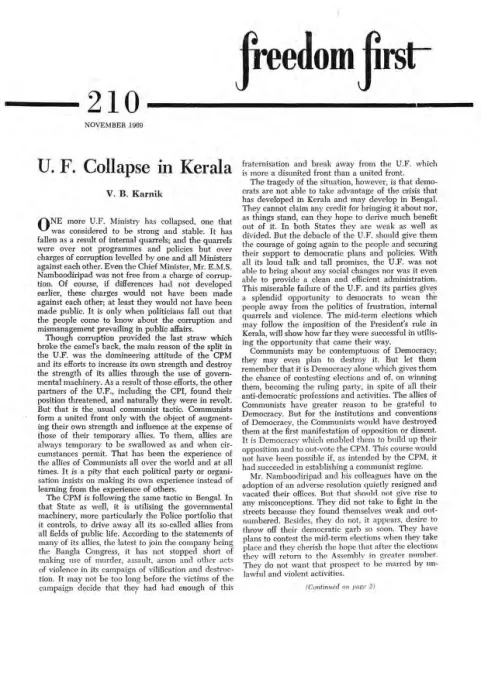
Writing as “Analyst,” a “Bengal Report” covers Indira Gandhi’s Calcutta visit, a Congress attempt to sideline West Bengal leader Atulya Ghosh, and sharpening CPI-CPM conflict within the United Front triggered by the Baranagar beating of CPI trade unionists.
-
V. B. Karnik reviews J. Bandyopadhyaya’s Social and Political Thought of Gandhi, summarising its dispassionate finding that the 1930-32 Civil Disobedience Movement was “practically a complete failure” undone by government repression, and its doubt, via Karl Jaspers, about satyagraha’s viability against totalitarian regimes.
-
A reprint from U.S. News & World Report, “Moscow’s Design For Asia,” argues the Soviet Union is expanding into the vacuum left by American withdrawal from Asia, citing Brezhnev’s June 1969 call for an Asian “collective security” system.
-
A memorandum presented to Indira Gandhi by Calcutta Congressmen catalogues sixteen “trends” of political violence and breakdown of law and order in West Bengal, including forcible occupation of land and over 1,000 withdrawn criminal cases, and calls for action under Article 356.
-
An editorial condemns the Ahmedabad communal riots as a national shame in the Gandhi centenary year, and a reader’s letter praises A. B. Shah’s earlier article on press freedom.
Essays
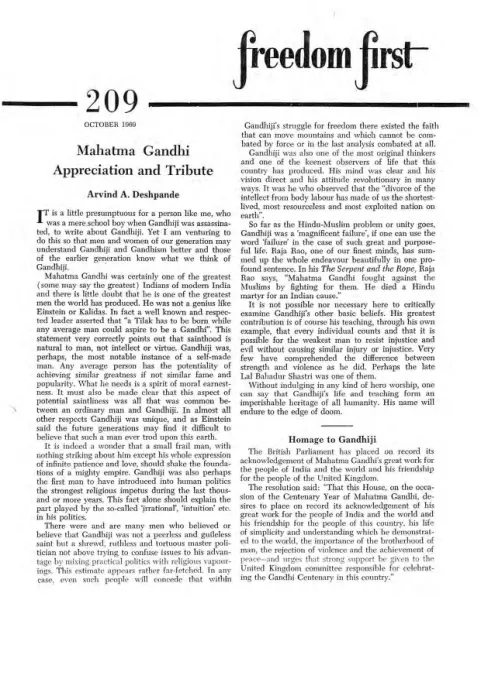
Mahatma Gandhi: Appreciation and Tribute
By Arvind A. Deshpande
Arvind A. Deshpande’s tribute argues that Gandhi’s greatness lay not in genius but in moral earnestness available to any ordinary person, making him, in the author’s words, the most notable instance of a ‘self-made man’ of saintliness. The essay defends Gandhi against charges that he was a shrewd, manipulative politician masking political calculation as religious idealism, calling that view ‘far-fetched’, and cites Raja Rao’s description of Gandhi’s death as a ‘Hindu martyr for an Indian cause’ to characterise the Hindu-Muslim question as Gandhi’s ‘magnificent failure’. It closes by crediting Gandhi’s central teaching as the demonstration, through personal example, that even the weakest individual can resist injustice without inflicting counter-injury, comparing Lal Bahadur Shastri as one of the few who grasped this distinction between strength and violence. A short accompanying note records a British Parliament resolution acknowledging Gandhi’s work for India and the world during his centenary year.
- Frames Gandhi’s greatness as accessible moral earnestness rather than exceptional genius, unlike ‘a Tilak’ who must be born
- Rejects the view that Gandhi was primarily a shrewd, manipulative politician using religion to obscure political calculation
- Calls Gandhi’s handling of Hindu-Muslim unity a ‘magnificent failure’, citing Raja Rao’s The Serpent and the Rope
- Credits Gandhi’s core teaching as showing that any individual can resist injustice and evil without causing injury
- Names Lal Bahadur Shastri as one of few who understood Gandhi’s distinction between strength and violence
- Notes the British Parliament passed a resolution honouring Gandhi during the centenary year
Pink Knights-Errant
A short unsigned item, reprinted from the weekly ‘Thought’ under the heading ‘Pink Knights-Errant’, criticises Indira Gandhi’s socialist ministers for consorting with declared and undeclared Communists: it recounts Dinesh Singh’s eulogy of Ho Chi Minh in Hanoi, Soviet officials’ praise of Mrs Gandhi’s government, Jagjivan Ram sharing a platform with Communists Bhupesh Gupta and Krishna Menon, and a Communist-fellow-traveller conference inaugurated by V. K. R. V. Rao. A companion editorial on the Ahmedabad communal riots calls them a national shame occurring in the Gandhi centenary year, in the city where Gandhi spent over two decades of his life, and argues that education and guarantees of communities’ lawful rights are the only durable remedy. A reader’s letter to the editor thanks Freedom First and its September 1969 article ‘The Press and the Present Crisis’ (by A. B. Shah) for warning about threats to press freedom.
- Criticises Congress ministers under Indira Gandhi for aligning with Communists and fellow-travellers, citing named incidents from August-September 1969
- Notes Soviet officials’ gratification at India’s political direction under Mrs Gandhi
- Editorial condemns the Ahmedabad communal riots as a national disgrace during the Gandhi centenary year, calling for investigation of a possible ‘hidden hand’
- Argues communal distrust persists despite two decades of secular democracy and requires education plus guaranteed community rights to eradicate
- A reader’s letter praises Freedom First’s September 1969 article on press freedom by A. B. Shah, warning against press nationalisation
P. M. And Party President
By A. G. Mulgaonkar
A. G. Mulgaonkar’s constitutional essay examines whether the Congress organisation (the President and Working Committee) can legitimately claim supervisory or directive control over the Congress Prime Minister and cabinet, a question sharpened by the clashes between Indira Gandhi and the Syndicate. Mulgaonkar concedes the organisation’s general claim to guide broad policy but argues the wider claim, extending to cabinet appointments and day-to-day administration, is unworkable and unconstitutional: under Articles 74 and 75 the Prime Minister and Council of Ministers are constitutionally answerable to Parliament, cabinet discussions are secret by oath, and the Congress President and Working Committee hold no more constitutional standing than private citizens. He rejects the three grounds advanced for organisational control (that the organisation raised funds and won the election; that Indian conditions require party supervision of government; that Congress rules provide for it), and invokes British precedents where Prime Ministers Asquith, Baldwin and Churchill resisted extra-constitutional attempts by party or press figures to control government action, quoting Baldwin’s rebuke to press lords Rothermere and Beaverbrook about ‘power without responsibility’.
- Poses the constitutional question of whether the Congress organisation can direct or control the Congress Prime Minister and government
- Concedes a limited role for the organisation in guiding broad policy but rejects claims to supervisory or directive authority over cabinet appointments and administration
- Cites Articles 74 and 75 of the Indian Constitution and the secrecy of cabinet discussions as barriers to organisational control
- Rejects the three grounds for the claim: financing/winning elections, special Indian conditions, and Congress constitution/rules
- Uses British parliamentary history (Asquith and the Lloyd George war-committee ultimatum, Baldwin versus press lords Rothermere and Beaverbrook) as precedent for resisting extra-constitutional control of a Prime Minister
- Argues a Prime Minister subject to a rival power centre would lack dignity, self-respect, and clear responsibility
Bengal Report: Indira Gandhi’s Visit And After
By Analyst
Writing under the byline ‘Analyst’ in the ‘Bengal Report’ column, this piece surveys West Bengal politics from mid-August to mid-September 1969: Indira Gandhi’s Calcutta visit following her Presidential-election victory, an attempted Congress manoeuvre to sideline Atulya Ghosh and his protege P. C. Chunder, her overture to Bangla Congress leader Ajoy Mukherjee that went nowhere, and sharpening conflict between the CPI and CPM within the United Front over trade-union turf and the Baranagar beating of CPI workers. It also covers the Ranjit Gupta report on the July 31 police vandalism in the Assembly, finding administrative failure and low-level police discontent, and reproduces a memorandum from women political workers describing West Bengal as being in ‘chaos and semi-anarchy’ under the United Front government, with the CPM accused of exploiting the police portfolio to entrench its own power.
- Covers Indira Gandhi’s Calcutta visit and mixed reception from Bangla Congress and other United Front partners
- Documents a Congress attempt to sideline West Bengal leader Atulya Ghosh and his protege P. C. Chunder, reversed under rank-and-file pressure
- Details sharpening CPI-CPM conflict within the United Front, triggered by the Baranagar beating of CPI trade unionists
- Summarises the Ranjit Gupta report on July 31 police vandalism, citing administrative failure and rank-and-file police discontent
- Reproduces a memorandum from women political workers describing West Bengal under United Front rule as in ‘chaos and semi-anarchy’
Moscow’s Design For Asia
By U.S. News & World Report
A reprint from U.S. News & World Report, ‘Moscow’s Design For Asia’ argues that as the United States retreats from its role as Asia’s security guarantor after Vietnam, the Soviet Union is expanding rapidly into the vacuum with an unmatched thrust since Czarist expansion, aiming to isolate Red China from its Asian neighbours and to fill the space left by British and American withdrawal ‘east of Suez’. It surveys Soviet inroads via trade, aid, and military hardware into Mongolia, India, Pakistan, Indonesia, Singapore, Malaysia and Japan, cites Brezhnev’s June 1969 call for an Asian ‘collective security’ system, and closes by quoting French Soviet-affairs expert Michel Tatu that the perceived China threat is pushing Soviet leaders toward stabilising relations with the West to secure their European flank.
- Frames Soviet expansion into Asia as filling the vacuum left by US withdrawal from its ‘world policeman’ role after Vietnam
- Identifies two Soviet objectives: isolating China from Asian neighbours, and moving into areas the US/Britain are vacating (Persian Gulf, Indian Ocean)
- Cites Brezhnev’s June 7, 1969 speech proposing a ‘system of collective security’ in Asia
- Details Soviet economic and military aid flows to Mongolia, India (600 million dollars pledged), Pakistan, Indonesia, Singapore, Malaysia and Japan
- Notes reports (unconfirmed) of a proposed Pakistan-Afghanistan land route and a possible Soviet naval base at Gwadar
- Closes by quoting Michel Tatu that the China threat is driving Soviet leaders to tighten relations with the West
Gandhiji’s Thoughts
By V. B. Karnik
V. B. Karnik reviews J. Bandyopadhyaya’s ‘Social and Political Thought of Gandhi’ (Allied Publishers, Rs. 32), praising it as a rare critical, social-scientific analysis of Gandhi’s thought rather than a merely descriptive or laudatory centenary tribute. Karnik summarises Bandyopadhyaya’s dispassionate assessment of satyagraha’s practical record, both individual (fasting) and group (Rajkot, the 1930-32 Civil Disobedience Movement, and the 1940-41 Individual Civil Disobedience Movement), concluding through the author that fasting requires a liberal socio-political setting and a sympathetic adversary, that group satyagraha is at best a ‘palliative rather than a cure’ for deep social conflict, and that the 1930-32 movement was ‘practically a complete failure’ despite meeting Gandhi’s non-violence condition, undone by government repression rather than internal weakness. Bandyopadhyaya, quoting Karl Jaspers, doubts satyagraha’s viability against totalitarian government, though he still allows non-violent resistance a subsidiary role in national defence. Karnik notes Bandyopadhyaya’s finding that Gandhi’s approach ignores social evolution’s deep-rooted causes of conflict, and though Karnik queries the author’s attempt to link Gandhi with Marx and Mao given Gandhi’s insistence that ‘means and ends are convertible terms’, he calls the book essential reading for any student of Gandhism.
- Reviews J. Bandyopadhyaya’s ‘Social and Political Thought of Gandhi’ as a rare critical, social-scientific study rather than hagiography
- Summarises the book’s finding that individual satyagraha (fasting) requires a liberal political setting and a sympathetic adversary to succeed
- Notes the book’s conclusion that the 1930-32 Civil Disobedience Movement was ‘practically a complete failure’, undone by government repression, not internal weakness
- Cites the book’s use of Karl Jaspers to argue satyagraha cannot work against totalitarian regimes, though non-violence may have a subsidiary defence role
- Karnik questions the book’s attempt to draw similarity between Gandhi and Marx/Mao, given Gandhi’s view that means and ends are convertible
- Recommends the book as essential for any serious student of Gandhism
Trends In Bengal (extracts from a memorandum presented to the Prime Minister)
‘Trends In Bengal’ reproduces extracts from a memorandum presented to Prime Minister Indira Gandhi during her August 1969 Calcutta visit by prominent Calcutta Congressmen, cataloguing sixteen numbered ‘trends’ under United Front rule: political workers assaulted and murdered across party lines, trade union and political freedoms severely restricted by fear of attack, properties destroyed, ‘Peoples Courts’ extorting fines from citizens, lands and fisheries forcibly occupied by armed party gangs, over 1,000 criminal cases withdrawn by the government, intimidation of judges, gheraos disrupting business and industry, a partisan and paralysed police and administration, High Court injunctions ignored, the rise of aggressive party senas (private armies), increasing use of firearms, and a pro-Chinese party openly propagating Mao’s doctrine of armed insurrection. The memorandum calls on the Prime Minister to act under Section 356 of the Indian Constitution.
- Lists sixteen documented trends of political violence and breakdown of law and order in West Bengal under the United Front government
- Describes assaults, murders, and terrorisation of political workers across all parties, and forcible occupation of lands and fisheries by armed gangs
- Notes withdrawal of over 1,000 criminal cases including violence, rioting, robbery, and murder charges, in some instances against courts’ protest
- Describes a partisan, paralysed police force and the rise of aggressive party ‘senas’ (private armies) as public authority erodes
- Flags a pro-Chinese party openly attacking the Indian Constitution and propagating Mao’s doctrine of armed insurrection
- Calls on the Prime Minister to take action under Section 356 of the Indian Constitution
With Many Voices (press digest column)
‘With Many Voices’ is the magazine’s recurring back-page compilation of press quotations on current events, epigraphed with Tennyson. Selections from Indian and international press in August-September 1969 comment on the Al-Aqsa mosque fire, Indira Gandhi’s foreign policy tilt toward Moscow, the erosion of liberal economic competition, government softness toward Muslim sentiment versus secular commitment, and general anxieties about socialism, democracy, and Cold War alignment, including quotes from Herbert Read, Malcolm Muggeridge, Frank Moraes, Svetlana Allilyeva (Stalin’s daughter), and Vinoba Bhave. The page also carries a Freedom First subscription form and the magazine’s standard imprint, naming V. B. Karnik as editor and publisher for the Democratic Research Service, Bombay.
- Compiles press quotations from Times of India, Indian Express, Opinion, Swarajya, Thought, Janata and other outlets on current events of August-September 1969
- Includes commentary on the Al-Aqsa mosque fire, Indira Gandhi’s foreign policy and domestic socialism, and communal/secular tensions
- Features quotes from Herbert Read, Malcolm Muggeridge, Frank Moraes, Svetlana Allilyeva (Stalin’s daughter), and Vinoba Bhave
- Carries the magazine’s subscription form and imprint naming V. B. Karnik as editor/publisher for the Democratic Research Service
Generated by the v1.5 extraction pipeline. Awaiting editorial review.
Metadata and summary are AI-extracted from the source PDF and reviewed for editorial accuracy. The original work is available via the Read PDF tab above (where present); paragraph-level citation inside the PDF is deferred to a future engagement.