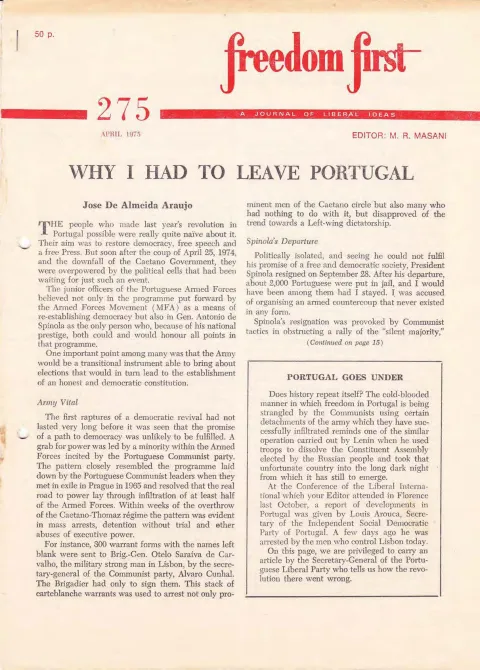
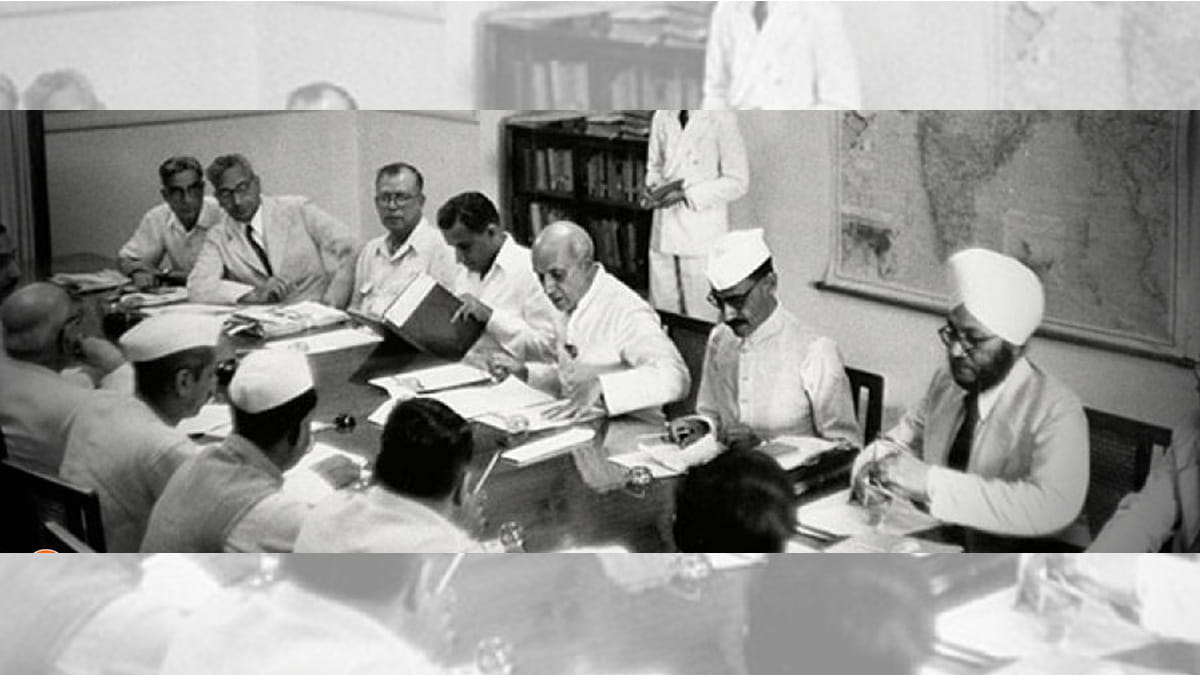
periodical issue
Freedom First
A Journal of Liberal Ideas
By BK Nehru, S. V. Raju
Published for the Democratic Research Service by J. R. Patel, Associate Editor, Freedom First at 127, M. Gandhi Road, Bombay 1 and printed by him at Inland Printers, 55 Gamdevi Road, Bombay 7. · Bombay · 1972
16 pages
Freedom First
Summary
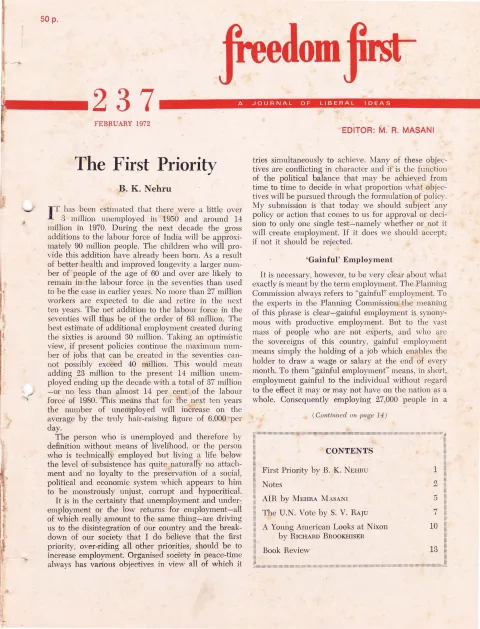
This is issue No. 237 (February 1972) of Freedom First, the Bombay-based classical-liberal monthly edited by M. R. Masani. The issue opens with B. K. Nehru’s B. F. Madon Memorial Lecture, ‘The First Priority’, arguing that mass unemployment makes job creation India’s overriding economic priority and criticizing government policies (subsidised industry, over-staffing, populist nationalization talk) that create the appearance of employment without productive output. The unsigned ‘Between You and Me and the Lamp Post’ notes column covers the Bangladesh war’s aftermath, the government’s handling of Sheikh Mujibur Rehman, the detention of Current editor D. F. Karaka, the 25th/28th Constitution Amendment Bills, and press freedom. Mehra Masani contributes a piece on All India Radio’s lack of autonomy from government control, contrasting it with the BBC and other democratic broadcasters and reviewing the unimplemented Chanda Committee recommendations. S. V. Raju analyses India’s near-total diplomatic isolation at the U.N. General Assembly vote on the December 1971 ceasefire resolution, arguing this reveals the costs of India’s alignment with the Soviet Union. Richard Brookhiser, a young American writer, offers a psychological read of President Nixon as a political ‘Romantic’ ahead of his planned trip to China. The issue also carries a translated Soviet ‘samizdat’ protest ballad by Mikhail Nozhkin, a review by Aziz Madni of the book ‘Shadow of the Bear’ (on the Indo-Soviet Treaty), and a back-page compilation of quotations titled ‘With Many Voices’.
Key points
-
B. K. Nehru’s Madon Memorial Lecture, “First Priority”, argues mass unemployment must override every other policy objective, projecting 37 million unemployed by 1980 and criticising government practices that manufacture false employment.
-
The “Notes” column welcomes Bangladesh’s liberation while criticising Indira Gandhi’s reversal on Constitution Amendment concessions and the detention of Current editor D. F. Karaka.
-
Mehra Masani’s “AIR” argues All India Radio remains anomalous among democracies in lacking BBC-style autonomy, rebutting government objections to implementing the Chanda Committee’s recommendations.
-
S. V. Raju’s “The U.N. Vote” reads India’s near-total isolation in the December 1971 ceasefire vote as evidence the Indo-Soviet Treaty destroyed its non-aligned credibility, calling for an “agonising reappraisal” of foreign policy.
-
Richard Brookhiser offers a psychological portrait of Nixon as a political “Romantic” ahead of his China trip, comparing him to Neville Chamberlain and Czar Alexander I at Tilsit.
-
A translated Soviet “magnitizdat” protest ballad by Mikhail Nozhkin satirises the hypocrisy of a privileged Soviet “New Class”, with an editorial note drawing a parallel to India’s own emerging elite.
-
Aziz Madni reviews “Shadow of the Bear” on the Indo-Soviet Treaty’s implications, and the closing “With Many Voices” page compiles quotations on the Bangladesh war’s diplomatic fallout.
Essays
First Priority
By B. K. NEHRU
B. K. Nehru’s lecture argues that unemployment is the central threat to India’s social and political stability and must override every other policy objective. He lays out projections showing the labour force growing by roughly 63 million over the 1970s against a realistic capacity to create only about 40 million jobs, leaving around 37 million unemployed by 1980 (some 14% of the labour force). He proposes a single test for any government policy: does it create employment? In the continuation (pages 14-15), Nehru argues that ‘gainful employment’ must mean productive employment, not simply drawing a wage regardless of output, and criticizes Government practices (overstaffing offices, unviable industrial projects, subsidies, and loans to uneconomic enterprises) that manufacture the appearance of employment without adding real production. He invokes Lenin’s 1921 New Economic Policy as a precedent for subordinating ideological preferences to the sheer necessity of increasing production, and closes by questioning whether India’s mix of political liberty and regulated economy is sustainable, warning against a national ‘macrophobia’ that favours large scale and government control over smaller, more efficient private enterprise.
- Unemployment rose from roughly 3 million in 1950 to about 14 million in 1970, with 63 million more entrants expected in the 1970s against a maximum of about 40 million new jobs.
- Nehru proposes a single-test policy standard: whether an action creates employment.
- He distinguishes ‘gainful’ employment (drawing a wage) from genuinely productive employment that adds to national output.
- Government practices that create false appearances of employment include overstaffing, unviable subsidised projects, and irrecoverable loans to uneconomic industries.
- He cites Lenin’s 1921 New Economic Policy as a historical parallel for prioritizing production over ideology when facing economic collapse.
- He criticizes an Indian bias toward large-scale (‘macrophobic’) production and against small-scale, labour-intensive industry.
- He closes with a philosophical question about whether India’s political liberty is compatible with its regulated economy.
Notes
The unsigned ‘Between You and Me and The Lamp Post’ notes column addresses several current events. It welcomes the liberation of Bangladesh and the return of Sheikh Mujibur Rehman, contrasting Freedom First’s consistent anti-imperialist stance (on Tibet, Hungary, Czechoslovakia, and Biafra) with what it calls the hypocrisy of those who stayed silent on Soviet and Chinese actions. It criticizes Indira Gandhi for reversing her position on Constitution Amendment Bill concessions within 24 hours, accuses ruling Congress Party members of ‘fascist’ hooliganism against opposition figures, criticizes the detention of Current editor D. F. Karaka under the Defence of India Rules as a misuse of power, and criticizes press book-burning of Karaka’s journal. It also discusses the government’s diplomatic tilt toward North Vietnam, the death of J&K Chief Minister G. M. Sadiq and press silence about his Communist sympathies, and the choice of Leonard Boudin (a lawyer with a record of defending Soviet spies and communists) as Daniel Ellsberg’s counsel in the Pentagon Papers case.
- Celebrates the liberation of Bangladesh and Sheikh Mujibur Rehman’s return, contrasting it with silence over Tibet, Hungary, Czechoslovakia and Biafra by some commentators.
- Criticizes Indira Gandhi for withdrawing two of three Constitution Amendment Bill provisions after claiming she would not be ‘pressurised’.
- Condemns ruling Congress Party members’ violent conduct against opposition figures as ‘fascist’, including the manhandling of Orissa’s Chief Minister.
- Argues the detention of Current editor D. F. Karaka under the Defence of India Rules was a misuse of emergency powers.
- Notes press silence about the Communist sympathies of the late J&K Chief Minister G. M. Sadiq.
- Criticizes New Delhi’s diplomatic tilt in favour of North Vietnam over South Vietnam.
- Highlights Ellsberg’s choice of Leonard Boudin, a lawyer known for defending Soviet spies and communists, as noteworthy.
AIR
By MEHRA MASANI
Mehra Masani argues that All India Radio remains an unusual holdout among democracies in being run directly as a department of the government rather than as an autonomous public corporation like the BBC. She surveys global broadcasting models (private/commercial in the US, autonomous corporations across Western Europe and much of Asia, and state control mainly in totalitarian countries) and situates India’s system as an anomaly. She traces the history of proposals for AIR’s autonomy, including Nehru’s 1948 Constituent Assembly remarks favouring a BBC-like semi-autonomous model, and the 1964 Chanda Committee (chaired by A. K. Chanda) commissioned by Indira Gandhi as Minister for Information and Broadcasting, which recommended converting AIR into an autonomous corporation by Act of Parliament. She rebuts the government’s standard arguments against autonomy (financial self-sufficiency, risk of commercialization, loss of parliamentary control, and national security) one by one, and concludes that the government’s real motive is fear that an independent AIR would refuse to serve the ruling party’s narrow political ends.
- India is characterized as nearly alone among democracies in keeping broadcasting as a direct government department rather than an autonomous corporation.
- Contrasts three global broadcasting models: private/commercial (US), autonomous public corporations (BBC, NHK, ABC, CBC, West Germany), and state-run (mostly totalitarian states, USSR, China).
- Recounts Nehru’s 1948 Constituent Assembly statement favouring a semi-autonomous, BBC-like structure for Indian broadcasting.
- Describes the 1964 Chanda Committee, appointed by Indira Gandhi, which recommended AIR’s conversion into an autonomous statutory corporation.
- Rebuts arguments that AIR cannot afford autonomy, that autonomy risks commercialization, that Parliament would lose control, and that state security requires direct government supervision.
- Concludes that the government’s true motive for resisting autonomy is fear that an independent AIR would not serve the ruling party’s political interests.
The U.N. Vote
By S. V. RAJU
S. V. Raju analyses the near-unanimous 104-nation U.N. General Assembly vote in December 1971 for a ceasefire resolution that India opposed, framing it as evidence of India’s diplomatic isolation over Bangladesh. He rejects Foreign Minister Swaran Singh’s claim that most voting nations simply failed to understand the ‘basic problem’, noting that nearly every regional bloc (Arab states, African states, South and Southeast Asian states, Latin American states, and most of Europe) voted for the resolution or abstained, leaving India dependent on Soviet-bloc support. He argues that India’s reliance on the Indo-Soviet Treaty destroyed the credibility of its long-cultivated non-aligned image, particularly given India’s own past silence on Tibet, Hungary, and Czechoslovakia. He calls for a fundamental ‘agonising reappraisal’ of foreign policy, including reconsidering India’s West Asia policy, prioritizing relations with South and Southeast Asian neighbours, and grounding foreign policy in reciprocity and self-interest rather than moralizing.
- 104 nations voted for the December 1971 U.N. ceasefire resolution that India opposed, leaving India isolated with mainly Soviet-bloc support.
- Raju rejects the government’s explanation that other nations failed to understand the ‘basic problem’ of genocide and refugees.
- Notes that virtually every regional bloc—Arab, African, South/Southeast Asian, Latin American, most of Europe—voted against India’s position or abstained.
- Argues India’s own past inaction on Tibet, Hungary, and Czechoslovakia undermined the credibility of its moral appeals over Bangladesh.
- Contends the Indo-Soviet Treaty destroyed India’s non-aligned image and international credibility.
- Calls for an ‘agonising reappraisal’ of foreign policy covering West Asia policy, South/Southeast Asian relations, and a shift toward reciprocity and self-interest.
A Young American Looks at Nixon
By RICHARD BROOKHISER
Richard Brookhiser, describing himself as a young American, offers a psychological portrait of President Nixon as a political ‘Romantic’ whose planned trip to Communist China reflects a deep-seated vision of himself as a peacemaker rather than mere pragmatism. He compares Nixon to Neville Chamberlain (quoting Churchill’s appraisal of Chamberlain in The Gathering Storm) and to Czar Alexander I meeting Napoleon at Tilsit, arguing that Romantics like Nixon believe in the essential goodness and persuadability of even hostile powers. Brookhiser suggests Nixon’s China initiative is driven by a hope to be remembered as a ‘Great Peacemaker’, paralleling his moves toward Rumania, the Middle East, and Kissinger’s Peking diplomacy, while acknowledging skepticism that the vision may be ‘all a fantasy’.
- Brookhiser argues Nixon’s planned China trip reflects a Romantic self-image as a historic peacemaker, not pure pragmatism.
- He compares Nixon’s psychology to Neville Chamberlain’s, quoting Churchill’s description of Chamberlain from The Gathering Storm.
- He compares Nixon’s anticipated meeting with Chinese leaders to Czar Alexander I’s meeting with Napoleon at Tilsit.
- Romantics, per Brookhiser, believe deeply in the essential goodness of people and the possibility of reconciliation even with adversarial powers.
- He notes the initiative carries political benefits (winning elections, commending Nixon to history) alongside its idealistic motivations.
- The essay ends on a note of self-aware uncertainty about whether this reading of Nixon is accurate.
Book Review
A translated Soviet ‘samizdat’/‘magnitizdat’ protest ballad by Mikhail Nozhkin, introduced with an explanatory note on the underground tape-recorded ballad tradition in the USSR. The ballad satirizes the hypocrisy of a privileged Soviet ‘New Class’ who preach austerity and revolutionary sacrifice while living in comfort, contrasted with the two bullet-holed overcoats and worn possessions preserved in the Lenin Museum. The introductory note draws an explicit parallel to India, suggesting a visit to Birla House, where Gandhi’s few possessions are kept, might inspire a similar refrain about India’s own emerging privileged class.
- The piece is a translated underground Soviet protest ballad (‘magnitizdat’, tape-recorded samizdat) by Mikhail Nozhkin.
- It satirizes a Soviet ‘New Class’ that enjoys imported clothes, luxury, and consumer goods while publicly preaching austerity.
- It contrasts this hypocrisy with the modest bullet-holed overcoats and few possessions preserved in the Lenin Museum.
- The introductory editorial note draws a direct parallel to India’s own emerging privileged class, referencing Gandhi’s few possessions at Birla House.
Essay 7
Aziz Madni reviews ‘Shadow of the Bear’, edited by A. P. Jain (176 pages, Rs. 15), a book collecting the proceedings of a September 1971 New Delhi seminar on the economic and political implications of the Indo-Soviet Treaty signed on 9 August 1971. The review finds the book, despite a title that might seem to slant against the treaty, a fair and well-documented account, citing seminar participants including M. R. Masani, T. N. Kaul, D. R. Mankekar, Prithvis Chakravarti, and General Cariappa, most of whom saw the treaty as constraining India’s freedom of action and tying it more closely to Soviet strategic interests in Asia and the Indian Ocean.
- The book under review, ‘Shadow of the Bear’ (ed. A. P. Jain, 176 pp., Rs. 15), collects proceedings of a September 1971 New Delhi seminar on the Indo-Soviet Treaty.
- The reviewer finds the book, despite its seemingly slanted title, a fair and dispassionate account of the treaty’s implications.
- Seminar participants broadly agreed the treaty constrained India’s freedom of action and had been under negotiation for two years before the Bangladesh crisis.
- The review cites warnings that Soviet and Chinese vetoes could each become tools to block future Security Council action favouring India.
- It concludes that the treaty has drawn Southern Asia into great-power competition, citing The Economist’s characterization of a ‘new Great Game’.
Essay 8
The back-page feature ‘With Many Voices’ compiles brief quotations from Indian and international figures and publications on the Bangladesh war, the Indo-Pakistan conflict, and related diplomatic fallout, drawn from sources including Indira Gandhi, C. Rajagopalachari, President Bhutto, and The Economist, alongside a subscription form for Freedom First.
- The feature compiles short quotations from public figures and publications on the Bangladesh war and its diplomatic aftermath.
- Sources quoted include Indira Gandhi, C. Rajagopalachari, President Bhutto, President Nixon, and repeated citations from The Economist and Encounter.
- It includes a subscription form for Freedom First with annual rates of Rs. 5 (Rs. 3 for students).
Generated by the v1.5 extraction pipeline. Awaiting editorial review.
Metadata and summary are AI-extracted from the source PDF and reviewed for editorial accuracy. The original work is available via the Read PDF tab above (where present); paragraph-level citation inside the PDF is deferred to a future engagement.