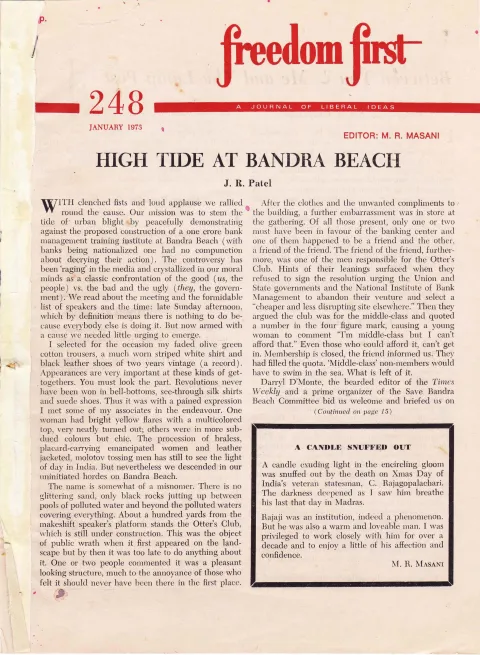
periodical issue
Freedom First
A Journal of Liberal Ideas
By S. V. Raju
Published for the Democratic Research Service by J. R. Patel, Associate Editor, Freedom First at 127, M. Gandhi Road, Bombay 1 ('Phone: 254341) and printed by him at Inland Printers, 55 Gamdevi Road, Bombay 7. · Bombay · 1973
16 pages
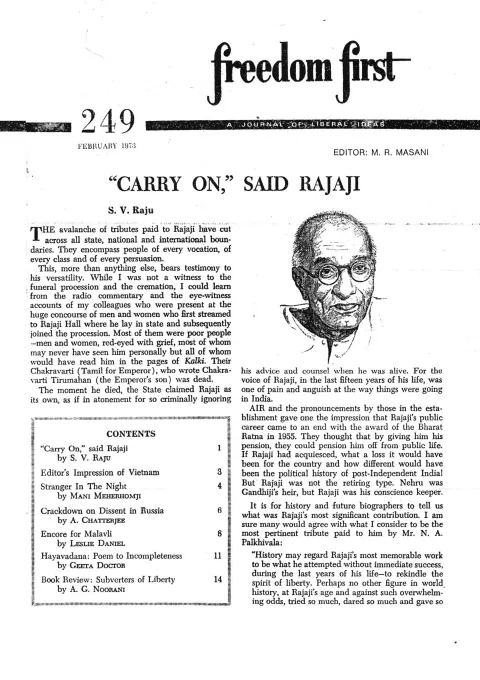
Freedom First
Summary
Freedom First issue no. 249 (February 1973), edited by M. R. Masani, opens with S. V. Raju’s tribute to C. Rajagopalachari (“Rajaji”), who had recently died, recounting his role in founding the Swatantra Party with Masani and his enduring moral authority over its members. The editor reports on his own six-day visit to South Vietnam, including a helicopter flight to the besieged town of An Loc, and relays President Thieu’s and the Vietnamese government’s optimism about the war effort. The issue also carries Mani Meherhomji’s as-told-to profile of an aging Bombay prostitute, A. Chatterjee’s survey of Soviet repression of dissidents (built around Natalia Gorbanevskaya’s book Red Square at Noon), Leslie Daniel’s retrospective assessment of the Malavli youth festival (Sneha Yatra), Geeta Doctor’s review of Girish Karnad’s play Hayavadana, and A. G. Noorani’s skeptical review of J. Bernard Hutton’s book The Subverters of Liberty. The volume’s argumentative center, across pieces on Rajaji, Vietnam, and Soviet dissent, is a defence of individual liberty against both communist and domestic statist overreach, paired with lighter cultural and human-interest reporting characteristic of the magazine’s format.
Key points
-
S. V. Raju’s tribute “‘Carry On,’ said Rajaji” recounts C. Rajagopalachari’s founding of the Swatantra Party with Masani and his final instruction to keep the party’s old guard together.
-
An editorial report on M. R. Masani’s six-day visit to South Vietnam describes his helicopter flight to besieged An Loc and his impression of “stability, strength and high morale”.
-
Mani Meherhomji’s “Stranger In The Night” is an as-told-to account of an aging Bombay prostitute’s decades in the trade and her eventual retreat from it for her daughter’s sake.
-
A. Chatterjee’s “Crackdown on Dissent in Russia” surveys Soviet repression built around Natalia Gorbanevskaya’s account of the 1968 Red Square protest and its dissidents’ psychiatric detention.
-
Leslie Daniel’s “Encore for Malavli” assesses the Malavli Youth Festival as an organisational success that misjudged youth appetite for lectures over music and freedom from supervision.
-
Geeta Doctor reviews Girish Karnad’s play “Hayavadana” as a brilliant if structurally uneven production, criticising Karnad’s treatment of the character Padmini.
-
A. G. Noorani reviews J. Bernard Hutton’s “The Subverters of Liberty” as an unverifiable “parody of Communist plots a Communist might write”.
Essays
”Carry On,” said Rajaji
By S. V. RAJU
S. V. Raju’s tribute describes the outpouring of grief at C. Rajagopalachari’s (Rajaji’s) death and argues that Rajaji spent his last fifteen years as a one-man opposition to Nehru, distressed at India’s drift toward statism. Raju recounts Rajaji founding the Swatantra Party with Masani in 1959 after concluding that Congress had taken a dangerous turn toward a controlling state, quotes Rajaji’s own words on the founding of the party and his critique of “socialism” as a euphemism for statism, and closes with a personal anecdote of Raju’s last meeting with Rajaji in Madras in June 1972, where Rajaji urged him to “carry on” and keep the party’s old guard together.
- Rajaji’s death drew tributes across all political and social lines, which the author reads as testimony to his versatility and reach beyond his own class.
- N. A. Palkhivala’s tribute is quoted at length: Rajaji’s most memorable work was what he attempted without success late in life, to rekindle the spirit of liberty.
- Rajaji considered Nehru’s Congress to concentrate all real political thought around anticipating Nehru’s own mind, leaving no room for dissent.
- Rajaji founded the Swatantra Party with Masani as a deliberate alternative to Congress, the Jana Sangh (seen as communally driven), and a monolithic Communist Party.
- Rajaji attacked ‘socialism’ as a euphemism for Statism, illustrated by his aphorism about paint boxes and pictures.
- By 1973 the Swatantra Party is described as in difficulties, blamed partly on the Congress split but chiefly on the Party’s own failure to live up to Rajaji’s and Masani’s founding standards.
- The author’s personal recollections of Rajaji emphasize his sharp memory, his ‘mischievous twinkle,’ and his terse, businesslike manner even in his eighties.
- The essay ends with Rajaji’s final instruction to the author in June 1972: to ‘carry on’ and keep the Swatantra Party’s ‘old guard’ together.
Editor’s Impression of Vietnam
This unsigned editorial report (attributed to editor M. R. Masani, referred to in the third person) describes Masani’s six-day visit to the Republic of Vietnam at the invitation of the Vietnam Council on Foreign Relations. Masani met Foreign Minister Tran Van Lam and other officials, was briefed by generals Nguyen Van Minh and Hung, flew by helicopter to the besieged town of An Loc to pay tribute to the defending ARVN forces, and visited a rural development programme village. He came away with an impression of ‘stability, strength and high morale,’ congratulated President Thieu on his firm negotiating stance, and reflected that many Indians sympathized with South Vietnam’s fight against Communist expansion.
- Masani visited Vietnam for six days at the invitation of the Vietnam Council on Foreign Relations, departing with an impression of ‘stability, strength and high morale.’
- He met Foreign Minister Tran Van Lam and was briefed by Lt. General Nguyen Van Minh and General Hung, ‘the hero of An Loc.’
- He flew by helicopter to An Loc to honor the ARVN defenders and visited the rural development programme village of An Thanh in Kien Hoa province.
- Masani congratulated President Thieu for resisting a ‘patched up peace’ and invoked Gandhi’s preference for genuine peace over ‘the peace of the grave-yard.’
- The piece frames Indian sympathy for South Vietnam as part of solidarity against Communist expansion in South East Asia.
Stranger In The Night
By MANI MEHERHOMJI
Mani Meherhomji’s feature is an as-told-to account of an aging Bombay prostitute, given the pseudonym ‘Janet,’ who describes her decades in the trade around Colaba and Warden Road: her introduction to sex at sixteen at a Colaba dance school, her methods and those of other prostitutes for extracting extra money from clients (including a detailed account of a woman who drugs and robs clients), her relationships with a ‘Welshman’ and an earlier partner named Casey, the children she bore and in one case gave up for adoption, a period in London where she was arrested for begging, and her eventual retreat from prostitution because her teenage daughter’s disapproval mattered more to her than income. The piece closes on Janet’s reflection that prostitution ‘begins with starvation, poverty and no education’ but ‘once it gets into your blood you can’t give it up.’
- Janet (a pseudonym) recounts her introduction to prostitution at sixteen at a Colaba dance school and her subsequent decades working Colaba and Warden Road.
- She describes tricks used by prostitutes to extract extra money from clients, including one who drugs clients with alcohol, robs their wallets, and sews the cash into her hemline.
- She recounts relationships with two men, ‘Casey’ and a ‘Welshman,’ the children she had by them, and giving up one son for adoption to New Zealand.
- She was briefly arrested by London police for begging with a baby while abroad with the Welshman.
- She stopped active prostitution because her teenage daughter, unaware at first, threatened to disown her if she continued, and that affection mattered more than money.
- Janet frames prostitution as originating in ‘starvation, poverty and no education’ but says the trade, once entered, is nearly impossible to leave.
Crackdown on Dissent in Russia
By A. CHATTERJEE
A. Chatterjee surveys Soviet repression of political dissent, opening with the ideological roots of intolerance of opposition in Lenin- and Stalin-era Marxism and the show trials that consumed early revolutionaries. The article examines the gap between the 1936 Soviet Constitution’s guarantees of speech, press, and assembly and the restrictive criminal-code articles (70, 190/1, 190/3) used to prosecute dissidents, using Natalia Gorbanevskaya’s book Red Square at Noon as its central case study of the August 1968 Red Square demonstration against the invasion of Czechoslovakia and the subsequent trial and psychiatric incarceration of protesters. It surveys the wider dissident movement (the Chronicle of Current Events, the Human Rights Committee, figures such as Sakharov and Solzhenitsyn), and closes with an account of intensified crackdowns (Pyotr Yakir’s arrest, Yuri Galanskov’s death, Buddhist monks arrested) attributed to Soviet anxiety that détente-era openness could destabilize the system.
- The article traces Marxist intolerance of dissent from Lenin and Trotsky through Stalin’s purges of the Revolution’s own founders.
- The 1936 Soviet Constitution’s Article 125 nominally guarantees speech, press, assembly, and demonstration, but is undercut by qualifying phrases and criminal code Articles 70, 190/1, and 190/3.
- Natalia Gorbanevskaya’s book Red Square at Noon documents the August 1968 Red Square protest against the invasion of Czechoslovakia and the arrest, trial, and psychiatric detention of the protesters.
- Psychiatric hospitals under KGB supervision are described as a mechanism for declaring dissent itself a symptom of mental illness.
- A clandestine Human Rights Committee and the underground Chronicle of Current Events sustain a dissident network despite constant risk of arrest.
- Internationally known figures like Sakharov, Solzhenitsyn and Rostropovich are described as relatively protected by their eminence.
- The piece closes on renewed repression — the arrest of Pyotr Yakir, the death of Yuri Galanskov, and the arrest of Buddhist monks — attributed to Soviet fears that détente-era contact with the West could erode the regime’s control.
Encore for Malavli
By LESLIE DANIEL
Leslie Daniel gives a retrospective assessment of the Malavli Youth Festival (‘Sneha Yatra’), conceding it was an organisational achievement but arguing that its planners misjudged the mood of youth by pairing intellectual discussion with entertainment: the young attendees embraced the music, dancing, and camp-style independence from parental supervision, but showed little interest in the planned lectures and debates. Daniel defends the festival against critics who called it a failure, noting some five thousand attendees at peak, well-run and inexpensive catering, and largely creditable behaviour apart from isolated incidents and some off-colour language from the compere that Daniel calls ‘uncalled for and unnecessary.’ He closes advocating for further such youth festivals as a chance for young people to mix across class, creed, and caste lines.
- The Malavli Youth Festival (‘Sneha Yatra’) is judged an organisational success but a misjudgement of youth mood, since planned intellectual discussions failed to engage attendees who wanted holiday-style fun.
- Attendance peaked around five thousand with a resident crowd of about three thousand; catering and accommodation are praised as capable and inexpensive.
- Indian music, initially met with slow appreciation from western-oriented youth, ultimately built rapport with the audience.
- Off-colour language by the compere is criticised as unnecessary and as having given critics of the festival ammunition.
- Daniel argues the festival gave youth a rare chance to be independent of parental supervision and to mix across class, creed and caste lines, and calls for further such festivals.
Hayavadana: Poem to Incompleteness
By GEETA DOCTOR
Geeta Doctor reviews Girish Karnad’s play Hayavadana as staged in English by the Madras Players, calling the production a brilliant success while raising reservations about the play’s structure. She summarises the central plot — the friendship of Devadatta and Kapila, both in love with Padmini, whose heads are accidentally swapped by Padmini after a double suicide and resurrection, leading to a second conflict resolved by the men’s mutual killing and Padmini’s Sati — and the frame story of Hayavadana, the horse-headed man seeking completeness. Doctor praises the folk-play atmosphere, the acting (especially of the two lead men), and the stage’s simple, effective set design, but criticises the play’s tonal shift from tragedy to ‘serio-comic’ business in the Hayavadana frame, argues Karnad is more interested in theme than character, and calls him ‘the typical male chauvinist’ in his treatment of Padmini, whose only means of redemption is self-sacrifice.
- Hayavadana (published 1971, award-winning) is reviewed in its first English production by the Madras Players, directed by Yamuna Prabhu and Lakshmi Krishnamurthy.
- The plot centers on Devadatta and Kapila, both in love with Padmini; a head-swap after their deaths results in a second rivalry that ends with both men killing each other and Padmini’s Sati.
- The frame story follows Hayavadana, a horse-headed man seeking bodily completeness, who eventually becomes a full horse.
- Doctor praises the play’s folk-theatre atmosphere, invocation to Ganesha, chorus staging, and especially the acting of the two male leads after the head exchange.
- She criticizes the abrupt tonal shift from the tragic Sati scene to the ‘serio-comic’ Hayavadana ending as an unsatisfying structural weakness.
- She argues Karnad is more interested in exploring theme than character, faulting his treatment of Padmini as reducing her to ‘a juicy attractive morsel’ redeemed only by self-sacrifice.
Book Review: Subverters of Liberty
By A. G. NOORANI
A. G. Noorani reviews J. Bernard Hutton’s book The Subverters of Liberty, a self-described exposé of a Communist plot to undermine the Western way of life through a covert ‘army’ of subverters directed from Moscow and Peking. Noorani is sharply skeptical of Hutton’s uncheckable sourcing (secret files he cannot name, informers he cannot identify) and mocks the book’s sweeping claims that Soviet and Chinese subversion lies behind everything from student violence to Arab hijackings. He gives qualified credit to the book’s chapter on the Bangladesh genocide and its account of Pakistan’s crackdown, but concludes that the book’s larger claims about a coordinated Sino-Soviet subversion network in South Asia — including named ‘master-subverters’ Jeje Khan and Abdul Hind — amount to unverifiable fantasy, calling it ‘a parody of Communist plots a Communist might write.’
- Hutton’s book claims to expose a coordinated Soviet/Chinese-run ‘army’ of undercover subverters manipulating unrest across the West and South Asia.
- Noorani criticizes the book’s reliance on unverifiable secret sources and unnamed informers.
- The book credits itself with access to coded Peking directives allegedly proving Chinese orchestration of the East Pakistan/West Pakistan/India conflict.
- Noorani gives qualified praise to the book’s chapter on the Bangladesh genocide as offering a useful, if partisan, summary of the 1971 crackdown.
- Noorani concludes the book’s broader conspiracy claims are unproven and self-serving, calling it a fantasy version of Communist subversion that a Communist might have written as parody.
Generated by the v1.5 extraction pipeline. Awaiting editorial review.
Metadata and summary are AI-extracted from the source PDF and reviewed for editorial accuracy. The original work is available via the Read PDF tab above (where present); paragraph-level citation inside the PDF is deferred to a future engagement.