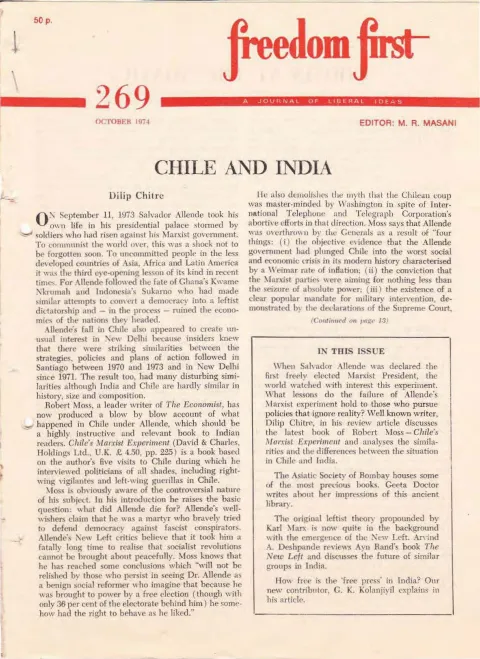
periodical issue
Freedom First
A Journal of Liberal Ideas
By Arvind A. Deshpande, Geeta Doctor, A. H. Doctor, H. R. Pasricha, Joan Contractor, Ramesh M. Bhatt, V. M. D.
Published for the Democratic Research Service by J. R. Patel, Associate Editor, Freedom First at 127, M. Gandhi Road, Bombay 1, and printed by him at Inland Printers, 55 Gamdevi Road, Bombay 7. · Bombay · 1974
16 pages
Freedom First
Summary
Freedom First No. 262 (March 1974), edited by M. R. Masani, is a full issue of this Bombay-based journal of liberal ideas, running the full 16 pages of the print run. The issue opens with Arvind A. Deshpande’s cautious welcome to the newly emerged Dalit Panther movement, weighing its ethical promise against the risk of violence and Marxist capture, and closes with the regular “With Many Voices” page of aggregated press quotations. In between, the unsigned “Between You & Me and The Lamp Post” column surveys current affairs — the Ahmedabad army call-in, the Bombay Central by-election, intemperate language among British and Indian politicians, a mercy-killing bill in the Lok Sabha, and corruption allegations against a former Union Minister drawn from A. G. Noorani’s book Ministers’ Misconduct. Geeta Doctor’s “Under Siege” is a wry first-person account of a student agitation at a Bombay university library. A. H. Doctor reviews Leonard Schapiro’s Totalitarianisms, using it to lay out the defining features of totalitarian rule. H. R. Pasricha’s “Blessings of Indian Socialism” is a satirical polemic against the practice of Indian socialism as a quasi-religious faith used to justify nationalisation, controls, and trade-union extortion. The issue also carries a P.E.N. All-India Centre resolution protesting the exile of Alexander Solzhenitsyn, book and journal reviews, and a review of the film The French Connection.
Key points
-
Arvind A. Deshpande’s “The Panthers We Deserve” welcomes the Dalit Panther movement as a hopeful, ethically-grounded countervailing force in Indian democracy, praising its Gandhian election-boycott tactic while warning against mistaking violence for strength and against capture by a Marxist faction under the poet Dhasal.
-
An unsigned front-page item condemns the Soviet arrest and deportation of Aleksandr Solzhenitsyn as “an insult to the whole world,” quoting Sakharov, and announces Freedom First will publish Solzhenitsyn extracts the following month.
-
The “Between You & Me and The Lamp Post” column covers the army’s welcomed deployment in Ahmedabad, alleges ruling-party defectors secretly helped Communist candidate Roza Deshpande win the Bombay Central by-election, rebuts Indira Gandhi’s complaint about intemperate political language, and quotes A. G. Noorani’s book Ministers’ Misconduct on the 1963 Malaviya-Serajuddin affair.
-
Geeta Doctor’s “Under Siege” is a mock-heroic first-person account of a student siege of a Bombay university library that fizzles out into random vandalism after the protest leadership “ran out of ideas.”
-
A. H. Doctor reviews Leonard Schapiro’s Totalitarianisms, defending the analytical validity of “totalitarianism” against critics like Herbert Spiro and Marcuse by comparing Nazism, Fascism, and Stalinism across five shared contours including the leader cult and subordination of the legal order.
-
H. R. Pasricha’s satirical “Blessings of Indian Socialism” likens Indian socialism to an esoteric faith whose “apostles” keep doctrine vague to extract black-money election contributions, reducing it in practice to nationalisation, state capitalism, and trade-union extortion.
-
Ramesh M. Bhatt reviews Kamalashankar Pandya’s Gujarati autobiography Veran Jivan, contrasting the Gandhian freedom-fighter’s principled withdrawal from public life with contemporaries like Nehru, JP, and Masani who built careers and parties; V. M. D. separately welcomes the launch of the journal Asian Affairs.
-
Joan Contractor’s review of The French Connection praises the film’s deliberate moral “sidelessness” on drug-dealing and Popeye Doyle’s near-amoral, chase-obsessed characterisation.
-
The P.E.N. All-India Centre’s 40th AGM resolution condemning Solzhenitsyn’s expulsion is reported alongside the issue’s statutory ownership filing naming Masani as editor, and the closing “With Many Voices” page compiles quotations from Meany, Kissinger, Brezhnev, and others on Watergate, Britain, and Sri Lanka.
Essays
The Panthers We Deserve
By Arvind A. Deshpande
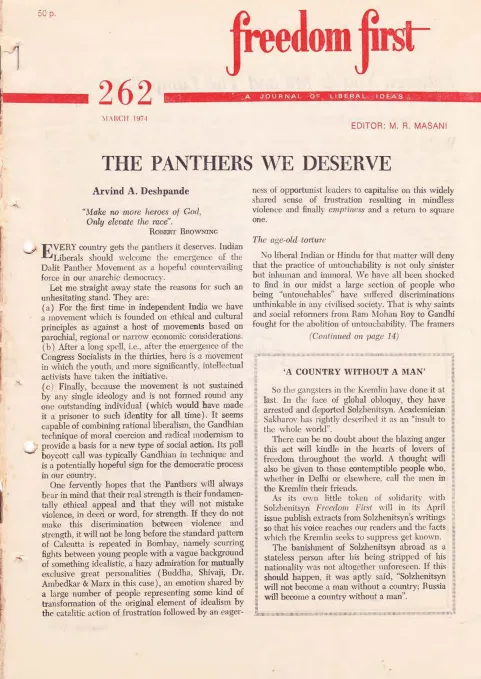
Arvind A. Deshpande argues that Indian liberals should welcome the Dalit Panther movement as a hopeful countervailing force in India’s “anarchic democracy,” citing its ethical and cultural (rather than narrowly parochial or economic) foundation, its capture of youth and intellectual energy last seen in the 1930s Congress Socialists, and its lack of a single binding ideology or leader. He praises its poll-boycott tactic as Gandhian in spirit. He then pivots to a caveat: the Panthers must not mistake violence for strength, lest Bombay repeat the factional street-fighting seen in Calcutta. The essay (continued on page 14) turns to the deeper diagnosis of untouchability as one expression of the broader phenomenon of caste and “pollution,” citing A. C. Mayer and Jayaprakash Narayan on caste’s persistence as India’s most powerful de facto political force. Deshpande traces the movement’s origin to a 1972 Marathi article by Dalit writer Raja Dhale marking a ‘Black Independence Day,’ and to a pamphlet by General Secretary J. N. Pawar. He notes the Panthers’ most significant political act to date, the boycott of a Bombay parliamentary by-election, as a Gandhian gesture, and worries about a Marxist faction under the poet Dhasal that looks to Marx rather than Buddha or Ambedkar, and about the movement’s weak economic thinking and confused sense of political allies. He ends cautiously optimistic, saying the Panthers’ future depends on the support they get from liberal and modernist elements in society.
- Deshpande welcomes the Dalit Panther movement as India’s first major movement founded on ethical/cultural rather than parochial or narrow economic grounds.
- He warns the Panthers must not mistake violence for strength, or Bombay risks repeating Calcutta-style factional street fighting.
- Untouchability is presented as one especially severe expression of the wider phenomenon of caste and ritual pollution, per A. C. Mayer.
- The movement’s origin is traced to Raja Dhale’s 1972 Marathi article calling Independence Day a ‘Black Independence Day’ for the oppressed.
- A Marxist faction of the Panthers led by the poet Dhasal worries the author, since it looks to Marx rather than Buddha or Ambedkar.
- The Panthers’ parliamentary election boycott in Bombay is praised as a genuinely Gandhian tactic.
- The author identifies confused economic thinking and uncertainty about political allies as the movement’s two weakest links.
- The essay closes on cautious optimism, contingent on support from liberal and modernist sections of society.
Under Siege
By Geeta Doctor
Geeta Doctor’s ‘Under Siege’ is a first-person, wryly comic account of a student siege of a university library in Bombay, structured as a mock-heroic narrative of a ‘fort’ under attack by chanting undergraduate protestors (‘Hail Hail Tope!’). The librarian and library staff are portrayed as unequal to the moment, while the narrator and colleagues improvise a defence using stacked encyclopaedias as ammunition. The piece closes by noting that, after the initial excitement, the confrontation dissolved anticlimactically as the student leadership ‘ran out of ideas’ and the crowd dispersed into random vandalism before going home.
- The essay narrates a student protest against the Vice-Chancellor’s office that spilled over into an attempted siege of the university library.
- The library’s physical solidity (stone walls, narrow windows, heavy doors) is comically likened to a mediaeval fort under siege.
- Library staff and campus police are depicted as ineffectual, more focused on maintaining decorum than repelling the crowd.
- The confrontation ultimately fizzles out without resolution, ending in window-breaking and tire-deflating rather than any political outcome.
On Understanding Totalitarianism
By A. H. Doctor
A. H. Doctor reviews Leonard Schapiro’s book Totalitarianisms (Pall Mall, London), presenting it as a timely rebuttal to scholars such as Herbert Spiro, Herbert Marcuse, and Benjamin Barber, who argue that ‘totalitarianism’ is a loaded, outdated Cold War term applicable equally to Western democracies. Doctor summarises Schapiro’s defence of the concept through detailed comparison of three prototypes — Hitler’s Nazism, Mussolini’s Fascism, and Stalin’s Communism — identifying five defining contours: the cult of ‘the leader,’ subjugation of the legal order, an official monopoly ideology, mass mobilisation and manufactured legitimacy, and subordination of party, army, and society to the leader’s personal control. The review closes by recommending the book to students of political science and to citizens of both democracies and ‘people’s democracies’ as a diagnostic tool for detecting totalitarian drift.
- Doctor frames the review as a defence of the analytical validity of ‘totalitarianism’ against critics like Herbert Spiro and Herbert Marcuse who call it a loaded Cold War term.
- Schapiro’s book studies three prototypes: Nazism under Hitler, Fascism under Mussolini, and Communism under Stalin.
- Schapiro identifies five contours of totalitarian systems, including the leader cult, subjugation of law, monopoly ideology, mass mobilisation, and subordination of the party/army/police.
- The 1971 forcible confinement of Soviet scientist Zhores Medvedev in a mental asylum is used as a concrete illustration of the difference between totalitarian and democratic systems.
- The review argues Western democracies retain independent courts and legal recourse that Soviet citizens structurally lack, rebutting claims of moral equivalence.
Blessings of Indian Socialism
By H. R. Pasricha
H. R. Pasricha’s ‘Blessings of Indian Socialism’ is a satirical polemic likening Indian socialism, as actually practised, to an esoteric faith whose priesthood (‘the apostles’) keeps its doctrine deliberately vague in order to extract black-money contributions from businessmen at election time while offering the common man the illusion of an approaching millennium through nationalisation. Pasricha argues that the residue of socialism once genuine social welfare is subtracted is simply nationalisation and state capitalism, and mocks compulsory grain procurement, land-ceiling legislation that fragments holdings to ‘postage stamp’ size, and the trade-union leadership that has grown up under the apostles’ patronage, extracting hush money from industrialists through strike threats. The piece ends by mocking the pretension that Indians possess a unique ‘genius’ for muddling any undertaking, closing with an Economist quotation about Britain and Argentina and a claim that the government is busy fulfilling the Marxian prophecy that the state will ‘wither away’ — in the wrong sense.
- Indian socialism is likened to an ‘esoteric faith’ whose priesthood deliberately keeps doctrine vague to serve its own interests.
- Socialism minus genuine social welfare, in Pasricha’s formulation, reduces simply to nationalisation and state capitalism.
- Trade union leaders are described as a new class that has matured under the encouragement of the socialist establishment, extracting hush money from industrialists via strike threats.
- Compulsory grain procurement and land-ceiling laws that fragment holdings to ‘postage stamp’ size are cited as examples of counterproductive socialist remedies.
- The essay closes by satirically suggesting the government is inadvertently fulfilling the Marxian prophecy of the state ‘withering away.‘
The French Connection (Film review)
By Joan Contractor
Joan Contractor reviews the film The French Connection, describing it as a tightly paced, morally ‘detached’ thriller about two New York narcotics agents chasing a heroin shipment. The review argues the film deliberately withholds any sociological or moral commentary on drug dealing, instead letting the audience become complicit ‘players in the game of catch-the-criminal’ alongside the protagonist Popeye Doyle, whose motivation is presented as a nearly amoral obsession with the chase itself rather than any stated ethical or professional purpose.
- The film is read as deliberately ‘sideless,’ refusing moral or sociological commentary on drug dealing despite ample opportunity.
- Audience sympathy for the police over the drug dealers is called ‘ironic’ given the police’s own carelessness with bystanders’ safety.
- Popeye Doyle’s motivation is presented as an almost monomaniacal desire to catch criminals, unconnected to stated moral revulsion or career ambition.
- The review credits screenwriter Ernest Sudyeman and director William Shielkin with the skill of presenting a genuinely ‘sideless’ story.
Reviews: Life in the Wilderness (Veran Jivan by Kamalashankar Pandya)
By Ramesh M. Bhatt
The Reviews page carries two items. Ramesh M. Bhatt reviews Veran Jivan, the Gujarati-language autobiography of Kamalashankar Pandya, a Gandhian freedom-fighter and lifelong public worker educated at Gandhi’s Gujarat Vidyapeeth, who devoted his life to Panchmahals district but ended up, in Bhatt’s reading, a disillusioned misfit as former socialist colleagues like Nehru, J. P., Ashoka Mehta, Lohia, and Masani went on to found parties and occupy high office while he himself withdrew from public life. V. M. D. separately welcomes the launch of a new bi-monthly journal, Asian Affairs — An American Review, edited by William Henderson and published by Crane, Russak & Co. for the American-Asian Education Exchange, describing its first issue as containing serious, if densely academic, articles on Asian and American-Asian policy.
- Ramesh M. Bhatt reviews Kamalashankar Pandya’s Gujarati autobiography Veran Jivan, describing Pandya as a Gandhian freedom fighter turned disillusioned public worker in Panchmahals district.
- The review contrasts Pandya’s principled withdrawal from politics with contemporaries like Nehru, J. P., Ashoka Mehta, Lohia, and Masani who built parties and careers.
- V. M. D. reviews the debut issue of the bi-monthly Asian Affairs — An American Review, noting its focus on Asian and American-Asian policy questions and its high, semi-academic register.
Reviews: A Welcome Journal (Asian Affairs review)
By V. M. D.
No summary was extracted for this article. Listed for completeness.
Between You & Me and The Lamp Post
The regular unsigned column ‘Between You & Me and The Lamp Post’ runs across pages 2-5, covering a run of short current-affairs items: the Army’s belated but well-received deployment during Ahmedabad’s civic unrest (with a cartoon lampooning Indira Gandhi as a tank commander addressing ‘95% of the people of India’); the Bombay Central by-election, in which defectors from the ruling party are said to have secretly thrown their weight behind the Communist candidate Roza Deshpande to defeat their own official nominee; a roundup of intemperate language used against political leaders in Britain (Edward Heath called ‘pig-headed’ and a ‘latter-day Nero’) and America (Nixon’s own supporters questioning his ‘mental and emotional stability’), contrasted with Mrs Gandhi’s complaint about harsh political language in India; a note on the introduction of a Mercy Killing bill in the Lok Sabha by Congress MP M. C. Daga; commentary on Mrs Gandhi’s (‘the Empress in Decline,’ per The Economist) turn toward Communist allies and the appointment of K. D. Malaviya, a figure the column brands ‘Moscow’s man’; and a long excerpt from A. G. Noorani’s book Ministers’ Misconduct detailing the 1963 Malaviya-Serajuddin financial-impropriety affair and Nehru’s resistance to a full public inquiry.
- The Army’s presence in Ahmedabad was welcomed by crowds even as ministers and ruling-party members feared to move about in public.
- The column alleges Trojan-horse defectors within the ruling party secretly helped the Communist candidate Roza Deshpande win the Bombay Central by-election.
- A survey of vitriolic language against Heath, Nixon, Churchill, and other Western leaders is used to rebut Mrs Gandhi’s complaint that Indian political discourse is uniquely intemperate.
- A Mercy Killing bill introduced by Congress MP M. C. Daga passed a Lok Sabha leave-to-introduce vote 71 to 15.
- K. D. Malaviya’s appointment as Cabinet Minister for Steel and Mines is read as a further step toward Soviet ‘satellitism.’
- A lengthy quotation from A. G. Noorani’s Ministers’ Misconduct recounts the 1963 Malaviya-Serajuddin affair, in which Nehru resisted a full judicial inquiry and refused to publish Justice S. K. Das’s report.
Solidarity with Solzhenitsyn: Indian Writers’ Protest
An unsigned box item on page 1 reacts to the Soviet arrest and forced deportation of Aleksandr Solzhenitsyn, describing it as an ‘insult to the whole world’ (quoting Andrei Sakharov) and announcing that Freedom First will publish extracts from Solzhenitsyn’s writing in its April issue as a gesture of solidarity.
- The Kremlin’s arrest and deportation of Solzhenitsyn, stripping him of citizenship, is condemned as an outrage.
- Academician Sakharov’s description of the act as ‘an insult to the whole world’ is quoted approvingly.
- Freedom First announces it will publish Solzhenitsyn extracts in its April 1974 issue in solidarity.
- The item closes with the epigram that Solzhenitsyn will not become a man without a country, but Russia will become a country without a man.
An unsigned notice reports that the P.E.N. All-India Centre, at its 40th Annual General Meeting on 18 February 1974, unanimously adopted a resolution deploring the Soviet expulsion and denaturalisation of Aleksandr Solzhenitsyn, expressing sympathy for him as a fellow writer and resolving to forward the resolution to Solzhenitsyn, to Soviet Chairman Podgorny, and to the press. The same page carries the mandatory ‘Statement About Ownership’ filing (Form IV) for Freedom First, naming J. R. Patel as printer and publisher, M. R. Masani as editor, and the Democratic Research Service as the owning entity.
- The P.E.N. All-India Centre’s 40th AGM (18 February 1974) unanimously condemned Solzhenitsyn’s expulsion and denaturalisation.
- The resolution was to be forwarded to Solzhenitsyn himself, to Soviet Chairman Podgorny, and to the press.
- The issue’s statutory ownership filing lists J. R. Patel as printer/publisher and M. R. Masani as editor, with the Democratic Research Service as owning entity.
With Many Voices
The closing page, ‘With Many Voices,’ is the magazine’s regular feature collecting short quotations from the world and Indian press on current events, spanning commentary on Nixon and Watergate, Kissinger’s negotiating philosophy, British political instability, the Bombay Prime Ministerial visit, food shortages and hoarding, and the state of Sri Lankan politics, closing with subscription information for Freedom First.
- The page compiles quotations from figures including George Meany, Henry Kissinger, Lord Atlee, Romesh Thapar, Indira Gandhi, Leonid Brezhnev, and Maurice Zinkin.
- Quotations touch on Nixon’s credibility, British political crisis, Indian foodgrain shortages, and Sri Lanka’s politics-economics mix.
- The page doubles as the issue’s subscription order form for Freedom First.
Generated by the v1.5 extraction pipeline. Awaiting editorial review.
Metadata and summary are AI-extracted from the source PDF and reviewed for editorial accuracy. The original work is available via the Read PDF tab above (where present); paragraph-level citation inside the PDF is deferred to a future engagement.