periodical issue
Freedom First
A Journal of Liberal Ideas
By S. V. Raju
Published for the Democratic Research Service by J. R. Patel, Associate Editor, Freedom First at 127, M. Gandhi Road, Bombay 1 ('Phone: 254341) and printed by him at Inland Printers, 55 Gamdevi Road, Bombay 7. · Bombay · 1974
16 pages
Freedom First
Summary
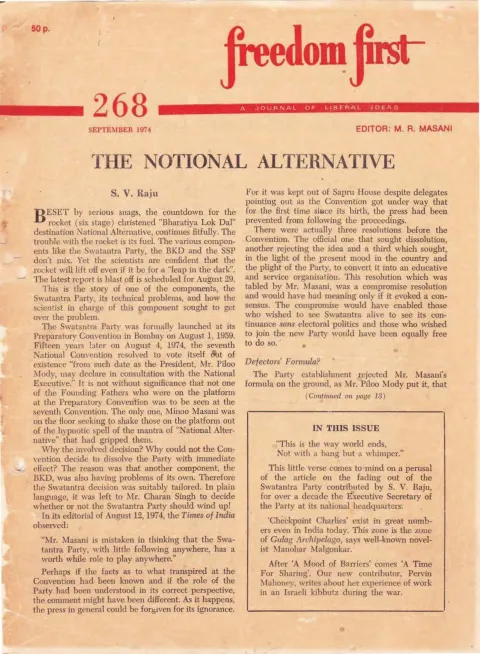
Freedom First issue 268 (September 1974), edited by M. R. Masani, is a miscellany of liberal commentary anchored by S. V. Raju’s lead essay ‘The Notional Alternative,’ which chronicles the Swatantra Party’s slow dissolution into a proposed six-party ‘National Alternative’ coalition (soon to be the Bharatiya Lok Dal), arguing the merger is a misnomer for what is really only a ‘notional’ rather than a genuine alternative to Congress. The unsigned ‘Between You and Me and The Lamp Post’ column takes up press freedom in Britain and India, Indira Gandhi’s ‘monopoly capitalism/fascism’ rhetoric, Soviet forced-labour camps, and a satirical dig at the ruling party’s economic record. Manohar Malgonkar contributes a short travel piece on multiplying police checkposts between Goa and Karnataka. Pervin Mahoney’s ‘A Time for Sharing’ is a first-person memoir of volunteering on an Israeli kibbutz through the outbreak of the Yom Kippur War. Ian Tickle’s ‘Explosive Uncertainty’ analyses the diplomatic fallout in Pakistan and Bangladesh from India’s 1974 nuclear test. Three signed book reviews cover a study of fascism, Balraj Madhok’s Jana Sangh-inflected account of Indian politics, and two journalistic histories of the D.M.K.’s rise in Tamil Nadu. The issue closes with a reader’s letter on foreign correspondents’ coverage of the nuclear test, a short item on a Soviet contingency plan for invading Yugoslavia after Tito’s death, and the regular ‘With Many Voices’ page of quotations.
Key points
-
S. V. Raju’s “The Notional Alternative” chronicles the Swatantra Party’s acrimonious dissolution into the proposed six-party “National Alternative” (soon Bharatiya Lok Dal) at its August 1974 convention, marked by gerrymandered delegate quotas and rejection of M. R. Masani’s compromise proposal to convert the party into a non-electoral “Swatantra Sewa Sangh.”
-
The “Between You & Me and The Lamp Post” column contrasts British proposals to centralise BBC broadcasting with an Italian court striking down state broadcast monopoly, accuses Indira Gandhi of “typical Communist jargon” in blaming “monopoly capitalism” for fascism, and reports the ILO’s censure of the USSR for forced labour.
-
Manohar Malgonkar’s “A Mood of Barriers” describes the proliferation of police checkposts (from two to five) between Goa and Karnataka, dubbing the searched zone “Gulag Archipelago” and arguing the repressive liquor and rice laws, not petty bribery, are the real problem.
-
Pervin Mahoney’s “A Time for Sharing” recounts volunteering on an Israeli kibbutz through the outbreak of the Yom Kippur War, when men were mobilised within 24 hours and the couple eventually fled via a heavily searched Lod Airport departure.
-
Ian Tickle’s “Explosive Uncertainty” argues India’s professed surprise at Pakistani anger over its nuclear test is hard to credit given longstanding Pakistani fears that India never accepted partition as final, while noting little genuine Indian effort to heal the post-1971 breach.
-
P. N. Driver reviews Paul Hayes’s Fascism, endorsing its rejection of the orthodox Marxist view of fascism as merely a last gasp of the propertied classes and its analysis of why Weimar German parties were too enfeebled to resist the Nazis.
-
Reviews of Balraj Madhok’s Jana Sangh-inflected Murder of Democracy and two K. S. Ramanujam books on the D.M.K.’s rise in Tamil Nadu cover, respectively, Charan Singh’s disillusionment with Sangh caste exclusivity and the D.M.K.’s retreat from secessionism once in power.
-
A reader letter signed “A Real Indian” cites a New Yorker report finding no jubilant Indians after the nuclear test, only cynicism about cooking oil and water, while a news item reports defector Jan Sejna’s disclosure of a Soviet plan, “Polarka,” to invade Yugoslavia upon Tito’s death.
-
The closing “With Many Voices” page quotes Walter Laqueur’s remark that Mrs. Gandhi inherited her father’s arrogance without his redeeming qualities.
Essays
The Notional Alternative
By S. V. Raju
S. V. Raju, for over a decade the Swatantra Party’s Executive Secretary, narrates the party’s protracted self-dissolution into a proposed ‘National Alternative’ — a six-component merger with the BKD, SSP and others meant to challenge Congress. He describes the acrimonious seventh National Convention (August 1-4, 1974) at which a compromise resolution by M. R. Masani — converting Swatantra into a non-political ‘Swatantra Sewa Sangh’ rather than dissolving it outright — was rejected by the party establishment as unworkable. The piece, continued from page 1 to pages 13-15, details the gerrymandering of convention delegates, the barracking of dissenting speakers, the rejection of a secret ballot, and the substantive objections of the 53 dissenting delegates: that the ‘national alternative’ label was a misnomer since major opposition parties like the Akali Dal and D.M.K. had declined to join, that the new party would secure no more votes than its components already held individually, and that key sponsors’ inconsistent public statements undercut confidence in the venture. Raju closes by arguing the party was broken up by the very methods — money power, manufactured conformity, meaningless slogans — that it had always stood against, and notes that Congress and the Communists, tellingly, ignored the new formation and concentrated their attacks on Jayaprakash Narayan instead.
- The Swatantra Party’s seventh National Convention (August 1-4, 1974) voted to dissolve itself into a new ‘National Alternative’ coalition, with the effective date left to Charan Singh’s discretion.
- M. R. Masani proposed a compromise resolution converting Swatantra into a non-electoral service organisation, the ‘Swatantra Sewa Sangh,’ which the party establishment rejected.
- The Convention was marked by gerrymandered delegate quotas (209 of 483 delegates from U.P. alone), barracking of dissenters, denial of a secret ballot, and reports of intimidation and vote-buying.
- Fifty-three delegates recorded formal dissent, and five states (Tamil Nadu, Maharashtra, Haryana, Kerala, Delhi) announced they would continue as Swatantra locally if the central party dissolved.
- The dissenters argued the ‘national alternative’ was better described as a ‘notional alternative,’ since major parties like the Akali Dal and D.M.K. stayed out and the new party’s founding leaders were already contradicting one another publicly.
- Raju frames the episode as ideologically significant: Swatantra’s clarity of principle, even in decline, contrasted with the power-driven, slogan-based methods that dissolved it.
Between You & Me and The Lamp Post
This unsigned editorial column of short items opens by contrasting a British Labour committee’s proposal to abolish the BBC’s independence and centralise broadcasting under government nominees with an Italian constitutional court ruling striking down state broadcasting monopoly, and asks whether a similar challenge could succeed in India. It reports Ljubo Sirc’s letter to the Daily Telegraph recounting his own show trial and imprisonment in Yugoslavia, used to needle PEN International for entertaining his former interrogator. A further item accuses Indira Gandhi of ‘typical Communist jargon’ for blaming ‘monopoly capitalism’ for supporting ‘fascist’ forces in India, arguing the only monopoly capitalism in the country is the government sector’s. Other items cover a train of Congress youth rally-goers dubbed a ‘Vandal Special’ by the press after looting stalls and molesting women passengers; a Lebanese Progressive Socialist Party leader’s admiring remarks about Hitler; the ILO’s censure of the USSR for forced labour in violation of a 1956 anti-forced-labour convention it had signed; and the debunking, by exiled Soviet gerontologist Dr. Zhores Medvedev, of Soviet propaganda claims about extreme-longevity ‘centenarians’ in the Caucasus.
- A British Labour Party committee proposed abolishing the BBC’s independence and centralising broadcasting under government nominees, which the column calls a setback for press freedom, contrasted with an Italian court ruling against state broadcast monopoly.
- Ljubo Sirc, a Glasgow University lecturer, is reported recalling his own death sentence and imprisonment in a Yugoslav show trial, used to criticise PEN International for entertaining his former captor Mr. Ribicic.
- The column accuses Indira Gandhi of using ‘typical Communist jargon’ in blaming ‘monopoly capitalism’ for backing fascist forces in India.
- A Congress youth rally special train from Delhi was found, on search, to be carrying looted liquor, rice and contraceptives, and was dubbed a ‘Vandal Special’ rather than ‘Youth Special’ by the press.
- The ILO voted 3:1 to list the USSR among nations non-compliant with anti-forced-labour conventions, the first time a ‘great power’ had been so listed.
- Soviet gerontologist Dr. Zhores Medvedev, in exile in London, is cited debunking the Soviet ‘Methuselah cult’ claiming implausible centenarian ages in the Caucasus as unsupported by valid birth records.
A Mood of Barriers
By Manohar Malgonkar
Manohar Malgonkar’s short travel piece contrasts the ease of long-distance bus travel in America and Britain, where he was never once stopped at a barrier, with the multiplying police checkposts on the sixteen-mile stretch between Goa and Karnataka — now five checkposts where there were only two under Portuguese rule. He describes the thorough, often degrading searches conducted at each barrier (ostensibly for liquor, given Karnataka’s absence of prohibition combined with strict local liquor law enforcement, and separately for rice), names the zone ‘Gulag Archipelago,’ and argues that the true villain is not the corruption that lets a one-rupee note smooth a traveller’s passage, but the repressive law itself that manufactures the conditions for such petty corruption.
- Malgonkar contrasts his barrier-free bus travel across America and Britain with the five police checkposts now standing on the sixteen-mile Goa-Karnataka route, up from two under Portuguese rule.
- He describes the checkposts’ searches as thorough and sometimes ‘agonizing,’ covering liquor (Karnataka bans possession even for personal use despite having no prohibition) and separately, rice.
- He dubs the zone between the two Goan and Karnataka checkposts ‘Gulag Archipelago’ and describes the roadside barrier crews’ undisguised relish in searching luggage.
- Malgonkar argues that petty bribery to avoid a search is not the real problem; the real villain is the repressive law itself, which drives even law-abiding travellers to bribe.
- The piece closes with a warning to future travellers to Goa to prefer flying and to carry patience if driving through the Majali or Anmode routes.
A Time For Sharing (Life in a Kibbutz)
By Pervin Mahoney
Pervin Mahoney recounts volunteering with her husband on an Israeli kibbutz, drawn by curiosity about collective living within a democracy. She describes the arrival at Lod Airport amid tension from a recent Japanese Red Army raid, the communal work in banana fields and fruit orchards under a strict 4 a.m. wake-up routine, the camaraderie and occasional friction among an international mix of volunteers and drifters, a raucous watermelon fight, and the observance of Passover despite the kibbutz’s otherwise informal, secular character. The piece pivots sharply when the Yom Kippur War breaks out: men are mobilised and driven away within 24 hours, the kibbutz — close to the Jordanian border and already scarred by years of nightly shelter use during the Six Day War era — reorganises its labour, and the couple eventually flee via a circuitous flight out of Israel, undergoing an intensive security search at Lod Airport before departure.
- The author and her husband volunteered on an Israeli kibbutz out of curiosity about collective living within a democracy, arriving via an uneventful El Al flight to a heavily guarded Lod Airport.
- Daily life involved a punishing 4 a.m. start for fieldwork (fruit, banana plantations), communal meals, and off-hours for swimming, films and socialising; a watermelon fight among volunteers is recounted at length as an emblem of the community’s rough camaraderie.
- Passover was observed with unusual formality compared to the kibbutz’s otherwise casual, secular daily life, though younger volunteers’ antics undercut the ceremony.
- The Yom Kippur War’s outbreak is announced by a quiet knock and the words ‘A war has started’; men are mobilised and taken away within 24 hours, and the kibbutz — near the Jordanian border — reorganises around women, children and volunteers.
- The couple eventually decide to leave, competing with crowds of tourists for any outbound flight and enduring an intensive Lod Airport security search suspicious of their having stayed in an Israeli-occupied West Bank town.
Explosive Uncertainty
By Ian Tickle
Ian Tickle examines the diplomatic fallout of India’s 1974 Rajasthan nuclear test on relations with Pakistan and Bangladesh. He argues the Indian government was disingenuous in professing surprise at Pakistan’s indignant reaction, given deep-seated Pakistani fear that India has never fully accepted 1947 partition as permanent, a fear reinforced by India’s role in Bangladesh’s secession and by suspicion of Indian involvement in unrest in Baluchistan and the North West Frontier. He notes growing suspicion in Bangladesh too, despite recent efforts to heal relations after the 1971 killings, citing the enthusiastic popular reception of President Bhutto’s visit to Dacca as evidence of renewed Bengali fear of India. Tickle concludes there is little evidence of actual Indian aggressive intent toward Pakistan, but equally little genuine effort to heal the breach, and cites a British government minister’s remark at a Geneva disarmament meeting questioning India’s peaceful assurances.
- Tickle argues India’s professed surprise at Pakistan’s angry reaction to its nuclear test is hard to credit given deep, longstanding Pakistani fears that India never accepted partition as final.
- He cites Pakistani suspicion of Indian involvement in unrest in Baluchistan and the North West Frontier, on top of the 1971 Bangladesh secession, as compounding factors.
- Despite recent Indian efforts to build friendly relations with Bangladesh after the 1971 massacres, Tickle notes growing suspicion there too, evidenced by the warm popular reception given President Bhutto during his Dacca visit.
- A British government minister at a Geneva disarmament meeting on July 8 is quoted doubting India’s assurances of peaceful nuclear intent.
- Tickle concludes there is little evidence of genuine Indian aggressive intent toward Pakistan, but also little real determination on India’s part to heal the post-partition breach.
Reviews: Fascism Explained
By P. N. Driver
P. N. Driver reviews Dr. Paul Hayes’s ‘Fascism’ (George Allen & Unwin), calling it a badly needed, accurate introduction to fascist theory notwithstanding the absence of any single canonical fascist text comparable to Das Kapital. He summarises Hayes’s rejection of the orthodox Marxist view that fascism was merely a last gasp of the propertied classes, noting Hayes’s argument that fascism, rooted in a form of economic nationalism, can arise in underdeveloped as well as developed societies. The review highlights Hayes’s account of why fascism failed to take root in Britain (the absence of felt need for new solutions to old economic grievances) and his chapter on why other political parties in Weimar Germany were too enfeebled and habituated to compromise to resist the Nazis effectively — with an extended quotation about the bourgeoisie surrendering to the Nazis because they promised security.
- Driver praises Hayes’s ‘Fascism’ as an accurate, badly needed introduction given the absence of any canonical fascist theoretical text.
- Hayes rejects the Marxist view of fascism as merely a desperate throw of the propertied classes, arguing it can recur in developed or underdeveloped societies alike.
- Hayes analyses fascism as most likely to flourish where there is a process of attempted economic change, and cites Nkrumah’s Ghana and Toure’s Guinea as examples outside the classic European cases.
- The review notes Hayes’s explanation of why fascism did not spread in Britain: the absence of any felt need for new solutions, given confidence that traditional remedies would cure unemployment.
- Driver highlights Hayes’s chapter 14 analysis of why German, Italian and other parties were enfeebled in opposing fascism, quoting Hayes’s comment that the German bourgeoisie ‘surrendered to the Nazis because they offered security.‘
Reviews: The Sangh Version
By V. B. Karnik
R. Srinivasan reviews Balraj Madhok’s ‘Murder of Democracy’ (S. Chand, New Delhi, 1973), describing it not as scholarly history but as a Jana Sangh-inflected ideological account of recent Indian politics, sympathetic to Sardar Patel and suspicious of Nehru’s capacity to govern. The review traces Madhok’s arguments that the Jana Sangh, founded by S. P. Mookerjee, was meant to fill the vacuum left by Patel’s death; that a missed opportunity for cooperation among opposition parties came after the 1967 elections; that Dr. Lohia’s ‘nihilistic’ anti-Congressism contributed to opposition disarray; and that the Jana Sangh itself bears responsibility for poor performance in several states. Srinivasan notes the book’s ambivalent treatment of Lal Bahadur Shastri and Charan Singh’s disillusioned remarks to Madhok about the RSS’s caste exclusivity, and closes that the book is clearly written with no ambiguity about the author’s own political stance, though it offers little on inner-party factional struggles.
- Madhok’s book is characterised as an ideological Jana Sangh account of recent Indian politics rather than scholarly history, sympathetic to Patel and suspicious of Nehru’s governing capacity.
- Madhok argues the Jana Sangh, founded by S. P. Mookerjee, was meant to fill the vacuum after Patel’s death, and quotes Mookerjee’s harsh assessment that no single man did India greater harm than Nehru.
- The book identifies the 1967 elections as a missed opportunity for opposition unity, and blames Dr. Lohia’s ‘nihilistic’ anti-Congressism for opposition disarray thereafter.
- Srinivasan recounts Charan Singh’s remark to Madhok that he had grown disillusioned with the Jana Sangh because it was narrow-minded and that no one who is not a Brahmin can have any place in the Sangh.
- The review notes the book offers proposals for election-machinery reform but concedes these are ‘of more academic interest’ since there is no possibility of their being enforced, and it says very little about inner-party factional struggles.
Reviews: Politics of D.M.K.
By R. Srinivasan
V. B. Karnik reviews two books by K. S. Ramanujam on the D.M.K.’s rise and rule in Tamil Nadu: ‘The Big Change,’ written after the 1967 election that brought D.M.K. to power, and ‘Challenge and Response,’ subtitled ‘an intimate report on Tamil Nadu politics (1967-71).’ Karnik praises the author’s journalistic access to figures including Rajaji and Annadurai and calls the account objective and interesting despite its journalistic rather than scholarly style. He summarises the argument that D.M.K.’s 1967 victory was significant less because Congress lost — it lost elsewhere too — than because D.M.K. provided a strong, stable alternative government, and traces the party’s 1971 mid-term poll victory (aided by Indira Gandhi’s support) despite the deaths of Annadurai and the loss of Rajaji’s backing. Karnik notes the books candidly record D.M.K.’s retreat from its earlier secessionist slogan and rationalist positions, and its failure to remain free of corruption, including an internal split whose long-term effects on the party cannot yet be foretold.
- The two books under review trace D.M.K.’s rise to power after the 1967 Tamil Nadu election and its consolidation through the 1971 mid-term poll.
- Karnik credits the author’s close personal relations with leading figures, including the late Rajaji and the late Annadurai, D.M.K.’s founder and first Chief Minister.
- The books argue D.M.K.’s 1967 victory mattered chiefly because it delivered a strong, stable government, unlike other states where Congress also lost but no comparable alternative emerged.
- D.M.K.’s 1971 mid-term poll victory increased its vote share from 38.18% (1967) to 41.92%, aided by the counterveiling support of Indira Gandhi and Congress despite the deaths of Annadurai and the loss of Rajaji’s backing.
- Karnik notes the books record D.M.K.’s retreat from its secessionist slogan and rationalist, anti-superstition emphasis once in power, and its failure to remain free of the ‘all-pervading disease of corruption,’ including a party split whose effects remain unclear.
Letter: “Real Indians” and Others
By A “Real Indian”
A reader signing as ‘A Real Indian’ writes in response to an earlier Freedom First article (‘The Big Bang’) that had complained American correspondents in India could not find an Indian unmoved by the Rajasthan nuclear test. The letter cites a New Yorker piece (July 22, 1974) quoting an Indian writer from New York who likewise found no jubilant Indians, only cynical, shrugging people more worried about cooking oil, water and mosquitoes than the bomb, and notes that cartoonist Laxman had been scathing about the disconnect between the test and the country’s poverty.
- The letter responds to a prior Freedom First article complaining that foreign correspondents assumed all Indians were thrilled by the nuclear test.
- It cites a New Yorker (July 22, 1974) piece quoting an Indian writer in New York who similarly reported meeting no jubilant Indians after the test, only cynical, shrugging ones.
- The correspondent notes ordinary Indians’ priorities were cooking oil, water, and mosquito-borne disease rather than the bomb.
- Cartoonist Laxman is cited as having been scathing, depicting starving villagers juxtaposed with politicians celebrating the bomb.
When Tito Dies
A short unsigned news item reports disclosures by defected Czechoslovak Major General Jan Sejna, in interviews with the Austrian magazine Profil, of a Soviet contingency plan codenamed ‘Polarka’ from the late 1960s for a Warsaw Pact invasion of Yugoslavia to begin immediately upon Marshal Tito’s death, led by Czechoslovak troops with KGB and local collaborator involvement, and asks whether such a plan still exists.
- Defected Czechoslovak Major General Jan Sejna disclosed to Austrian magazine Profil a Soviet-devised plan, ‘Polarka,’ for invading Yugoslavia upon Tito’s death.
- The plan envisaged a Warsaw Pact invasion of East Austria led by Czechoslovak troops, followed by occupation of South Austria and then invasion of Yugoslavia to reintegrate it into the Soviet bloc.
- The plan reportedly included lists of public figures marked for immediate arrest and relied on roughly 4,000 collaborators within the Austrian police and security forces.
- The Austrian Defence Minister confirmed awareness of such a plan and said Profil’s publication had been cleared by the Foreign Minister.
- The item suggests the 1968 Soviet invasion of Czechoslovakia was necessary groundwork for ‘Polarka’ and asks whether an equivalent plan persists today.
With Many Voices
The closing page, ‘With Many Voices,’ is the magazine’s regular column of unattributed and attributed quotations from world press and public figures, taking its title from Tennyson’s ‘Ulysses.’ The quotations range across cease-fire politics in Nagaland, Soviet mentality, Kissinger on caviar, Harold Wilson’s political prospects, India’s nuclear test being ‘for civil engineering purposes,’ and closes with Walter Laqueur’s remark that Mrs. Gandhi inherited her father Jawaharlal Nehru’s arrogance and self-righteousness without his redeeming qualities.
- The page is a curated set of quotations from sources including The Economist, Time, National Review, Newsweek and Commentary, framed by an epigraph from Tennyson’s ‘Ulysses.’
- One quotation from the Daily Telegraph mocks the claim that India’s nuclear test was ‘for civil engineering purposes.’
- M. N. Roy is quoted (from ‘Problems of Communism,’ March-April 1974) recalling a joke that he was considered a true Communist by Polish Communists of the Luxemburg school, while Lenin was seen as a nationalist.
- The page closes with Walter Laqueur’s remark in Commentary (August 1974) that Mrs. Gandhi inherited her father’s arrogance and self-righteousness but few of his redeeming features.
- The subscription coupon for Freedom First, addressed to the Democratic Research Service in Bombay, appears on the same page alongside the publication’s imprint.
Generated by the v1.5 extraction pipeline. Awaiting editorial review.
Metadata and summary are AI-extracted from the source PDF and reviewed for editorial accuracy. The original work is available via the Read PDF tab above (where present); paragraph-level citation inside the PDF is deferred to a future engagement.