periodical issue
Freedom First
Is Solzhenitsyn Right?
By M. R. Masani, Robert C. Toth, Thomas W. Lippman, S. P. Aiyer
Published for the Democratic Research Service by J. R. Patel, Associate Editor, Freedom First at 127, M. Gandhi Road, Bombay 1 (Phone: 254341) and printed by him at Inland Printers, 55 Gamdevi Road, Bombay 7 · Bombay · 1976
16 pages
Freedom First
Summary
Freedom First No. 281 (April 1976), edited by M. R. Masani, opens with an editorial invoking Alexander Solzhenitsyn’s BBC Panorama interview of 1 March 1976 as vindication of the magazine’s long-standing warnings about Western appeasement of Soviet totalitarianism, and links it to domestic developments under the Emergency, including the Maharashtra Bar Council’s resolution urging revocation of the proclamation. The unsigned ‘Between You & Me and The Lamp Post’ column comments on the dismissal of state governments in Tamil Nadu and Gujarat, the Union Budget, Lord George-Brown’s resignation from the British Labour Party, the Rhodesian crisis, and the Labour leadership contest. World News items cover the Solzhenitsyn interview in full, a Soviet Glavlit book-smuggling scandal, and North Korean dynastic politics, plus a review of a controversial Cairo film about Nasser-era secret police torture. The bulk of the issue (pages 8-14) reproduces the Bombay High Court Division Bench’s judgement on a censorship case brought under Emergency press-censorship guidelines, examining item by item whether nine specific Freedom First articles were rightly banned, and finding for the magazine on all but one item plus one earlier-decided item. The issue closes with a critical book review of Donald Rogowski’s Rational Legitimacy by S. P. Aiyer and the recurring ‘With Many Voices’ quotations column.
Key points
-
M. R. Masani’s editorial “Is Solzhenitsyn Right?” treats the writer’s 1 March 1976 BBC Panorama warning of the West’s “sudden and imminent fall” as vindication of the magazine’s own long-standing warnings, noting Lord George-Brown’s resignation from the Labour whip in apparent solidarity and dismissing Eurocommunism as a rehash of discredited 1940s promises from Gomulka, Gottwald and Rakosi.
-
The “Between You & Me and The Lamp Post” column criticises the dismissal of elected state governments in Tamil Nadu and Gujarat as a violation of India’s federal structure, gives the March 1976 Union Budget “two cheers,” and commends the Swiss proportional-representation model over British-style majoritarianism.
-
Solzhenitsyn’s BBC interview, reported in full, warns the Soviet Union’s war-footing economy extracted Western concessions without needing nuclear war, criticises the “spirit of Helsinki” as strengthening Soviet totalitarianism, and argues that free circulation of The Gulag Archipelago inside the USSR would quickly collapse communist ideology.
-
Lord George-Brown’s resignation of the Labour whip over the defeat of Lord Goodman’s press-freedom amendment is reported alongside a Glavlit censorship official’s fifteen-year black-market book-smuggling scandal and a New York Times item on Kim Il Sung’s dynastic promotion of his son as “crown prince” in North Korea.
-
Thomas W. Lippman reports on a popular Cairo film, based on a Neguib Mahfouz novel, dramatising secret-police torture under Nasser, noting Sadat’s own public “corrective revaluation” acknowledging Nasser-era “deviations” and prison camps.
-
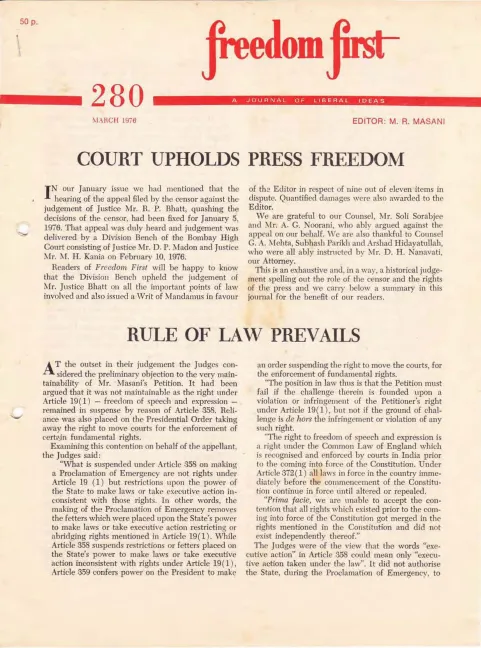
A lengthy reproduction of the Bombay High Court Division Bench’s censorship judgement finds the government’s objections to nine Freedom First items “fanciful and far-fetched,” upholding the Maharashtra Bar Council’s right to publish its resolution urging revocation of the Emergency and warning that banning historical material would make it impossible to publish any account of the freedom movement.
-
S. P. Aiyer reviews Donald Rogowski’s Rational Legitimacy, finding its rejection of cultural-determinist theories of government persuasive but its application to a supposedly “pillarized” Indian society overly abstract, leaving him “cold and uninspired.”
Essays
Is Solzhenitsyn Right?
By M. R. Masani
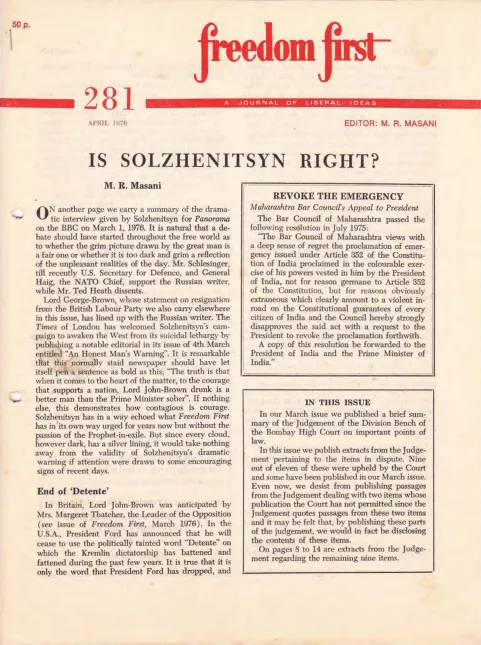
M. R. Masani’s editorial ‘Is Solzhenitsyn Right?’ takes up the international debate provoked by Alexander Solzhenitsyn’s 1 March 1976 BBC Panorama interview, in which the exiled writer warned of the ‘sudden and imminent fall’ of the West. Masani surveys reactions — Schlesinger and General Haig supportive of Solzhenitsyn’s grim assessment, Ted Heath dissenting, The Times of London praising his ‘campaign to awaken the West from its suicidal lethargy,’ and Lord George-Brown resigning from the Labour whip in apparent solidarity. Masani notes that Freedom First has voiced similar warnings for years ‘without the passion of the Prophet-in-exile,’ and finds encouragement in signs that detente is losing political favour: Ford’s disavowal of the word ‘detente,’ and challenges to Kissinger’s policy from Reagan and Senator Jackson. The editorial’s second half, ‘Old Hat,’ dismisses Western media excitement over Italian and French Communist ‘Eurocommunism’ as naive, comparing it to being fooled by Gomulka, Gottwald, and Rakosi’s earlier promises of national-communist independence from Moscow, each of which the editorial quotes to demonstrate their emptiness.
- Masani frames Solzhenitsyn’s March 1976 BBC interview as external validation of Freedom First’s long-running warnings about the West’s complacency toward Soviet power.
- Surveys the range of Western reactions: Schlesinger and Haig sympathetic, Ted Heath dissenting, The Times editorializing in Solzhenitsyn’s favour.
- Notes Lord George-Brown’s resignation from the Labour whip as a sign of the debate’s political reach in Britain.
- Reports signs of a shifting US political mood: Ford dropping the word ‘detente,’ challenges from Reagan and Senator ‘Scoop’ Jackson to Kissinger’s policy.
- Argues that professed ‘national communism’ in Italy and France is ‘old hat,’ a rehash of discredited 1940s promises made by Gomulka, Gottwald, and Rakosi, quoting each to expose the pattern.
Between You & Me and The Lamp Post
The unsigned column ‘Between You & Me and The Lamp Post’ comments on current events in short sections. ‘Union of India?’ criticises the dismissal of elected state governments in Tamil Nadu and Gujarat under President’s Rule, arguing this violates the federal structure the Constituent Assembly deliberately built to accommodate India’s diversity, and warns that unchecked centralisation could eventually threaten national unity. ‘Two Cheers for the Budget’ gives a qualified assessment of the Union Budget presented by C. Subramaniam on 15 March, welcoming excise and income-tax relief but criticising continued deficit financing and inadequate structural reform toward agriculture, competition, and foreign capital.
- The column argues that removing elected governments in Tamil Nadu and Gujarat via Presidential Orders violated constitutional requirements and eroded India’s federal structure.
- Notes the Editor’s own past position, shared with the Constituent Assembly majority, that federalism was essential to accommodating India’s ethnic, religious, and linguistic diversity.
- Criticises both the Centre for avoiding elections and Tamil Nadu’s DMK government for accepting the postponement rather than seeking a state election.
- Gives the March 1976 Union Budget ‘two cheers’: welcomes excise/tax relief but faults continued deficit financing and the lack of structural shift toward agriculture, competition, and foreign equity capital.
- Warns that a unitary drift, if it continues, risks the kind of separatist pressures the federal structure was designed to prevent.
Continuing ‘Between You & Me and The Lamp Post,’ this section covers President Sadat’s denunciation of the Soviet Union and Egypt’s abrogation of its 1971 Treaty of Friendship with Moscow; the contested election for the leadership of the British Labour Party (won by James Callaghan-era context implied) compared with the Conservative Party’s earlier election of Margaret Thatcher over Ted Heath; and British Foreign Secretary James Callaghan’s appeal to Ian Smith for majority rule in Rhodesia, which the column calls simplistic. It argues that in multi-racial societies majority rule alone is not necessarily democratic, and commends the Swiss system of proportional representation and composite cabinet government — previously advocated for India by the late P. Kodanda Rao — as a fairer model than winner-take-all majoritarianism, citing Switzerland, Lebanon, and by implication India’s own Partition as illustrations.
- Describes President Sadat’s abrogation of Egypt’s 1971 Treaty of Friendship with the Soviet Union following Brezhnev’s opposition to Cairo’s liberalization policy.
- Contrasts the British Labour and Conservative parties’ internal leadership elections, noting neither party uses first-past-the-post for choosing its own leader despite defending it for general elections.
- Criticises British Foreign Secretary Callaghan’s call for simple majority rule in Rhodesia as ‘too simple by half,’ arguing multi-racial societies need minority protections and government by consent.
- Praises the Swiss model of proportional representation and composite cabinet government as more stable than majoritarianism, citing Switzerland’s prosperity as an example.
- Credits the late P. Kodanda Rao, described as ‘a great Liberal,’ as an advocate of the Swiss system for India, and speculates that adopting it might have prevented Partition.
World News: Solzhenitsyn Fears Fall of West
This World News item summarises Alexander Solzhenitsyn’s dramatic BBC Panorama interview of 1 March 1976, conducted with Michael Charlton in Northamptonshire. Solzhenitsyn warns of the West’s possible ‘sudden and imminent fall,’ hints at KGB assassination attempts against himself, and argues the Soviet Union’s war-footing economy has extracted concessions from a West so willing to accommodate that ‘nuclear war was not even necessary.’ He criticises the ‘spirit of Helsinki’ as strengthening Soviet totalitarianism rather than human rights, cites examples of KGB persecution suppressed in exchange for Western journalists’ freer access, and expresses abhorrence for Bertrand Russell’s phrase ‘better red than dead.’ He argues that a people that no longer remembers its history has lost its soul, and suggests that if the Gulag Archipelago’s three volumes were freely available in the USSR, communist ideology would collapse quickly.
- Solzhenitsyn predicts the West may face a ‘sudden and imminent fall’ caused by its own capitulations, and hints obliquely at KGB attempts on his own life.
- Argues the Soviet Union’s economy is so war-oriented that the West’s concessions made nuclear war unnecessary to extract Soviet gains.
- Criticises the ‘spirit of Helsinki’ as, for Soviet citizens, meaning only a strengthening of totalitarianism, not human rights.
- Describes Western journalists trading freer movement in the USSR for silence about new instances of persecution.
- Expresses abhorrence for Bertrand Russell’s ‘better red than dead’ as morally hollow, contrasting it with the absolute good-versus-evil clarity learned by those who lived through the concentration camps.
- Argues that if the Gulag Archipelago were freely available and read within the Soviet Union, communist ideology would quickly collapse.
Lord George-Brown Quits Labour
A short item reports Lord George-Brown’s resignation of the Labour whip in the House of Lords on 2 March 1976 in protest at the Government’s handling of Lord Goodman’s press-freedom amendment to the Trade Union and Labour Relations (Amendment) Bill, quoting his statement that the Labour Party ‘has become the establishment’ and refuses individual freedom, and his declaration that he now joins ‘Bernard Levin and the army of Solzhenitsyn and Sakharov who stand for freedom.’
- Lord George-Brown resigned the Labour whip on 2 March 1976 over the defeat of Lord Goodman’s press-freedom amendment.
- He frames his 45-year party membership as broken by the party’s abandonment of individual freedom.
- He explicitly links his resignation to the Solzhenitsyn debate, aligning himself with ‘the army of Solzhenitsyn and Sakharov.‘
Moscow Censor Sold Books to Black Market
By Robert C. Toth
Robert C. Toth’s report describes a Soviet black-market scandal in which a senior Glavlit (censorship agency) official, Andrei Sokolov, was found to have diverted confiscated foreign books and other seized goods to the Moscow black market for fifteen years before his arrest and seven-year sentence at hard labour. The piece is followed by an unsigned New York Times editorial, ‘Nepotism in Pyongyang,’ surveying dynastic tendencies among Communist rulers — Stalin’s grooming of his son Vasily, Khrushchev’s son-in-law Alexei Adzhubei, Mao’s wife Chiang Ching — and concluding that North Korea’s Kim Il Sung is likely the leading practitioner, having made his son Kim Jong Il ‘crown prince and No. 2 man’ while sidelining his brother Kim Yong Ju.
- Glavlit official Andrei Sokolov ran a 15-year black-market operation selling confiscated foreign literature and other seized goods, concealed in sealed safes registered as destroyed.
- Sokolov received seven years at hard labour after a raid found 170 sacks of confiscated literature; his superior was quietly retired by Premier Alexei Kosygin.
- The Nepotism in Pyongyang editorial surveys dynastic succession attempts under Stalin, Khrushchev, and Mao before concluding Kim Il Sung is the ‘champion practitioner’ among Communist dictators.
- Kim Il Sung is reported to have promoted his son Kim Jong Il to ‘crown prince and No. 2 man’ in the North Korean party, while his brother Kim Yong Ju was demoted.
Popular Cairo Film
By Thomas W. Lippman
Thomas W. Lippman reports on a popular Cairo film, based on a novel by Neguib Mahfouz, that dramatizes torture and brutality by the secret police under the late President Nasser, depicting the ordeal of two young lovers, Zeinab and Ismail, who are imprisoned and abused before being freed by President Sadat’s ‘corrective revaluation’ of Nasser’s legacy. The piece notes Sadat’s own public balancing of Nasser’s legacy — crediting Nasser’s achievements while acknowledging ‘deviations’ and ‘prisons and detention camps’ that lasted longer than they should have.
- The film, adapted from a Neguib Mahfouz novel, is Cairo’s most popular current attraction and graphically depicts torture, rape, and political imprisonment under Nasser’s secret police.
- Nasser himself is not directly criticised in the film, but his photograph looms over scenes of abuse of innocent victims.
- The story follows medical students Zeinab and her fiance Ismail, who are tortured, and Ismail is coerced into a false confession after a threat to repeat Zeinab’s rape.
- President Sadat reportedly viewed the film privately before release and has publicly offered a balanced assessment of Nasser, acknowledging ‘deviations’ and prison camps that ‘remained longer than they should have.‘
Court’s Comments on Censored Articles (extracts from Bombay High Court Division Bench judgement)
This long section (pages 8-14) reproduces the Bombay High Court Division Bench’s judgement in a censorship case brought against the Appellant (the government censoring authority) over the banning of several Freedom First items under Emergency-era press guidelines dated August 5, 1975, and related rules. The Court reviews each disputed item — a Swarajya writ-petition report, a report on Nasser being called a ‘Dictator and Communist,’ an Amnesty International item on police duty to disobey torture orders, the Maharashtra Bar Council’s resolution urging revocation of the Emergency, a Swiss Press Review item quoting Ambassador Moynihan on developing countries’ self-inflicted problems, a Senator Church quotation about ‘wicked government,’ a P. Kodanda Rao letter proposing a Swiss-style constitution for India (including a quoted passage on Lord Linlithgow and Lord Wavell’s views on Indian democracy), an open letter to the US Ambassador on Saxbe’s frankness, and a J. L. Nain quotation on public-sector unfair trade practices — and finds, item by item, that the government’s objections were ‘fanciful and far-fetched,’ upholding publication of all items except the article by Mr Tarkunde and one headed ‘Jai Jayawardene’ (already decided in an earlier judgement referenced but not printed here).
- The Bombay High Court Division Bench reviews nine specific censored items from Freedom First, finding the government’s censorship objections ‘fanciful and far-fetched’ in almost every case.
- The Court holds that reporting on a court’s own injunction against a censor is not itself ‘colourable’ or objectionable, rejecting an argument based on ‘esprit de corps’ protection of censors.
- In the ‘Nasser Dictator & Communist’ item, the Court finds no basis for the claim that quoting Egyptian trial testimony against Nasser could harm India’s relations with the United Arab Republic.
- The Court rejects the argument that an Amnesty International item on police officers’ duty to disobey torture orders could ‘confuse’ police or military officers into disobeying lawful orders.
- It upholds the Maharashtra Bar Council’s right to publish its resolution urging revocation of the Emergency, calling the resolution a legitimate exercise of the constitutionally recognised right of dissent within permissible limits, citing precedents including Niharendu Dutt Majumdar v. The King Emperor and Kedar Nath Singh v. State of Bihar.
- The Court dismisses the claim that a Senator Church quotation about ‘wicked government’ — reproduced without identifying context — would mislead readers into thinking it referred to India.
- On the P. Kodanda Rao letter quoting Lord Linlithgow’s and Lord Wavell’s views on Indian and Muslim attitudes to ballot secrecy, the Court finds no likelihood that reproducing historical opinions could inflame communal tension, and warns that banning such historical material would make it impossible to publish any account of the freedom movement.
- The Court concludes that except for the article by Mr Tarkunde and the item headed ‘Jai Jayawardene,’ the presiding judge Bhatt J. was right to set aside the censor’s orders and issue a writ of mandamus permitting publication.
Review: Cold and Uninspiring (Rational Legitimacy by Donald Rogowski)
By S. P. Aiyer
S. P. Aiyer reviews Donald Rogowski’s Rational Legitimacy (Princeton University Press, 1974), which rejects prevailing sociological and ‘political culture’ explanations for why societies accept particular forms of government, and instead advances a theory that people choose governments ‘rationally’ based on ethnic and occupational information available to them. Aiyer finds Rogowski’s critique of cultural-determinist theories (citing counterexamples like the West German Federal Republic’s post-Weimar stability) persuasive but judges the positive theory of rational legitimacy overly abstract, particularly Rogowski’s application of it to a supposedly ‘pillarized’ traditional Indian society, concluding the book ‘leaves me cold and uninspired.’
- Rogowski rejects cultural-determinist and ‘political culture’ theories of why people accept given forms of government, citing the West German Federal Republic’s stability as a counterexample to Weimar-era pessimism.
- Rogowski instead proposes that people choose forms of government ‘rationally,’ basing decisions on the ethnic and occupational information available to them.
- Applied to India, Rogowski suggests its historically ‘pillarized’ caste-structured society limited state power, but that increased mobility and communication may now require authoritarian leadership, arguing democracy ‘has little immediate future’ outside a plebiscitary or ‘guided’ form.
- Aiyer judges the book’s scholarship dressed up formidably as a Ph.D. thesis but ultimately ‘too abstract for ordinary mortals,’ leaving him ‘cold and uninspired.‘
With Many Voices
The recurring ‘With Many Voices’ quotations column collects short excerpts from world press and public figures on topics of politics, freedom, and government, drawn from sources including The Economist, International Herald Tribune, Encounter, National Review, and the Guardian, spanning December 1975 to March 1976.
- Includes Rajmohan Gandhi’s warning that only a true saint can receive continual adulation without damage to character.
- Quotes Chou-en-lai’s remark ‘I shall soon be seeing Karl Marx,’ and Jonas Savimbi’s rejection of a minority regime imposed by ‘Cuban troops and Russian tanks.’
- Includes commentary from Peregrine Worsthorne on trade unions and the ‘modern equivalent of God’s work,’ and Michael Oakeshott’s aphorism that ‘the conjunction of dreaming and ruling generates tyranny.’
- Closes with Erik von Kuehnelt-Leddihn’s provocative comparisons of ‘liberated’ post-colonial atrocities to European colonization and a rhetorical question about Idi Amin versus Queen Victoria.
Generated by the v1.5 extraction pipeline. Awaiting editorial review.
Metadata and summary are AI-extracted from the source PDF and reviewed for editorial accuracy. The original work is available via the Read PDF tab above (where present); paragraph-level citation inside the PDF is deferred to a future engagement.