periodical issue
Freedom First
A Journal of Liberal Ideas
By M. R. Masani, Bernard Levin, Geeta Doctor, A. G. Noorani
Published for the Democratic Research Service by J. R. Patel, Associate Editor, Freedom First at 127, M. Gandhi Road, Bombay 400 023 (Phone: 273914) and printed by him at Inland Printers, 55 Gamdevi Road, Bombay 400 007 · Bombay · 1976
16 pages
Freedom First
Summary
Freedom First No. 285 (August 1976), edited by M. R. Masani, appears in the thirteenth month of the Emergency. The issue opens with Masani’s editorial attacking the Swaran Singh Committee’s proposed “Duties of the Citizen” as a device to subordinate Fundamental Rights to unenforceable Directive Principles and to place government conduct beyond judicial scrutiny. The “Between You & Me and the Lamp Post” column surveys the Entebbe rescue, a French prosecutorial-transfer controversy, and the Polish government’s climbdown on food prices, drawing a common lesson about price controls and the rule of law. A paired excerpt, “Tass vs. The Times”, sets a Soviet commentator’s defence of the Indian Emergency against a Times editorial skeptical of Mrs Gandhi’s justifications, continued by Bernard Levin’s bicentennial tribute to the United States as the “last best hope of all mankind”. Resolutions from the Citizens for Democracy annual meeting call for constitutional safeguards against arbitrary Emergency proclamations and for early, free elections. A lengthy “World News” digest, reprinted from British and American papers, covers Swiss aid politics, Soviet meat shortages, a smuggled dissident film, the trial and imprisonment of Soviet critics, the war in Angola, and a libel suit brought by a Newsweek correspondent against a Soviet weekly. The issue closes with a theatre review of a Gujarati play by Geeta Doctor, A. G. Noorani’s review of an edited volume on the mechanics of Communist takeovers worldwide (with attention to the Indian case), and a page of aphoristic quotations, “With Many Voices”.
Key points
-
M. R. Masani’s “Oh, The Frivolity Of It!” attacks the Swaran Singh Committee for giving the public only twelve days to respond to its proposed constitutional “Duties of the Citizen,” objecting most sharply to the recommendation that courts be barred from testing the validity of laws enforcing them.
-
The “Between You & Me and the Lamp Post” column praises the Entebbe rescue as proof that deterrent action against terrorism works, and cites Poland’s rapid reversal of steep food-price increases after riots as evidence that price controls are no substitute for supply and demand even under a totalitarian government.
-
“Tass vs. The Times” juxtaposes a Soviet commentator’s defence of the Indian Emergency as a response to colonial-era Western press hostility against a Times editorial arguing Western disappointment stemmed from misplaced faith that Indian parliamentary practice extended beyond an English-educated urban elite.
-
Bernard Levin’s bicentennial essay insists America remains “the last, best hope of all mankind” 200 years after independence, contrasting its self-healing constitutional order against France, Italy, Africa, and India under its “seedy dictator.”
-
Resolutions from the Citizens for Democracy annual meeting call for making Emergency proclamations justiciable, for confining suspension of fundamental rights strictly to genuine war or insurrection, and for general elections no later than March 1977.
-
A “World News” digest reports Swiss voters rejecting an interest-free loan to the International Development Association, a smuggled Granada Television documentary on Soviet ethnic-minority dissent, and a Guardian piece on the political misuse of Soviet psychiatry against dissident Vladimir Bukovsky.
-
Geeta Doctor’s theatre review of the Gujarati play Vaishakhi Koyal praises its unusual lyricism and its heroine’s complexity, departing from typical melodramatic Gujarati stage stereotypes.
-
A. G. Noorani reviews The Anatomy of Communist Takeovers, highlighting Hammond’s thesis that only Yugoslavia, Albania, China and North Vietnam saw genuinely indigenous Communist takeovers, with Soviet policy today driven chiefly by Russian national interest rather than doctrinal world revolution.
Essays
Oh, The Frivolity Of It!
By M. R. Masani
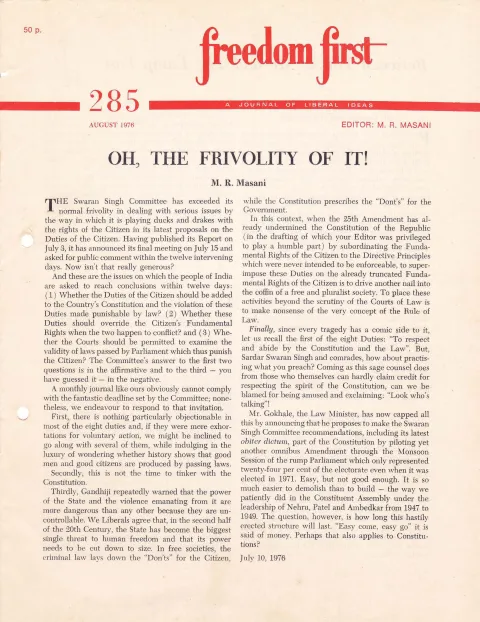
M. R. Masani’s editorial “Oh, The Frivolity of It!” attacks the Swaran Singh Committee for treating the proposed constitutional Duties of the Citizen frivolously, giving the public only twelve days to respond to a report published July 3 before a final meeting on July 15. Masani objects most sharply to the Committee’s recommendation that these Duties should override the Citizen’s Fundamental Rights and that courts should not be permitted to examine the validity of laws enacted to enforce them. He argues this compounds the damage already done by the 25th Amendment, which subordinated Fundamental Rights to the (originally non-justiciable) Directive Principles, and closes by noting the irony of a government that cannot itself claim to respect the spirit of the Constitution now lecturing citizens on constitutional duty.
- The Swaran Singh Committee published its report on July 3 and demanded public comment within twelve days, which Masani calls an absurdly short deadline for serious constitutional change.
- Of the three core questions the Committee considered, it answered that Duties should be added to the Constitution and made punishable by law, but that courts should NOT be permitted to test the validity of laws passed to enforce them.
- Masani argues many of the eight proposed Duties would be unobjectionable as voluntary exhortations, but rejects making them legally binding at a time when the Constitution itself is under strain.
- He connects this proposal to the earlier 25th Amendment, which he says already subordinated Fundamental Rights to the (historically non-enforceable) Directive Principles.
- He closes by pointing out the contradiction of the ruling party recommending citizens’ Duty to respect the Constitution while itself accused of violating its spirit.
Between You & Me and The Lamp Post
The unsigned “Between You & Me and The Lamp Post” column covers four items: praise for the Israeli Entebbe hostage rescue as a model of resisting terrorism through deterrent action rather than appeasement; a French controversy (“Judges’ Siberia”) over the transfer of a Deputy Public Prosecutor investigating oil-price-rigging, contrasted approvingly with the routine transfer of judges “by the dozen” within India without similar public outcry; the Polish government’s rapid reversal of steep food-price increases after price riots, used to argue that price controls are no substitute for market-set prices even under a totalitarian government; and a closing item on “Anti-Climax in Italy”, observing that the Italian general election produced a continuance of the status quo, with the Christian Democrats retaining power despite public dissatisfaction and the Communists failing to break through, and lamenting that the small centrist Liberal, Republican, and Social Democratic parties lost ground rather than gaining from disaffected voters. A closing item, “A Happy Combination”, welcomes the election of General Eanes as President of Portugal and his invitation to Mario Soares to form a government as a reassuring sign for Portuguese democracy.
- The Entebbe rescue is praised as proof that resolute deterrent action against terrorism, not appeasement, is the right response, with praise for President Ford, President Giscard d’Estaing, and Prime Minister Callaghan for welcoming the Israeli action.
- The column draws an implicit contrast between France’s public uproar over a single prosecutor’s transfer and the routine, unremarked transfer of High Court judges “by the dozen” in India (or its region), calling the French reaction “a breath of fresh air.”
- Poland’s swift reversal of proposed 30-70 per cent food price increases, after riots and deaths, is presented as proof that price control and arbitrary price-fixing are no substitute for the laws of supply and demand, even under a totalitarian government.
- The column notes that black markets are the inevitable consequence of suppressing market prices, whether in Poland or the Soviet Union.
- On Italy, the column argues that Christian Democratic misgovernment failed to translate into Communist gains, and regrets that centrist parties committed to free enterprise and pluralism did not capture disaffected votes.
- The election of General Eanes as President of Portugal, and his call on Mario Soares to form a government, is welcomed as reassurance that Portugal will remain within the free world.
TASS vs. The Times
“Tass vs. The Times” juxtaposes two contemporaneous statements on the first anniversary of the Indian Emergency. A Tass dispatch quotes Soviet commentator Sergei Bulantsev defending the Indira Gandhi government’s emergency measures as a response to a Western press campaign rooted in colonial-era hostility, and citing the intimidation of ministers and industrial unrest as justifying “resolute measures.” The accompanying Times of London editorial, by contrast, argues that Western disappointment with India stems from the high hopes invested in Indian democracy as heir to a Westminster-style, British-transmitted system, and suggests that this assumption of Indian democratic capacity was itself poorly founded, since parliamentary practice took root chiefly among an English-educated urban elite rather than the broader peasant population.
- The Soviet commentator Sergei Bulantsev is quoted via Tass arguing that Western press criticism of India’s Emergency reflects a deep-rooted colonial-era dislike of Third World development rather than genuine concern for democracy.
- The Tass item cites the attempted assassination of railways minister L. N. Mishra as an example of violence the Western press allegedly ignored before the Emergency.
- The Times editorial argues that Western, and especially British, disappointment with India stems from the unusually high expectations placed on Indian democracy as the best-transmitted example of British parliamentary institutions among former colonies.
- The Times piece contends that this assumption was flawed because parliamentary practice in India was confined mainly to an English-educated ruling class, “divorced from India’s peasant masses.”
- The Times also revisits the Cold War-era assumption that India would stand as Asia’s democratic counterweight to Communist China, arguing this framing was never well founded.
‘Last Best Hope of All Mankind’
By Bernard Levin
Bernard Levin’s bicentennial essay, reprinted (per its closing credit) courtesy of The Times, argues that despite Britain’s fashionable pessimism about the United States, America genuinely remains “the last, best hope of all mankind” 200 years after the Declaration of Independence. Levin catalogues the failures of other polities and regimes—France’s flirtation with a Stalinist-leaning Communist leader, Italy’s uneasy relationship with its own Communists, Africa’s disappointing record on “liberation” and “independence,” India under its “seedy dictator”—to argue that no other nation offers a comparably self-healing constitutional order or comparable material generosity to the rest of the world. He closes by affirming that America’s constitutional fabric remains sound as it enters its third century, holding out to the world “unlimited promise” and “unlimited hope.”
- Levin rejects what he calls the “idle fashion” of decrying America in Britain, insisting the United States remains, 200 years on, the “last, best hope of all mankind.”
- He compares the condition and prospects of the U.S. favourably against France (menaced by “the Stalinist thug Marchais”), Italy (“everybody’s favourite communist” Berlinguer), Africa post-independence, and India, which he describes dismissively as ruled by a “seedy dictator.”
- He credits the United States with the greatest act of material generosity in world history through its post-war foreign aid, despite receiving little gratitude and much hostility in return.
- He argues the U.S. deserves credit for setting up and disproportionately funding NATO, offering the world protection of freedom rather than merely cash or machine-tools.
- Levin acknowledges America’s continuing struggles — on race, and on reconciling capitalism’s benefits with its “selfishness” — but insists its constitutional fabric remains intact as it enters its third century.
Citizens for Democracy
This item reproduces two resolutions adopted at the Annual General Meeting of Citizens for Democracy, held in Bombay on June 19-20, 1976. The first resolution opposes any amendment of the Constitution while freedom of expression is curtailed, public meetings banned, thousands held without trial, and the Lok Sabha’s mandate expired, and calls for specific constitutional amendments to make Emergency proclamations justiciable, to confine suspension of fundamental rights strictly to genuine war or insurrection, and to secure judicial and Election Commission independence from executive patronage. The second resolution urges early general elections, no later than March 1977, preceded by release of political prisoners, restoration of press freedom, and removal of the ban on public meetings, and separately urges the government to scrap the 1974 and 1975 amendments to election law, which the resolution says gutted expenditure ceilings and let ruling-party candidates use public funds and officials in campaigns.
- Citizens for Democracy’s AGM resolution opposes constitutional amendment during the Emergency, citing curtailed free expression, banned public meetings, detention without trial, and the Lok Sabha’s expired five-year mandate.
- The resolution calls for amendments making Emergency proclamations under Articles 352 and 356 justiciable, and confining suspension of fundamental rights to actual war or insurrection.
- It calls for judicial independence (removing Chief Justice and High Court appointments from executive patronage) and an independent Election Commission appointed by a Prime Minister-Opposition Leader-Chief Justice committee.
- A second resolution demands general elections no later than March 1977, preceded by release of political prisoners, restored press freedom, and lifting the ban on public meetings, calling any election held otherwise “a fraud.”
- The resolution also calls for scrapping the 1974 and 1975 election-law amendments, which it says removed real limits on candidate election expenditure and let government officials assist ruling-party campaigns.
World News
The “World News” digest reprints a run of items from British and American papers covering the wider world in mid-1976. It reports Swiss voters rejecting a government-backed interest-free loan to the International Development Association; a Washington Post piece on declining meat content and quality in Soviet sausage amid poor harvests; a Pravda item lamenting the decline of modest Soviet weddings in favour of lavish status-driven banquets; a Times report on the setback to South Korean democratic dissent following the fall of Saigon; an Observer account of a smuggled Granada Television documentary showing Soviet ethnic-minority dissent, featuring dissidents Anatole Scharansky and Boris Levitas; a Times report on UNITA’s guerrilla war against the Angolan government and its Cuban-backed MPLA forces; a report on Newsweek correspondent Alfred Friendly’s libel suit against a Soviet weekly that accused him of working for the CIA; and a Guardian piece on the imprisoned dissident Vladimir Bukovsky, condemning the political misuse of Soviet psychiatry against critics such as Valentyn Moroz, and naming Jean-Paul Sartre, Daniel Ellsberg, Mary McCarthy, and Noam Chomsky as having petitioned on the issue.
- Swiss voters rejected, by a 56.5 per cent majority, a government-backed £45 million interest-free loan to the International Development Association, reflecting scepticism about the value of international aid transfers.
- A Washington Post report describes Soviet authorities quietly ordering reduced meat content in sausages amid a poor grain harvest, while maintaining prices, leaving consumers dissatisfied with quality.
- A Times report on South Korea states that the fall of Saigon strengthened President Park Chung Hee’s authoritarian rule by allowing the regime to invoke external threat to justify suppressing dissent.
- A smuggled Granada Television film reportedly documents Soviet ethnic-minority (Jewish, German, Ukrainian, Tatar) resistance activity, including footage of dissidents Anatole Scharansky and Boris Levitas, and was seized in part by the KGB.
- A Times report describes UNITA’s guerrilla campaign against Angola’s MPLA government and Cuban forces, claiming around 4,000 active fighters and control of an area “more than three times the size of Switzerland.”
- A Guardian piece condemns Soviet psychiatric abuse used against dissidents, centred on the imprisonment of Vladimir Bukovsky, and references a petition against the practice signed by Jean-Paul Sartre, Daniel Ellsberg, Mary McCarthy, and Noam Chomsky.
The Cry of the Koel
By Geeta Doctor
Geeta Doctor’s theatre review, “The Cry of the Koel”, covers the Gujarati play Vaishakhi Koyal by the poet-playwright Sitansh Yashashchandra, praising it as a rare instance of lyricism and sensitivity on the contemporary Gujarati stage. The review summarizes the plot—the industrialist’s wife Alka’s chaste but emotionally consuming epistolary romance with a young man, Abhaysingh Parmar, conducted through letters ostensibly written on behalf of her illiterate young ward Ratan, which nearly collapses Ratan’s own engagement to Abhay when Alka discovers Ratan is pregnant by someone else—and praises the play for giving its heroine complexity rather than the usual stereotypes of victimhood or seductiveness on the Gujarati stage. Doctor credits director/actor Pravin Joshi and lead actress Sarita for a largely mature production, while criticizing some melodrama and finding Ratan’s actress less able to carry the play’s darker later turns.
- The review covers Vaishakhi Koyal, a Gujarati play by poet-playwright Sitansh Yashashchandra, praising its unusual lyricism relative to typical melodramatic Gujarati stage fare.
- The plot centres on Alka, wife of industrialist Vikram, whose repressed emotional life is drawn out through letters she writes on behalf of her illiterate ward Ratan to a young man, Abhaysingh Parmar, with whom Alka herself falls in love without ever meeting him properly.
- Doctor singles out the play for giving its central woman, Alka, complexity and dignity rather than the stereotypes of “long-suffering womanhood” or seductress common on the Gujarati stage.
- The review credits director Pravin Joshi (who also played the husband, Vikram) and lead actress Sarita for a mature, restrained production, with praise also for the actress playing Ratan in the play’s lighter early scenes.
- Doctor criticizes some melodrama in a scene involving the illegitimate pregnancy revelation and finds the actress playing Ratan less able to carry the play’s darker later turns.
Communist Takeovers
By A. G. Noorani
A. G. Noorani reviews The Anatomy of Communist Takeovers (Yale University Press, 1975), edited by Thomas T. Hammond with Robert Farrell as associate editor, a multi-contributor study of how Communist parties gained power in twenty-two countries since 1917, alongside abortive attempts elsewhere. Noorani summarizes Hammond’s thesis that only four takeovers (Yugoslavia, Albania, China, North Vietnam) were genuinely indigenous, guerrilla-driven outgrowths of World War II resistance movements with little dependence on Soviet military support, while most others were installed directly by the Red Army. He highlights the volume’s case studies of successful and failed takeovers, notes two omissions/oddities in Hammond’s list of failures (the 1948 Communist revolt in India under B. T. Ranadive, and the ambiguous classification of Chile under Allende), and quotes at length Malcolm Mackintosh’s analysis of Stalin’s foreign policy as an inextricable fusion of Russian nationalism and Communist ideological mission. The review closes by endorsing Hammond’s conclusion that Soviet policy today is driven primarily by considerations of Russian national interest rather than commitment to world revolution.
- The reviewed volume, edited by Thomas T. Hammond, studies Communist takeovers (and failed attempts) in over twenty countries since 1917, with contributors chosen for authority on each case.
- Hammond’s introductory and concluding essays argue that only Yugoslavia, Albania, China, and North Vietnam saw genuinely indigenous Communist takeovers via guerrilla armies tied to WWII resistance, with the Soviet army playing little or no role in these four.
- Noorani flags two omissions/anomalies in Hammond’s list of failed Communist takeovers: the 1948 Communist revolt in India led by B. T. Ranadive (which Noorani supports by quoting Nehru’s 1949 Constituent Assembly remarks), and the ambiguous treatment of Chile under Salvador Allende as a takeover attempt.
- The review quotes at length Malcolm Mackintosh’s analysis that Stalin’s foreign policy fused Russian nationalism with genuine Communist ideological commitment, and that Stalin’s limitations became apparent when facing situations (like Yugoslavia or China) outside direct Soviet control.
- Gerald Hesger’s case-study essay on Kerala is highlighted as showing Communist power there resting on a unique convergence of caste, class, and organisation not replicated elsewhere in India.
- Noorani endorses the volume’s concluding argument that Soviet policy toward Communist movements abroad is now driven chiefly by Russian national interest rather than doctrinal commitment to world revolution.
With Many Voices
The closing page, “With Many Voices” (its title drawn from Tennyson), collects short quotations clipped from the international press during June-July 1976 without editorial commentary, ranging from wry political one-liners (President Mobutu of Zaire on African democracy, David Steel and Cyril Smith on British politics, John Pardoe on the moribund two-party system) to weightier statements on freedom and government (James Madison on gradual versus violent encroachments on liberty, Jimmy Carter on foreign aid, William V. Shannon on presuming the worst absent a free press). A Blitz editorial notes Indira Gandhi’s eighth visit to the Soviet Union, the fourth since becoming Prime Minister.
- The page compiles unannotated quotations from British and American press and public figures during June-July 1976, framed by an epigraph from Tennyson’s ‘Ulysses’.
- Quotations include Cyril Smith, M.P., calling Margaret Thatcher “a cheeky, arrogant bitch,” and John Pardoe describing the British two-party system as “dead but won’t lie down.”
- A quoted Blitz editorial observes that Indira Gandhi’s June 1976 trip was her eighth visit to the Soviet Union and the fourth since becoming Prime Minister.
- James Madison is quoted (via a Times report on his Virginia Convention speech) warning that liberty is more often eroded by gradual encroachment than by sudden usurpation.
- William V. Shannon is quoted proposing a rule of thumb for judging authoritarian governments: absent a free press, assume the worst and place the burden of doubt on the government.
Generated by the v1.5 extraction pipeline. Awaiting editorial review.
Metadata and summary are AI-extracted from the source PDF and reviewed for editorial accuracy. The original work is available via the Read PDF tab above (where present); paragraph-level citation inside the PDF is deferred to a future engagement.