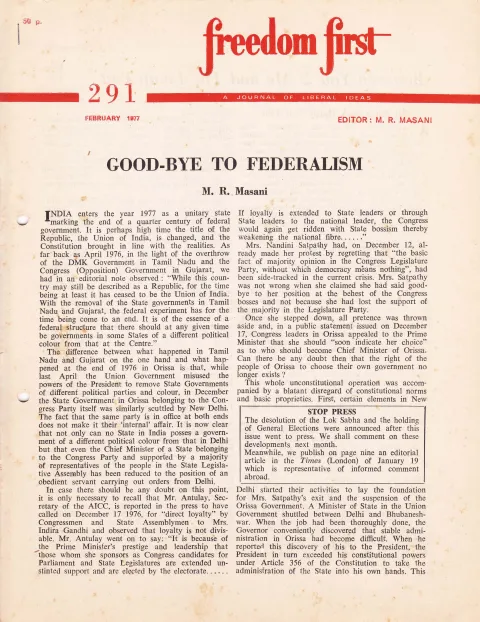
periodical issue
Freedom First
A Journal of Liberal Ideas
By S. V. Raju
Published for the Democratic Research Service by J. R. Patel, Associate Editor, Freedom First at 127, M. Gandhi Road, Bombay 400 023 (Phone: 273914) and printed by him at Mohan Mudranalaya, Acme Estate, Sewri (East), Bombay 400 015. · Bombay · 1976
16 pages
Freedom First
Summary
Freedom First No. 288 (November 1976) is a complete 16-page issue of the Bombay-based liberal monthly edited by M. R. Masani. The issue opens with Masani’s editorial ‘Prices Are Like Water,’ which uses the metaphor of water finding its own level to argue that price controls cannot defeat the underlying laws of supply, demand, and money supply, and warns that deficit-financed budgets were reigniting Indian inflation in 1976. Masani’s regular column ‘Between You & Me and the Lamp Post’ comments wryly on the Koh-i-noor diamond dispute, Ian Smith’s Rhodesia settlement and the duplicity surrounding it, bank nationalisation debates in Britain, and the 1976 Swedish and West German elections as evidence of a swing away from socialism. M. Murlidhar contributes ‘Trade Unions as Press Censors,’ arguing that British trade unions, especially the NUJ and SOGAT, had begun exercising an insidious form of press censorship from within, citing cases involving the Financial Times and the Observer. Peter Sager’s ‘Models of Majority Rule?’ is a reported piece on the deteriorating, Cuban- and Soviet-backed regimes in Angola and Mozambique, presented as a cautionary counter-example to Western pressure for ‘majority rule’ in Rhodesia. A ‘World News’ digest reprints excerpts and editorials from the international press on Rhodesia, Katyn, Sri Lankan press freedom, Soviet dissidents, and Mao’s death. The Letters section carries an exchange between Masani and Dr. Murlidhar on labour indiscipline versus business malpractice, and a separate letter alleging suppression of Gandhian literature in Indore. The Reviews section carries S. V. Raju on Irving Wallace’s novel The R Document and A. G. Noorani’s lengthy review-essay on Hugo Young’s The Crossman Affair, examining the legal battle over publication of Richard Crossman’s Cabinet diaries and the doctrine of collective Cabinet responsibility. The issue closes with ‘With Many Voices,’ a page of quoted press excerpts, and a subscription form.
Key points
-
M. R. Masani’s “Prices Are Like Water” argues price controls cannot defeat the underlying laws of supply, demand and money supply, citing a 4.7% wholesale price rise in mid-1976 and Poland’s abandoned 1976 price hikes after riots as a cautionary parallel.
-
The “Between You & Me and the Lamp Post” column recounts the Koh-i-noor diamond dispute (quoting Nehru that “diamonds are for emperors and India does not need emperors”), criticises the Kissinger-brokered Rhodesia settlement as based on “deceit,” and welcomes the 1976 Swedish and West German election results as a rejection of socialism.
-
M. Murlidhar’s “Trade Unions as Press Censors” argues British trade unions, especially the NUJ and SOGAT, have begun exercising an insidious form of press censorship, citing disputes at the Financial Times and the Observer.
-
Peter Sager’s “Models of Majority Rule?” surveys deteriorating, Cuban- and Soviet-backed Angola and Mozambique — industrial production down 70% and agricultural production down 90% in Mozambique — as a cautionary counter-example to Western pressure for “majority rule” in Rhodesia.
-
A “World News” digest covers a Guardian editorial accusing Kissinger of deceit over the Rhodesia settlement, the Sri Lankan High Court invalidating emergency regulations used against a Tamil leader, and Soviet pilot Lt. Viktor Belenko’s defection with a MIG-25.
-
A letters exchange between M. Murlidhar and Masani debates whether business malpractice deserves equal blame with labour indiscipline, while N. C. Zamindar alleges communist workers suppressed a Gandhian-literature pushcart in Indore.
-
S. V. Raju reviews Irving Wallace’s The R Document, a thriller imagining a 35th US Constitutional Amendment suspending the Bill of Rights during emergencies, praising it as “a thriller and an educator.”
-
A. G. Noorani reviews Hugo Young’s The Crossman Affair on the legal battle over publishing Richard Crossman’s Cabinet diaries, highlighting Lord Chief Justice Widgery’s balancing of Cabinet confidentiality against the public’s right to know how they are governed.
Essays
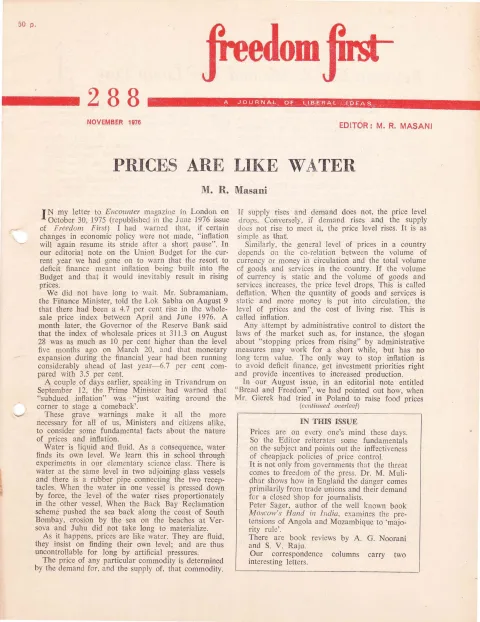
Prices Are Like Water
By M. R. Masani
In ‘Prices Are Like Water,’ M. R. Masani revisits warnings he issued in an October 1975 letter to Encounter magazine that inflation would resume once deficit financing was built into the Union Budget. He cites Finance Minister Subramaniam’s admission of a 4.7 per cent rise in the wholesale price index between April and June 1976, the Reserve Bank Governor’s figures showing the index 10 per cent higher over five months, and Prime Minister Indira Gandhi’s own warning in Trivandrum that ‘subdued inflation’ was poised to return. Masani then develops an extended analogy: prices, like water, are fluid and will find their own level regardless of administrative pressure, just as water finds a common level between connected vessels or as land reclamation causes compensating erosion elsewhere. He explains inflation and deflation as a function of the ratio between money in circulation and the volume of goods and services, and argues that price controls and ‘stopping prices from rising’ by administrative fiat only drive goods into the black market, never addressing the root causes of deficit finance, misdirected investment priorities, and insufficient production incentives. The essay continues onto page 2, where Masani recounts an anecdote from around 1960-61 rebutting Nehru’s claim that ‘a little inflation’ aids a developing economy, and cites the British economist Graham Hutton’s comparison of price administration to plastic surgery that merely displaces a problem rather than solving it, plus a reference to Poland’s 1976 food-price riots under Gierek as a further illustration.
- Masani had warned in an October 1975 Encounter letter that inflation would resume if deficit financing continued.
- Official data cited: 4.7% wholesale price rise (April-June 1976); index up 10% over five months per the RBI Governor; monetary expansion running at 6.7% versus 3.5% the prior year.
- PM Indira Gandhi herself warned in a September 12 Trivandrum speech that ‘subdued inflation’ could return.
- Central analogy: prices behave like water, finding their own level regardless of artificial pressure, illustrated by the Back Bay Reclamation causing erosion at Versova and Juhu.
- Inflation/deflation defined as a function of the ratio between currency in circulation and the volume of goods/services.
- Price controls only push goods into the black market (‘free market’ in Soviet parlance) rather than curbing inflation.
- Real remedies proposed: avoid deficit finance, fix investment priorities, and provide production incentives.
- Poland’s 1976 attempt by Gierek to raise food prices, which triggered strikes and had to be abandoned, is cited as a real-world parallel.
Between You & Me and The Lamp Post
Masani’s regular column ‘Between You & Me and the Lamp Post’ covers four brief topics. ‘Diamonds Are Forever’ recounts the controversy over Pakistan’s demand for the return of the Koh-i-noor diamond, quoting Nehru’s remark that ‘diamonds are for emperors and India does not need emperors,’ and notes Prime Minister Callaghan’s rejection of the Pakistani request. ‘Black Racism Runs Amuck’ criticises Ian Smith’s agreement (brokered by Kissinger and pressure from the US, Britain and South Africa) to majority rule in Rhodesia within two years, arguing the deal is already being undermined by Angola’s and Mozambique’s communist leaders. ‘44 Year Pendulum’ welcomes the electoral defeat of Olof Palme’s Social Democrats in Sweden after 44 years and the strong Christian Democrat showing in West Germany as evidence that ‘socialism has been rejected by the more advanced nations.’ ‘On Nationalising Banks’ contrasts Britain’s rejection of a Labour proposal to nationalise banks and insurance companies with the manner in which India’s own bank nationalisation was imposed by Ordinance in 1969, arguing depositors and the country gained nothing from it. ‘No Duel But…’ notes Margaret Thatcher’s recent visit to Delhi as a guest of the Indian government and her forthright anti-Soviet remarks in contrast to her earlier sharp exchange with Indira Gandhi.
- Recounts the Koh-i-noor diamond dispute triggered by Bhutto’s claim, with Nehru quoted opposing its return and Callaghan formally rejecting Pakistan’s request.
- Criticises the Kissinger-brokered Rhodesia settlement as based on ‘deceit’, foreshadowing the ‘Black Racism Runs Amuck’ item and the later World News excerpt on the same topic.
- Welcomes the 1976 Swedish and West German election results as a rejection of socialism, quoting the incoming Swedish coalition leader’s pledge to ‘break up power concentrations.’
- Contrasts Britain’s near-unanimous rejection of bank nationalisation with the way India’s 1969 bank nationalisation was pushed through by presidential Ordinance under Mr. Giri.
- Notes Margaret Thatcher’s 1976 Delhi visit and her stated ‘throughly realistic’ stance toward the USSR.
Trade Unions as Press Censors
By M. Murlidhar
M. Murlidhar’s ‘Trade Unions as Press Censors’ argues that trade unions in Britain, though legitimate as bargaining instruments, have begun functioning as a new and insidious threat to press freedom. He recounts how the National Union of Journalists (NUJ) demanded the Financial Times stop publishing a freelance rugby correspondent’s reports because the writer, lacking sufficient income from journalism, was denied union membership yet also barred from writing ‘regularly’ without it — a bind he calls (quoting Lord Goodman) a denial of ‘the talented man’s’ right to exploit his talent. Murlidhar then details several 1970s disputes at the Observer involving SOGAT (Society of Graphical and Allied Trades): a critical letter about the printing industry that print-workers tried to suppress, and a later dispute where the union threatened a strike to stop publication of a rival union’s write-up unless a reply was simultaneously published. He closes by endorsing self-censorship exercised by editors as preferable to any outside censorship, whether from government or from organised labour, arguing external censorship ‘infringes creativity, dwarfs originality and defeats the very idea of press freedom.’
- Frames trade unions, alongside other organised pressure groups, as a ‘new type of threat to press freedom’ operating from within democratic countries.
- Recounts the NUJ’s refusal to let a freelance rugby correspondent join the union (for insufficient income from journalism) while also blocking the Financial Times from publishing his non-member reports.
- Cites Lord Goodman’s account in the Political Quarterly (April-June 1976) describing the episode as denying ‘the talented man’ the right to exploit his talent.
- Details a May 1970 Observer dispute in which SOGAT’s leader objected to a critical article and later letters about the printing industry, leading the editor to suppress a follow-up letter.
- Describes a November 1970 dispute between two printing unions in which the Observer’s editor had to negotiate simultaneous publication of a union reply to avoid a strike.
- Concludes that editorial self-censorship is preferable to any external censorship, including from unions, government or other pressure groups.
Models of Majority Rule?
By Peter Sager
Peter Sager’s ‘Models of Majority Rule?’ surveys the deteriorating conditions in newly independent Angola and Mozambique, presented implicitly as a warning about what ‘majority rule’ can produce elsewhere in southern Africa. In Angola, the Soviet-backed MPLA government depends on 20,000 Cuban troops to defend itself against continuing FNLA and UNITA guerrilla resistance, with Fidel Castro affirming Cuban forces will stay to ‘defend that country from foreign aggression.’ In Mozambique, the FRELIMO government under Samora Machel faces hunger revolts, an anti-Machel movement in Montepez, and a clandestine opposition radio station (‘The Voice of Free Africa’), while relying on 1,500 Tanzanian troops. Sager documents severe economic collapse in both countries — chronic food shortages, a 70% fall in industrial production and 90% fall in agricultural production in Mozambique amid a white population exodus from 260,000 to 2,000 — alongside deepening Soviet and East German military and administrative involvement (training troops and police, running the harbours of Luanda and Lobito, providing teachers and doctors, and prospecting for minerals in exchange). He concludes that the Soviet Union, despite lacking the economic resources to actually develop the region, is using the crisis to expand its strategic position ahead of an anticipated ‘coming battle for South Africa,’ a battle he says ‘can and should be avoided.’
- Angola’s MPLA government is defended by roughly 20,000 Cuban troops against FNLA and UNITA guerrilla resistance rooted in the Bakongo and Ovimbundu ethnic groups.
- Mozambique’s FRELIMO government under Samora Machel faces internal hunger revolts, an anti-Machel movement, and an underground opposition radio station, and depends on 1,500 Tanzanian troops.
- Economic collapse is severe: white population fell from 260,000 to 2,000, industrial production down 70%, agricultural production down 90%, chronic food shortages in Luanda and Maputo.
- Soviet and East German involvement is deep and growing: military training, control of Angolan harbours, provision of teachers/doctors, and mineral prospecting rights as compensation.
- Sager frames Soviet involvement as strategically opportunistic rather than developmental, anticipating a future ‘battle for South Africa.‘
World News
The ‘World News’ section reprints excerpts and editorials from the international press on several topics. A Guardian editorial (‘Not Persuasion But Deceit’, September 28) accuses Henry Kissinger and the British government of misrepresenting the terms under which Ian Smith agreed to Rhodesian majority rule, particularly around the composition of a proposed Council of State, and argues the presidents of the frontline states never accepted the two-year timetable as final. A Guardian news item (‘Emergency Law Invalid’, September 11) reports that three Sri Lankan High Court judges discharged Tamil Liberation Front leader A. Amirthalingham after ruling the emergency regulations under which he was tried invalid. A Times editorial (‘The Stigma of Katyn’, September 17) recounts the 1940 Katyn massacre of Polish officers by Soviet forces and criticises the British government for being intimidated by Soviet protest into withholding full recognition from a commemorative monument. A short item notes Sri Lanka’s banning of Shakespeare from government-school English curricula as linguistically inaccessible to students. A New York Times editorial (‘A Lieutenant’s Credo’, September 11-12) discusses the defection of Soviet pilot Lt. Viktor Belenko with a MIG-25 and his statement that Soviet life ‘has not changed… from that existing in the days of Czarist Russia when there had been no freedom.’ An item from Free China Weekly (‘Mao Dies; Mainland Turmoil’) predicts intensified power struggle in China after Mao Tse-tung’s death. Finally, an Observer report (‘Christians Are Mad — KGB’, August 29) describes the forcible psychiatric internment of a young Russian Orthodox Christian, Alexander Argentov, after the KGB broke up an informal seminar of young religious intellectuals, quoting his smuggled appeal to Patriarch Pimen.
- Guardian editorial accuses Kissinger and the British government of deceit over the terms of Ian Smith’s agreement to Rhodesian majority rule, especially regarding a proposed Council of State.
- Guardian news report: Sri Lankan High Court judges ruled emergency regulations invalid and discharged Tamil leader A. Amirthalingham.
- Times editorial ‘The Stigma of Katyn’ criticises British government reticence in commemorating the 1940 Soviet massacre of Polish officers at Katyn.
- Sri Lanka’s Education Department banned Shakespeare from government-school curricula as linguistically inaccessible.
- New York Times editorial on Soviet pilot Lt. Viktor Belenko’s defection with a MIG-25, and his statement about the absence of freedom in the Soviet Union.
- Free China Weekly predicts intensified internal Chinese Communist power struggle following Mao Tse-tung’s death.
- Observer report on the KGB’s forcible psychiatric internment of Russian Orthodox Christian Alexander Argentov after a seminar of young religious intellectuals was broken up.
Essay 6
The Letters section carries two items. In the first, M. Murlidhar (writing from Bombay, dated September 10) accuses Masani of omitting the ‘rich’ business class from a prior list of the indisciplined, citing tax evasion, hoarding, and black-marketing as economic sins comparable to labour indiscipline; Masani’s editorial reply defends the original article, cites his own Lok Sabha budget speeches (quoting a 1966 speech on tax arrears) calling for effective tax collection, and reasserts that gherao of a corrupt businessman is itself indiscipline and a crime that must be handled by courts, not mobs. The second letter, from N. C. Zamindar, alleges that communist workers in Indore forced a Sarvodaya Sahitya Bhandar pushcart selling Gandhian and Vivekananda-Vinoba literature off a public site associated with the Jawaharlal Nehru Camp, and that the foundation stone of a Jai Hind Bhavan was pulled down by municipal corporation workers, asking Freedom First to investigate.
- M. Murlidhar’s letter accuses Masani of omitting the rich business class from criticism of indiscipline, citing tax evasion, hoarding and black-marketing.
- Masani’s editorial reply cites his own 1966 Lok Sabha budget speech pressing for effective tax collection, and reasserts that gherao of a businessman is itself indiscipline and a crime for courts, not mobs, to address.
- N. C. Zamindar’s letter alleges communist workers forced out a pushcart selling Gandhian and Vivekananda-Vinoba literature in Indore and pulled down the foundation stone of a Jai Hind Bhavan.
- Zamindar requests Freedom First investigate the Indore episode as suppression of Gandhian writings.
Letters (On Discipline; Are Gandhiji’s Writings Objectionable?)
By M. Murlidhar; N. C. Zamindar
S. V. Raju reviews Irving Wallace’s political thriller The R Document (India Book House / Corgi edition), which imagines a near-future America so overwhelmed by crime that the President and 37 of 50 states have approved a 35th Constitutional Amendment suspending the Bill of Rights during declared national emergencies. Raju summarises the plot’s key figures — a compromised FBI Director, an Attorney General torn between loyalty to the President and civil-libertarian instincts, and opposition led by a group called the Defenders of the Bill of Rights — and the mechanics by which the Amendment would grant a President-appointed Committee on National Safety plenipotentiary power. He praises the novel as skilfully plausible political fiction in the tradition of Ayn Rand and Allen Drury, crediting it as ‘a thriller and an educator’ that renders a valuable public service by dramatising the fragility of constitutional rights, and recommends it highly for both pleasure and education.
- The R Document imagines a near-future US where crime has overwhelmed law enforcement, prompting a 35th Amendment to suspend the Bill of Rights during declared emergencies.
- 37 of 50 states and the U.S. Congress have already approved the Amendment in the novel; only California’s ratification remains outstanding.
- Key characters include a compromised FBI Director devoted to the Amendment’s passage, a conflicted Attorney General, and an opposition group called the Defenders of the Bill of Rights.
- Raju situates Wallace within a genre of fact-based political thriller writers including Ayn Rand and Allen Drury, calling them ‘modern day Dumas.’
- Raju highly recommends the book as both entertainment and civic education about the value of constitutional rights.
Reviews: The R Document (Irving Wallace) / Crossman Affair (Hugo Young)
By S. V. Raju
A. G. Noorani reviews Hugo Young’s Crossman Affair (Hamish Hamilton / Jonathan Cape, in association with the Sunday Times), a detailed account of the legal battle over publication of the late Richard Crossman’s Cabinet diaries. Noorani narrates the dispute’s course: Crossman’s death in April 1974; the Cabinet Secretary Sir John Hunt’s insistence, per convention, that the manuscript be submitted for clearance; the executors’ and Sunday Times’s decision to proceed with serialisation regardless when clearance was refused; the Attorney-General’s ultimately unsuccessful attempt to obtain a permanent injunction; and Lord Chief Justice Widgery’s landmark judgment balancing Cabinet confidentiality against freedom of the press and public interest. Noorani gives close attention to Widgery’s reasoning — extending the Argyll v. Argyll doctrine of confidence to Cabinet secrets while rejecting a ‘Draconian’ perpetual injunction given the ten-year-old status of the material — and to the broader constitutional stakes: the competing public interests of preserving free Cabinet discussion and ensuring ‘people should know how they are governed.’ He closes by praising judicial review as an indispensable, if demanding, feature of democratic government, and by noting an important omission in Young’s book: the Court of Appeal proceedings and Lord Denning’s remarks from The Times of June 28, 1975.
- The book recounts the decade-long dispute over publishing Richard Crossman’s Cabinet diaries after his 1974 death, against the convention requiring Cabinet Secretary clearance of ministers’ memoirs.
- The Sunday Times and Crossman’s executors proceeded with serialisation from January 1975 despite the Cabinet Office’s refusal to clear the text, prompting an Attorney-General injunction bid.
- Lord Chief Justice Widgery refused a permanent injunction, extending the Argyll v. Argyll doctrine of confidence to Cabinet material but finding the ten-year lapse of time decisive against restraint.
- Noorani highlights Widgery’s balancing test: confidentiality of Cabinet discussion versus freedom of the press and the public’s right to know how they are governed.
- Noorani notes editor Harold Evans’s affidavit arguing that both the public and government itself benefit from frankness rather than secrecy about governmental actions.
- Noorani flags an omission in Young’s account: it lacks the Court of Appeal proceedings and Lord Denning’s June 1975 remarks on the case.
With Many Voices
The closing page, ‘With Many Voices,’ is a compilation of quotations drawn from the international press during 1976, prefaced by a Tennyson epigraph. It includes Rabindranath Tagore on the dangers of a ‘gagged world,’ Margaret Thatcher on the demands placed on women in politics, Milton Friedman on the market-determined value of currency, and a series of aphoristic Economist observations on North Korea, Peru and Ecuador, Iran, Mao’s death, and Arab criticism, alongside remarks from Flora Lewis, James Callaghan, and a Krokodil joke about socialism and the Sahara Desert. The page closes with the issue’s subscription form and imprint details identifying J. R. Patel as Associate Editor and the printer as Mohan Mudranalaya, Bombay.
- Compilation of press quotations under the title ‘With Many Voices,’ prefaced by an epigraph from Tennyson.
- Includes Rabindranath Tagore on the danger of a ‘gagged world’ and Milton Friedman on currency value being market-determined.
- Margaret Thatcher quoted on the higher bar faced by women in politics; James Callaghan quoted on Britain living on ‘borrowed time, borrowed money and even borrowed ideas.’
- Several Economist one-liners on North Korea, Peru/Ecuador, Iran, and the death of Mao Tse-tung.
- Page closes with the Freedom First subscription form and the issue’s registration/printing imprint.
Generated by the v1.5 extraction pipeline. Awaiting editorial review.
Essay 9
No summary was extracted for this article. Listed for completeness.
Metadata and summary are AI-extracted from the source PDF and reviewed for editorial accuracy. The original work is available via the Read PDF tab above (where present); paragraph-level citation inside the PDF is deferred to a future engagement.