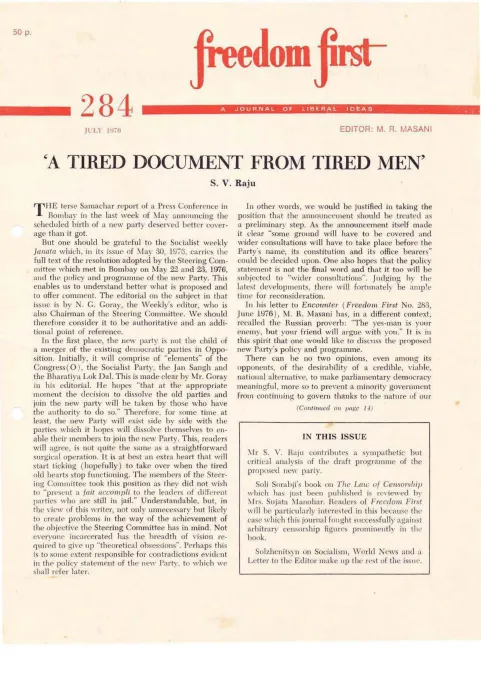
periodical issue
Freedom First
A Journal of Liberal Ideas
By M. R. Masani, Hedrick Smith, A. G. Noorani, Geeta Doctor, Philip Norman
Published for the Democratic Research Service by J. R. Patel, Associate Editor, Freedom First at 127, M. Gandhi Road, Bombay 400 023 (Phone: 273914) and printed by him at Mohan Mudranalaya, Acme Estate, Sewri (East), Bombay 400 015. · Bombay · 1977
16 pages
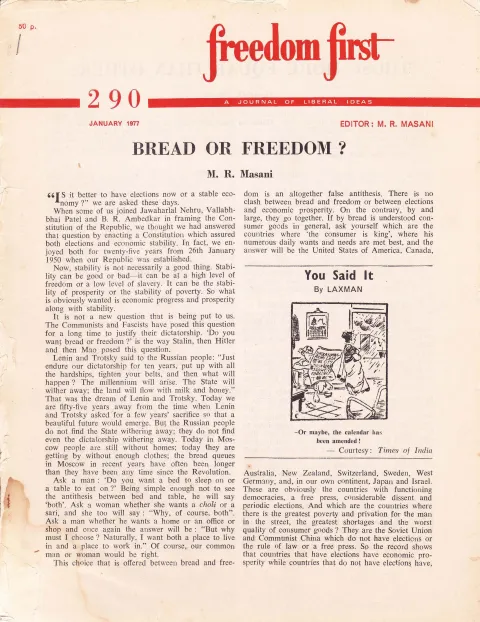
Freedom First
Summary
Freedom First No. 290 (January 1977) is edited by M. R. Masani for the Democratic Research Service, Bombay. The issue’s stated theme, per its own “In This Issue” note, is the compatibility of democracy and economic progress on one hand and communism with extreme inequality on the other. Masani’s opening editorial, “Bread or Freedom?”, argues that the supposed choice between elections and economic prosperity is a false antithesis invented by dictatorships (Stalin, Hitler, Mao) to justify suppressing freedom, and that in practice democracies deliver more prosperity than authoritarian states. This is paired with an extended extract from Hedrick Smith’s book The Russians (reprinted via New Age), cataloguing the hidden system of privilege enjoyed by the Soviet nomenklatura elite despite official claims of socialist equality. The issue’s World News digest surveys global affairs (Soviet global strategy, a Soviet nuclear disaster cover-up, Yugoslav defence planning, Aeroflot’s failures, a U.S. “Committee on the Present Danger,” British press freedom, and North Korean propaganda financing). A report covers a Bombay High Court judgment holding that Emergency-era press censorship orders exceeded their legal authority. The issue closes with reader letters on judicial review and press restrictions, two book reviews (a study of the Indian National Congress 1929-42, and a study of the origins of modern French leftism), a satirical filler item, and a page of quotations (“With Many Voices”).
Key points
-
M. R. Masani’s “Bread or Freedom?” rejects the framing that a nation must choose between elections and economic stability as an antithesis invented by dictatorships, arguing democracies with free elections and rule of law consistently outperform authoritarian states on prosperity.
-
A reprinted extract from Hedrick Smith’s The Russians catalogues the hidden privilege system of the Soviet nomenklatura elite — closed stores, “certificate roubles,” chauffeured Zil limousines, and the rank-contingent dacha system — presented as vindicating Sanjay Gandhi’s claim that inequality is worse in socialist countries.
-
A “World News” digest cites Brian Crozier’s thesis of a slow-motion “Third World War” through Soviet expansionism since 1945, Zhores Medvedev’s revelations of two covered-up Soviet disasters, and the founding of the US “Committee on the Present Danger” to warn Carter about Soviet military expansion.
-
A Bombay High Court ruling in the Sadhana magazine case held that even during the Emergency, strong criticism of government policies and named ministers remains permissible so long as it does not seek to create disaffection toward “Government established by law” as such.
-
Reader letters debate judicial review’s necessity in India, call for dissolving Parliament and holding February 1977 elections, and attribute rising prices to central government deficit financing.
-
A. G. Noorani reviews B. R. Tomlinson’s The Indian National Congress and the Raj, 1929-1942, highlighting Gandhi’s unifying but non-partisan role amid Congress factionalism and the contrast between Subhas Chandra Bose’s independent Bengal base and the business-funded Gandhian establishment.
-
Geeta Doctor reviews Pierre Gombin’s The Origins of Modern Leftism on post-1968 French “contestation” politics, criticising the ideology’s vague, mystical faith in the proletariat as echoing the very Marxist certainties it claims to reject.
Essays
Bread or Freedom?
By M. R. Masani
M. R. Masani’s editorial “Bread or Freedom?” rejects the framing, current in Indian political debate of the day, that a nation must choose between holding elections and achieving economic stability. He recalls that the Indian Constitution, which he helped frame alongside Nehru, Patel and Ambedkar, was meant to secure both freedoms and economic stability together, and that India enjoyed both from 1950 until recently. He traces the bread-or-freedom framing to dictators (Stalin, Hitler, Mao) and to Lenin and Trotsky’s promise that hardship under dictatorship would eventually wither the state and bring abundance — a promise Masani says the Soviet Union has conspicuously failed to deliver on. He argues ordinary people never actually face a choice between bread and freedom (citing analogies of wanting both a bed and a table, both a home and a workplace) and that empirically, countries with elections, free press and rule of law (the U.S., Canada, Australia, New Zealand, Switzerland, Sweden, West Germany, Japan, Israel) enjoy more prosperity than authoritarian states like the Soviet Union and Communist China, which suffer the greatest poverty and shortages. He closes with a personal reflection on having warned as early as 1968 that parliamentary democracy in India was more fragile than Indira Gandhi’s government claimed, saying those fears have now become “grim facts,” and restates his answer to the opening question: India should have both bread and freedom, and bread through freedom.
- Argues the ‘bread or freedom’ choice is a false antithesis invented by dictatorships to justify suppressing liberty.
- Cites Lenin and Trotsky’s promise of eventual abundance after enduring dictatorship, contrasted with the reality of continued shortages in the USSR fifty-five years later.
- Claims democracies with free elections, free press and rule of law consistently outperform authoritarian states on prosperity and consumer welfare.
- Recalls his own role in drafting India’s Constitution alongside Nehru, Patel and Ambedkar to secure both elections and economic stability.
- References a 1968 warning (at a seminar in Coonoor) that Indira Gandhi’s assurances about the permanence of parliamentary democracy in India could not be trusted, which he says has since been borne out.
Those More Equal Than Others
By Hedrick Smith
This is a reprint of extracts from Hedrick Smith’s Pulitzer-winning book The Russians (Smith was the New York Times’ Moscow correspondent for three years), framed by an editorial note explaining that New Age had disputed Sanjay Gandhi’s claim (quoted in the Hindustan Times) that wage inequality is worse in socialist countries, and that Freedom First reproduces Smith’s account to show Sanjay Gandhi was right. The extract is an ethnographic tour of the hidden privileges of the Soviet nomenklatura: closed stores on Granovsky Street where the politically connected buy caviar, smoked salmon and imported goods unavailable to ordinary citizens; a tiered system of ‘Kremlin ration’ parcels distributed by rank; hard-currency Beryozka shops and ‘certificate roubles’ available to well-connected officials; the secretive nomenklatura roster controlling access to privilege; Brezhnev’s official salary of 900 roubles against much higher real income; fleets of chauffeured Volgas, Chaikas and black Zil limousines (Politburo members’ Zils reportedly worth about £40,000 apiece); access to banned Western films and literature; the informal patronage network known as blat; the closed ‘Kremlin Clinic’; and lavish country dachas at Zhukovka, the Crimea and elsewhere, allotted and revoked strictly by Party rank, including examples involving Brezhnev, Khrushchev, Stalin, Foreign Minister Andrei Gromyko and former Ukrainian party boss Pyotr Shelest. The extract as rendered breaks off mid-anecdote about Brezhnev’s mother visiting his Moscow apartment.
- Introduced via an editorial framing note responding to a New Age dispute over Sanjay Gandhi’s claim about inequality in socialist countries.
- Describes closed, unmarked stores (e.g. on Granovsky Street) serving the Soviet elite with goods unavailable to ordinary citizens.
- Details a formal ranked system, the ‘Kremlin ration’ (Kremlevsky payok), distributing perquisites by seniority.
- Explains ‘certificate roubles’ and hard-currency Beryozka shops as a further layer of privilege resented by ordinary Russians.
- Describes the nomenklatura as a self-perpetuating roster of positions controlled by the Party, operating like a ‘self-perpetuating fraternity.’
- Catalogues chauffeured limousines (Volga, Chaika, Zil) as visible status markers, with Brezhnev’s official salary contrasted against his much higher real income.
- Covers exclusive access to banned Western films/literature and a closed ‘Kremlin Clinic’ for the elite.
- Extensive detail on the dacha system (Zhukovka-1 and -2, Crimea, Pitsunda, Zavidovo) as the most prized and most rank-contingent perquisite, illustrated via Gromyko and the demoted Ukrainian leader Pyotr Shelest.
World News
The World News section is a digest of short, unbylined items reprinted from Western wire and press sources, forming a ‘tour d’horizon’ of global affairs as the issue’s own preface describes it. Items include: a summary of British analyst Brian Crozier’s thesis that a slow-motion ‘Third World War’ has been underway since 1945 through Soviet expansionism, now shifting focus to Africa (from Swiss Press Review); a report citing Soviet dissident scientist Dr. Zhores Medvedev on two previously unpublicised Soviet disasters — a 1960 moon-rocket explosion that killed dozens of leading space scientists including Marshal Nedelin, and a 1958 nuclear waste explosion near Blagoveshensk in the Urals that caused mass radiation sickness and deaths that were covered up (from The Observer); a piece on Yugoslav military exercises rehearsing defence against a hypothetical Soviet invasion (from The Economist); an account of chronic delays, overbooking and shortages afflicting Aeroflot and Soviet civil aviation, including a federal indictment of Aeroflot’s New York office for illegal ticket pricing (from The Guardian and Washington Post); a report on the formation of the U.S. ‘Committee on the Present Danger,’ including Paul Nitze, to warn the incoming Carter administration about Soviet military expansion (from International Herald Tribune); a note on Harold Evans (editor of The Sunday Times) calling for lawyers to become more engaged in fighting for press freedom in Britain (from The Times); a report on British bank unions, the CBI and National Westminster opposing Labour Party plans to nationalise major banks and insurers (from The Guardian); and an item on North Korea’s practice of buying advertising space in Western newspapers to publish verbatim extracts from Kim Il-sung’s writings, funded in part through diplomatic drug trafficking in Scandinavia (from Swiss Press Review).
- Reprints Brian Crozier’s thesis (from his book Security and the Myth of Peace) that a Third World War, conducted through Soviet expansionism rather than direct conflict, has been underway since 1945 and is now pivoting toward Africa.
- Cites Soviet dissident Dr. Zhores Medvedev’s revelations of two covered-up Soviet disasters: a 1960 rocket-launch explosion that killed many leading space scientists, and a 1958 nuclear waste explosion near Blagoveshensk causing mass radiation casualties.
- Describes Yugoslav military exercises (‘Golija 76’) rehearsing defence against a presumed Soviet invasion route through Hungary.
- Details chronic dysfunction in Soviet civil aviation (Aeroflot), including overbooking, stranded passengers, and a U.S. federal indictment for illegal fare practices.
- Reports the founding of the U.S. Committee on the Present Danger to warn President-elect Carter about Soviet military expansion.
- Notes British Sunday Times editor Harold Evans urging lawyers to take up the cause of press freedom.
- Covers British bank unions and business bodies opposing Labour’s bank-nationalisation plans.
- Reports North Korea paying Western newspapers to print Kim Il-sung’s writings verbatim, financed partly through diplomatic drug trafficking.
Censor Not Protected by Emergency
An unbylined report describes a Bombay High Court Division Bench decision (Justices V. D. Tulzapurkar and Gadgil), delivered 7 December 1976, allowing a petition by the magazine Sadhana challenging government orders that forfeited certain issues of the magazine and the press where it was printed, under Rule 47 of the Defence and Internal Security of India Rules, 1971. The government had argued the petition was not maintainable given the Presidential Order of 8 January 1976 suspending Article 19 rights and the Supreme Court’s recent Habeas Corpus decision on detention orders. The Bench held the petition maintainable because Sadhana was not invoking Article 19 but challenging the orders on other grounds, and distinguished the Habeas Corpus precedent as governed by different considerations (Articles 21 and 19). On the merits, the judges held the forfeiture orders illegal because the forfeited issues contained no ‘prejudicial reports’ as Rule 47 required, and ruled that even during the Emergency, criticism of government policies and even strong criticism of ministers and officials is permissible so long as it does not attempt to create disaffection toward ‘Government established by law’ — a formulation the judges said must be distinguished from criticism of the individuals holding office. The orders of forfeiture were accordingly set aside.
- Bombay High Court (Justices Tulzapurkar and Gadgil) allowed magazine Sadhana’s petition against government forfeiture orders issued under Rule 47 of the Defence and Internal Security of India Rules, 1971.
- Held the petition maintainable despite the Emergency-era Presidential Order suspending Article 19, because Sadhana’s challenge did not rest on invoking Article 19.
- Distinguished the Supreme Court’s Habeas Corpus case as governed by different considerations (Articles 19 and 21).
- Ruled the forfeited issues contained no ‘prejudicial reports’ as required by Rule 47, making the forfeiture orders illegal.
- Established the principle that even during Emergency, strong criticism of government policies, measures, and named ministers/officials remains permissible unless it seeks to create disaffection toward ‘Government established by law’ as such.
Letters
By Hirji Jehangir; V. S. Varkhedkar; R. Srinivasan; N. C. Zamindar
A Letters page carries four items. Hirji Jehangir writes on judicial review, arguing India’s lack of British-style constitutional maturity makes judicial review more, not less, necessary here, to which the Editor replies citing British precedents (the Tameside case) as evidence judicial review of the executive is possible even without a Bill of Rights. V. S. Varkhedkar’s letter calls on all political parties to give up their claims to represent ‘six hundred million’ citizens and urges the President to restore genuine self-determination to the people by dissolving Parliament and holding general elections in February 1977. R. Srinivasan’s letter on prices endorses an earlier editorial (‘Prices are Like Water’), attributing price rises substantially to deficit financing by the central government. N. C. Zamindar’s letter reports that at an ‘Anand Bal Mela’ event in Indore organised by Antar Bharati (a wing of the Rashtra Seva Dal) with Congress help, the communists had a book stall but the Sarvodaya Sahitya Bhandar was again refused space, calling this ironic given Antar Bharati’s Gandhian associations.
- Hirji Jehangir argues India’s constitutional immaturity relative to Britain makes judicial review of legislation more necessary, not less.
- The Editor’s reply cites the British Tameside education case as an example of judicial review of executive decisions even without a Bill of Rights.
- V. S. Varkhedkar calls for dissolution of Parliament and General Elections in February 1977, urging the President to restore self-determination to the people.
- R. Srinivasan attributes rising prices largely to deficit financing by the central government.
- N. C. Zamindar reports that a Sarvodaya book stall was denied space at a Congress-backed Indore event while a communist book stall was permitted, calling it ironic given the organiser’s Gandhian ties.
The Penultimate Phase (review of The Indian National Congress and the Raj 1929-1942 by B. R. Tomlinson)
By A. G. Noorani
A. G. Noorani reviews B. R. Tomlinson’s The Indian National Congress and the Raj, 1929-1942 (Macmillan, Rs. 55). Noorani praises the book for examining the comparatively neglected penultimate phase of British rule, when the Congress first assumed provincial administrative power under the 1935 Government of India Act and negotiated with the British over the prospect of full independence, arguing the period’s institutional legacies (a semi-independent Reserve Bank, retained central control of defence and foreign affairs) shaped norms still relevant to independent India’s constitutional structure. Noorani highlights Tomlinson’s account of Gandhi’s dominant, non-partisan role amid Congress factionalism (over the khaddar and franchise qualifications for membership), the book’s contrast between Subhas Chandra Bose’s independent, unideological following in Bengal and the wealthier, big-business-funded ‘Gandhian’ establishment leaders (Patel, Birla, Bajaj), and its detailed, unflattering account of N. B. Khare’s misuse of the police during factional battles. Noorani regrets the book omits Bombay from its six-province study but calls it, overall, a good, well-researched study, while advising readers to discount Tomlinson’s judgments on matters (like the merits of the Cripps offer) outside his stated scope.
- Reviews B. R. Tomlinson’s The Indian National Congress and the Raj, 1929-1942, praising its focus on the neglected period between Gandhian mass politics and 1947 independence.
- Highlights the book’s account of Congress factionalism and Gandhi’s unifying but non-partisan role, including his proposed khaddar and subscription qualifications for Congress membership.
- Contrasts Subhas Chandra Bose’s independent political base in Bengal with the Gandhian establishment’s dependence on funding from big Indian business (Birla, Bajaj, Patel, Desai).
- Notes the book’s critical account of Dr. N. B. Khare’s misuse of police power in factional disputes.
- Criticises the book’s omission of Bombay from its six-province study, while endorsing its overall scholarly value and cautioning against Tomlinson’s judgments on matters beyond his research scope (e.g. the Cripps offer).
Turn Left for Utopia (review of The Origins of Modern Leftism by Pierre Gombin)
By Geeta Doctor
Geeta Doctor reviews Pierre Gombin’s The Origins of Modern Leftism (Pelican Books), a study of post-1968 French leftist thought by a scholar attached to the Centre National de la Recherche Scientifique. The review explains that Gombin traces the ‘contestation’ politics that erupted in the May-June 1968 French student revolts and general strike, tracing its intellectual descent from figures like H. Lefebre, P. Chaulieu, Claude Lefort, and the Situationiste Internationale group, and contrasts this new leftism (organised around concepts of ‘alienation’ and ‘contestation’ rather than orthodox Marxist ‘exploitation’ and ‘revolution’) with Jean-Paul Sartre’s more Marxist-adjacent but never party-affiliated political stance. Doctor summarises Gombin’s account of the movement’s core claims: that any imposed system, whether called ‘State Capitalism’ or ‘State Socialism,’ is equally illegitimate; that consciousness must evolve through struggle (citing Hungarian theorist Anton Pannekoek); and that the new left’s ultimate aim, per the Situationiste Internationale, is not the mere seizure of power but the abolition of power itself in favour of full self-realization and poetry. Doctor is critical of this vision as vague, mystical, and blind to the fact that its ‘touching faith in the proletariat’ echoes exactly the ambivalences and impracticalities of the old Marxist left it claims to supersede, and questions its relevance to Asian societies which, she argues, have not undergone the same alienation from over-mechanised affluence as the West.
- Reviews Pierre Gombin’s The Origins of Modern Leftism, tracing the intellectual roots of French ‘contestation’ politics from May 1968 through thinkers like Lefebvre, Chaulieu, Lefort and the Situationiste Internationale.
- Contrasts this new leftism’s vocabulary (‘alienation,’ ‘contestation,’ ‘council communism’) with orthodox Marxism’s ‘exploitation’ and ‘revolution.’
- Notes Sartre’s ambivalent position: sympathetic to Marxism in emotional terms but never a Communist Party member, and increasingly marginal to the movement’s practical impact.
- Summarises the Situationiste view that the ultimate leftist aim is not seizing power but abolishing power altogether to achieve self-realization (‘poetry’).
- Doctor criticises the ideology as vague and mystical, arguing its faith in the proletariat mirrors the very Marxist certainties it claims to reject, and questions its relevance to Asian societies not shaped by the same industrial alienation.
Sterling No More
By Philip Norman (Sunday Times)
A short satirical filler item, ‘Sterling No More’ by Philip Norman (reprinted from the Sunday Times), recounts a joke-like anecdote of a British businessman in a Hong Kong hotel whose request for a girl results in her fleeing in terror because ‘he wants to pay me in sterling’ — a gag on the pound’s weak international standing in the period.
- A brief satirical anecdote plays on sterling’s depreciated international reputation in 1976-77.
- Reprinted from the Sunday Times, byline Philip Norman.
With Many Voices
The closing page, ‘With Many Voices,’ is a compiled column of short quotations from the international press (Times, Economist, Survey, International Herald Tribune) on topics including Jimmy Carter’s unpredictability ahead of taking office, Soviet euphemisms for the ‘archipelago’ of labour camps, British trade union politics, price controls, detente, and Cold War geopolitics, framed by an epigraph from Tennyson. It closes with the magazine’s subscription form and imprint details (Democratic Research Service; printed by J. R. Patel at Mohan Mudranalaya, Bombay).
- A compiled quotations column drawing on Times, Economist, Survey and International Herald Tribune sources from October-November 1976.
- Includes commentary on Jimmy Carter’s opacity as President-elect, Soviet censorship of the word ‘archipelago,’ and detente risks.
- Framed by an epigraph from Tennyson (‘The deep Moans round with many voices…’).
- Closes with the subscription form and publication imprint for Freedom First, Democratic Research Service, Bombay.
Generated by the v1.5 extraction pipeline. Awaiting editorial review.
Metadata and summary are AI-extracted from the source PDF and reviewed for editorial accuracy. The original work is available via the Read PDF tab above (where present); paragraph-level citation inside the PDF is deferred to a future engagement.