periodical issue
Freedom First
A Journal of Liberal Ideas
By M. R. Masani, M. Murlidhar, E.P., N. K. Seetharaman, Bernard Levin
Published for Democratic Research Service by J. R. Patel, Associate Editor, Freedom First at 127, M. Gandhi Road, Bombay 400 023 ... and printed by him at Mohan Mudranalaya, Acme Estate, Sewri (East), Bombay 400 015 · Bombay · 1977
16 pages
Freedom First
Summary
Freedom First No. 293 (April 1977) is the Bombay-based classical-liberal periodical’s issue immediately following the defeat of the Congress Party and Indira Gandhi in the 1977 general election that ended the Emergency. Editor M. R. Masani opens with a fable of a princess who abuses an elephant until it rebels, allegorising the Indian people’s endurance of the Emergency and their decisive verdict against dictatorship; he lays out an agenda of electoral reform, rule of law, federalism, limited government, and depoliticised civic life for the new Janata government. The issue also carries the editor’s ‘Between You & Me and the Lamp Post’ column of short political commentary on world affairs (Carter and Sakharov, Idi Amin, campus unrest at LSE and Essex, Hitler-Marxism parallels); an essay by M. Murlidhar on the Soviet Union’s decades-long campaign against religion and its incomplete success; a sharply critical profile of British Labour politician Michael Foot reprinted from Free Nation; N. K. Seetharaman’s tribute to C. Rajagopalachari’s (Rajaji) lifelong advocacy of individual liberty against statism; a World News digest of wire-service items (Carter’s letter to Sakharov, Djilas, Carrillo, Uganda, Enoch Powell, Soviet chewing gum); a Bernard Levin review (reprinted from The Times) marking the 100th issue of Survey magazine; an obituary of Bertram D. Wolfe; and a closing page of quoted opinion, ‘With Many Voices’, plus a subscription form.
Key points
-
M. R. Masani’s editorial “The Lady and the Elephant” allegorises the Indian electorate’s endurance of the Emergency and its 1977 verdict against Congress, blaming Indira Gandhi’s refusal to resign after the 1975 Allahabad High Court verdict and calling her subsequent actions a “constitutional coup d’etat”.
-
Masani lists five imperative needs for the incoming Janata government: electoral reform through proportional representation, restoration of the rule of law and judicial independence, federalism, identification of foreign supporters of the Emergency, and limited Gandhian government.
-
In his “Between You & Me and the Lamp Post” column, Masani praises President Carter’s outreach to Soviet dissidents Sakharov and Bukovsky, criticises British equivocation over barring Idi Amin from the Commonwealth Conference, and reports on Marxist-led student unrest at Essex and LSE.
-
M. Murlidhar’s essay traces the Soviet campaign against religion from Marx and Lenin through the 1929 League of Militant Godless and a wartime honeymoon for the Orthodox Church, concluding that religion survives privately despite official suppression.
-
An abridged Free Nation piece, reprinted as “The High-Speed Virgin”, accuses British Labour politician Michael Foot and other “Gentlemen Socialists” of using socialist rhetoric to disguise an authoritarian instinct to govern others “for their own good”.
-
N. K. Seetharaman’s tribute frames C. Rajagopalachari’s entire public life as a struggle for individual freedom, citing his 1959 Swatantra Party warning against a “true Leviathan” state and his defence of Article 19 rights against erosion.
-
A World News digest reprints Carter’s letter to Sakharov, Milovan Djilas’s appeal on Yugoslav political prisoners, and an exposé of Spanish Communist leader Santiago Carrillo’s role in the 1936 Paracuellos massacres.
-
Bernard Levin’s reprinted Times review marks the 100th issue of Survey magazine, and the issue closes with an obituary of Bertram D. Wolfe, a founder of the Communist International turned resolute foe of Soviet dictatorship and author of Three Who Made a Revolution.
Essays
Essay 1
By M. R. Masani
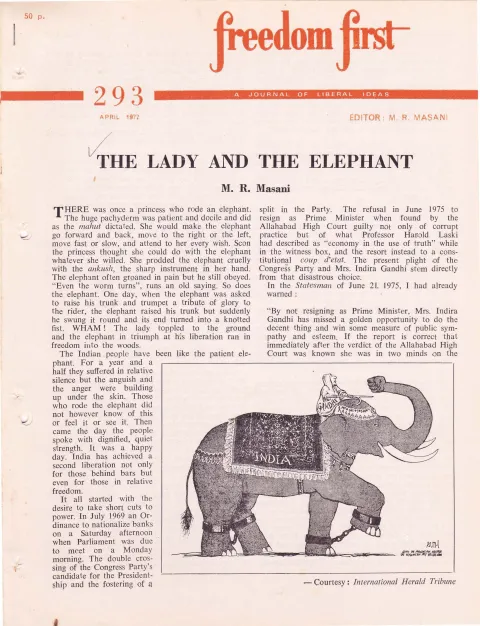
M. R. Masani’s editorial opens with an allegory: a princess rides an elephant that obeys her every cruel command until, one day, the beast turns and throws her off, then runs free into the woods. The Indian people, Masani writes, were like that patient elephant, suffering silently under the Emergency for eighteen months before finally speaking at the ballot box. He traces the crisis to Indira Gandhi’s refusal to resign as Prime Minister after the Allahabad High Court found her guilty of corrupt election practice in June 1975, opting instead for a ‘constitutional coup d’etat’. He quotes his own 1975 warning in the Statesman that she had missed a chance to resign with dignity, and recalls having predicted the breakdown as early as 1962 and 1969. Masani welcomes the Janata victory as a rejection of dictatorship and a restoration of the rule of law and judicial independence, but insists the underlying problems — food shortage, population growth, economic stagnation, illiteracy — remain unsolved and require ‘a new design for living’ rather than a return to the pre-Emergency status quo. He lists five imperative needs for the new government: electoral reform (proportional representation), maintenance of the rule of law and an independent judiciary, federalism, identifying which foreign governments supported the Emergency, and limited government along Gandhian lines. He closes by arguing that citizenship and ‘voluntaryism’ — not politicians or parties — will ultimately save India, invoking Jayaprakash Narayan’s view that political parties are a ‘necessary evil’ resting on inadequate grassroots citizenship.
- Opens with an allegorical fable of a princess and an elephant to frame the Emergency and the 1977 election defeat of the Congress Party.
- Blames the crisis on Indira Gandhi’s refusal to resign after the Allahabad High Court’s 1975 corrupt-practices verdict, calling her subsequent actions a ‘constitutional coup d’etat’.
- Quotes his own June 1975 Statesman warning that she had forfeited dignity and credibility by not resigning.
- Welcomes the Janata victory as a warning to potential dictators and a restoration of rule of law and judicial independence.
- Lists five ‘imperative needs’: electoral reform via proportional representation, rule of law/judicial independence, federalism, identifying foreign friends versus supporters of the Emergency, and limited (Gandhian) government.
- Criticizes forcible vasectomy under the Emergency’s population-control drive as a ‘brutal obscenity’.
- Cites Walter Lippmann’s The Public Philosophy on the danger that failure to govern well breeds counter-revolutionary authoritarianism.
- Argues that citizens, not politicians, will save India, invoking Jayaprakash Narayan’s view of political parties as a ‘necessary evil’.
The Lady and the Elephant
By M. R. Masani
M. R. Masani’s ‘Between You & Me and the Lamp Post’ column offers a set of short, opinionated notes on current events. He praises President Carter’s early handling of Soviet dissent, contrasting Carter’s letter to Andrei Sakharov and reception of Vladimir Bukovsky with President Ford’s earlier missed opportunity to meet Solzhenitsyn, and argues Communist regimes respond to courage, not to diplomatic caution. He discusses the Rhodesian succession crisis, praising Ian Smith’s proposal for a referendum among the black population. He criticises the British Foreign Office’s equivocation over Idi Amin’s threat to attend the June 1977 Commonwealth Conference, arguing Amin should simply be barred entry. He welcomes British courts striking down a Post Office workers’ boycott of mail to South Africa while noting the ‘double standards’ of a labour union that would never boycott mail to the USSR or Eastern Bloc. He also reports on student violence against Sir Keith Joseph at Essex University and the illegal occupation of LSE by students opposing fee increases, framing both as the work of a ‘small Marxist minority’ that authorities should confront rather than indulge. The column closes with a note on a controversy over whether Hitler said National Socialism and Marxism are ‘basically the same’, which Masani endorses as true regardless of whether Hitler actually said it, citing the Stalin-Hitler pact of 1939.
- Praises Carter’s outreach to Soviet dissidents Sakharov and Bukovsky as a sign of principled leadership, contrasted with Ford’s earlier avoidance of Solzhenitsyn.
- Argues Communist regimes are provoked to aggression by cowardice, not by displays of Western sympathy for dissidents.
- Comments on the Rhodesian succession crisis, endorsing Ian Smith’s proposed referendum among the black population.
- Criticises British equivocation over whether to bar Idi Amin from the June 1977 Commonwealth Conference given his record as ‘that racist murderer’.
- Welcomes a British court ruling against a Post Office workers’ boycott of mail to South Africa, but flags the ‘double standard’ that no such boycott is proposed against the USSR, East Germany, or Angola.
- Reports on student violence against Sir Keith Joseph at Essex University and an illegal LSE occupation over fee increases, blaming a ‘small Marxist minority’.
- Notes that fascism, properly understood, is opposed to capitalism and close to communism, not its ally.
- Discusses the controversy over an alleged Hitler quotation equating Nazism and Marxism, endorsing its substance via the 1939 Stalin-Hitler pact.
Has USSR Achieved Atheism?
By M. Murlidhar
M. Murlidhar’s essay examines whether the Soviet Union has succeeded in eradicating religion. He traces the official Soviet ideology’s hostility to religion from Marx’s characterisation of it as ‘an opium of the masses’ through Lenin’s elaboration, describing the Bolshevik state’s campaign: disfranchisement of clergy under the 1918 constitution, abolition of the synod, confiscation of church property, the 1929 formation of the League of Militant Godless, anti-Christmas and anti-Easter campaigns, and bans on religious instruction for minors. He describes a shift after the German invasion of the USSR, when Stalin granted the Orthodox Church a ‘honeymoon’ period of restored status in exchange for patriotic support against Hitler, followed by renewed but more calibrated suppression in the de-Stalinization era, including Komsomol warnings about religion’s influence on youth and educational schemes explicitly designed to teach children that religion and science are irreconcilable. The essay concludes that despite decades of official effort, religion has not been erased from Russian life: statistics on baptisms, church weddings and religious funerals, plus survey data showing high rates of belief among older Russians and women, indicate that religion survives as a private and family-transmitted practice and continues to influence Russian literary culture, even though it has been crippled as a formal institution.
- Frames the question as whether the USSR has actually achieved atheism despite decades of anti-religious policy.
- Traces Marx’s and Lenin’s ideological hostility to religion as ‘an opium of the masses’ and ‘spiritual moonshine’.
- Details concrete Soviet measures: disfranchisement of clergy, the 1918 constitution’s separation of church and state, confiscation of church property, and the 1929 League of Militant Godless.
- Describes a wartime ‘honeymoon’ under Stalin in which the Orthodox Church regained status in exchange for patriotic support against Germany.
- Notes renewed but more calibrated anti-religious campaigns after Stalin’s death, including Komsomol statements and school curricula designed to teach religion and science are irreconcilable.
- Cites 1960s statistical surveys: 60% of children baptised in church, 15% of marriages and 30% of funerals performed in Orthodox rite.
- Notes over 70% of believers are above 40 and over 70% of women believe in God, suggesting religion persists via family transmission.
- Concludes religion survives in Russian literary and private life even though crippled as a formal institution.
Rise and Fall of Michael Foot
By E.P. (abridged from an article in Free Nation, London)
This piece, presented as an abridged reprint of an article from the London Free Nation (originally titled ‘The High-Speed Virgin’), is a highly critical profile of British Labour politician Michael Foot, prefaced by editorial framing noting Foot’s reputation had been ‘so rapidly deflated’ by his conduct in office. The article argues Foot’s long-standing image as a principled libertarian left-winger has been exposed as hollow now that he holds real power as Leader of the House of Commons; it accuses him and other ‘Gentlemen Socialists’ of using ‘socialism’ as a cloak for a feudal instinct to organise and govern people ‘for their own good’, citing new laws that entrench the Closed Shop and curtail press freedom. A boxed sidebar, ‘Lie of the Week’, reproduces a Times exchange in which Foot denounced Bernard Levin for calling Mrs Gandhi a would-be dictator, alongside The Economist’s satirical invitation to nominate the most absurd Indian-politics quotation of the week, including a Foot remark suggesting Mrs Gandhi could have had herself assassinated like Allende to escape criticism.
- Reprinted (abridged) from the London Free Nation under its original title ‘The High-Speed Virgin’.
- Argues Michael Foot’s reputation as a principled libertarian left-winger has collapsed now that he wields real government power.
- Accuses ‘Gentlemen Socialists’ like Foot and Tony Benn of using the language of socialism to disguise an authoritarian, quasi-feudal instinct to govern others ‘for their own good’.
- Cites laws entrenching the Closed Shop and narrowing press freedom as evidence of this shift from rhetoric to authoritarian practice.
- Includes a ‘Lie of the Week’ sidebar quoting Foot’s denunciation of Bernard Levin over remarks about Mrs Gandhi, and The Economist’s satirical contest around it.
Rajaji and Freedom
By N. K. Seetharaman
N. K. Seetharaman’s tribute essay on C. Rajagopalachari (‘Rajaji’) frames his entire public life as one sustained struggle for individual freedom from state and social bondage. It opens by praising Rajaji’s early social reforms as Chairman of the Salem Municipality, opening civic amenities to Harijans and Scheduled Castes against orthodox opposition, and his practical commitment to inter-caste marriage by marrying his daughter to Gandhi’s son. The essay then turns to Rajaji’s political philosophy of the individual versus the state, situating him against the background of pluralist versus monistic theories of sovereignty, and cites his 1959 address inaugurating the Swatantra Party warning against the Congress’s drift toward a ‘true Leviathan’ state that mistrusts citizens and multiplies controls. Rajaji is shown citing Harold Laski’s definition of liberty and warning, in a 1965 Swarajya article, that controlled production and prices amount to controlling persons, not things. The essay reviews Article 19 of the Indian Constitution’s fundamental rights and Rajaji’s concern that these rights were being eroded, citing the abolition of privy purses and the creation of linguistic states (which Rajaji called a ‘tribal idea’) as instances of this erosion. It clarifies that Rajaji’s opposition to nationalisation was not a brief for exploitative capitalism but a concern that state monopoly is as harmful as private monopoly, and that incentives are essential to a developing economy.
- Frames Rajaji’s entire life as one continuous struggle for individual freedom from state and social restriction.
- Credits Rajaji’s tenure as Chairman of Salem Municipality with opening civic access to Harijans and Scheduled Castes against orthodox opposition.
- Notes Rajaji’s practical support for inter-caste marriage, citing his own daughter’s marriage to Gandhi’s son.
- Discusses pluralist versus monistic conceptions of the state as the philosophical backdrop to Rajaji’s thought.
- Quotes Rajaji’s 1959 Swatantra Party inaugural address warning against the Congress’s drift toward a ‘true Leviathan’ state.
- Cites Rajaji’s 1965 Swarajya article arguing controlled production and prices amount to control of persons, robbing them of ‘the will-to-be-free’.
- Reviews Article 19 fundamental rights and Rajaji’s concern over their erosion, including abolition of privy purses and linguistic states policy.
- Clarifies Rajaji’s opposition to nationalisation rested on the danger of state monopoly, not a defence of exploitative private capitalism.
World News
The ‘World News’ digest reprints short wire-service items from international papers covering: the full text of President Carter’s February 5, 1977 letter to Soviet dissident Andrei Sakharov affirming human rights as a central concern of his administration; Milovan Djilas’s appeal to West European Communist parties to press Belgrade on human rights, including his claim of roughly 600 political prisoners in Yugoslavia versus an estimated 10,000 in the USSR; an expose of Spanish Communist leader Santiago Carrillo’s role in the 1936 Paracuellos mass executions near Madrid, contrasted with his current ‘democratic halo’; a report on Uganda’s costly new UN mission building despite requesting UN financial aid; Enoch Powell’s claim that Britain held ‘the whip hand’ within the EEC due to comparatively better living standards; and a note on the Soviet Union’s first domestically produced chewing gum, greeted by Pravda-style praise despite the product’s long association with ‘Western decadence’.
- Reprints Carter’s February 5, 1977 letter to Sakharov affirming human rights as central to U.S. foreign policy.
- Reports Milovan Djilas’s appeal to West European Communists on Yugoslav human rights, citing about 600 political prisoners there versus roughly 10,000 in the USSR per Sakharov’s estimate.
- Details historian Hugh Thomas’s account implicating Santiago Carrillo in the 1936 Paracuellos massacres near Madrid, undercutting his current reformist image.
- Notes Uganda’s construction of an oversized 15-story UN mission building despite appealing to the UN for $15 million in financial aid.
- Reports Enoch Powell’s claim that Britain held ‘the whip hand’ in the EEC due to higher living standards than continental Europe.
- Notes with irony the Soviet Union’s launch of domestically produced chewing gum, previously scorned as a symbol of Western decadence.
Review: What an Innings! (on Survey magazine’s 100th issue)
By Bernard Levin, courtesy: The Times
This is a review by Bernard Levin, reprinted from The Times, celebrating the 100th issue of Survey: A Journal of East and West Studies, edited by Leopold Labedz. Levin situates Survey within the declining tradition of the British intellectual quarterly, praising Labedz for keeping the journal alive, respected, and accessible to general readers for a quarter century while covering East-West and Soviet-bloc affairs with contributors including Andrei Amalrik, Raymond Aron, Zbigniew Brzezinski, Milovan Djilas, Leszek Kolakowski and Andrei Sinyavsky. He highlights the 100th issue’s scoop on the fate of Soviet ambassador Ivan Maisky, drawing on new revelations by Alexander Nekrich about a planned fresh Stalinist purge cut short by Stalin’s death, and quotes at length from Raymond Aron’s essay on Solzhenitsyn and Sartre, which contrasts Sartre’s moral relativism with Solzhenitsyn’s clear rejection of ideological crimes.
- Reviews the 100th issue of Survey: A Journal of East and West Studies, edited by Leopold Labedz for a quarter century.
- Praises Survey for balancing rigorous scholarship on East-West/Soviet affairs with accessibility to the general reader.
- Lists distinguished past contributors including Amalrik, Aron, Brzezinski, Djilas, Kolakowski, Pipes, Schapiro, Seton-Watson, Sinyavsky and Sperber.
- Highlights the issue’s scoop on Soviet ambassador Ivan Maisky’s postwar fate, based on Alexander Nekrich’s account of a planned Stalinist purge halted by Stalin’s death.
- Quotes extensively from Raymond Aron’s essay contrasting Solzhenitsyn’s moral clarity with Sartre’s relativist defence of Marxism as ‘the unsurpassable philosophy of our epoch’.
- Closes praising Labedz and contributors for ‘unremitting fidelity, courage, consistency and truth’ in serving the cause of freedom.
Bertram D. Wolfe (obituary note)
A brief obituary notice for Bertram D. Wolfe, described as one of the founders of the Communist International and perhaps its last surviving member, who died on February 21, 1977 from burns sustained in an accident. The notice recalls Wolfe as one of the fiercest polemicists yet gentlest of men, who became a resolute foe of international Communism and Soviet dictatorship after Stalin’s rise but never let his opposition distort his scholarship, citing his 1948 book Three Who Made a Revolution (on Lenin, Trotsky and Stalin, translated into 28 languages) as a classic study. It recalls a painting by Diego Rivera depicting the founders of the Communist International that hung in Wolfe’s New York home, in which Wolfe featured more prominently than Stalin. The editor recalls Wolfe as a close personal friend and quotes his final postcard to the magazine, sent the previous August, expressing pleasure that Freedom First was ‘holding on, however precariously’.
- Bertram D. Wolfe, a founder of the Communist International, died February 21, 1977 from accidental burns.
- Described as one of the fiercest polemicists and gentlest of men, who became a resolute foe of Soviet dictatorship without letting his opposition distort his scholarship.
- His 1948 book Three Who Made a Revolution, on Lenin, Trotsky and Stalin, is called a classic, translated into 28 languages.
- Recalls a Diego Rivera painting of the Communist International’s founders in which Wolfe featured more prominently than Stalin.
- He was Senior Fellow at the Hoover Institution on War, Revolution and Peace at Stanford from 1966 until his death.
- The editor recalls Wolfe as a personal friend and quotes his final postcard expressing pleasure that Freedom First was ‘holding on, however precariously’.
With Many Voices
‘With Many Voices’ is the issue’s closing page of curated quotations from the world press, epigraphed by Tennyson, on themes echoing the issue’s concerns with democracy, dictatorship, and double standards. Quoted sources include the Daily Telegraph on Indian politicians’ ‘unintelligible manoeuvring’; Lionel Edwards linking democracy and free economy as logically as dictatorship and the state; Mussolini’s dictum equating liberalism with the individual and fascism with the state; President Carter on human rights and reciprocity with Moscow; Winston Churchill defending the moral logic of arming against Soviet buildup; Professor Kolakawski’s quip likening non-totalitarian Communism to ‘the idea of fried snowballs’; Sanjay Gandhi’s claim about CIA versus KGB agents in India; and remarks on Enoch Powell’s oratory and a wry item about Royal Air Force regional commanders named Lock and Ness (‘Monstrous’). The page closes with the Freedom First subscription form (annual subscription Rs. 5.00, published by Democratic Research Service) and the imprint naming J. R. Patel as Associate Editor and printer.
- A curated page of short press quotations under the Tennyson-derived title ‘With Many Voices’.
- Includes Lionel Edwards’s claim that democracy and free economy are as logically linked as dictatorship and the state.
- Includes Mussolini’s dictum: ‘When one says liberalism, one says the individual and when one says fascism, one says the state.’
- Includes a Wall Street Journal line, ‘A democracy suspended once can be suspended again,’ echoing the issue’s central theme.
- Includes Professor Kolakawski’s quip comparing non-totalitarian Communism to ‘the idea of fried snowballs’.
- Includes Sanjay Gandhi’s claim about a ratio of KGB to CIA agents in India.
- Closes with the Freedom First subscription form and publication imprint naming J. R. Patel as Associate Editor, published by Democratic Research Service, Bombay.
Generated by the v1.5 extraction pipeline. Awaiting editorial review.
Essay 9
No summary was extracted for this article. Listed for completeness.
Metadata and summary are AI-extracted from the source PDF and reviewed for editorial accuracy. The original work is available via the Read PDF tab above (where present); paragraph-level citation inside the PDF is deferred to a future engagement.