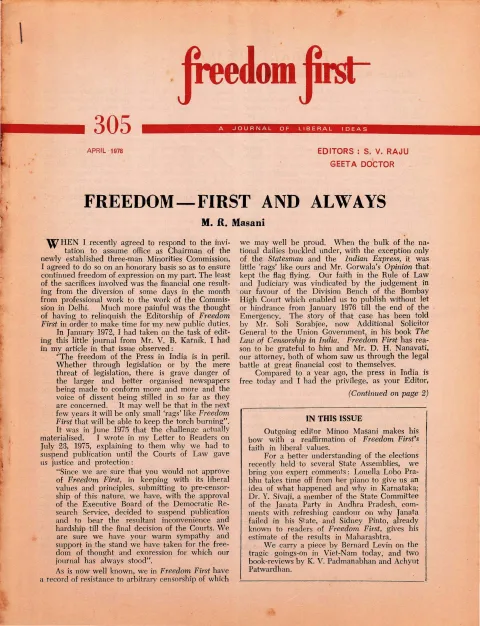
periodical issue
Freedom First
A Journal of Liberal Ideas
Published for Democratic Research Service by J. R. Patel, Associate Editor, Freedom First at 127, M. Gandhi Rd., Bombay 400 023 (Phone: 273914) and printed by him at States' People Press, Choga Street, Fort, Bombay-400 001. · Bombay · 1977
16 pages
Freedom First
Summary
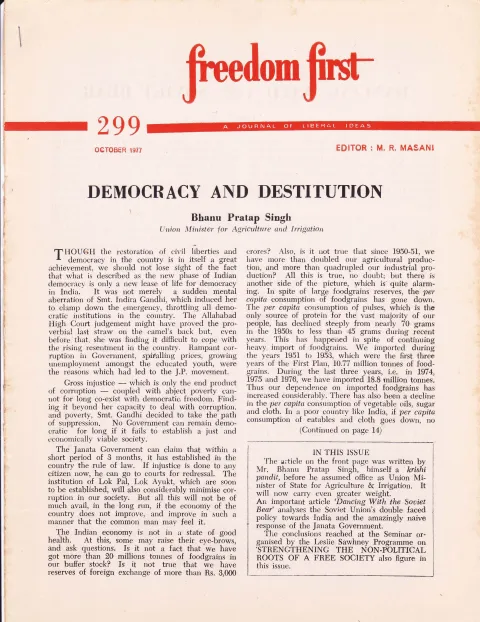
Freedom First No. 299 (October 1977), edited by M. R. Masani, appears roughly three months after the Emergency-era Janata Party electoral victory and is preoccupied with adjudicating that transition: how much has genuinely changed, and what remains broken. The issue opens with Union Minister Bhanu Pratap Singh’s essay on the persistence of rural destitution despite the political restoration of civil liberties, and carries a two-part continuation on agricultural policy reform. A pseudonymous piece, ‘Dancing with the Soviet Bear,’ accuses the Soviet Union and the CPI of having fully backed Indira Gandhi’s Emergency and then pivoting seamlessly to court the Janata government. S. A. A. Pinto’s second installment on torture and preventive detention argues that legal remedies against police brutality exist on paper but are barely enforced, and that the change of government in Delhi has not reformed practice on the ground. A report on a Leslie Sawhney Programme seminar records a wide range of liberal and Sarvodaya-aligned participants debating how to strengthen the non-political roots of a free society. The World View digest surveys foreign press commentary on Coca-Cola’s exit from India, a Sikkimese leader’s memorandum against Indian ‘annexation,’ and astrology in Indian politics. The issue closes with a review of S. R. Maheshwari’s book on President’s Rule, a Groucho Marx obituary tribute, a reader’s letter defending Israel’s negotiating position, and the regular ‘With Many Voices’ page of quotations from world figures.
Key points
-
Union Minister Bhanu Pratap Singh’s “Democracy and Destitution” argues that restored civil liberties do not solve India’s underlying rural poverty, citing falling per-capita food consumption and stagnant agricultural growth, and calls on the Janata Party to make eliminating destitution within ten years its central economic goal.
-
Writing pseudonymously as “Cato”, “Dancing With the Soviet Bear” accuses the Soviet Union and CPI of having fully backed the Emergency and denounced Janata leaders as “fascists”, only to pivot to courting the new government, noting the CPI’s collapsed 1977 Lok Sabha tally.
-
K. Vedamurthy’s “Rajaji Centenary” reveals Rajagopalachari’s true birth date as December 10, 1878 (coinciding with Human Rights Day), recalls his early anti-caste advocacy and 1962 meeting with President Kennedy on nuclear testing, and calls for marking his centenary as an International Year of Human Rights.
-
S. A. A. Pinto’s second instalment on torture and preventive detention argues legal remedies exist on paper under IPC sections 330-331 but are barely enforced, recounting his own eyewitness account of a police beating near Grant Road Station in April 1977.
-
A report on a Leslie Sawhney Programme seminar, with participants including Achyut Patwardhan, B. R. Shenoy, Piloo Mody and Khushwant Singh, concludes that democracy is only a means to a free society and that continuous grass-roots vigilance, not periodic elections alone, is needed to safeguard it.
-
A World View digest covers the Indian government’s demand that Coca-Cola dilute its equity or leave the country, and Sikkimese politician Nar Bahadur Khatiwada’s secret petition to Morarji Desai denouncing India’s 1975 annexation of Sikkim as “imperialist and expansionist”.
-
Girish Munshi reviews S. R. Maheshwari’s book on President’s Rule, noting its 36 documented impositions of Article 356 and questioning why the practice rose sharply between 1971-76 despite Congress’s electoral dominance.
-
M. Savidor, a Member of the Knesset, writes rejecting characterisations of Israel’s negotiating stance as intransigent, stating 95% of Israelis would rather be called intransigent than accept Arab preconditions for negotiation.
Essays
Democracy and Destitution
By Bhanu Pratap Singh
Bhanu Pratap Singh, writing just before assuming office as Union Minister of State for Agriculture and Irrigation, argues that the restoration of civil liberties and democracy under the Janata government, while a real achievement, does not by itself solve India’s underlying problem of poverty and injustice, which he holds responsible for driving Indira Gandhi to impose the Emergency in the first place. He marshals statistics on declining per-capita consumption of foodgrains, pulses, vegetable oils, sugar and cloth, and on rising food-grain imports, to argue that official growth figures mask a deepening crisis of rural destitution. In the essay’s continuation, he contends that ending destitution requires refocusing state investment on agriculture rather than industry, citing the stagnation of agricultural growth after 1960-61 relative to population growth, and calling for the Janata Party to make abolishing destitution within ten years its central economic goal. He closes by cataloguing India’s shortfalls in irrigation, fertiliser use, mechanised power and agricultural credit, arguing these are correctable with land-based resources rather than requiring new capital, provided savings are not siphoned off through price manipulation favouring industry.
- The end of the Emergency is only ‘a new lease of life for democracy,’ not a solution to the poverty and corruption that produced it.
- Per-capita consumption of foodgrains and pulses has fallen even as foodgrain imports have nearly doubled between the early 1950s and the mid-1970s.
- Per-capita agricultural production in 1976-77 was below 1960-61 levels in real terms, while rural incomes lag urban incomes by a widening ratio.
- Industrial growth rates have also declined, which the author attributes to weak agricultural demand.
- India’s irrigated area is only about 30% against a potential of 80%, fertiliser use per hectare is a small fraction of requirement, and agricultural credit from nationalised banks is a small share of total lending.
- The author calls on the Janata Party to make eliminating destitution within ten years its central economic mission, funded by redirecting agricultural savings rather than new industrial investment.
Dancing With the Soviet Bear
By “Cato”
Writing under the pseudonym ‘Cato,’ the author argues that Soviet praise for the Janata government’s foreign policy continuity is opportunistic hypocrisy, given the Soviet Union’s unabashed support for Indira Gandhi’s Emergency and its condemnation of Jayaprakash Narayan and other opposition leaders as ‘fascists’ and ‘anti-national’ while the Emergency lasted. The essay traces the CPI’s parallel reversal — from celebrating the Emergency’s ‘invaluable’ role in 1976 to a 1977 party resolution admitting the public’s ‘sense of suffocation and fear’ — and situates this within a broader pattern of Soviet-aligned communist parties courting nationalist governments (citing the Indonesian PKI’s strategy under Aidit during Sukarno’s rule) while positioning themselves to seize power once such governments falter. It closes by noting the CPI’s collapsed Lok Sabha tally after the 1977 election and warns the Janata government against the same credulity Indira Gandhi’s regime showed toward Soviet friendship.
- The Soviet Union ‘unabashedly supported’ the Emergency and denounced JP Narayan, Morarji Desai and other Janata leaders as fascists and anti-national while it lasted.
- The CPI’s own National Council admitted, only two months after praising the Emergency’s ‘mistakes and excesses’ had ended, that it had underestimated public fear and suffocation under Emergency rule.
- The essay compares Soviet strategy in India to the Indonesian PKI’s strategy of inflating a nationalist president’s power under Sukarno, which ended in the PKI’s destruction.
- The CPI’s Lok Sabha seat count fell from 23 to 7, and its vote share from 4.73% to 2.82%, in the post-Emergency election.
- The essay criticises Indian politicians (naming Rajni Patel and citing V. I. Sizov) for extending an overly warm welcome to Soviet officials after the change of government.
Rajaji Centenary
By K. Vedamurthy
K. Vedamurthy marks the approaching centenary of C. Rajagopalachari’s birth, revealing that Rajaji’s true birth date (established while assisting the Rajaji Biography Committee) was December 10, 1878, rather than the December 8 long celebrated by admirers — a date that happens to coincide with Human Rights Day. The essay reviews Rajaji’s early advocacy against caste and untouchability predating Gandhi’s involvement, his late-life turn to opposing nuclear weapons testing (including a 1962 meeting with President Kennedy that Kennedy credited as a major civilising influence), and closes with an appeal that India and the world mark Rajaji’s centenary year, from December 10 1977, as an International Year of Human Rights.
- Rajaji’s correct birth date was established as December 10, 1878, not the December 8 traditionally celebrated — a date coinciding with Human Rights Day, adopted by the UN in 1948 on Rajaji’s seventieth birthday.
- Rajaji campaigned against caste and untouchability from early in the century, before Gandhi made it a central plank of the freedom movement.
- At age 84, Rajaji made his only trip abroad to campaign for a treaty suspending nuclear tests, meeting President Kennedy in 1962.
- President Kennedy is quoted telling an aide that Rajaji’s impact on him was one of the most civilising influences since he became President.
- The essay calls for December 10, 1977 to be marked as the start of an ‘International Year of Human Rights’ in Rajaji’s honour.
Torture & Preventive Detention - II
By S. A. A. Pinto
S. A. A. Pinto continues his critique of torture and preventive detention (part II), arguing that Emergency-era police brutality was merely an intensification of long-standing ‘normal’ practice rather than a new phenomenon, with Naxalite detainees treated as especially fair game. He explains that Indian law already criminalises torture (IPC sections 330-331) but that enforcement against police is almost nonexistent, and that preventive-detention regimes leave detainees especially vulnerable since they are held without trial. He recounts personally witnessing an unprovoked police beating of a young man near Grant Road Station in April 1977, and describes degrading conditions at Bombay’s remand court as unchanged despite thirty years of independence. Citing constitutional scholar H. M. Seervai’s defence of preventive detention as consistent with a responsible Executive, Pinto argues the Congress-era record of unconstrained one-party rule shows this trust was misplaced, and closes by quoting V. G. Ramachandran’s warning that unchecked executive power over personal liberty invites ‘abject slavery.’
- Torture is already criminalised under IPC sections 330-331 (up to 10 years’ rigorous imprisonment for ‘grievous hurt’), but prosecutions of police are rare.
- Naxalite detainees are described as treated as ‘sub-human’ and an especially common target of custodial abuse, both before and during the Emergency.
- Pinto recounts eyewitnessing a policeman beating a young man near Grant Road Station, Bombay, in April 1977, with no bystander intervention.
- Bombay’s remand court (formerly the Chief Police Court) is described as physically decrepit and largely populated by the poorest of the poor, many undernourished or ill.
- Constitutional scholar H. M. Seervai’s defence of preventive detention (relying on U.S. Justice Jackson’s dictum that a bill of rights must not be a ‘suicide pact’) is challenged as ‘doctrinaire’ given the Congress’s actual record of unchecked one-party rule for 30 years.
- The essay calls for publicising victims’ rights, exemplary punishment of officers who torture, forensic-lab funding, and sustained press/judicial vigilance.
Free Society the End, Democracy the Means (Conclusions of the seminar organised by the Leslie Sawhney Programme on ‘Strengthening the Non-political Roots of a Free Society’)
This unsigned report summarises the conclusions of a seminar organised by the Leslie Sawhney Programme on ‘Strengthening the Non-Political Roots of a Free Society,’ drawing participants from public life, management, law, academia, journalism and the Sarvodaya movement. The seminar agreed that democratic process is only a means to a free, pluralistic, non-exploitative society, and that the Emergency exposed how fragile non-political civic roots are when the state concentrates power. Discussion ranged across education reform, caste and gender inequality, media concentration and press freedom (criticising both the Emergency-era Prevention of Objectionable Matter Act and continuing ‘subtle threats’ after its repeal), the shortcomings of the Chanda Committee’s recommendations on broadcasting, and the need to decentralise power and cultivate ‘grass-roots vigilance’ rather than relying on periodic elections alone to safeguard a free society.
- Participants included Achyut Patwardhan, Prof. V. V. John, M. R. Masani, P. G. Mavalankar, Soli Sorabji, C. R. Irani, Piloo Mody, Balraj Madhok, Prof. Ram Joshi, Khushwant Singh, Shamim Ahmed Shamim, Col. Manohar Malgonkar, Prof. B. R. Shenoy, K. D. Desai, Narayan Desai, Dr. (Mrs.) Promila Kapur, Dr. C. Kulshrestha, Kanshi Ram, and Jehangir Patel.
- The seminar held that democracy is a means to a free, pluralistic, non-exploitative society, not an end in itself, and that non-political civic roots need active strengthening.
- Education reform, decentralised small-scale projects, and reduced political interference in curricula were urged, citing a Prime Minister’s office directive to withdraw a textbook as an example of political interference.
- The seminar criticised continuing government control of newsprint and advertising (DAVP) as tools for disciplining the press, and found the Chanda Committee’s recommendations on broadcasting undermined by a new, delay-inducing committee.
- Caste, gender inequality and rural poverty were identified as key non-political fault lines requiring ‘radical change’ in resource allocation toward agriculture.
- The seminar concluded that periodic elections alone cannot safeguard a free society; continuous accountability and grass-roots vigilance, alongside a decentralised, participative society, are needed.
World View (news digest: Coke Success Abhorrent; Transfer Secrets or Leave; Sikkim Plea to India; Political Magic)
The ‘World View’ digest reprints excerpts from the foreign press on three stories: the Wall Street Journal and New York Times coverage of the Indian government’s demand that Coca-Cola transfer majority ownership and technical know-how to Indian shareholders or leave the country, forcing Industries Minister George Fernandes’s policy into an international dispute; a Calcutta-datelined report on Sikkimese politician Nar Bahadur Khatiwada’s secret petition to Prime Minister Morarji Desai denouncing India’s 1975 annexation of Sikkim as ‘imperialist and expansionist,’ with signatures from elected Sikkim Assembly members and an appeal for Jayaprakash Narayan’s support; and a Bombay-datelined piece on the persistence of astrology and occult practice in contemporary Indian politics, including the release of a man arrested for ticketless travel after invoking a connection to Raj Narain.
- The Wall Street Journal editorially backed Coca-Cola against the Indian government’s demand to dilute foreign equity to 40% and share its formula, calling Industry Minister George Fernandes’s policy self-defeating.
- The New York Times reported the Indian government gave Coca-Cola a year (from April) to transfer 60% of equity to Indian shareholders or cease operations.
- Sikkimese politician Nar Bahadur Khatiwada, once a supporter of merger with India, presented Prime Minister Morarji Desai a petition signed by ten, including four elected Sikkim Assembly members, alleging India’s role in a ‘phoney revolution’ during the 1973 unrest and the 1975 abolition of the monarchy.
- Khatiwada’s delegation sought support from Jayaprakash Narayan in Patna en route to New Delhi.
- A Bombay item recounts a man in Gonda, Uttar Pradesh arrested for a fake railway pass being released after invoking his connections to controversial minister Raj Narain, allegedly due to his reputation as a Tantra expert.
In Memory of Groucho Marx
A short unsigned tribute reprints several of Groucho Marx’s best-known witticisms following his death on August 19 at age 86, paired with a cartoon commenting on U.S.-China-Taiwan relations reprinted from The Guardian.
- The tribute marks Groucho Marx’s death in hospital at age 86 with a selection of his famous one-liners.
- It notes his brothers Harpo and Chico, who both died in the 1960s, had promised to contact him from the afterlife if possible.
Letter: No Suicide for Israel
By M. Savidor, Member of Knesset
A letter to the editor from M. Savidor, a Member of the Knesset, rejects characterisations of Israel’s negotiating stance as intransigent, arguing that Israel is willing to negotiate a full peace treaty with freedom of movement across borders, but rejects the Arab position that Israel must first surrender all ‘occupied’ territories and recognise a Palestinian state before any negotiation. Savidor states that 95% of Israelis would rather remain ‘intransigent’ than accept such preconditions, and that Israel will not commit suicide under external pressure.
- Savidor rejects the charge of Israeli intransigence as ‘malicious propaganda.’
- He states Israel is willing to negotiate a full peace treaty with freedom of movement across borders.
- He rejects preconditions requiring Israel to cede all occupied territories and recognise Palestinian statehood before negotiations.
- He states that 95% of Israelis would rather be called ‘intransigent’ than accept those preconditions.
- The letter closes: ‘We are not going to commit suicide and nobody will force us to do so.‘
Review: President’s Rule by S. R. Maheshwari (MacMillan)
By Girish Munshi
Girish Munshi reviews S. R. Maheshwari’s book ‘President’s Rule’ (MacMillan, Rs. 50, 216 pp.), which surveys the 36 impositions of President’s Rule across Indian states, the constitutional genesis of Article 356, and the roles of the President, Central Government, Parliament and Governors in its use. The review notes Maheshwari’s finding that President’s Rule was imposed 7, 9 and 16 times respectively in 1950-66, 1967-70 and 1971-76, a rising frequency the reviewer finds under-explained given the Congress’s growing electoral dominance in the same period. Munshi credits the book with raising, though not fully answering, pointed questions about whether Article 356 has been used to serve the ruling party’s factional interests, bypass rival parties, or reverse unwelcome policy decisions, and about the conduct of Governors and central ministers deputed to handle President’s Rule.
- Maheshwari’s book documents 36 impositions of President’s Rule and identifies six recurring causal patterns: party instructions, defections, withdrawal of coalition support, agitation, corruption, and necessity.
- President’s Rule was imposed 7 times in 1950-66, 9 times in 1967-70, and 16 times in 1971-76, despite the Congress’s sweeping 1971 Lok Sabha majority (352 of 518 seats).
- The review notes the Supreme Court’s ruling in U.N.R. Rao v. Smt. Indira Gandhi (AIR 1971 SC 1002) established the President has no independent powers beyond the advice of the Council of Ministers.
- Munshi faults the book for not adequately explaining why the frequency of imposition rose so sharply from 1971-76 despite Congress’s electoral dominance.
- The review lists further unanswered questions the book raises: whether Article 356 was used to rescue state-level factions, deny rival parties governance, or reverse unwelcome policy, and whether appointing central ministers to oversee President’s Rule undermines Governors’ constitutional standing.
With Many Voices (quotations column)
The regular ‘With Many Voices’ page compiles short quotations from contemporary public figures on power, liberty, and government, drawn from the world press of July-September 1977, alongside the issue’s subscription form and publication colophon.
- Quotations range across Margaret Thatcher on communism and fascism as ‘two feet’ of socialism, Jimmy Carter on American foreign policy, N. A. Palkhiwala on the 42nd Amendment, and the Prince of Wales on Britain’s Commonwealth.
- The page also includes A. D. Gorwala on individual civic responsibility and quotations on the corrupting effect of political power.
- The colophon confirms the issue was published for Democratic Research Service by J. R. Patel, Associate Editor, at 127 M. Gandhi Rd, Bombay, and printed at States’ People Press, Fort, Bombay.
Generated by the v1.5 extraction pipeline. Awaiting editorial review.
Metadata and summary are AI-extracted from the source PDF and reviewed for editorial accuracy. The original work is available via the Read PDF tab above (where present); paragraph-level citation inside the PDF is deferred to a future engagement.