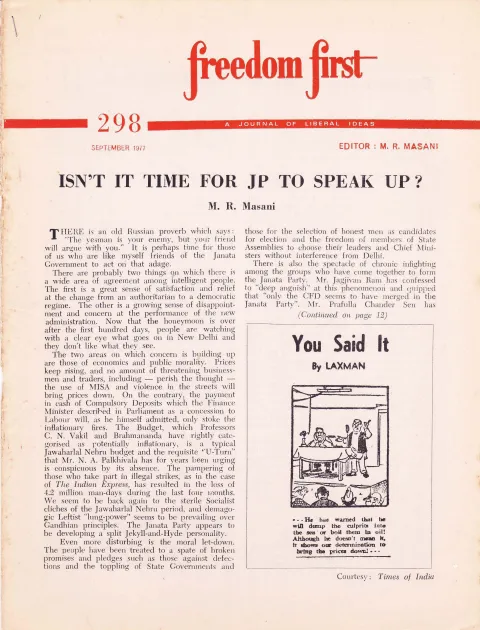
periodical issue
Freedom First
A Journal of Liberal Ideas
By Jayaprakash Narayan, M. R. Pai
Published for the Democratic Research Service by J. R. Patel, Associate Editor, Freedom First at 127, M. Gandhi Rd., Bombay 400 023, and printed by him at States' People Press, Choga Street, Fort, Bombay-400 001. · Bombay · 1977
16 pages
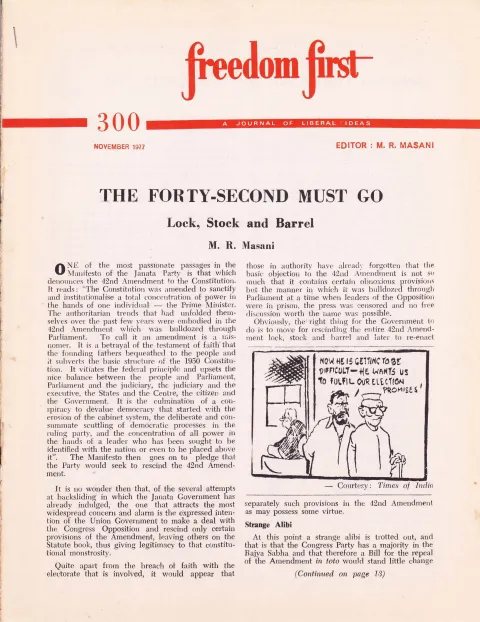
Freedom First
Summary
Freedom First issue No. 300 (November 1977), edited by M. R. Masani, appears in full across these 16 rendered pages, running from the cover through the closing subscription notice and imprint. The issue is dominated by post-Emergency constitutional politics: Masani’s lead editorial demands the Janata Government repeal the 42nd Amendment ‘lock, stock and barrel’ rather than retain any of its provisions, a position echoed by a Lawyers’ Group memorandum from the ‘Committee of a Hundred’ reproduced in full and by a report on a Supreme Court Bar Association statement. Alongside this constitutional theme, the issue carries Jayaprakash Narayan’s tribute message on Masani’s memoir ‘Bliss Was It In That Dawn’, an editorial page (‘Between You & Me and The Lamp Post’) on miscellaneous topical items (Soviet psychiatric abuse, euthanasia, sex-discrimination law, Hindi-language politics, Air India liquor policy), a condensed profile of Paul Johnson’s break from the British Labour Party, a report on a seminar critical of the Samachar news-agency monopoly report, a World News digest of wire-service items, a feature on West African bureaucratic dysfunction (‘wawa’), two book reviews (of ‘Prophets of Freedom and Enterprise’ and of a study of Central Asian art), a note on the founding of the Rajaji Foundation, three letters to the editor on the Emergency’s aftermath and cultural commentary, and a closing page of quoted aphorisms (‘With Many Voices’) plus the subscription coupon and imprint.
Key points
-
M. R. Masani’s lead editorial demands the Janata Government repeal the 42nd Amendment “lock, stock and barrel” rather than compromise with the Congress opposition, objecting to the anti-democratic manner of its Emergency-era passage and its reduction of the President to a “puppet”.
-
Jayaprakash Narayan’s tribute message on Masani’s memoir “Bliss Was It In That Dawn” recalls their decades-long friendship since their Nasik Road Central Prison days and praises the book as an objective account of their generation’s struggle.
-
A condensed profile traces Paul Johnson’s public break from the Labour Party after his “Farewell to the Labour Party” piece, situating him among prominent Labour defectors and describing his conviction that political freedom is impossible without economic freedom.
-
Masani’s Ahmedabad address, “Not By Politics Alone”, argues socialism and secularism both wrongly claim for the State what belongs to God or conscience, and calls for dismantling the “permit-license-quota-raj” in favour of Rajaji’s “Farm, Family and Freedom”.
-
A Bombay seminar organised by the Indian Committee for Cultural Freedom criticises the Janata government’s plan to replace the Samachar news agency with three new agencies, arguing this merely swaps one government monopoly for three and would run heavy financial deficits.
-
The Committee of a Hundred’s Lawyers Group submits a memorandum demanding total repeal of the 42nd Amendment, backed by a Supreme Court Bar Association statement of “alarm and dismay” at its continued use to deprive citizens of rights.
-
M. R. Pai reviews Prophets of Freedom and Enterprise, an essay collection on Adam Smith, Keynes, Friedman, Mises and Hayek, arguing it corrects Marxist misrepresentations and flags Mises and Popper as neglected voices in Indian discourse.
-
David Lamb’s reprinted Los Angeles Times feature describes “wawa” (“West Africa Wins Again”), expatriate shorthand for the region’s chronic bureaucratic dysfunction and unreliable infrastructure.
-
The Rajaji Foundation is announced as a registered trust to spread Rajagopalachari’s message of Dharma and liberal-society norms, with M. R. Masani and S. V. Raju among its trustees.
Essays
The Forty-Second Must Go — Lock, Stock and Barrel
By M. R. Masani
M. R. Masani’s lead editorial argues that the Janata Government must repeal the 42nd Amendment to the Constitution entirely, rather than accept a compromise brokered with the Congress opposition that would retain some of its provisions. He contends the core objection to the Amendment is not merely its individual clauses but the anti-democratic manner of its passage during the Emergency, when opposition leaders were jailed and the press censored. The essay continues on page 13, rejecting the ‘strange alibi’ that a repeal bill would fail in the Rajya Sabha, criticizing the proposed retention of ‘secular’ and ‘socialist’ in the Preamble as unnecessary and pointing out the Constitution already guarantees religious freedom and property rights, and objecting to the Amendment’s diminishment of the President to a ‘puppet’ bound by Cabinet advice. Masani quotes Jayaprakash Narayan’s Prison Diary describing ‘the supremacy of Parliament’ as code for dictatorship of the Prime Minister and Cabinet, and closes urging the Janata Government not to make a mistake the country would regret.
- Argues for total repeal of the 42nd Amendment, not a partial compromise with the Congress opposition
- Objects primarily to the anti-democratic manner in which the Amendment was passed during the Emergency
- Rejects the alibi that the Rajya Sabha’s Congress majority would block a full repeal bill
- Criticizes retaining ‘secular’ and ‘socialist’ in the Preamble as redundant given existing constitutional guarantees
- Warns that reducing the President to a rubber stamp of the Prime Minister’s advice risks repeating 26 June 1975
- Cites Jayaprakash Narayan’s Prison Diary on the ‘supremacy of Parliament’ concealing dictatorship by the Cabinet/Prime Minister
’A Nostalgic Experience’
By Jayaprakash Narayan
The editorial miscellany column ‘Between You & Me and The Lamp Post’ covers several unrelated topical items: praise for psychiatrists at a Honolulu conference for belatedly condemning Soviet political abuse of psychiatry (naming Sidney Bloch and Peter Reddaway’s book ‘Russia’s Political Hospitals’); a note on Dr. Christian Barnard’s death-pact remarks tied to his book ‘The Night Season’; a British sex-discrimination tribunal and House of Lords case (Mr. Peake) about women workers leaving factories early, decided by Lord Denning; commentary mocking Atal Behari Vajpayee’s Hindi-language speech at the UN and the cost of promoting Hindi as an international language; a note on Air India being asked to stop serving liquor and the risk to its reputation; and, on a separate page, praise for the West German commandos’ Mogadishu hostage-rescue operation (another ‘Entebbe’).
- Welcomes psychiatrists’ belated condemnation of Soviet abuse of psychiatry for political ends, citing the book ‘Russia’s Political Hospitals’
- Notes Dr. Christian Barnard’s public death-pact remarks around his book ‘The Night Season’
- Covers a UK sex-discrimination tribunal/House of Lords case on differential treatment of factory workers by sex
- Mocks the cost and rationale of promoting Hindi as an international language after Vajpayee’s UN speech
- Criticizes a proposed liquor ban on Air India flights as a threat to the airline’s reputation and tourism
- Praises the West German commando raid at Mogadishu airport as another ‘Entebbe’-style triumph of firmness over terrorist blackmail
Paul Johnson Discards Socialism
By Jayaprakash Narayan
A short tribute message from Jayaprakash Narayan, sent to the publishers of M. R. Masani’s memoir after reading an advance copy, recalling their decades of friendship despite political and religious differences (Narayan a socialist critical of Gandhi at the time, Masani a Congress-turned-liberal), and praising Masani’s autobiographical writing from ‘My India’ through ‘Bliss Was It In That Dawn’ as fair, perceptive, and readable. Narayan credits Masani with unusual forensic ability in his brief parliamentary career and calls the book an objective, truthful account of the struggle and upheaval of their generation of young nationalists and socialists.
- Narayan calls reading Masani’s memoir a ‘nostalgic experience’ recalling their friendship since the Nasik Road Central Prison days
- Notes both men became ‘Gandhians’ intellectually and spiritually despite early disagreements with Gandhi
- Praises Masani’s forensic ability during his short parliamentary career
- Describes the book’s period as one of ‘struggle and upheaval’ for young nationalists and socialists
- Recommends the book to Indian youth as an objective and truthful account for inspiration toward national service
Farewell to the Labour Party
A condensation of a Michael Davis article from the Sunday Observer Review profiling Paul Johnson, the former Editor of the New Statesman and Labour Party member, following his public resignation from Labour and his 4,000-word ‘Farewell to the Labour Party’ piece. The article situates Johnson within a wider trend of prominent Labour figures (Lord Shawcross, George Brown, Woodrow Wyatt, Dick Taverne, Hugh Thomas, Roy Jenkins, David Marquand, Brian Walden) drifting from the party, and profiles Johnson’s personality and intellectual formation, including his recollection of a 1952-53 Tribune lunch where Nye Bevan told him trade unionism was a defensive reaction to capitalism and that Bevan combined socialist concern for the public good with intense individualism. Johnson’s own conversion, he says, required both ‘intellectual conviction’ and ‘a moment of emotional shock’ — the latter triggered by British Rail’s treatment of long-serving workers during a closed-shop dispute.
- Paul Johnson resigned from the Labour Party in September 1977 and published ‘Farewell to the Labour Party’ in the New Statesman
- Article situates Johnson among a list of prominent Labour defectors including Lord Shawcross, George Brown, Woodrow Wyatt, Roy Jenkins
- Johnson recalls Nye Bevan telling him trade unionism was ‘a defensive reaction to capitalism’ and that Bevan combined socialism with individualism
- Johnson holds that political freedom is impossible without economic freedom, and collectivism threatens liberty
- His break required both intellectual conviction and an emotional shock tied to a British Rail closed-shop dismissal case
- Portrays Johnson as a combative, order-loving, black-and-white thinker (e.g., Benn v. Thatcher) increasingly influential on former Labour voters
Not By Politics Alone
A report (‘Not By Politics Alone’) on M. R. Masani’s address to the Ellisbridge Jaycees in Ahmedabad on Gandhi’s Birth Anniversary, arguing that socialism and secularism both demand for the state what belongs to God or individual conscience, and that India suffers from too much politics and too little citizenship. Masani warns against blaming the Emergency solely on ‘the wickedness of one person’ and the cult of personality, tracing the deeper failure to weak social and non-political roots — illiteracy, superstition, caste, untouchability, subordination of women — and a quarter-century of an imposed materialist and Statist philosophy that neglected individual character-building. He calls for dismantling the ‘permit-license-quota-raj’ (a phrase he attributes to Rajaji) and restoring freedom of choice to consumer, producer, and investor, invoking Rajaji’s values of ‘Farm, Family and Freedom’.
- Masani argues socialism and secularism both wrongly claim for the State what belongs to God or individual conscience
- Warns against blaming the Emergency purely on personal wickedness or cult of personality
- Attributes democratic fragility to weak social roots: illiteracy, superstition, caste, untouchability, women’s subordination
- Criticizes a quarter-century of imposed materialist/Statist philosophy neglecting individual character
- Calls for dismantling the ‘permit-license-quota-raj’ and restoring freedom of choice to consumer, producer and investor
- Invokes Rajaji’s values of ‘Farm, Family and Freedom’ as what India’s God-fearing masses believe in
No Samachar Monopoly — Majority Report Criticised
A report on a Bombay seminar organised by the Indian Committee for Cultural Freedom and the Indian Liberal Group, chaired by Anant Kanekar, criticizing the Janata Government’s Committee Report recommending replacement of the Samachar news agency with three new agencies (Sandesh, Varta, News India), arguing this merely replaces one government monopoly with three, misconceives the function of a news agency by loading it with responsibilities like ‘moulding of public opinion,’ and would run heavy financial deficits (Sandesh Rs. 35 lakhs, News India Rs. 60 lakhs, aggregate deficit estimated to reach Rs. 1.7 crores). Participants included M. R. Masani, Ratansinh Rajda, C. R. Irani, and several editors and journalists; the seminar called instead for restoring PTI and UNI with full freedom to develop international news coverage and start regional-language services.
- Seminar organised by the Indian Committee for Cultural Freedom and Indian Liberal Group criticizes the Report recommending Samachar’s replacement by Sandesh, Varta and News India
- Participants argue this replaces one government monopoly with three, not genuine competition
- Report’s financial projections show deficits of Rs. 35 lakhs (Sandesh) and Rs. 60 lakhs (News India), estimated to reach Rs. 1.7 crores aggregate
- Report criticized for loading news agencies with vague duties like ‘moulding of public opinion’ and ‘social responsibility’
- Seminar calls instead for restoring PTI and UNI with full freedom for international coverage and regional-language services
- Notes Prime Minister and Information Minister had invited public discussion but report copies were hard to obtain, limiting debate
Wawa — Unseen Ruler of W. Africa
By David Lamb
No summary was extracted for this article. Listed for completeness.
World News (Russia’s Luxury Car; How Not To Create Jobs; Carter Wants To Scrap Welfare; Jay Intervenes For Mrs. Thatcher)
By Kevin Klose (Russia’s Luxury Car item); others uncredited/agency-sourced
A feature by David Lamb (courtesy Los Angeles Times) describing ‘wawa’ — an acronym for ‘West Africa Wins Again’ — as shorthand among expatriates in West Africa for the chronic unreliability, inefficiency, and bureaucratic dysfunction encountered there: missed flights, broken infrastructure, and shoddy craftsmanship. The piece illustrates the phenomenon with anecdotes (an American housewife in Liberia, an Air Nigeria flight that forgot its baggage, an Air Zaire flight sent to the wrong destination, an Accra airport running out of fuel) and contrasts Western frustration with African patience, suggesting the tropical climate and traditional subsistence economy explain the lack of urgency, and notes that French/British-run Dakar and Abidjan are less affected because they remain ‘run basically by the French’.
- ‘Wawa’ (‘West Africa Wins Again’) is expatriate shorthand for chronic unreliability and inefficiency across West Africa
- Anecdotes include missed and misdirected flights (Air Nigeria, Air Zaire), broken infrastructure, and an airport running out of fuel
- Contrasts Western frustration over punctuality with Africans’ patience, framed as culturally distinct concepts
- Suggests warm climate and a traditionally sufficient subsistence economy explain the lack of urgency to fix problems
- Notes Dakar and Abidjan are comparatively unaffected because they remain ‘run basically by the French’
Drink Creates Havoc in Soviet Shops; Powell’s Race Figures ‘Coming True’
By Mary Ellen Synon (Powell’s Race Figures item)
A ‘World News’ digest of short wire-service items reprinted from foreign papers: Kevin Klose (Washington Post) on the Soviet Union’s new luxury Chaika car reserved exclusively for officials while ordinary citizens wait for smaller Zhigulis and Moskvitches; a satirical five-point ‘Permanent Strategy to Fight Unemployment’ attributed to Murray Weidenbaum mocking standard interventionist policy prescriptions (Time, October 3); a report that President Carter urged Congress to scrap the US welfare system in favour of a work-based scheme (Sunday Observer, August 7); and an item on Peter Jay’s diplomatic intervention that salvaged a near-failed meeting between Margaret Thatcher and President Carter, involving Cyrus Vance, Zbigniew Brzezinski and Kingman Brewster (Daily Telegraph, September 15).
- Soviet Union unveils the ‘Seagull’/Chaika model 14 luxury car reserved exclusively for officials, while citizens queue for smaller cars
- Satirical ‘briefing for liberals’ by Murray Weidenbaum lists tongue-in-cheek policies guaranteed to worsen unemployment
- President Carter urges Congress to scrap the US welfare system for a new work-conditioned scheme
- Peter Jay’s diplomatic intervention helped salvage a near-failed Thatcher-Carter meeting, with the White House calling it a one-off exception
Committee of a Hundred Demands Total Repeal — Lawyers’ Memorandum on 42nd Amendment
Further World News items continuing onto page 9 and 10: a Times of India report (Moscow, July 28) on a survey by the weekly Literary Gazette using British breath-test equipment finding widespread drunkenness among Soviet shop staff, prompting calls for trade inspectors to curb it; and a Daily Telegraph (September 15) item in which Dipak Nandy, former director of the Runnymede Trust, admits Enoch Powell’s 1960s predictions about racial demographic concentration in British inner cities are ‘coming true’, despite having previously dismissed Powell’s statistics as ‘simply mad’.
- Soviet survey using British breath-test equipment finds widespread drunkenness among shop staff in an unnamed Soviet town
- Cashiers had the best sobriety record; warehousemen, butchers and vegetable sellers were the worst offenders
- Dipak Nandy, former Runnymede Trust director, admits Enoch Powell’s demographic predictions on immigration are ‘coming true’
- Nandy had previously dismissed Powell’s race statistics as ‘simply mad’
Reviews: Freeedom First and Last (Prophets of Freedom and Enterprise, ed. Michael Evens)
By M. R. Pai
A report on the Committee of a Hundred’s Lawyers Group (Porus Mehta, Anil Diwan, D. H. Nanavaty, and Mr. & Mrs. Radhakrishnan) preparing a memorandum to the Prime Minister and Union Law Minister demanding total repeal of the 42nd Amendment, reproducing the memorandum’s arguments in full: that all Emergency-era amendments were made without public debate, a muzzled press, and imprisoned opposition leaders, and should be repealed altogether with any genuinely useful provisions reintroduced later through fresh, openly-debated constitutional amendments. It also cites a Supreme Court Bar Association statement of August 5, 1977 expressing ‘alarm and dismay’ at governments relying in courts on the 42nd Amendment to deprive citizens of legal rights, and notes the Bombay Bar Association passed a similar resolution.
- Lawyers Group of the Committee of a Hundred (Porus Mehta, Anil Diwan, D. H. Nanavaty, Mr. & Mrs. Radhakrishnan) prepares memorandum demanding total 42nd Amendment repeal
- Memorandum argues Emergency-era amendments lacked public debate, muzzled press, and imprisoned opposition leaders, making them illegitimate
- Recommends repealing the Amendment wholly, then reintroducing any useful provisions via fresh, openly debated amendments
- Cites Supreme Court Bar Association’s August 5, 1977 statement of alarm at governments relying on the 42nd Amendment to deprive citizens of rights
- Notes the Bombay Bar Association passed a similar resolution
Reviews: Art of Central Asia (by Chhaya Bhattacharya)
By M. R. Pai
A book review by M. R. Pai of ‘Prophets of Freedom and Enterprise’, edited by Michael Evens (Kogan Page), a collection of essays on Adam Smith, John Stuart Mill, Alfred Marshall, John Maynard Keynes, Milton Friedman, Ludwig von Mises, Karl Popper and F. A. Hayek. Pai argues the book usefully dispels Marxist misrepresentations of these thinkers, contrasts Keynes and Friedman as both fundamentally liberal despite their opposing prescriptions, highlights Friedman’s warnings about inflation from government monopoly over money supply, and singles out Mises and Popper as neglected in India for their warnings against a State transformed into an all-powerful Moloch. He closes urging Indian intellectuals who lived through the Emergency’s ‘enlightened dictatorship’ to honestly weigh these liberal thinkers’ arguments.
- Reviews ‘Prophets of Freedom and Enterprise’, ed. Michael Evens, covering eight liberal economic/political thinkers
- Argues the book corrects Marxist misrepresentations of Adam Smith, Mill and others
- Presents Keynes and Friedman as both liberal in orientation despite differing economic prescriptions
- Highlights Friedman’s warning that inflation stems from government’s monopoly abuse over money supply
- Flags Mises and Popper as neglected in Indian intellectual discourse for warning against the State becoming a Moloch
- Frames the review against the backdrop of India’s Emergency as an ‘enlightened dictatorship’ experience
The Rajaji Foundation
A book review by Geeta Doctor of ‘Art of Central Asia’ by Chhaya Bhattacharya (Agam Prakasan, Rs. 200), a study based on the author’s doctoral thesis at the Freie University, West Berlin, examining ancient Silk Road artifacts including Aurel Stein’s finds, with particular focus on wooden objects and Buddha figures from the Berlin Museum’s collection of 552 illustrated items. The review notes the book traces regional and oasis-wise distinctive styles, including Gandharan influences, and praises its detailed cataloguing though noting it targets specialist rather than general readers.
- Reviews Chhaya Bhattacharya’s ‘Art of Central Asia’, based on her doctoral thesis at the Freie University, West Berlin
- Covers Silk Road artifacts recovered by Aurel Stein and other expeditions, focusing on wooden objects and Buddha figures
- Catalogues 552 illustrated objects from the Berlin Museum’s collection with serial and registration numbers
- Discusses regional/oasis-wise stylistic distinctions and Gandharan influences in Central Asian art
- Judged useful primarily as a specialist reference guide rather than general reading
Letters: The Tip of the Iceberg
By Manohar Malgonkar
A short news item reporting that Mr. Masani, addressing a Bombay press conference on 23 September, announced the formation of the Rajaji Foundation as a registered trust to spread Rajaji’s message of Dharma and the norms for a free, liberal society, proposing public meetings, study circles, seminars, discussions and publications. The Foundation’s trustees are listed as M. R. Masani, Parmanand Kejriwal, Girish K. Munshi, K. H. Subramanian, Sosan L. Panday and S. V. Raju, based at 143 Mahatma Gandhi Road, Bombay.
- Rajaji Foundation announced as a registered trust at a Bombay press conference on 23 September
- Purpose is to spread Rajaji’s message of Dharma and norms for a free, liberal society through public meetings, study circles, seminars and publications
- Trustees named: M. R. Masani, Parmanand Kejriwal, Girish K. Munshi, K. H. Subramanian, Sosan L. Panday, S. V. Raju
- Located at 143 Mahatma Gandhi Road, Bombay 400 023
Letters: Land of Superstitions and Fads
Three letters to the editor. Manohar Malgonkar’s ‘The Tip of the Iceberg’ argues the Emergency-era censorship concealed deeper scandals than have yet emerged, comparing US Watergate malpractices favourably (as merely disloyal but not self-enriching) to alleged Indian abuses, and asking rhetorically what became of files destroyed at No. 1 Safdarjung Road. An anonymous or pseudonymous humorous letter, ‘Land of Superstitions and Fads,’ satirizes Indian political and social attitudes toward drink, cow protection, English-language politics, and gender double standards. M. Murlidhar’s letter criticizes Prime Minister Morarji Desai for bowing to pressure from RSS and ‘socialist’ colleagues on issues like naxalite releases and government charity-home closures, expressing hope that fears of Desai following an ‘Ajoy Mukherjee’-style trajectory prove wrong. A further letter on J.P. and Janata differs with Masani’s September 1977 article, defending the 42nd Amendment’s fundamental-duties chapter as worth retaining even amid otherwise abrogating the amendment, signed Jal Irani.
- Manohar Malgonkar’s letter argues Emergency-era abuses were far worse and better concealed than Watergate-style American malpractices
- Malgonkar questions what happened to destroyed files at No. 1 Safdarjung Road and cites cases like Jakotia, Nagarwala, Maruti and Tulmohan
- A satirical letter, ‘Land of Superstitions and Fads’, mocks contemporary debates over prohibition, cow protection and the English language
- M. Murlidhar criticizes PM Morarji Desai for wavering under pressure from RSS and ‘socialist’ elements within his own coalition
- Jal Irani’s letter defends retaining the 42nd Amendment’s fundamental-duties chapter even while supporting repeal of the rest
- Letters collectively reflect ongoing post-Emergency debate over accountability, governance, and constitutional reform
Letters: J. P. and Janata
By Jal Irani
The closing page, ‘With Many Voices,’ collects brief quoted aphorisms and remarks from world newspapers and public figures (Joseph Gormley, P. G. Mavalankar, David Steel, Fred Emery, C. G. K. Reddy, A. D. Gorwala, The Economist, Bernard Shaw, Indira Gandhi, Boris Pasternak, Wole Soyinka, among others) under a Tennyson epigraph, followed by the Freedom First subscription coupon and the publication’s imprint naming J. R. Patel as Associate Editor and States’ People Press, Fort, Bombay as printer.
- Compiles short quoted aphorisms from world press and public figures under a Tennyson epigraph
- Includes remarks from Joseph Gormley, David Steel, A. D. Gorwala, Bernard Shaw, Boris Pasternak, Wole Soyinka and others
- Quotes Indira Gandhi on the contrast between Agra’s Taj Mahal/Fort and Delhi’s Qutab Minar/Indira Gandhi herself as attractions
- Includes the Freedom First annual subscription coupon (Rs. 5.00) addressed to Democratic Research Service, Bombay
- Imprint identifies J. R. Patel as Associate Editor and States’ People Press as printer
Generated by the v1.5 extraction pipeline. Awaiting editorial review.
Metadata and summary are AI-extracted from the source PDF and reviewed for editorial accuracy. The original work is available via the Read PDF tab above (where present); paragraph-level citation inside the PDF is deferred to a future engagement.