periodical issue
Freedom First
A Journal of Liberal Ideas
By S. V. Raju
Published for the Democratic Research Service by J. R. Patel, Associate Editor, Freedom First at 127, M. Gandhi Rd., Bombay 400 023 (Phone 273914) and printed by him at States' People Press, Choga Street, Fort, Bombay-400 001. · Bombay · 1977
16 pages
Freedom First
Summary
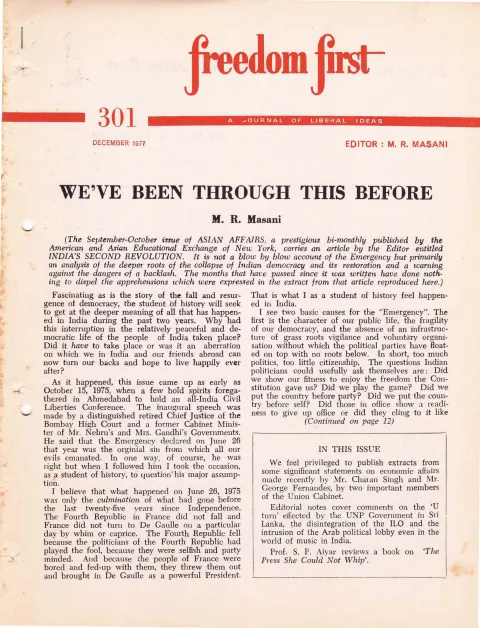
Freedom First No. 301 (December 1977) appears five months into the Janata Party government that replaced Indira Gandhi’s Congress regime after the Emergency. The issue’s center of gravity is the editor M. R. Masani’s essay ‘We’ve Been Through This Before,’ which argues that the Emergency was not an aberration but the culmination of a quarter-century of statist economic planning and institutional indiscipline, and which closes by questioning whether Janata’s leaders — and Jayaprakash Narayan personally — can live up to their own austerity pledge. Around this centerpiece the issue assembles a ‘Wisdom from New Delhi’ feature reprinting extracts from two sitting Union Cabinet ministers, Charan Singh (Home Minister) and George Fernandes (Industries Minister), each making a market-friendly, anti-planning case in his own idiom; a report by S. V. Raju on the Indian Liberal Group’s absorption into Janata; a compilation of world news items (Rhodesia, Soviet aid, British trade unions, Tito’s Yugoslavia); a review by S. P. Aiyar of ‘The Press She Could Not Whip,’ an anthology of foreign press commentary on the Emergency; and the recurring ‘With Many Voices’ page of aphoristic press quotations. The volume’s evident stance is classical-liberal and anti-Congress/anti-Emergency, skeptical of both socialist planning and unchecked executive power, while withholding unconditional trust from the new Janata government as well.
Key points
-
M. R. Masani’s lead essay “We’ve Been Through This Before” argues the Emergency was the culmination of a quarter-century of statist planning and weak citizenship rather than a sudden aberration, invoking Croce’s warning that democracy needs autonomous social forces and quoting Nirad Chaudhuri’s view of Indira Gandhi’s rule as an inherited extension of Nehru’s authority.
-
Masani questions whether Jayaprakash Narayan can hold Janata politicians to their pledge of “austerity and honesty”, drawing a parallel to Gandhiji being sidelined by Nehru and Patel after 1947.
-
A “Wisdom from New Delhi” feature reprints Home Minister Charan Singh blaming India’s economic troubles on the Second Five-Year Plan’s neglect of agriculture in favour of heavy industry, and Industries Minister George Fernandes arguing that true employment requires diffusing purchasing power to rural areas.
-
S. V. Raju reports on the Indian Liberal Group’s absorption into the new Janata Party, crediting the 1977 election with vindicating the liberal view that “bread and freedom are indivisible” and noting Finance Minister H. M. Patel is a former Swatantra Party president.
-
The lamp-post column praises Sri Lanka’s UNP government for liberalising foreign exchange and dismantling import monopolies as a model New Delhi has not matched, and criticises India’s blocking of a Zubin Mehta/Israeli Philharmonic concert under Arab-lobby pressure.
-
A World News digest reports the EEC’s criticism of minimal Soviet-bloc development aid, returning Rhodesian guerrilla leader James Chikerema’s surprising support for Ian Smith’s settlement demands, and an investigation into Yugoslav President Tito’s wife Jovanka.
-
S. P. Aiyar reviews The Press She Could Not Whip, an anthology of foreign press coverage of the Emergency, crediting foreign correspondents like David Selbourne with a courage the domestic press lacked, and recounting Oriana Fallaci’s interview in which Mrs. Gandhi called herself “surrounded by a bunch of idiots”.
Essays
We’ve Been Through This Before
By M. R. Masani
M. R. Masani’s lead essay, reproduced from an article he wrote for the American journal Asian Affairs, argues against reading the 1975 Emergency as a sudden aberration in Indian democracy. He traces its roots to the character of India’s public life — ‘too much politics, too little citizenship’ — and to the economic pattern set by the Second Five-Year Plan, which he says built up Statism incompatible with democracy. He invokes Benedetto Croce’s warning that free societies need autonomous social forces (the landed farmer, the shopkeeper, the independent professional) to survive, and argues India let those forces atrophy. He quotes at length from Nirad Chaudhuri’s Encounter essay depicting Indira Gandhi’s rule as an inherited, pathological extension of her father Jawaharlal Nehru’s authority, and from A. D. Gorwalla’s Opinion column, which withheld unconditional support from the new Janata government even while welcoming it. Masani closes by asking pointedly whether Jayaprakash Narayan can hold politicians to their pledge of austerity and honesty, or whether he will instead be tarred by their compromises, drawing a parallel to Gandhiji being sidelined by Nehru and Patel after 1947.
- Frames the Emergency as the culmination of 25 years of statist planning and weak citizenship, not a one-off aberration.
- Blames excessive emphasis on heavy industry since the Second Five-Year Plan for building an incompatible-with-democracy ‘Statism’.
- Invokes Croce’s thesis that democracy requires autonomous social forces (farmers, shopkeepers, professionals) as a bulwark against centralized power.
- Quotes Nirad Chaudhuri’s argument that Indira Gandhi’s autocracy was a natural, hereditary extension of Nehru’s own authority, not a rupture from it.
- Cites A. D. Gorwalla’s conditional, skeptical support for the new Janata government despite welcoming the end of ‘unbridled tyranny’.
- Questions whether Jayaprakash Narayan can hold Janata politicians to their pledge of ‘austerity and honesty in personal and public life’ underwritten at the March 24, 1977 New Delhi ceremony.
- Draws a historical parallel between JP’s position and Gandhiji being sidelined by Nehru and Patel after the 1947 transfer of power.
Between You & Me and The Lamp Post
The unsigned ‘Between You & Me and The Lamp Post’ editorial column offers short, sharp commentary on current affairs: it praises Sri Lanka’s United National Party government for liberalising foreign exchange controls and dismantling state import monopolies as a model the Janata government in Delhi has not matched despite Prime Minister Morarji Desai’s free-market rhetoric; it welcomes the Carter administration’s withdrawal from the ILO over the organisation’s tolerance of Soviet-bloc labour repression and its politicisation around Israel; it criticizes the Indian government for caving to an ‘Arab lobby’ by blocking a Bombay concert by conductor Zubin Mehta’s Israeli Philharmonic Orchestra; and it questions India’s decision to gift 28,000 tonnes of wheat to the Soviet Union as loan repayment while domestic poverty persists.
- Praises Sri Lanka’s UNP government for liberalising foreign exchange, ending state import monopolies, and abolishing its Ministry of Economic Planning, contrasting this with New Delhi’s slower reforms.
- Welcomes President Carter’s withdrawal of the US from the ILO over its tolerance of forced labour in Soviet-bloc states and politicisation against Israel.
- Criticizes the Indian government for blocking a planned Zubin Mehta/Israeli Philharmonic Orchestra concert in Bombay due to pressure from an ‘Arab lobby’ in the Ministry of External Affairs.
- Questions India’s gift of 28,000 tonnes of wheat to the Soviet Union as loan repayment, citing criticism from Janata MP Dr. Subramaniam Swamy that domestic poor lack sufficient food.
- Notes Prime Minister Morarji Desai’s public statements favouring foreign capital, decentralisation, and press freedom, while asking whether these liberal concepts will be implemented in practice.
New Role for Indian Liberals: Indian Liberal Group Report to Liberal International
By Mr. S. V. Raju
S. V. Raju, writing as a member of the Indian Liberal Group for the Liberal International’s newsletter, reports that former Swatantra Party liberals merged into the new Janata Party (People’s Party) coalition alongside left-wing socialists and former Congressmen. He argues the 1977 election results vindicated the liberal view that ‘bread and freedom are indivisible,’ notes that many former Swatantra rank-and-file campaigned for Janata candidates and some were elected to the Lok Sabha and state legislatures, and highlights that the new Finance Minister, H. M. Patel, is a former Swatantra Party president. Raju concludes that liberals’ ‘real role’ is only now beginning, as they must build on public awareness of individual liberty and the idea of bread accompanied by freedom.
- Reports the merger of the erstwhile Swatantra Party (described as ‘the Liberal party in India’) into the new Janata Party coalition.
- Credits the liberal position that ‘bread and freedom are indivisible’ with being vindicated by the 1977 election results.
- Notes former Swatantra members were elected to the Lok Sabha and state legislatures, and some became ministers.
- Identifies Finance Minister H. M. Patel as a former Swatantra Party president.
- Frames the Janata Party manifesto as combining liberal individual-liberty concerns with some retained ‘socialist nostrums’.
Wisdom From New Delhi (Mr. Charan Singh interview; Mr. George Fernandes speech)
This feature reprints extracts from statements by two Union Cabinet ministers. Home Minister Charan Singh, interviewed by a weekly journal, argues that India’s economic troubles stem from decades of neglecting agriculture in favour of heavy industry, a pattern he traces to the Second Five-Year Plan framed under Nehru’s government on the advice of P. C. Mahalanobis. He cites Nehru’s own later admissions of the mistake and criticizes concentrated economic power, corruption in the public sector (citing B. R. Shenoy’s study), and excessive trade union power, while favouring cottage- and small-scale industry over big-scale production. Industries Minister George Fernandes, addressing the Bombay Chamber of Commerce, argues that genuine full employment requires more than makeshift work, calls for building rural purchasing power rather than concentrating it in cities, and stresses that neither public nor private sector should be treated as inherently virtuous or vicious — each has its role.
- Charan Singh blames three interlinked problems — scarcity, unemployment, and income disparity — on decades of neglect of agriculture in favour of heavy industry.
- He traces the shift to the Second Five-Year Plan, framed under Nehru’s government on planner P. C. Mahalanobis’s advice, which cut agriculture’s budget share from 37% to 17.5% and raised industry’s to 23.8%.
- He cites Nehru’s own 1963 Lok Sabha admissions that the Planning Commission’s approach caused unemployment and concentrated economic power.
- He invokes B. R. Shenoy’s study estimating that 20-40% of public sector investment gets diverted into private incomes through corruption.
- He advocates cottage- and small-scale production wherever feasible, arguing large-scale industry both worsens trade-union ‘headaches’ and manufactures goods better suited to smaller producers.
- George Fernandes argues true employment must ‘satisfy’ workers rather than simply keep them occupied, and that India needs roughly 10 million new jobs a year for a decade.
- Fernandes calls for diffusing purchasing power to rural areas rather than concentrating it in cities, framing this as necessary for industrial growth itself.
- Fernandes insists neither the public nor private sector is inherently virtuous, and that government policy should eliminate the vices and cultivate the virtues of both.
World News
The ‘World News’ compilation reprints extracts from international press coverage: Patrick Keatley in the Guardian on the EEC’s criticism of the Soviet bloc’s minimal development aid to the Third World; Ian Mills in the Guardian reporting that returning Rhodesian guerrilla leader James Chikerema now supports two of Ian Smith’s settlement demands; a Neue Zuercher Zeitung piece on the difficulty of finding representative black leadership for a Rhodesian settlement; Times and Sunday Times survey data showing British public opposition to bank nationalisation and ambivalence about trade unions; a Commercial Appeal report on the ten drugs found in Elvis Presley’s system at his death; and Michael Dobbs in the Guardian on Yugoslav President Tito’s wife Jovanka being investigated for exceeding her political influence.
- EEC Development Commissioner Claude Cheysson criticized the Soviet bloc for giving barely 7% of what OECD nations give in Third World development aid.
- Returning Rhodesian guerrilla leader James Chikerema surprised observers by backing Ian Smith’s demands for a parliamentary blocking mechanism and retention of Rhodesia’s armed forces.
- British survey data shows most trade union members themselves oppose the closed shop and mass picketing, and majorities across parties oppose bank nationalisation.
- Elvis Presley’s autopsy found ten drugs in his bloodstream at death, including an antihistamine, codeine, and demerol.
- Yugoslav sources confirm President Tito’s wife Jovanka is being investigated by a commission over her influence on political and military appointments.
Review: The Press She Could Not Whip (ed. Amiya Rao and B. G. Rao)
By S. P. Aiyar
S. P. Aiyar reviews ‘The Press She Could Not Whip,’ edited by Amiya Rao and B. G. Rao (Popular Prakashan, 1977), an anthology of foreign press writing about the 1975-77 Indian Emergency drawn from 52 newspapers and periodicals across the US, UK, France, Germany, Australia, Pakistan and Hong Kong. Aiyar credits foreign correspondents with maintaining a courage the domestic press generally lacked under censorship, citing examples such as David Selbourne’s Guardian dispatches exposing sycophancy toward Indira Gandhi and R. K. Karanjia’s fawning Blitz commentary, alongside Oriana Fallacci’s account of Mrs. Gandhi’s candid, embittered remarks after an interview. Aiyar judges the book valuable for understanding the Emergency and Mrs. Gandhi’s character, though he notes minor production flaws (poor-quality paper degrading cartoon reproductions) and wishes the editors’ introduction said more about censors’ interference with foreign journalists.
- The anthology draws from 52 foreign newspapers and periodicals covering the Emergency, including the Economist, Times, and Guardian.
- Aiyar argues foreign correspondents’ scrutiny helped restore Indian and world opinion in favour of democracy where the domestic press had largely capitulated.
- Cites David Selbourne’s Guardian articles exposing sycophancy and Bonapartism around Mrs. Gandhi’s regime, and R. K. Karanjia’s uncritical Blitz praise of her as a figure of ‘highly evolved Renaissance mind’.
- Recounts Oriana Fallacci’s interview anecdote in which Mrs. Gandhi, believing herself unheard, called herself ‘surrounded by a bunch of idiots. And Democracy!’
- Notes minor criticisms: some cartoons are poorly reproduced due to paper quality, and the editors’ introduction underexplains their own encounters with censorship.
With Many Voices
The closing ‘With Many Voices’ page compiles short aphoristic quotations on current affairs from the international and Indian press, spanning topics from non-alignment and monarchical government to trade unions and Cold War posturing, framed by an epigraph from Tennyson. The page also carries the subscription form for Freedom First, published by the Democratic Research Service, and the issue’s printing/registration colophon naming J. R. Patel as Associate Editor and publisher.
- Compiles brief quotations from figures including Ram Jethmalani, B. P. Koirala, Margaret Thatcher, Peter Jay, Piloo Mody, and various newspapers on contemporary political topics.
- Piloo Mody is quoted repeatedly on Mrs. Gandhi’s political dilemma regarding her son Sanjay and the difficulty of assessing her role independent of him.
- Carries the Freedom First subscription form (annual subscription Rs. 5.00) addressed to the Democratic Research Service, Bombay.
- The colophon records the issue was published by J. R. Patel, Associate Editor, and printed at States’ People Press, Bombay.
Generated by the v1.5 extraction pipeline. Awaiting editorial review.
Metadata and summary are AI-extracted from the source PDF and reviewed for editorial accuracy. The original work is available via the Read PDF tab above (where present); paragraph-level citation inside the PDF is deferred to a future engagement.