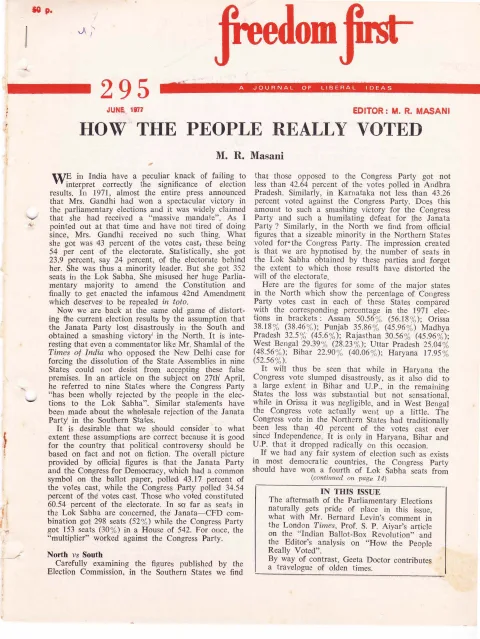
periodical issue
Freedom First
A Journal of Liberal Ideas
By S. V. Raju, C. Rajagopalachari
Published for the Democratic Research Service by J. R. Patel, Associate Editor, Freedom First at 127, M. Gandhi Rd., Bombay 400023 ... and printed by him at States' People Press, Ghoga Street, Fort, Bombay-400 001. · Bombay · 1978
16 pages
Freedom First
Summary
This December 1978 issue of Freedom First (No. 313, edited by S. V. Raju and Geeta Doctor) opens with an editorial by Raju arguing that Indira Gandhi’s by-election victory from Chikmagalur is being overplayed as a national referendum by both her supporters and a bungling Janata Party, and closes with a satirical world-affairs column, book and film reviews, and a reader’s letter on fighter-aircraft procurement. The volume’s centre of gravity is political commentary on the post-Emergency landscape: Gandhi’s return to Parliament, Janata’s disarray, and a reprinted 1963 Rajaji essay on corruption and dedicated public service (timed to his forthcoming birth centenary). Other contributors range across literary criticism (Indian writing in English), foreign affairs digests reprinted from the international press, and reviews of a coffee-table book on the Ganga, a book on Indo-Soviet relations, and two American films (Saturday Night Fever and Looking for Mr. Goodbar).
Key points
-
S. V. Raju’s “A Blessing in Disguise?” argues Indira Gandhi’s Chikmagalur by-election win is being overplayed as a national referendum, quoting Jayaprakash Narayan’s warning that it was an “isolated event”, and suggests the defeat could force Janata’s squabbling factions to unite.
-
A reprint of C. Rajagopalachari’s 1963 Swarajya essay “A Dedicated Service, The Only Hope”, published for his forthcoming birth centenary, attributes India’s corruption to excessive government control over production and appointments, warning that unchecked corruption risks revolution, anarchy, or dictatorship.
-
The “Of Cabbages & Kings” column covers Indira Gandhi’s first post-Emergency trip to the West for her father’s 89th birthday celebrations, and the hostile British press reception including a barbed Bernard Levin-Peregrine Worsthorne exchange in the Times.
-
Margaret P. Joseph surveys the growth of Indian writing in English as an emerging field of literary study, assessing R. K. Narayan, Manohar Malgonkar, Raja Rao, and Kamala Markandaya, and debating whether authentic “Indian-ness” requires writing in a regional language.
-
A World News digest covers the Soviet Union’s status as the world’s fifth-largest Muslim power, Poland’s Communist leadership managing coverage of Karol Wojtyla’s election as Pope John Paul II, and China’s post-Mao turn to Japan’s economic model.
-
Manohar Malgonkar reviews the photographic volume Ganga, Sacred River of India, praising Raghubir Singh’s photography over Eric Newby’s text, while Nitin Raut dismisses Indian Soviet Relations 1947-77 as a biased, propagandistic compilation.
-
Manjula Padmanabhan reviews Saturday Night Fever and Looking for Mr. Goodbar, finding both films quietly puncture the myth of unrestrained American freedom despite their structurally similar protagonists.
-
A reader’s letter from Ranjan Guha argues India’s choice of the Jaguar fighter over the Swedish Viggen was militarily unsound and driven by politics rather than merit.
Essays
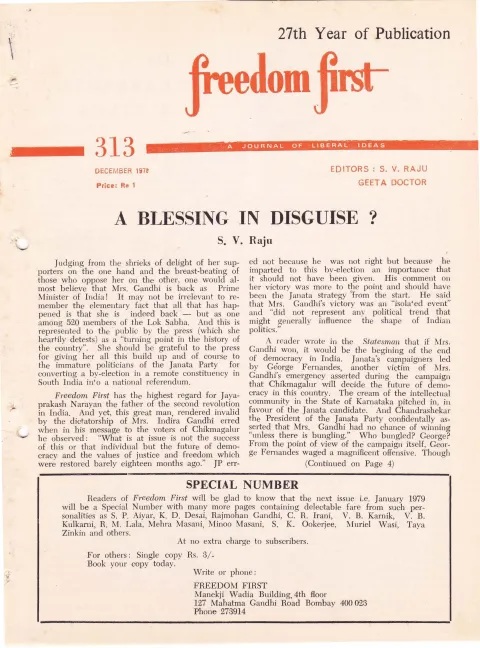
A Blessing in Disguise?
By S. V. Raju
S. V. Raju’s editorial argues that Indira Gandhi’s Chikmagalur by-election win has been inflated into a national turning point by both her jubilant supporters and her opponents’ hand-wringing, when in fact she is merely one of 520 Lok Sabha members. He credits Jayaprakash Narayan’s warning that the vote was an ‘isolated event’ with no bearing on Indian politics generally, and surveys international press reaction, including a Statesman reader’s alarmist comparison and a barbed exchange in the London Times pitting a civil-libertarian columnist against Peregrine Worsthorne. The piece continues (p.4) tracing the Janata Party’s disorganised Chikmagalur campaign, George Fernandes’s fatalistic remarks about the contest, and the argument that Mrs Gandhi’s strategy is to divide the country along have/have-not and majority/minority lines. Raju concludes that if the loss forces the squabbling Janata constituents to unite, the by-election result may yet prove a blessing in disguise.
- Raju frames the Chikmagalur by-election as being wrongly read as a national referendum on Indira Gandhi’s return.
- Jayaprakash Narayan is quoted from his message to Chikmagalur voters warning that Gandhi’s win reflected an ‘isolated event’ rather than a political trend.
- International press reaction is surveyed, including a Statesman letter, and a London Times exchange between a civil-liberties columnist and Peregrine Worsthorne.
- The essay recounts Janata’s disorganised campaign, George Fernandes’s remarks, and Chandrashekar’s confident prediction of a Janata win.
- Raju argues Gandhi’s electoral strategy rests on pitting harijans and backward classes against caste Hindus and the illiterate majority against the literate minority.
- The piece closes on the hope that the by-election defeat forces Janata’s factions to bury the hatchet, making the result a ‘blessing in disguise’.
Of Cabbages & Kings (column: “A Private Visit”, “Ghosts at Matheran”, “‘Decruitment’ in Denmark”)
By SVR / GD
A miscellany column of short pieces under the recurring ‘Of Cabbages & Kings’ banner (attributed to S.V.R. and G.D.). ‘A Private Visit’ recounts Indira Gandhi’s first trip to the West since the Emergency, ostensibly to attend her father’s 89th birthday celebrations in London, and the hostile press reception she received there, including a sharp exchange between Bernard Levin and Peregrine Worsthorne in the London Times. ‘Ghosts at Matheran’ is a reflective travel piece on the hill station’s decaying colonial-era mansions, its small municipal library, and local ghost lore. ‘Decruitment in Denmark’ describes a Danish corporate practice of phased, voluntary demotion for ageing senior managers as an alternative to abrupt retirement, illustrated by the case of retail manager Tage Nielson.
- ‘A Private Visit’ covers Indira Gandhi’s trip to London for her father Nehru’s 89th birthday, the diplomatic passport granted by the Janata government, and hostile British press coverage of her visit.
- The item quotes a barbed exchange between Bernard Levin and Peregrine Worsthorne in the London Times over Britain’s welcome of Gandhi.
- ‘Ghosts at Matheran’ is a melancholy travel sketch of decaying colonial mansions, a small multilingual municipal library, and local hill-folk beliefs about spirits.
- ‘Decruitment in Denmark’ profiles a Danish corporate practice of voluntary phased demotion before retirement, illustrated by retail manager Tage Nielson’s choice to become a junior clerk.
A Dedicated Service, The Only Hope
By C. Rajagopalachari
A reprint of C. Rajagopalachari’s May 1963 Swarajya essay, republished on the occasion of what would have been his hundredth year and ahead of a commemorative statue unveiling and postage stamp. Rajaji argues that pervasive corruption at every level of Indian administration flows from excessive government control over production, distribution, and public appointments, and that democracy itself has been debased into ‘a puppet dancing to the pull of money-strings.’ He recounts a conversation with an anonymous, experienced official who described bribery among judges and district magistrates as endemic and unavoidable. Rajaji warns that unchecked corruption risks tipping the country into revolution, anarchy, or dictatorship, and calls for a smaller, better-paid, less controlling administrative machinery, reduced taxation, release of private capital from planning’s ‘barbed wire entanglement,’ and a revival of Gandhian-era simplicity and honesty among a new generation of dedicated public servants.
- Rajaji attributes India’s corruption crisis to extensive government controls over production, distribution, transport, and public appointments.
- He relays an anonymous senior official’s account of bribery among judges and magistrates as widespread and normalized.
- He warns that unaddressed corruption could lead to revolution, anarchy, or dictatorship.
- His prescriptions include leaner administration, higher salaries for public servants, lower taxation, and freeing private capital and industry from planning controls.
- He calls for recruiting idealistic young people into public service and reviving the simplicity and honesty associated with the Gandhian and pre-Independence era.
In Defence of Indian Writing in English
By Margaret P. Joseph
Margaret P. Joseph surveys the growth of Indian writing in English from a defensive, apologetic tradition into a recognized field of literary and academic study, while cautioning against uncritical acclaim. Drawing on David McCutchion’s essays for the Writers’ Workshop, she argues that measured against Sanskrit, Chinese, and even English literary history, Indian English writing is still a young tradition that deserves rigorous rather than indulgent criticism. She surveys the credit side of the balance sheet—R. K. Narayan, Manohar Malgonkar, Raja Rao, and Kamala Markandaya—and debates whether authentic ‘Indian-ness’ requires writing in a regional language at all, concluding that colloquial rather than dialect-heavy English, in the manner of Narayan, is the more viable path, and that great literature in a non-native tongue (she invokes Milton’s Satan) is entirely possible.
- Joseph traces Indian English writing’s shift from a defensive posture to an accepted academic subject, citing David McCutchion’s Writers’ Workshop essays.
- She warns against inflated Western acclaim producing a decline in critical standards applied to Indian writers.
- She surveys leading practitioners: R. K. Narayan, Manohar Malgonkar, Raja Rao, and Kamala Markandaya, each assessed for style and command of English.
- She discusses the debate over whether Indian identity can be authentically rendered only in a regional language versus in English.
- She argues for colloquial rather than regionally-dialected English as the workable solution, citing Narayan’s technique, and invokes Milton to argue great literature need not be in one’s native tongue.
World News (Tokyo the World’s Costliest City; Sadat, Yes, But Why Begin; The World’s Fifth Largest Muslim Power; Polish Communists in a Dilemma; Speaker Hedge Please Note; Lessons in Pragmatism)
A ‘World News’ digest of short items reprinted from international newspapers (The Guardian, The Times of London, Herald Tribune). Items cover the UN’s cost-of-living ranking naming Tokyo the world’s most expensive city; commentary on Anwar Sadat and Menachem Begin sharing the Nobel Peace Prize; a report on the scale and character of Islam within the Soviet Union; the Polish Communist Party’s cautious handling of Karol Wojtyla’s election as Pope John Paul II; a piece on proposed fines for parliamentary insults in the West German Bundestag; and a report on China’s turn to Japan as a model for economic modernization after Mao’s death.
- Tokyo is named the world’s costliest city in a UN cost-of-living survey, ahead of Kinshasa, Accra, and New York.
- The item on the 1978 Nobel Peace Prize argues that pairing Sadat with Begin diminished the award’s value given Begin’s more reluctant, reactive diplomacy.
- A report describes the Soviet Union as the world’s fifth-largest Muslim power, with Sufi orders reportedly gaining ground over officially tolerated Islam.
- Poland’s Communist leadership is shown managing press coverage of Karol Wojtyla’s papal election with strict directives while still permitting pilgrimages to Rome.
- A closing item describes China’s post-Mao leadership studying Japan’s Meiji-era and postwar economic model as a template for modernization.
Book Review: Ganga, Sacred River of India
By Manohar Malgonkar
Manohar Malgonkar reviews ‘Ganga, Sacred River of India,’ a coffee-table volume of photographs by Raghubir Singh with text by Eric Newby. He praises the choice of the name ‘Ganga’ over the anglicized ‘Ganges’ and credits the book with successfully tracing the river’s course while explaining its religious significance to Hindus, though he finds Newby’s text more like a ‘high-school level crash course’ than his usual travelogue prose. The review’s real enthusiasm is for Singh’s photography, which Malgonkar says needs no explanatory text and captures a narrative arc showing the Ganga’s holiness diminishing as it becomes more integrated into ordinary riverside life.
- The review praises the book’s choice of ‘Ganga’ over the colonial-derived ‘Ganges’ as the more historically apt and euphonic title.
- Malgonkar credits Eric Newby’s text with useful detail on the river’s religious significance but calls it a ‘high-school level crash course’ rather than Newby’s usual travelogue style.
- He singles out Raghubir Singh’s photography as the book’s real strength, needing no accompanying explanation.
- He notes the photographs trace an arc in which the river’s holiness seems to diminish the more it is absorbed into everyday riverside life.
Book Review: Indian Soviet Relations 1947-77
By Nitin Raut
Nitin Raut reviews ‘Indian Soviet Relations 1947-77,’ edited by V. B. Singh, dismissing the volume as a biased and propagandistic compilation lacking academic objectivity. He argues the book fails to place Indo-Soviet ties within the broader context of shifting international détente, omits Soviet backing of Pakistan during the Kashmir dispute despite covering Soviet help during the Bangladesh crisis, and takes at face value a Soviet Encyclopaedia characterization of Gandhian philosophy as a ‘progressive’ anti-imperialist doctrine, despite the Soviet Union itself once branding Gandhi an ‘imperialist agent.’ He concludes the book has value only as an uncritical reference for pro-Soviet readers.
- Raut criticises the volume’s editors for biased, propagandistic treatment of Indo-Soviet relations lacking academic objectivity.
- He faults the book for omitting Soviet support for Pakistan on Kashmir despite covering Soviet assistance during the Bangladesh crisis.
- He highlights a contradiction: the Soviet Encyclopaedia’s praise of Gandhian philosophy as ‘progressive,’ despite the USSR once calling Gandhi an ‘imperialist agent.’
- The review characterizes the book as largely a chronological record of diplomatic visits, pacts, and ‘friendship weeks’ rather than critical analysis.
Film Review: Looking for Mr. Goodbar, on a Saturday Night, Feverishly
By Manjula Padmanabhan
Manjula Padmanabhan reviews two American films, ‘Saturday Night Fever’ and ‘Looking for Mr. Goodbar,’ finding an uncanny structural resemblance between their protagonists, Tony Manero and Terry Dunn, despite the films’ independent origins. Both are young, restless New Yorkers seeking release through nightlife who undergo a personal catharsis and both flee, at moments of crisis, to the subway. She reads Tony’s story as populated by broad, interchangeable comic types and Terry’s as harsher and more harrowing, reflecting her more conservative, non-immigrant background and the ways men in the story escape consequences that trap women. Padmanabhan argues both films quietly puncture the myth of unrestrained American freedom, showing characters buckling under social pressures, and suggests the films may be either an unintentional preview of a Americanizing world or a warning against following the American example.
- Padmanabhan notes an uncanny structural resemblance between Saturday Night Fever’s Tony Manero and Looking for Mr. Goodbar’s Terry Dunn despite the films being made independently.
- Both protagonists seek release through nightlife, undergo catharsis at a peak of stress, and flee via the New York subway.
- She contrasts Tony’s comic, cliché-filled story with Terry’s harsher, more harrowing arc shaped by her conservative background.
- She highlights the films’ shared, largely unintentional message that the ‘American Way’ is not always the best or happiest.
- She reads the merging of squalor and ‘Americana’ in both films as newly possible in a way it was not before.
Letter: Why Jaguar, Why Not Viggen
By Ranjan Guha
A reader’s letter from Ranjan Guha argues that the Indian government’s choice of the Anglo-French Jaguar over the Swedish Viggen and French Mirage F-1 was militarily unsound, citing detailed comparative statistics on top speed, range, acceleration, runway requirements, and payload performance drawn from Jane’s All the World’s Aircraft and an Economist report on an RAF survey calling the Jaguar ‘theoretically supersonic’ but ‘in fact underpowered.’ Guha suggests the decision was driven by politics and by the U.S. veto of the Viggen deal rather than by objective defence merit, and calls for defence procurement to be kept out of the political arena.
- Guha presents comparative performance statistics (speed, range, acceleration, runway needs) showing the Viggen and Mirage F-1 outperforming the chosen Jaguar.
- He cites an Economist report on an RAF survey describing the Jaguar as ‘theoretically supersonic’ but ‘in fact underpowered.’
- He notes the U.S. vetoed the Viggen deal, implicating geopolitics rather than merit in the final choice.
- He argues defence procurement decisions should be kept free of political considerations.
With Many Voices
The closing ‘With Many Voices’ page is a compilation of short quotations drawn from contemporary press sources (The Economist, Time, The Guardian, Newsweek, India Today, and others), covering figures such as Jimmy Carter, Anwar Sadat, Enoch Powell, Jerry Brown, and Datuk Hussein Onn, on subjects ranging from American politics to Indo-Soviet trade and Conservative Party tactics in Britain. The page also carries the magazine’s subscription form and imprint, noting it is published for the Democratic Research Service by J. R. Patel.
- The page compiles brief quotations from world leaders and commentators as published in contemporary international press.
- Quoted figures include Jimmy Carter, Anwar Sadat, Enoch Powell, Governor Jerry Brown, and Malaysian PM Datuk Hussein Onn.
- The page carries the Freedom First subscription form addressed to the Democratic Research Service in Bombay.
- The imprint identifies J. R. Patel as Associate Editor and lists the printer, States’ People Press, Bombay.
Generated by the v1.5 extraction pipeline. Awaiting editorial review.
Metadata and summary are AI-extracted from the source PDF and reviewed for editorial accuracy. The original work is available via the Read PDF tab above (where present); paragraph-level citation inside the PDF is deferred to a future engagement.