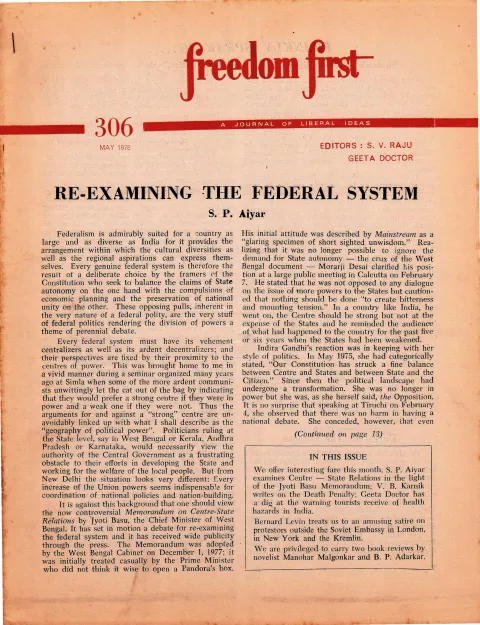
periodical issue
Freedom First
A Journal of Liberal Ideas
Edited by S. V. Raju
Published for the Democratic Research Service by J. R. Patel, Associate Editor, Freedom First at 127, Mahatma Gandhi Road, Bombay 400 023 (Phone: 273914) and printed by him at Commercial Printers & Stationers, 525 S. Bapat Marg, Dadar, Bombay-400 028 · Bombay · 1979
16 pages
Freedom First
Summary
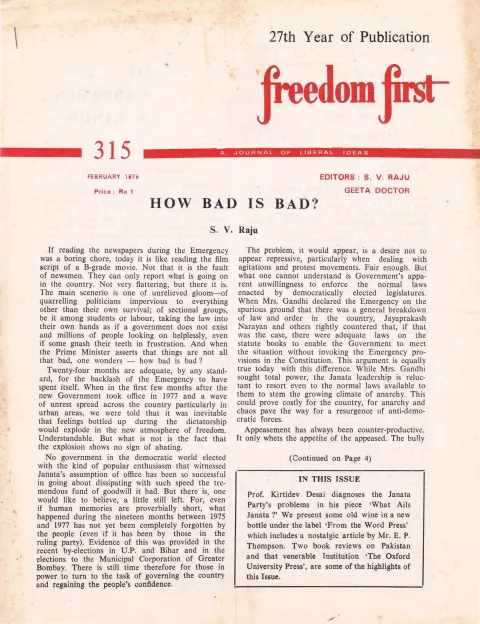
Freedom First No. 315 (February 1979) is the monthly journal of liberal opinion edited by S. V. Raju and Geeta Doctor, published for the Democratic Research Service. This issue opens with Raju’s editorial “How Bad Is Bad?”, which argues that the Janata government’s reluctance to enforce ordinary law against agitating students and labour unions is fostering a climate of anarchy that could ultimately benefit anti-democratic forces. It is followed by the regular satirical miscellany column “Of Cabbages & Kings” (on the bank employees’ strike settlement, Madras flooding, and the Janata government’s habit of manufacturing non-issues), a lengthy analytical essay by Kirtidev D. Desai, “What Ails Janata?”, diagnosing the structural and leadership causes of the ruling party’s factional crisis, a “From the World Press” reprint section built around E. P. Thompson’s personal memoir on Nehru and the Emergency (“Tell Us Mr. Michael Foot”, from The Guardian) alongside shorter reprinted pieces on political cliche, totalitarianism, and Southeast Asian geopolitics, three book reviews (on a study of Bhutto’s Pakistan, a history of the Oxford University Press, and a text on investment decisions), a reader letter protesting the unofficial banning of a Kannada satirical film, and the closing quotes column “With Many Voices”.
Key points
-
S. V. Raju’s “How Bad Is Bad?” argues that the Janata government’s reluctance to enforce existing law against agitating students and labour unions, rather than any lack of legal power, is fostering a climate of anarchy, contrasting this passivity with Indira Gandhi’s Emergency-era overreach.
-
Raju cites the murder of a manager named Godrej and assaults on university Vice-Chancellors as evidence that sectional groups are bullying a passive state, concluding that maintaining law and order is the Janata coalition’s one indispensable duty.
-
Kirtidev D. Desai’s “What Ails Janata?” diagnoses the ruling party’s crisis as structural rather than merely personal, tracing it to the mismatch between the coalition’s five distinct political traditions and Morarji Desai’s inflexible leadership style, and to the imbalance between formal top posts and the Jan Sangh and BLD’s real parliamentary weight.
-
Desai warns that Charan Singh’s alienation risks eroding Janata’s rural/kisan support base and calls for genuine collective leadership rather than the suppression of any one faction.
-
E. P. Thompson’s reprinted Guardian memoir, “Tell Us Mr. Michael Foot”, recounts his father’s friendship with Nehru and his own clandestine meetings with student opponents of the Emergency at Jawaharlal Nehru University, who repeatedly asked why the British Labour left had failed to condemn Mrs Gandhi’s suppression of civil liberties.
-
Thompson’s piece also quotes his father’s 1939 diary describing meetings with Congress Working Committee members including Kripalani, Rajagopalachari, and Sarojini Naidu, and wartime correspondence exchanged with Nehru while he was imprisoned at Dehra Dun.
Essays
How Bad is Bad?
By S. V. Raju
In “How Bad Is Bad?”, S. V. Raju surveys the deteriorating law-and-order climate twenty-four months after the Janata Party’s 1977 electoral victory, arguing that the initial euphoria of the “second freedom” has given way to disillusionment as quarrelling politicians, student unrest, and increasingly militant labour action go unchecked. He contends the government’s reluctance to invoke existing statutes against agitators (rather than any lack of legal power) is the core problem, drawing a contrast with Indira Gandhi’s Emergency-era over-reach: where she sought total power, the Janata leadership is reluctant to use even the normal powers available to it. Raju warns that this appeasement of disorder is counter-productive and cites the murder of a manager named Godrej and the beating of Vice-Chancellors and university officials as evidence that sectional groups (students, labour) are bullying a passive state. He closes by insisting that maintaining law and order is the basic, non-negotiable duty of any government regardless of its constituents’ ideological differences, and that the Janata Party’s dwindling public goodwill will not last through to the next election cycle.
- Twenty-four months after taking power, the Janata government has failed to arrest a spreading climate of unrest among students and labour.
- Raju argues the problem is not inadequate laws but the government’s unwillingness to enforce laws already on the statute books.
- He draws a pointed contrast with the Emergency: Mrs Gandhi sought total power, whereas Janata is reluctant to use even normal powers.
- Appeasement of agitators is described as counter-productive, emboldening further lawlessness.
- Vice-Chancellors and university administrators have been assaulted and had records destroyed by student minorities.
- Trade unions are characterised as largely captured by political parties or self-serving individuals rather than serving members’ genuine interests.
- The murder of a manager (Godrej) inside his own home is cited as a shocking instance of labour-related violence.
- Raju concludes that maintaining law and order is the Janata coalition’s one indispensable, ideology-independent duty, and that public patience is running out.
Of Cabbages & Kings (Who Won?; Madras when it Drizzles)
By SVR / GD
Kirtidev D. Desai’s “What Ails Janata?” is a structural diagnosis of the Janata Party’s internal crisis roughly eighteen months after its 1977 landslide. Desai identifies three fundamental causes beyond the oft-cited personality clashes (Morarji Desai’s obstinacy, Charan Singh’s power-lust, Raj Narain’s antics): (i) an incongruity between the coalitional nature of the party — five distinct political traditions merged into one — and Prime Minister Morarji Desai’s inflexible, monologue-driven leadership style, which the essay contrasts with Madhu Limaye’s preferred consensus model; (ii) a discrepancy between the party’s formal power structure (in which the smaller constituent groups hold the top posts of prime minister and party president) and the informal power balance (in which the Jan Sangh and BLD, each roughly a third of the parliamentary strength, are the real heavyweights); and (iii) substantive divergences in political culture and development philosophy, chiefly the tension between a Congress-style political tradition and a non-Congress one, and between the Nehru model of industrial, urban-led development and the Gandhian model of rural, decentralised development formally adopted by Janata but resisted in practice by several constituent groups. Desai traces the crisis’s escalation from the 1977 election-ticket disputes through the resignation of Charan Singh’s group from the Union Cabinet in mid-1978, and warns that a sullen, alienated Charan Singh retains a formidable rural/kisan political base that Janata cannot afford to lose. He concludes that only a genuine, collective leadership arrangement — not the suppression of one faction or another — can resolve the crisis, and that the party’s failure would be a heavy historical responsibility given the scale of the 1977 popular mandate.
- Desai attributes the Janata crisis to three structural causes, not merely personality conflicts: leadership-style incongruity, formal/informal power discrepancy, and divergence in political culture and development philosophy.
- The party is described as ‘a party-in-making’, a coalition of five distinct political traditions not yet fused into a homogeneous whole.
- Morarji Desai’s monologue-driven, ‘sermonising’ leadership style is contrasted unfavourably with Madhu Limaye’s consensus-based theory of coalition management.
- Formally, small constituent groups hold the top posts (PM, party president), but informally the Jan Sangh and BLD each command roughly a third of parliamentary strength, creating an unstable formal/informal power mismatch analogous to the UN Security Council’s permanent-member imbalance.
- Charan Singh and the BLD favour the Gandhian, agriculture-oriented development model; other constituents (CFD, Socialists, Congress-O) quietly prefer to retain elements of the Nehru model.
- Charan Singh’s alienation risks eroding Janata’s rural/kisan support base, since he has become a symbol of farmer resurgence in North India.
- Desai warns that Janata cannot survive the defection of either of its two political heavyweights (Jan Sangh or BLD) and calls for collective leadership and reconciliation rather than factional victory.
A Genius for the Non-issue
By SVR
Reprinted from The Guardian under the “From the World Press” banner, E. P. Thompson’s “Tell Us Mr. Michael Foot” is a personal memoir recounting his father Edward John Thompson’s friendship with Jawaharlal Nehru from the 1930s through Nehru’s imprisonment during the Second World War, and Thompson’s own visits to India during and immediately after the 1975-77 Emergency. Thompson describes clandestine meetings with underground student opponents of the Emergency at Jawaharlal Nehru University, the surveillance and interrogation they faced, and their repeated, anguished question to him as a visiting Briton: why had the British Labour movement, and particularly Michael Foot, failed to condemn Indira Gandhi’s suppression of civil liberties despite Labour’s professed reverence for Nehru’s legacy? Thompson intersperses this narrative with excerpts from his father’s 1939 diary of meeting the Congress Working Committee (including vivid character sketches of Kripalani, Rajagopalachari, Maulana Azad, Pattabhi Sitaramayya, and Sarojini Naidu) and from wartime correspondence between his father and Nehru, exchanged while Nehru was imprisoned at Dehra Dun. The piece ends with Thompson’s reflection on India’s enduring intellectual and political vitality despite Emergency-era repression, and a final, unanswered question addressed to Mrs Gandhi about what became of the “true Nehru tradition.”
- The essay is a personal memoir combining Thompson’s own visits to Emergency-era India (1976-77) with his father Edward John Thompson’s 1939 diplomatic visit to India and wartime friendship with Nehru.
- Thompson describes underground meetings with student opponents of the Emergency at Jawaharlal Nehru University, held under fear of police surveillance and informants.
- The recurring question posed to Thompson by his Indian hosts is why the British Labour Party, and Michael Foot specifically, endorsed or failed to criticise Mrs Gandhi’s Emergency despite Labour’s professed admiration for Nehru.
- Excerpts from Edward Thompson’s 1939 diary record his impressions of Congress Working Committee members including Kripalani, Rajagopalachari, Maulana Azad, Pattabhi Sitaramayya, and Sarojini Naidu.
- Correspondence between Edward Thompson and Nehru (1939-1946), including letters written while Nehru was imprisoned at Dehra Dun jail, is quoted at length.
- The essay closes with Thompson contrasting India’s vibrant, pluralistic intellectual life with the risk of a ‘rolled up’ authoritarian sub-continent, and an unresolved rhetorical question to Mrs Gandhi about the Nehru legacy.
Generated by the v1.5 extraction pipeline. Awaiting editorial review.
Metadata and summary are AI-extracted from the source PDF and reviewed for editorial accuracy. The original work is available via the Read PDF tab above (where present); paragraph-level citation inside the PDF is deferred to a future engagement.