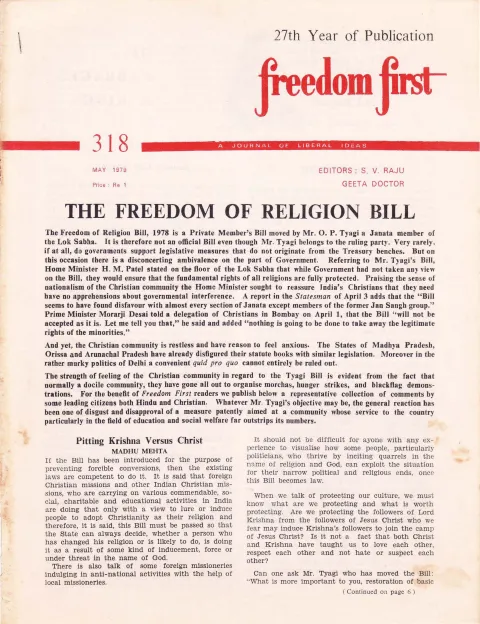
periodical issue
Freedom First
'Swatantra' Wins in U.K.
By S. V. Raju
Published for the Democratic Research Service by J. R. Patel, Associate Editor, Freedom First at 127, Mahatma Gandhi Road, Bombay 400 023 (Phone: 273914) and printed by him at Commercial Printers & Stationers, 525-S, Bapat Marg, Dadar, Bombay-400 028 · Bombay · 1979
16 pages
Freedom First
Summary
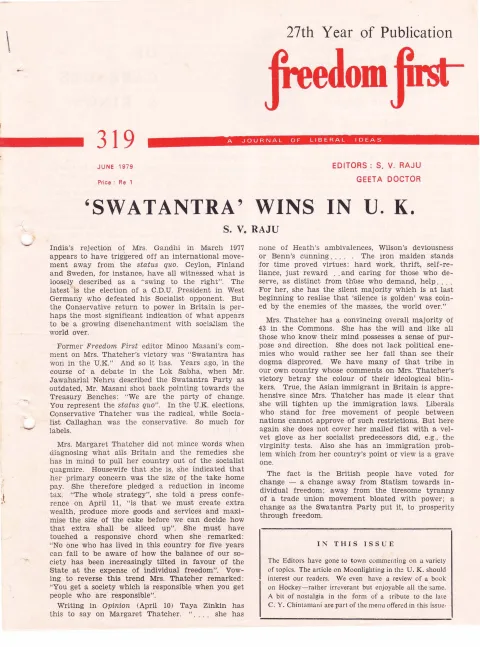
This is issue No. 319 of Freedom First (June 1979), a monthly journal of liberal ideas published in Bombay by the Democratic Research Service, edited by S. V. Raju and Geeta Doctor. The issue’s lead piece welcomes Margaret Thatcher’s Conservative victory in the 1979 UK general election as a vindication of Swatantra-style free-market liberalism and a rebuke to Statism, framing it explicitly through the lens of the defunct Swatantra Party’s old slogans. The regular ‘Of Cabbages & Kings’ column and several short editorial notes by S. V. Raju and Geeta Doctor cover a miscellany of topics: the Indian government’s flirtation with the non-aligned ‘Inter-Press Service’, child-rearing and corporal punishment, MPs’ demands for perquisites, an export row over ‘holy cow’ corned beef, President’s Rule after the fall of the Kakodkar ministry in Haryana, press-union tensions in Britain, and railway strike politics under Industries Minister George Fernandes. S. Sahay’s ‘Politics in the States’ surveys factional turmoil within the ruling Janata Party across Uttar Pradesh, Bihar, Himachal Pradesh, Haryana and Orissa. A tribute by Capt. R. L. Rau (Retd.) memorializes the late journalist C. Y. Chintamani, editor of the Allahabad Leader, as an exemplar of a vanishing breed of fearless Indian newspaper editors. World News items (mostly Daily Telegraph reprints) cover Islam in Soviet Central Asia, Brezhnev-era Soviet hypocrisy, French intellectuals’ disillusionment with the USSR, and repression of an independent trade union in Romania. Alan Osborn’s ‘Moonlighting — British Style’ (reprinted from the Daily Telegraph) examines Britain’s black economy and high marginal tax rates. The issue closes with three book reviews (on education, South Asian land tenure, and Indian hockey administration) and the ‘With Many Voices’ page of topical quotations.
Key points
-
S. V. Raju’s “‘Swatantra’ Wins in U.K.” reads Margaret Thatcher’s May 1979 election victory as validation of Swatantra-style classical liberalism, reviving Minoo Masani’s line that “Swatantra has won in the U.K.” and praising Thatcher’s pledge to cut income tax and grow the economy before redistributing it.
-
The “Of Cabbages & Kings” column criticises PTI’s near-agreement with the non-aligned Inter-Press Service as compromising press independence, and mocks Indian Ministers of State for demanding higher travel allowances and a retirement housing colony.
-
S. Sahay’s “Politics in the States” surveys Janata Party factionalism across Uttar Pradesh, Bihar, Himachal Pradesh, Haryana and Orissa, concluding the party functions as an ideologically empty “umbrella” whose factions pursue only tactical wins.
-
Capt. R. L. Rau’s tribute to the late editor C. Y. Chintamani situates him among a vanished generation of fearless pre-independence Indian newspaper editors who confronted colonial rule despite the Defence of India Rules.
-
Alan Osborn’s reprinted Daily Telegraph piece “Moonlighting — British Style” examines Britain’s black economy, estimated at 7.5% of GDP, disputing the theory that high marginal tax rates alone drive undeclared work.
-
A World News digest covers Soviet Central Asia’s growing Muslim population and Islamic consciousness, Brezhnev’s hypocrisy in condemning China’s Vietnam incursion given the USSR’s own occupation of Czechoslovakia, and repression of the independent Free Union of Romanian Workers under Ceausescu.
-
Book reviews cover Muriel Wasi’s Living and Learning on education, Robert Eric Frykenberg’s edited Land Tenure and Peasant in South Asia, and Sunil Gujral’s Indian Hockey, which blames the sport’s decline on self-interested administrators.
-
The closing “With Many Voices” page compiles quotations including Margaret Thatcher on ability versus sex and Ayatollah Khomeini on executing rather than trying criminals.
Essays
’Swatantra’ Wins in U.K.
By S. V. Raju
S. V. Raju’s lead article reads Margaret Thatcher’s May 1979 election victory as part of a worldwide ‘swing to the right’ against Statism, following Congress’s defeat of Indira Gandhi in 1977. He revives former Freedom First editor Minoo Masani’s line that Thatcher’s win means ‘Swatantra has won in the U.K.’, recalling Masani’s old riposte to Nehru in the Lok Sabha that the Swatantra Party, not the Congress establishment, represented the party of change. Raju praises Thatcher’s pledge to cut income tax and grow the economic ‘cake’ before redistributing it, and frames the Conservative victory as a rejection of trade-union power and a vote for individual freedom over statism.
- Frames Thatcher’s 1979 victory as validation of Swatantra Party-style classical liberal politics.
- Cites Minoo Masani’s remark that ‘Swatantra has won in the U.K.’
- Recalls Masani’s Lok Sabha exchange with Nehru: Swatantra as ‘the party of change’ versus Congress as the status quo.
- Highlights Thatcher’s pledge to cut income tax and ‘create extra wealth’ before redistribution.
- Notes Thatcher’s tough stance on immigration is criticised by some liberal-minded observers even as her economic policy is praised.
- Concludes the British vote was a rejection of trade-union power and a turn toward individual freedom.
Of Cabbages & Kings
By SVR / GD (initialed items: Watch Out For ‘IPS’!, Spanking Rights, More Demands from the Privileged Ones, Animals for Parliament, Too Corny For Words, Defection Does Not Always Pay, Rights? Yes! But…, The Dawn of Wisdom?)
The regular ‘Of Cabbages & Kings’ column (epigraph from Lewis Carroll) collects four short pieces. ‘Watch Out for IPS!’ (SVR) criticises the government’s push to have PTI sign an agreement with the Inter-Press Service, a non-aligned news-agency cooperative Raju regards as a propaganda vehicle for Third World dictatorships, praising PTI’s initial refusal and quoting C. R. Irani’s account of government pressure via the PTI board. ‘Spanking Rights’ (GD) discusses a new Swedish law banning corporal punishment of children and reflects on comparative child-rearing and child-labour conditions in the West, Persia, and India. ‘More Demands from the Privileged Ones’ (SVR) mocks Union Ministers of State demanding higher travel and sumptuary allowances and MPs demanding a retirement housing colony. ‘Animals for Parliament’ (GD) reports on a British animal-welfare campaign (GECCAP) during the UK election and critiques factory farming and slaughter practices, including in India.
- PTI’s near-refusal, then signing, of an ‘experimental’ agreement with the Inter-Press Service (IPS) is criticised as compromising press independence.
- C. R. Irani is cited alleging government pressure via PTI board member D. R. Mankekar.
- A new Swedish law bans parental corporal punishment; the column weighs this against child-labour conditions in the West, Persia (carpet-weaving), and India.
- Ministers of State in India are mocked for demanding higher travel allowances and complaining to the Prime Minister.
- MPs across party lines are criticised for demanding a retirement housing colony in the capital.
- British animal-rights campaigners (GECCAP) raised welfare issues during the 1979 election; the column extends this to critique factory farming and slaughter methods, including practices in India.
A cluster of short SVR editorial notes. ‘Too Corny for Words’ satirises the ‘holy cow’ export controversy, noting corned beef/buffalo exports to the Middle East amid the Paunar cow-protection agitation. ‘Defection Does Not Always Pay’ praises the Central Government and Home Minister for not exploiting the fall of the Kakodkar government via defections, but criticises the imposition of President’s Rule instead of fresh elections. ‘Rights? Yes! But…’ reflects on trade unions overriding others’ rights, using a West German printers’ strike/bombing incident involving the London Times international edition as a cautionary example, and invokes Gandhi’s decision to call off the Quit India movement when it turned violent. ‘The Dawn of Wisdom?’ is a skeptical item on Industries Minister George Fernandes urging railway workers not to strike, framed as an ironic reversal of Fernandes’s earlier union-agitator role.
- Satirises the ‘holy cow’ export controversy: corned beef/buffalo meat exports to the Middle East during the Paunar cow-protection agitation.
- Praises the Centre and Home Minister for not exploiting the Kakodkar government’s collapse via defections, but faults the choice of President’s Rule over fresh elections.
- Uses a West German printing-union bombing/picketing incident (targeting the London Times’ international edition) to argue unions can override others’ rights.
- Invokes Gandhi’s decision to halt the Quit India movement once it turned violent as a model of self-restraint absent from present-day agitators.
- Notes the irony of former trade-union militant George Fernandes, now Industries Minister, pleading with railway workers not to strike.
A Salutary Decision
By SVR
A short unsigned continuation item, ‘A Salutary Decision’ (by SVR, continued from page 4), welcomes the government’s move to bring public-sector undertakings within the purview of the Monopolies and Restrictive Trade Practices Act, while suggesting that Monopolies and Restrictive Trade Practices should be separated in the law and warning against the government exempting favoured bodies like the STC.
- Welcomes government decision to bring public-sector undertakings under the MRTP Act.
- Suggests decoupling ‘Monopolies’ from ‘Restrictive Trade Practices’ in the law for clarity.
- Warns against carving out exemptions (e.g., for the STC) that would undermine the reform.
Politics in the States
By S. Sahay
S. Sahay’s ‘Politics in the States’ (credited to All India Radio) surveys the factionalism gripping the ruling Janata Party in mid-1979. He argues that despite constant talk of ‘crisis’, no faction is actually anxious about losing power before the 1982 elections, and that infighting is really about internal jockeying rather than genuine ideological rupture. He runs through Uttar Pradesh (Naresh Yadav’s replacement by Banarasidas amid BLD–Jansangh tension over RSS-linked ministers), Bihar (Karpuri Thakur’s ouster and his subsequent obstruction of successor Ram Sunder Das), Himachal Pradesh (Shanta Kumar facing dissidents), Haryana (Devilal dismissing RSS-oriented ministers), and Orissa (Routray retaining power against the Biju Patnaik faction). Sahay concludes that Janata factions care only about tactical victories, not collective unity, and that the party functions as an ‘umbrella’ lacking any unifying principle, unlike the old Congress.
- Argues that despite talk of ‘crisis’, no Janata faction plans to leave the party before 1982.
- Details factional battles in U.P. between BLD and Jansangh/RSS-aligned elements over cabinet composition.
- Covers Karpuri Thakur’s fall in Bihar and his subsequent efforts to undermine successor Ram Sunder Das.
- Surveys dissident challenges to Chief Ministers in Himachal Pradesh and Orissa (Routray vs. Biju Patnaik faction).
- Notes Devilal’s dismissal of RSS-oriented ministers in Haryana.
- Concludes the Janata Party is an ideologically empty ‘umbrella’ whose factions pursue narrow tactical wins rather than collective purpose.
C. Y. Chintamani - A Tribute
By Capt. R.L. Rau (Retd.)
Capt. R. L. Rau (Retd.) offers a personal tribute to C. Y. Chintamani, the late editor of the Allahabad Leader, situating him among a generation of fearless Indian newspaper editors (Annie Besant, Kasturi Ranga Iyengar, B. G. Horniman, Sadanand, Kalinath Roy, Moti Lal Ghosh) who confronted British colonial rule through their editorials despite the Defence of India Rules. Rau, who says he ‘learnt the ABC of journalism’ at Chintamani’s feet in the Leader’s office, praises Chintamani’s honesty, courage of conviction, and independence from political patronage, contrasting this vanished era of powerful editor-proprietors with the more impersonal, agency-mediated and proprietor-controlled press of 1979.
- Situates C. Y. Chintamani among a cohort of fearless pre-independence Indian newspaper editors.
- Credits this generation with pioneering fearless criticism of British rule despite the Defence of India Rules.
- Laments the decline of the powerful individual editor in favour of impersonal, proprietor- and agency-controlled newspapers.
- Describes Chintamani as honest, consistent, and free of political or financial patronage in reaching his elected public position.
- Personal reminiscence: the author says he learned journalism directly under Chintamani at the Leader in Allahabad.
Moonlighting - British Style
By Alan Osborn
Alan Osborn’s ‘Moonlighting — British Style’ (reprinted from the Daily Telegraph, April 30) examines Britain’s ‘black economy’ of undeclared second-job and cash-in-hand work. It surveys estimates of the size of the underground economy (Inland Revenue chairman Sir William Pile’s guess of 7.5% of GDP, or roughly £9,000 million, evading tax), disputes the theory that high marginal tax rates alone drive moonlighting (noting France and Italy have more of it despite lower rates), links the practice to the end of Schedule A tax relief on home repairs, and notes both major parties lack a concrete plan to curb it since doing so risks alienating a large bloc of voters.
- Estimates the British ‘black economy’ at roughly 7.5% of GDP per the Inland Revenue chairman, costing up to £3,000 million in lost tax revenue.
- Argues moonlighting is not simply driven by high marginal tax rates, since France and Italy have more of it with lower rates.
- Links growth in moonlighting to the abolition of Schedule A income tax relief for home repairs.
- Notes enforcement is politically difficult since it would alienate both moonlighters and their customers, a large voting bloc.
- Reports neither Labour nor the Conservatives had a concrete manifesto commitment to curb moonlighting.
World News (Islam In Marxland; Pot Calls Kettle Back; Dissecting Soviet Society)
By Richard Beeston, The Daily Telegraph / various wire sources
The ‘World News’ section carries three items. ‘Islam in Marxland’ (Richard Beeston, Daily Telegraph, April 18) describes Soviet Central Asia’s Muslim population boom and growing ethnic/Islamic consciousness amid the Iranian revolution and Afghan civil war. ‘Pot Calls Kettle Back’ criticises Brezhnev’s hypocrisy in condemning China’s Vietnam incursion while the USSR itself occupies Czechoslovakia under the ‘Brezhnev doctrine’. ‘Dissecting Soviet Society’ (a Time review, April 30) covers two French bestsellers critical of Soviet society — the Kehayans’ Street of the Red Proletariat and Hélène Carrère d’Encausse’s The Burst Empire — the latter arguing Soviet nationalities policy has failed to create a unified ‘Homo Sovieticus’ and that the USSR harbours some 120 million potential dissidents.
- Soviet Central Asia’s Muslim population is booming and increasingly conscious of ties to Iran, Afghanistan and Pakistan.
- Brezhnev’s Kremlin toast criticising China’s Vietnam incursion is presented as hypocritical given the USSR’s own 1968 invasion of Czechoslovakia and the ‘Brezhnev doctrine’.
- Two French bestsellers — the Kehayans’ memoir and Carrère d’Encausse’s The Burst Empire — mark a shift among French (often Marxist) intellectuals toward sharper criticism of Soviet society.
- Carrère d’Encausse’s thesis: the USSR’s non-Slavic population growth represents a demographic ‘time bomb’ with as many as 120 million potential dissidents.
Grievances in a Workers’ Paradise
By The Daily Telegraph, April 30
A Daily Telegraph report (April 30) on repression of the independent ‘Free Union of Rumanian Workers’ under President Ceaușescu: members allegedly detained, interrogated, and in some cases jailed under ‘parasitism’ laws; the union’s open letter to the French Committee for the Defence of Human Rights in Rumania denies government claims that it is a ‘terrorist organisation of a Fascist type’, and a suspicious letter purporting to come from workers renouncing the union is treated by French labour circles as a probable police fabrication.
- The Free Union of Rumanian Workers (about 2,000 members) alleges harassment, arbitrary arrest and interrogation by state security (Securitate).
- Three members were jailed for two months under an anti-‘parasitism’ law after a ‘parody of a trial’.
- Romanian authorities deny the union’s legitimacy, branding it a ‘terrorist organisation of a Fascist type’.
- A letter purporting to be from workers renouncing the union, sent to the French Force Ouvrière union, is treated by Romanian exile circles as a likely police fabrication.
Book Review: Living and Learning (Muriel Wasi); Land Tenure and Peasant in South Asia (Robert Eric Frykenberg)
By S. P. AIYAR / Prof. (Mrs.) S. RAMACHANDRAN
Three book reviews close out the issue. S. P. Aiyar reviews Muriel Wasi’s Living and Learning (Datta Book Centre, 1978), a collection of essays and AIR talks on education contrasting Greek Socratic and Indian guru-chela traditions of teaching, addressing public schools, co-education, and the training of teachers; Aiyar praises its elegance but questions Wasi’s optimism about integrating underprivileged children into elite schools and faults her for not addressing bureaucratic obstruction of Indian education. Prof. (Mrs.) S. Ramachandran reviews Robert Eric Frykenberg’s edited volume Land Tenure and Peasant in South Asia (Orient Longman, 1977), a twelve-paper collection on the history, economics and politics of South Asian land reform, noting its valuable but geographically narrow (mainly South Indian) focus. C. L. Proudfoot reviews Sunil Gujral’s Indian Hockey (Vikas, 1978), a polemic blaming self-interested administrators for Indian hockey’s decline, judging the book’s argument sound but its dense style self-defeating as a vehicle for reform.
- Wasi’s Living and Learning contrasts Socratic and guru-chela pedagogical traditions and argues for shifting emphasis from teaching to learning.
- Aiyar questions whether Wasi’s proposal to admit poor children to elite public schools would work without addressing systemic bureaucratic failure in Indian education.
- Frykenberg’s edited volume presents twelve papers in three parts: historical land tenure, dimensions of landed relations, and dimensions of development/reform.
- Ramachandran notes the volume’s valuable interdisciplinary approach but criticises its narrow, mainly South Indian geographic coverage.
- Gujral’s Indian Hockey argues Indian hockey’s decline stems from self-interested, ignorant administrators (‘a Mafia of self-centred charlatans’).
- Proudfoot judges Gujral’s book intellectually sound but self-defeatingly written in a style inaccessible to those who could act on its argument.
Book Review: Indian Hockey (Sunil Gujral)
By C. L. PROUDFOOT
No summary was extracted for this article. Listed for completeness.
With Many Voices
The closing ‘With Many Voices’ page (epigraph from Tennyson) is a compilation of topical quotations from the world press, including Margaret Thatcher on ability versus sex, Ayatollah Khomeini on executing rather than trying criminals, remarks on hanging former Iranian officials, Joseph Brodsky on Soviet writers, and observations by Nigel Lawson, Germaine Greer, David Shears and others, plus a Bombay Dyeing advertisement.
- Compiles quotations on Thatcher’s gender and leadership style from the Daily Telegraph.
- Includes Ayatollah Khomeini’s remarks (via The Economist) on executing rather than trying criminals in post-revolutionary Iran.
- Cites Joseph Brodsky (Reader’s Digest) on Soviet writers being identified by their prison cells rather than book covers.
- Includes Nigel Lawson’s line that modern socialism ‘is about envy, and about nothing else’.
- Closes the issue with miscellaneous commentary on inflation, the Shah of Iran, and Saudi Arabian dress-measurement restrictions.
Generated by the v1.5 extraction pipeline. Awaiting editorial review.
Metadata and summary are AI-extracted from the source PDF and reviewed for editorial accuracy. The original work is available via the Read PDF tab above (where present); paragraph-level citation inside the PDF is deferred to a future engagement.