periodical issue
Freedom First
A Journal of Liberal Ideas
Edited by S. V. Raju
Published for the Democratic Research Service by J. R. Patel, Associate Editor, Freedom First at 127, Mahatma Gandhi Road, Bombay 400 023 (Phone: 273914) and printed by him at Commercial Printers & Stationers, 525 S. Bapat Marg, Dadar, Bombay-400 028. · Bombay · 1979
16 pages
Freedom First
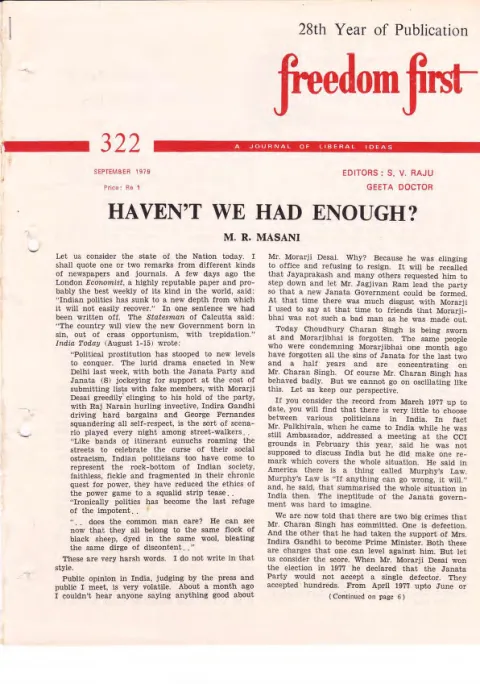
Summary
Issue No. 322 of Freedom First (September 1979, 28th year of publication), edited by S. V. Raju and Geeta Doctor, opens with M. R. Masani’s cover essay “Haven’t We Had Enough?”, a talk delivered to the Progressive Group in Bombay on 9 August 1979 surveying the collapse of the Janata government, the defection politics that brought Charan Singh to power with Indira Gandhi’s support, and President Sanjiva Reddi’s dissolution of the Lok Sabha. Masani argues for limited, disciplined government over both dictatorship and the drift he sees in unchecked democracy, blaming statism and the “Permit-Licence Raj” for corrupting Indian public life, and calls for a new generation of honest, non-professional politicians. The “Of Cabbages & Kings” column (initialed GD and SVR) comments on the Morvi flood relief effort, an Asean foreign ministers’ musical soiree, the President’s constitutional options in dissolving Parliament, and the debate over whether Charan Singh should have been kept on as caretaker PM, quoting Rajaji’s and Acharya Kripalani’s views on non-political caretaker governments. K. H. Subramaniam’s essay “Consumer Exploitation” surveys the weak state of consumer protection in India, contrasting it with the American consumer-rights framework and Ralph Nader-style activism, and pressing for a stronger regulatory and legal regime against fraud, false advertising and monopoly pricing. The book review section covers P. R. Brahmananda’s “Planning for a Futureless Economy” (reviewed by Prof. Pestonji N. Driver) and Mohamed Heikal’s “Sphinx and Commissar: The Rise and Fall of Soviet Influence in the Middle East” (reviewed by K. V. Padmanabhan). A short unsigned piece, “On Slogans,” reprinted from Time (12 February 1979), reflects on the history and psychology of political and advertising slogans. The issue closes with “With Many Voices,” a page of quotations on democracy, leadership and international affairs drawn from The Economist, Time, the Daily Telegraph and other sources.
Key points
-
M. R. Masani’s “Haven’t We Had Enough?”, a talk to the Progressive Group, surveys the collapse of the Janata government and Charan Singh’s ascent as caretaker Prime Minister with Indira Gandhi’s tacit support, defends President Sanjiva Reddi’s dissolution of the Lok Sabha, and blames the Permit-Licence Raj for institutionalising corruption.
-
Masani cites Sri Lanka under Jayawardene and Egypt under Sadat as successful economic “U-turns” away from socialism, and calls for a new generation of honest, non-professional citizen-politicians to enter public life.
-
The “Of Cabbages & Kings” column debates whether President Reddi was right to dissolve the Lok Sabha rather than install an alternative government, arguing he erred only in retaining Charan Singh as caretaker PM, and invokes Rajaji’s and Acharya Kripalani’s calls for non-political caretaker governments before elections.
-
K. H. Subramaniam’s “Consumer Exploitation” argues Indian consumers are systematically shortchanged by producers, government and trade unions acting in concert, citing an Indian-made refrigerator’s roughly 800% tax content, and calls for a Ralph Nader-style consumer lobby.
-
Prof. Pestonji N. Driver reviews P. R. Brahmananda’s Planning for a Futureless Economy, praising its challenge to the Planning Commission’s employment claims and its “wage-goods” analysis of chronic unemployment and inflation under the Mahalanobis strategy.
-
K. V. Padmanabhan reviews Mohamed Heikal’s Sphinx and Commissar, tracing two decades of Soviet involvement in Egypt from the 1956 Suez Crisis to Sadat’s 1976 abrogation of the Egypt-Soviet Friendship Treaty and turn toward American-brokered peace.
-
An unsigned piece reprinted from Time, “On Slogans”, reflects on the psychology of political and advertising catchphrases, running through historic slogans from “Give me liberty or give me death” to “We shall overcome”.
Essays
Haven’t We Had Enough?
By M. R. Masani
M. R. Masani’s lead essay, based on a talk to the Progressive Group in Bombay on 9 August 1979, argues that India’s politicians across parties have discredited themselves through opportunistic defections and jockeying for power following the fall of the Janata government. He traces the events by which Charan Singh took office as caretaker prime minister with the Congress (Indira Gandhi faction)‘s support, and defends President Sanjiva Reddi’s decision to dissolve the Lok Sabha and call fresh elections rather than inviting Jagjivan Ram to try to form a government. Masani contends that India needs “democracy with discipline and discipline without dictatorship,” blames the Permit-Licence Raj and statism for institutionalising corruption, and calls for a new class of honest, non-professional citizen-politicians to enter public life within the next six months to a few years, warning that failure risks a slide toward authoritarian rule.
- Surveys press commentary (Economist, Statesman, India Today) describing Indian politics in mid-1979 as having ‘sunk to a new depth’
- Argues there is ‘nothing to choose’ between Charan Singh and Morarji Desai/Jagjivan Ram given mutual defections and courting of Indira Gandhi’s support
- Defends President Sanjiva Reddi’s dissolution of the Lok Sabha and call for fresh elections as constitutionally justified given the risk of further defections under any alternative government
- Blames ‘Statism’ and the Permit-Licence Raj, inherited from Nehru’s economic policy, for fusing political and economic power and fueling corruption
- Cites Sri Lanka under Jayawardene and Egypt under Sadat as examples of successful ‘U-turns’ away from socialist economic policy
- Calls for limited but strong government — strong in law and order, but not dabbling in business, industry and agriculture
- Urges people in their 30s-50s with private means and professional backgrounds to enter politics to displace career politicians
Of Cabbages & Kings
The ‘Of Cabbages & Kings’ column, headed by a Lewis Carroll epigraph, opens with a piece on the Morvi dam-burst flood disaster, criticizing Indian complacency about natural-disaster casualties while praising the spontaneous relief response from industry and ordinary citizens, including Ahmedabad textile workers who donated a day’s wages. A second item, ‘To Asean With Music,’ wryly recounts musical performances by Asean foreign ministers at a Bali summit as reported in the Far Eastern Economic Review, and speculates satirically about the political constraints an Indian or Iranian foreign minister would face in similar circumstances. Editorial pieces on ‘Commonsense and the Constitution’ and ‘The President’s Options’ examine, in Q&A style, whether President Sanjiva Reddi was justified in dissolving the Lok Sabha and calling fresh elections rather than installing an alternative government, quoting Reddi’s pre-Independence Day broadcast on the deterioration of public morality. A further piece, ‘Poll Yes! Charan No!,’ argues the President was wrong only in asking Charan Singh to continue as caretaker PM, invoking Rajaji’s 1960 Swarajya essay calling for non-political caretaker governments before elections, and Acharya Kripalani’s similar recent advice, alongside press reports of the Charan Singh government’s ‘pre-poll sops.’
- Criticises Indian and international complacency (‘ho-hum’ attitude, per the BBC) about the scale of casualties in the Morvi flood disaster
- Praises spontaneous relief efforts by industrial houses and citizens, including Ahmedabad Textile Labour Association workers donating a holiday’s wages
- Satirically recounts a musical evening among Asean and allied foreign ministers at Bali, contrasting it with the political constraints an Indian or Iranian minister would face
- Analyses, in Q&A form, whether President Sanjiva Reddi was justified in dissolving the Lok Sabha rather than installing Jagjivan Ram or a national government
- Quotes President Reddi’s pre-Independence Day broadcast on the erosion of constitutional conventions and public morality
- Argues the President erred only in retaining Charan Singh as caretaker PM rather than installing a non-political caretaker government
- Cites Rajaji’s 1960 Swarajya article and Acharya Kripalani’s recent statements calling for non-political caretaker governments before elections
- Notes press reports (Indian Express, Times of India) of pre-election concessions and alleged misuse of authority by the Charan Singh caretaker government
Consumer Exploitation
By K. H. Subramaniam
K. H. Subramaniam’s ‘Consumer Exploitation’ argues that Indian consumers are systematically shortchanged by producers, government and trade unions acting in concert, citing examples such as high consumer prices despite ample corporate profits, heavy taxation embedded in the price of goods (fridges, petrol, cars), false advertising, and coupled or gimmick selling. Drawing on J. K. Galbraith’s account of the reversal of the classical consumer-sovereignty model, the essay contrasts India’s weak consumer protections with the American Presidential Commission’s enumerated consumer rights (safety, information, choice) and laments the absence of an Indian Ralph Nader-style consumer movement, calling for a stronger consumer lobby and legal accountability regime.
- Defines consumerism as ‘getting value for money in terms of goods and services’ and argues the consumer interest group is diffuse compared to producer and labour interests
- Illustrates producer-labour collusion at consumer expense with an anecdote about a Madras company’s wage-goods bonus dispute passed on to consumers
- Cites examples of the Indian consumer paying more for locally made goods than for imported equivalents despite steep customs duties
- Notes an Indian-made refrigerator carries roughly 800% tax content and petrol nearly 300%, calling pricing based on ‘capacity to pay’ rather than value an unfair practice
- Quotes Galbraith on the reversal of the classical consumer-market-producer ‘accepted sequence’ into producer-driven demand management
- Enumerates the American Presidential Commission’s consumer rights: safety, information, and choice/competitive pricing
- Criticises the exclusive focus of Indian consumer activism on adulteration and short-weighting, neglecting subtler exploitation like coupled selling and disregarded warranties
- Calls for a strong consumer lobby, alliance with government monitoring, and legislation making warranty non-performance a punishable offence
Planning for a Futureless Economy
Prof. Pestonji N. Driver reviews P. R. Brahmananda’s ‘Planning for a Futureless Economy’ (Himalaya Publishing House, 1978), praising its courage in challenging the Planning Commission’s employment-creation claims and the Mahalanobis strategy, and its ‘wage-goods’ analysis of chronic unemployment, poverty and inflation, while pushing back on some of the author’s specific criticisms, including his comparison of India’s development record unfavourably to China’s and his objection to rural road development. The review calls the book ‘vitally important’ despite some defective arguments, and criticizes the lack of translations into Indian languages that would let policymakers, especially in the Janata government, access it.
- Praises Brahmananda, alongside Prof. C. N. Vakil, for courageously critiquing India’s Five-Year Plans and their employment claims
- Summarises the book’s ‘wage-goods’ strategy argument that neither unemployment nor poverty can be solved through the Mahalanobis planning strategy
- Notes the book predicts severe, prolonged inflation as a consequence of the Mahalanobis strategy
- Disputes the author’s favourable comparison of China’s development record to India’s, citing China’s neglect of the West as a hidden cost
- Questions the author’s objection to rural road development as not sufficiently benefiting the rural poor
- Criticises the unavailability of the book’s ideas in translation for India’s 1,652 ‘mother tongues’, limiting its impact on non-English-reading policymakers
- Concludes the book makes a serious, largely fair case for reconsidering past planning mistakes despite some flawed specific arguments
Book Review: Planning for a Futureless Economy (P. R. Brahmananda) and Sphinx and Commissar: The Rise and Fall of Soviet Influence in the Middle East (Mohamed Heikal)
By Prof. Pestonji N. Driver / K. V. Padmanabhan
K. V. Padmanabhan reviews Mohamed Heikal’s ‘Sphinx and Commissar: The Rise and Fall of Soviet Influence in the Middle East’ (Collins, London), summarising the book’s account of two decades of Soviet involvement in Egypt from the 1956 Suez Crisis through Nasser’s death in 1970 and the eventual expulsion of Soviet influence under Anwar Sadat, culminating in Sadat’s 1976 abrogation of the Egypt-Soviet Friendship Treaty and turn toward American-brokered peace with Israel. The review praises Heikal’s insider access as a former Nasser confidant, minister and Al Ahram editor, and calls the book an outstanding, objective and meticulously detailed account.
- Recounts the 1956 Suez Crisis, Nasser’s nationalisation of the Canal, and the Soviet threat that helped force British/French/Israeli withdrawal
- Describes growing Soviet-Egyptian ties through the Aswan High Dam project and Khruschev’s 1964 visit to Egypt
- Notes the devastating impact of the 1967 Six-Day War on Egyptian forces and Nasser’s inability to recover before his death in September 1970
- Traces the gradual post-1970 deterioration of Soviet-Egyptian relations under Anwar Sadat
- Describes Sadat’s turn to the Americans (Kissinger) after the 1973 Arab-Israeli war and the 1976 abrogation of the Friendship Treaty as the breaking point with Moscow
- Credits Heikal’s unique access as Nasser’s information/foreign minister and Al Ahram editor, and his personal relationships with Soviet leaders including Khruschev
- Praises the book’s objectivity and its ‘dos and don’ts’ guidance Nasser reportedly compiled for handling Khruschev
On Slogans
An unsigned short piece, ‘On Slogans,’ reprinted from Time magazine (12 February 1979), reflects on the potency and psychology of political and commercial slogans, running through a history of memorable American political and advertising catchphrases and speculating whether an oversupply of sloganizing dilutes its persuasive power in the same way an oversupply of money debases currency.
- Argues a well-crafted slogan mobilizes latent emotion and plays on audience prejudices and verities
- Runs through a list of historic American political slogans, from ‘Give me liberty or give me death’ to ‘We shall overcome’
- Lists well-known commercial advertising slogans to illustrate the same psychological mechanism at work in business
- Poses the open question whether slogan oversupply dilutes catchiness the way currency oversupply dilutes value, offering this as a hopeful theory
With Many Voices
‘With Many Voices,’ the closing quotations page (epigraph from Tennyson), gathers short quotes on democracy, leadership, elections and international affairs from sources including The Economist, Time, the Daily Telegraph, the Conservative Party manifesto, Arun Shourie’s Indian Express column, and remarks by Margaret Thatcher, Henry Kissinger and others, spanning July-August 1979.
- Includes Economist quotes on the pace of elections and a Prime Minister’s duty to overcome rather than pander to prejudice
- Quotes Henry Kissinger on avoiding nuclear war without succumbing to nuclear blackmail
- Quotes Margaret Thatcher declaring ‘I am not bulliable’ and the Conservative manifesto’s call to reduce the state’s share of national income
- Quotes Arun Shourie on India’s dilemma between handing government to ‘louts’ or watching them paralyse Parliament
- Includes a Sunday Telegraph observation on the seeming inconsistency of progressive support for abortion alongside opposition to capital punishment
- Notes the issue’s colophon: published for the Democratic Research Service by J. R. Patel, Associate Editor, Freedom First, at 127 Mahatma Gandhi Road, Bombay 400023
Generated by the v1.5 extraction pipeline. Awaiting editorial review.
Essay 6
No summary was extracted for this article. Listed for completeness.
Essay 7
No summary was extracted for this article. Listed for completeness.
Metadata and summary are AI-extracted from the source PDF and reviewed for editorial accuracy. The original work is available via the Read PDF tab above (where present); paragraph-level citation inside the PDF is deferred to a future engagement.