periodical issue
Freedom First
A Journal of Liberal Ideas
Published for the Democratic Research Service by J. R. Patel, Associate Editor, Freedom First at 127, Mahatma Gandhi Road, Bombay 400 023 (Phone: 273914) and printed by him at Commercial Printers & Stationers, 525 S. Bapat Marg, Dadar, Bombay-400 028. · Bombay · 1979
16 pages
Freedom First
Summary
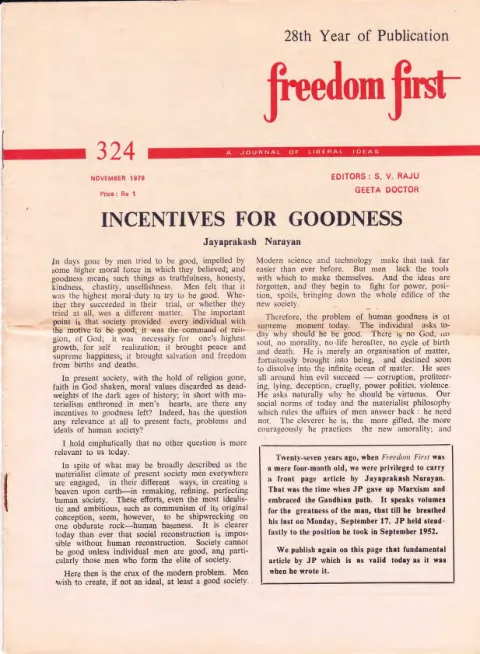
This November 1979 issue of Freedom First (No. 324, 28th year of publication, edited by S. V. Raju and Geeta Doctor) opens with a reprint of Jayaprakash Narayan’s 1952 essay “Incentives for Goodness,” republished as a tribute following JP’s death on 17 September 1979, with an editorial note explaining the reprint’s occasion. The editorial column “Of Cabbages & Kings” comments on the Sikkim election verdict, Charan Singh’s attack on Nehru’s agricultural record, N. A. Palkhivala’s return to arguing against the 42nd Amendment, and the tangled web of party alliances ahead of the impending general election. A “Debate” section carries reader letters responding to Minoo Masani’s earlier article “Haven’t We Had Enough?”, debating whether India’s political crisis calls for a change of politicians, a change of constitution, or a mobilisation of independents and intellectuals. Maj. Gen. E. D’Souza examines the Army-versus-Air Force dispute over control of Army Aviation and helicopter assets. A reprinted Economist piece surveys India’s approaching general election against the backdrop of Indira Gandhi’s resurgence, and Vladimir Bukovsky, a Russian dissident, argues against holding the 1980 Olympics in Moscow on human-rights and political-stability grounds. The issue closes with two book reviews (of Stephan Alter’s novel Neglected Lives and S. Radhakrishnan’s Indian Religions) and a page of aphoristic quotations, “With Many Voices.”
Key points
-
A reprint of Jayaprakash Narayan’s 1952 essay “Incentives for Goodness,” republished as a tribute after his death on 17 September 1979, argues that modern materialism has eroded religion’s traditional grounding for morality and that only transcending materialism, not any particular doctrine, can restore a durable incentive to goodness.
-
S. V. Raju’s editorial column “Of Cabbages & Kings” reads the Sikkim election result as proof the 1975 merger referendum was manufactured, criticises the caretaker government for defending the 42nd Amendment in court despite N. A. Palkhivala’s advocacy against it, and satirises the opportunistic pre-election alliances among Congress(U), Congress(I), Janata, Lok Dal, AIADMK, DMK, CPI and CPI(M).
-
A “Debate” section carries reader letters responding to Minoo Masani’s “Haven’t We Had Enough?”, with contributors from Gujarat, Andhra Pradesh, Maharashtra and Kerala split between backing independent candidates, blaming self-serving politicians rather than the constitution, and appealing to intellectuals for moral leadership.
-
Maj. Gen. E. D’Souza (Retd.) examines the Army-versus-Air Force dispute over control of Army Aviation helicopters, weighing the Army’s case for tighter battlefield liaison against the Air Force’s case for unified airspace control and cost, and concludes a separate Army Aviation arm is currently beyond India’s economic means.
-
A reprinted Economist piece, “India Votes In (and for?) Freedom,” frames the coming general election as offering no clear policy choice despite India’s remarkable record of resolving crises, including the 1975-77 Emergency, through the ballot, and asks whether it will restore power to the hands whose earlier abuse of it voters had condemned.
-
Russian dissident Vladimir Bukovsky’s “The Moscow Olympics” argues the Soviet Union fails the IOC’s own standards of political stability and non-discrimination, citing occupation of the Baltic states, KGB vetting of athletes, and restricted access to Soviet Jews, and calls holding the Games in Moscow a betrayal.
-
Muriel Wasi reviews Stephan Alter’s novel Neglected Lives, praising its sympathetic, multi-narrator portrait of Lucknow’s Anglo-Indian community and its refusal to caricature Anglo-Indian identity and sexuality.
-
Padmini Murti reviews S. Radhakrishnan’s Indian Religions, highlighting his argument that no religion can claim superiority over others and that cross-fertilisation among traditions, once outdated ritual is stripped away, enriches spiritual life.
Essays
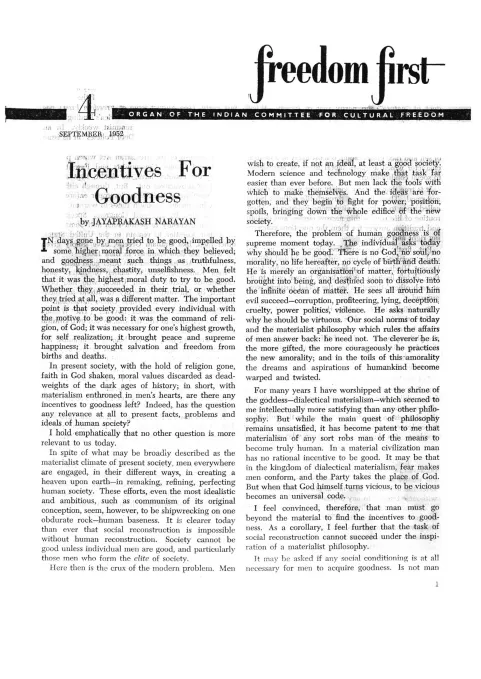
Incentives for Goodness
By Jayaprakash Narayan
A reprint of JP’s September 1952 essay, republished with an editorial framing note marking his death on 17 September 1979. JP argues that modern materialist philosophy has stripped away the traditional religious incentives to goodness, leaving individuals with no rational motive to be virtuous, and that social reconstruction is impossible without a prior reconstruction of the individual’s moral character. He contends that the elite’s character and philosophy, more than the character of the masses, determines whether a society turns toward good or evil, and that only by transcending materialism (without necessarily returning to any specific religious doctrine) can individuals find a durable incentive toward goodness.
- Argues traditional goodness was motivated by religious belief in God, salvation, and moral law, which have been eroded by modern materialism.
- Frames the central question as whether any incentive to goodness remains once God, soul, and an afterlife are disbelieved.
- Distinguishes ‘harmless decent’ men, whose morality is untested by real moral choice, from the corrupting effect of social crisis (e.g., communal violence between Hindus and Muslims).
- Argues the elite’s philosophy and character shape a society’s fate more than that of the general population.
- Concludes that materialism (including dialectical materialism, which JP says he personally ‘worshipped’ for years) cannot logically ground a demand for goodness, and that only going ‘beyond the material’ can restore it.
- Frames his own break from Marxism as intellectual as much as moral.
Of Cabbages & Kings
By SVR (S. V. Raju)
The regular editorial notes column, signed SVR (S. V. Raju), comments on four current-affairs items: the Sikkim state election results as vindication of the merger with India; N. A. Palkhivala’s return to arguing in the Supreme Court against the 42nd Constitutional Amendment even as the caretaker government contests his petition; Charan Singh’s criticism of Jawaharlal Nehru’s neglect of agriculture in favour of heavy industry; and a satirical rundown of the tangled, opportunistic alliances among Congress(U), Congress(I), Janata, the Lok Dal, AIADMK, DMK, CPI and CPI(M) ahead of the coming general election.
- Reads the Sikkim Assembly election result, in which all national parties were rejected in favour of the pro-Chogyal Sikkim Janata Parishad, as proof the 1975 merger referendum was manufactured.
- Criticises the caretaker government for arguing to retain the 42nd Amendment in court even after having pledged to remove it, naming N. A. Palkhivala’s advocacy against it.
- Defends Charan Singh’s claim that Nehru-era planning favoured heavy industry over agriculture.
- Satirises the shifting, contradictory alliance patterns among Janata, Congress(U), Congress(I), Lok Dal, AIADMK, DMK, CPI and CPI(M) as the election approaches.
- Notes a Times of India finding that only 39.8% of the dissolved Lok Sabha’s members were graduates.
Debate: Haven’t We Had Enough?
By Various readers (V. R. Boal, R. N. Bhaskaran, K. P. Bhagat, A Madhava Wariar, Vijay Phadke, M. K. D. Patel)
A ‘Debate’ feature carrying reader letters responding to Minoo Masani’s earlier Freedom First article ‘Haven’t We Had Enough?’. Contributors from across India (Gujarat, Andhra Pradesh, Maharashtra, Kerala) largely agree India’s political class has failed but disagree on the remedy: some call for backing independent candidates over party nominees, others insist the constitution itself is not the problem but the self-serving politicians who abuse it, and several appeal to intellectuals and the ‘uncontaminated younger generation’ to provide moral leadership. One letter tabulates civic-election results from Kerala showing independents outperforming all named parties.
- V. R. Boal (Rajkot) argues the key problem is how to remove corrupt politicians without destroying democracy itself.
- R. N. Bhaskaran (Andhra Pradesh) blames the failure on the electorate’s own selfishness rather than the political system, invoking Gandhi’s movement as the standard.
- A. Madhava Wariar (Kottayam) cites Kerala civic-election results (independents winning 2497 of 6200 declared results, more than any party) as evidence voters prefer independents when given a real choice.
- Vijay Phadke (Pune) argues the need is not to change the constitution but to change the ‘greedy lot of politicians,’ calling for a revolution in political culture.
- M. K. D. Patel (Vallabh Vidyanagar) makes ‘A Plea to Intellectuals,’ arguing the educated elite has failed to set an example and that mobilising honest independent candidates could yet check corrupt factions, citing the unanimous nomination of Justice Hidayatullah as Vice-President as proof good candidates can still prevail.
- K. P. Bhagat (Nagpur) blames 28 months of Janata non-performance and rampant defections on politicians’ pursuit of personal ambition, and calls for honest citizens to organise electoral councils.
Army Aviation
By Maj. Gen. E. D’Souza, PVSM (Retd.)
Maj. Gen. E. D’Souza (Retd.) examines the dispute between Army Headquarters and Air Headquarters over whether the Army should control its own helicopter and light-aircraft fleet (‘Army Aviation’) for artillery observation, vertical envelopment, and close support, or whether this should remain an Air Force responsibility. He lays out the Army’s case (sharper liaison with ground forces, faster reaction time, precedent from Israel, USA, NATO and Pakistan) and the Air Force’s counter-case (unified control of airspace, the high cost of duplicating training and maintenance infrastructure, and India’s weak economic position given the oil crisis), concluding that a separate Army Aviation arm is currently beyond India’s economic means and undesirable, and recommending unified, cooperative arrangements modelled loosely on Canada instead.
- Describes the Army’s argument for its own Aviation arm: tighter liaison with ground troops, faster response, and use of existing Air Observation Post pilots drawn from the Regiment of Artillery.
- Notes current production of the Chetak helicopter (based on the Sud Aviation Alouette) at HAL Bangalore, but says it lacks the payload for a true armed-helicopter role; contrasts it with the larger Soviet Mi-8 and Mi-24 (the latter used by Afghan forces).
- Presents the Air Force’s counter-arguments: unified control of airspace is essential, duplicating training/maintenance/R&D infrastructure would be prohibitively expensive, and helicopter piloting requires career-long specialisation incompatible with the Army’s tenure-based postings.
- Cites India’s deteriorating economic position (OPEC price rises, foreign exchange strain, poor monsoon) as a reason to avoid an expensive third aviation arm.
- Concludes Army Aviation is ‘beyond our economic resources nor is it desirable at the present juncture,’ recommending shared logistics/training infrastructure across the three services instead, citing the model of Canada and the effective India inter-service cooperation seen in the 1971 war.
India Votes In (and for?) Freedom
By The Economist, September 1 (reprint, unsigned)
A reprint from The Economist (September 1 issue) surveys India’s approaching general election, framing it as a paradox: the world’s largest democracy has an unmatched record of peacefully resolving political crises through elections (including ending Indira Gandhi’s 1975-77 Emergency), yet the coming election presents no clear policy choice, only a scramble of opportunistic alliances among Janata’s fragments (Jagjivan Ram, Charan Singh), Congress, and Mrs Gandhi, whose position has been strengthened by the chaos. The piece concludes that the central question hanging over the election is whether it will restore power to the very hands whose earlier abuse of it (1975-77) the electorate had condemned two years before.
- Frames India’s ability to hold free elections despite immense diversity, mass poverty, and illiteracy as a remarkable achievement, rare enough to be exhilarating.
- Notes that even the 1975-77 Emergency was ended not by coup or civil war but by the government yielding to a nationwide democratic demand.
- Argues the 1977 election gave a clear verdict against Indira Gandhi and Sanjay Gandhi’s excesses, but the 1979 election offers no equivalent clarity, only rival personal ambitions.
- Describes Janata’s fragmentation after Morarji Desai’s fall, with Charan Singh’s brief premiership as caretaker after Congress withdrew support and parliament’s dissolution.
- Observes that recent political manoeuvring has strengthened Mrs Gandhi’s position, since Janata’s leaders (Jagjivan Ram, Charan Singh) have had to court her.
- Concludes the central question is whether the coming election will restore power to the same hands whose 1975-77 abuse of it voters had previously condemned.
The Moscow Olympics
By Vladimir Bukovsky
Vladimir Bukovsky, a Russian dissident who reached Britain three years earlier, argues against holding the 1980 Olympics in Moscow. He contends the Soviet Union fails the IOC’s own requirements of political stability and non-discrimination: it occupies the Baltic states, Ukraine and Moldavia; suppresses minority nationalities’ cultures and languages; bans independent trade unions; subjects Olympic athletes to KGB political vetting; and will restrict foreign visitors’ movements and contact with Soviet Jews during the Games. He argues the Games’ proceeds will fund Soviet ‘strategic’ aims and that holding them in Moscow would reward, rather than restrain, Soviet human-rights abuses.
- Argues the Soviet Union fails the IOC’s Rule 3 requirement against racial, nationalist, religious or political discrimination, citing suppression of minority nationalities and languages.
- Cites ongoing occupation of the Baltic states, Ukraine and Moldavia (from 1939-40) as evidence against claims of political stability.
- Notes Olympic sailing events are to be held in illegally occupied Estonian territory.
- Describes KGB political vetting of Soviet athletes and restriction of foreign visitors’ movement and access to Soviet Jews during the Games.
- Argues Games proceeds in hard currency will help finance Soviet ‘strategic needs.’
- Concludes that holding the Olympics in Moscow at this juncture is ‘a great mistake’ politically and ‘a betrayal’ and ‘a crime’ from a human standpoint.
Book Review: Neglected Lives by Stephan Alter
By Muriel Wasi
Muriel Wasi reviews Stephan Alter’s novel ‘Neglected Lives’ (Andre Deutsch, 1979), praising it as a groundbreaking, sympathetic portrait of Lucknow’s Anglo-Indian community told through multiple narrators. The review summarises the plot centred on Lionel, an Anglo-Indian boy raised in post-1947 Lucknow, his relationships with Sujeeta and later Sylvia, his uncertain paternity between his official father Charles and family friend Brigadier Teddy Augden, and the community’s anxieties about identity, legitimacy, and its diminishing status in independent India. Wasi commends the novel’s psychological complexity and its refusal to caricature Anglo-Indians as merely sexually permissive or rootless, calling it an understanding, non-cynical treatment of a misunderstood community.
- Introduces Lionel, an Anglo-Indian boy in post-1947 Lucknow, whose parents’ confused sense of identity (his mother lightens her skin and calls an unseen England ‘home’) mirrors the community’s broader crisis.
- Describes the novel’s multi-narrator structure (Lionel, Augden, Nat, and later Salim Ahmed) used to present overlapping perspectives on the same events.
- Notes the uncertain paternity plot: whether Lionel’s biological father is Charles or family friend Brigadier Teddy Augden, given the two couples’ past history of exchanging spouses.
- Observes that sex plays a dominant role in the novel but argues the book is not salacious, situating Anglo-Indian sexuality within questions of rootlessness and social taboo rather than caricature.
- Praises the novel’s treatment of the tension between the older generation’s obsession with ‘legitimacy’ and the younger generation’s more relaxed attitude to community and marriage.
- Concludes the novel succeeds not by answering the identity questions it raises but by making a misunderstood community understood with sympathy rather than contempt or cynicism.
Book Review: Indian Religions by S. Radhakrishnan
By Padmini Murti
Padmini Murti reviews ‘Indian Religions’ by S. Radhakrishnan (Vision Books, New Delhi, 1979), a collection of essays by the philosopher-statesman on the basic tenets of Hinduism, Buddhism, Jainism, Sikhism, and religions that took root in India such as Islam, Christianity and Zoroastrianism. The review emphasises Radhakrishnan’s argument that no religion can claim superiority over others, that cross-fertilisation among religious traditions enriches spiritual life, and that the essence of religion has often been obscured by outdated ritual; the reviewer credits the collection with making Radhakrishnan’s thought on comparative religion accessible to general readers.
- Describes the book as a collection of essays on the basic tenets of India’s major religions, both indigenous (Hinduism, Buddhism, Jainism, Sikhism) and those that took root in India (Islam, Christianity, Zoroastrianism).
- Highlights Radhakrishnan’s argument that religions should strengthen shared ideals and understand their differences sympathetically rather than claim mutual superiority.
- Quotes Radhakrishnan’s metaphor that religious paths ‘separate us’ in the valley but ‘are all one’ from the summit.
- Notes the reviewer’s view that religions have become obscured by outdated rituals and superstitions that Radhakrishnan sought to strip away to reveal their common essence.
- Credits the book with making Radhakrishnan’s thought accessible to ordinary readers as well as scholars.
Generated by the v1.5 extraction pipeline. Awaiting editorial review.
Metadata and summary are AI-extracted from the source PDF and reviewed for editorial accuracy. The original work is available via the Read PDF tab above (where present); paragraph-level citation inside the PDF is deferred to a future engagement.