periodical issue
Freedom First
A Journal of Liberal Ideas
Published for the Democratic Research Service by J. R. Patel, Associate Editor, Freedom First at 127, Mahatma Gandhi Road, Bombay 400 023 (Phone: 273914) and printed by him at Kaiser-E-Hind Publishers & Printers 300, Perin Nariman Street, Bombay 400 001 · Bombay · 1980
16 pages
Freedom First
Summary
Freedom First No. 335 (November 1980) is the monthly Bombay journal of liberal ideas edited by Nissim Ezekiel, founded by M. R. Masani, in its 29th year of publication. The issue’s centre of gravity is Soviet expansionism and its regional fallout: an address by Dutch Liberal International MP F. Bolkestein on Western strategy after the invasion of Afghanistan, a piece by J. G. Tiwari on the Gdansk agreement and Poland’s independent trade unions, and a sharply critical essay by Y. Shivaji on India’s non-aligned posture toward Moscow. Domestically, Nissim Ezekiel’s opening editorial condemns the National Security Ordinance and the nationalisation of Maruti as a ‘backdoor Emergency’ under Indira Gandhi’s government. A three-part ‘Voices’ column carries short reader pieces on rural pollution, everyday bribery, and the Maharashtra Chief Minister’s remarks on democracy. A substantial ‘World of Books’ section reviews Bipan Chandra’s Nationalism and Colonialism in Modern India, Meira Chand’s novel The Gossamer Fly, and two poetry collections by Sunita Jain and Meena Alexander. The issue closes with K. V. Subrahmanyam’s essay ‘Right and Wrong in Politics’, tracing the moral basis of authority from Orwell and Hayek through ancient religious ethics to the modern nation-state and the corporate/multinational order.
Key points
-
Nissim Ezekiel’s editorial “Backdoor Emergency” condemns the National Security Ordinance’s due-process failures and the Maruti nationalisation, following the A. C. Gupta Commission’s findings of irregularities, as evidence of a “backdoor Emergency” under Indira Gandhi.
-
Dutch MP F. Bolkestein’s Berlin speech, “Soviet Imperialism and Western Strategy,” sets out five Western objectives on Afghanistan and argues detente must be paired with Western rearmament, citing Helmut Schmidt and the Sakharov case before the Hague tribunal.
-
J. G. Tiwari’s “Soviet Imperialism and Poland’s Revolt” credits the Gdansk agreement’s concessions to Polish workers, and the emergence of KOR, the Church and independent intellectuals, as a historic step toward pluralism the Soviet leadership has so far tolerated.
-
Y. Shivaji’s “Soviet Imperialism and India’s Stance” argues India’s recognition of the Heng Samrin regime and muted response to Afghanistan reveal a foreign policy that flatters Moscow and has hollowed non-alignment into mere economic backwardness.
-
A three-part “Voices” column covers rural sewage and pollution neglect, the pervasiveness of everyday bribery from school admissions to Lockheed-style scandals, and criticism of the Maharashtra Chief Minister’s suggestion that judges should not interpret the Constitution.
-
The World of Books section reviews Bipan Chandra’s Marxian Nationalism and Colonialism in Modern India, Meira Chand’s novel The Gossamer Fly, and poetry collections by Sunita Jain and Meena Alexander.
-
K. V. Subrahmanyam’s “Right and Wrong in Politics” traces the search for an objective political morality from Orwell and ancient religious ethics through Bertrand Russell, arguing pluralist self-governing institutions, not written constitutions alone, sustain democratic order, and closing with a critique of Gandhi’s “imaginary ideals” and Nehru’s admiration for Stalin’s nationalities policy.
Essays
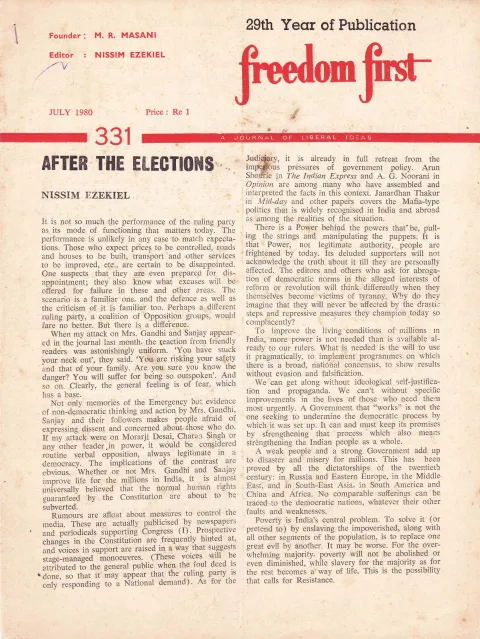
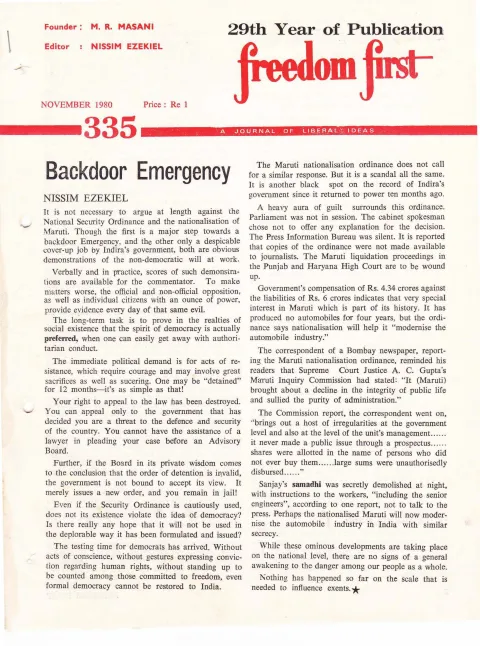
Backdoor Emergency
By NISSIM EZEKIEL
In the unsigned-by-byline (signed ‘Nissim Ezekiel’) lead editorial ‘Backdoor Emergency’, the editor argues that the National Security Ordinance and the ordinance nationalising Maruti are both demonstrations of the Indira Gandhi government’s non-democratic instincts, even though only the former is a formal step toward Emergency-style rule. He details the due-process failures of the security ordinance (no right of appeal to courts, no lawyer before the Advisory Board, indefinite 12-month detention) and reviews the Maruti nationalisation as a cover-up following the A. C. Gupta Commission’s findings of irregularities, undisclosed share allotments, and unauthorised disbursements, plus the secret night-time demolition of Sanjay Gandhi’s samadhi. Ezekiel calls for acts of civic resistance and warns that formal democracy cannot be restored to India without them.
- The National Security Ordinance removes the right to appeal to courts and to legal counsel before an Advisory Board, allowing 12-month detention without trial.
- The Maruti nationalisation ordinance is characterised as a ‘despicable cover-up job’ rather than a genuine industrial policy measure.
- Government compensation of Rs. 4.34 crores against Maruti liabilities of Rs. 6 crores is cited as evidence of special interest in the company.
- Justice A. C. Gupta’s Maruti Inquiry Commission is quoted describing irregularities in management and unauthorised disbursements.
- Sanjay Gandhi’s samadhi was secretly demolished at night with instructions to workers not to talk to the press.
- The editorial calls the overall pattern a ‘backdoor Emergency’ and urges immediate acts of civic resistance.
Soviet Imperialism and Western Strategy
By F. BOLKESTEIN, M.P. (Netherlands)
F. Bolkestein, a Dutch Member of Parliament, delivers a speech to the Liberal International’s annual conference in Berlin (5 September 1980) arguing that the Soviet invasion of Afghanistan confirms the USSR’s character as an expansionist, hegemonial power. He lays out five Western objectives on Afghanistan (full Russian withdrawal, secure borders, an acceptable regime, free return of refugees, and future assurances) and argues détente must be paired with Western rearmament, citing Helmut Schmidt and SALT II/III. He calls for confidence-building measures across Europe including Russia, criticises Soviet human-rights conduct (citing the Sakharov case before an international tribunal at The Hague), and closes by arguing the West’s comparative wealth, education, and technology give it grounds for confidence rather than appeasement.
- Argues the USSR is an expansionist power, citing its annexation of half a million square kilometers after WWII and interventions in 1948, 1953, 1956, 1968.
- Sets out five Western objectives on Afghanistan: full Soviet withdrawal, secure Afghan borders, an acceptable regime, free return of refugees, future assurances.
- Argues detente requires simultaneous Western rearmament (SS-20s, Backfire bombers, Pershing IIs, cruise missiles) to be credible.
- Cites Chancellor (Helmut) Schmidt’s warning that ‘continuity of detente cannot persist if you let the military equilibrium deteriorate.’
- Calls for pressing Soviet human-rights obligations under the Helsinki accords, citing the Hague tribunal on the Sakharov case.
- Closes on a note of Western self-confidence, comparing Western wealth, schooling, and technology favourably against the Soviet system.
Soviet Imperialism and Poland’s Revolt
By J. G. TIWARI
J. G. Tiwari surveys the aftermath of the Gdansk agreement, arguing the concessions Edward Gierek’s government granted Polish workers — notably the right to form independent trade unions and to strike — mark a historic step toward pluralism within the Communist system. He credits the Solidarity-era Self-Defence Committee (KOR), the Church, and intellectuals as emergent independent power centres, quotes the editor of Politkia urging Polish moderation to avoid provoking Soviet counteraction, and notes the Soviet leadership’s restraint (no Brezhnev-doctrine intervention as in 1956 Hungary) while warning that the USSR’s tolerance has practical limits tied to the enormous military and economic costs of any invasion.
- The 21-point Gdansk agreement (31 August) grants Polish workers independent trade unions and the right to strike.
- Stanislaw Kania, the new Polish Communist Party leader, has announced a commission to decentralise the economic system.
- KOR (the Self-Defence Committee), the Church, and intellectuals are named as emergent independent power centres challenging the monolithic Communist regime.
- The editor of Politkia is quoted advising a ‘moderate course’ so as not to provoke Soviet counter-action.
- The Soviet Union avoided invoking the Brezhnev doctrine or 1956-style intervention, reportedly because of the huge military and economic cost (a million men, several tank divisions) and risk to detente.
- Poland’s tradition of cultural, religious, and intellectual freedom is presented as distinguishing it from other Eastern Bloc states.
Soviet Imperialism and India’s Stance
By Y. SHIVAJI
Y. Shivaji delivers a pointed critique of Indian foreign policy under Indira Gandhi, arguing India’s recognition of the Vietnam-backed Heng Samrin regime in Kampuchea and its muted response to the Soviet invasion of Afghanistan reveal a foreign policy that flatters Moscow rather than defending non-alignment’s founding principles. He argues Brezhnev’s praise of India’s ‘stabilising role’ in Asia at Alma Ata is itself evidence India is being cast in a subordinate role serving Soviet regional strategy, and that non-alignment has been hollowed out into a doctrine of economic backwardness rather than genuine political neutrality, leaving countries like Cuba able to align with Moscow while still claiming non-aligned status.
- Criticises India’s recognition of the Heng Samrin regime in Kampuchea as inconsistent with genuine non-alignment.
- Argues India’s response to the Soviet invasion of Afghanistan has been muted compared to how it would react to comparable action by a capitalist power.
- Reads Brezhnev’s Alma Ata speech praising India’s ‘stabilising role’ in Asia as evidence India has been cast in a ‘handmaidenly role’ in Soviet regional strategy.
- Argues non-alignment has drifted from a doctrine of political neutrality to one of economic backwardness, allowing communist states like Cuba to claim non-aligned status.
- Warns that India’s uncertain economic independence risks becoming a loss of political independence as well.
- Cites Singapore Deputy PM Rajaratnam’s view that it is up to smaller powers to resist superpower efforts to extend influence.
Voices 1: Rural Decay
By HARISH KUMAR
The first ‘Voices’ item, ‘Rural Decay’ by Harish Kumar, surveys environmental degradation in rural India: inadequate sewage systems (only ~200 of 2,921 towns have any), contaminated drinking-water wells, dust pollution from unmetalled roads, deforestation, and noise pollution from vehicles and railways. The author attributes the crisis to poor land management and widespread public apathy compounded by poverty, illiteracy, and unemployment, and argues existing legislation like the Water Pollution Control Act has proven largely ineffective.
- Only about 200 of India’s 2,921 towns have any kind of sewage facilities; most sewage is dumped untreated into rivers or the sea.
- Contaminated open wells and mercury/cyanide/arsenic pollution are linked to disease outbreaks, citing the river Khan at Indore as an example affecting 18,000 people in 23 villages.
- Dust pollution from unmetalled village roads is described as a major health hazard, carrying disease and vehicle-exhaust lead particles.
- Deforestation, despite official prohibition, is cited as disturbing ecological balance and removing natural pest control.
- The Water Pollution Control Act is described as having remained ‘largely ineffective.’
- The root cause is identified as public apathy rooted in poverty, illiteracy, and preoccupation with survival.
Voices 2: For Services Rendered
By SHERNAVAZ COLAH
The second ‘Voices’ item, ‘For Services Rendered’ by Shernavaz Colah, is a wry essay on the pervasiveness of bribery in Indian daily life, from school admissions and medical-college seats to driving licences, minimum-wage inspectors, and street-level protection payments collected by local ‘dadas’ and policemen. The author extends the argument to the highest levels of government, alluding to Jaguar deals, Swiss bank accounts, and Lockheed-style scandals, and concludes that curbing corruption is ultimately a matter of individual refusal to offer bribes, however difficult that is in practice.
- Frames bribery as pervasive across Indian society, contrasting it with the Soviet term ‘blat’ for using connections.
- Describes school admission ‘donations,’ medical college seat purchases (Rs. 50,000 cited), and driving-test bribes as everyday examples.
- Describes street-level extortion by local ‘dadas’ and police collecting ‘hafta’ from vendors and a bootlegger.
- Recounts an anecdote of a Minimum Wages Act inspector being placated with tea rather than enforcing pay for underpaid peons.
- Extends the critique to elite-level corruption: Jaguar deals, Swiss bank accounts, Lockheed-style scandals benefiting ministers’ families.
- Concludes that curbing the trend requires individuals to refuse to offer bribes, even though this is difficult when a child’s future is at stake.
Voices 3: Democratic Hypocrisy
By ABRAHAM SOLOMON
The third ‘Voices’ item, ‘Democratic Hypocrisy’ by Abraham Solomon, attacks the Maharashtra Chief Minister’s remark that ‘the English form of democracy was not suited to our nation’ as a self-serving rhetorical move common among Indian politicians. The author notes the Chief Minister’s stated view that judges of the Supreme or High Courts should not interpret the Constitution because they lack ‘contact with the common man,’ and connects this with his call for more power to be vested in Indira Gandhi, reading both as signs of a slide back toward Emergency-style rule under a new guise.
- Criticises the Maharashtra Chief Minister’s claim that ‘English’ democracy is unsuited to India given widespread poverty.
- Notes the Chief Minister’s reported view that Supreme and High Court judges should not interpret the Constitution due to lack of contact with ‘the common man.’
- Reads this as a threat to judicial independence and human rights.
- Notes the Chief Minister’s plea for more power to be placed in Indira Gandhi’s hands.
- Concludes that Indira Gandhi is ‘relentlessly introducing the Emergency again—in a new guise.‘
The World of Books: Nationalism and Colonialism in Modern India (review of Bipan Chandra)
By F. A. MECHERY
F. A. Mechery reviews Bipan Chandra’s Nationalism and Colonialism in Modern India (Orient Longman, 1979), a collection of essays applying a Marxian framework to the Indian nationalist movement. The review credits Chandra’s account of the Indian capitalist class’s ‘two-fold’ relationship to imperialism and his ‘Pressure-Compromise-Pressure and Step by Step’ model of the freedom struggle’s strategy, but argues the Marxian framework is too rigid to explain Gandhi’s deliberate strategic choices, non-violence, and the political education of the masses, and that the theory leaves the psychological and philosophical roots of Gandhi’s leadership unexplained.
- Chandra argues the Indian capitalist class had a short-term interest in stability under the Raj but a long-term interest in ending empire.
- Introduces Chandra’s ‘Pressure-Compromise-Pressure and Step by Step’ account of nationalist strategy.
- Contrasts the Moderates (citing Gokhale, 1907) with the Extremist leader Tilak, whom Chandra brackets with Gandhi as representatives of the industrial bourgeoisie.
- The reviewer argues the Marxian framework cannot adequately explain Gandhi’s deliberate leadership choices or the mass political education achieved through Satyagraha and civil disobedience.
- Notes the historic rivalry between Indian and British capital, citing the eighteenth-century Indian shipbuilding industry as a case study.
- Concludes the book is valuable for understanding the historical roots of India’s underdevelopment despite its rigid theoretical frame.
The World of Books: The Gossamer Fly by Meira Chand
By ZERIN ANKLESARIA
Zerin Anklesaria reviews Meira Chand’s novel The Gossamer Fly (John Murray), praising its taut, economical prose and its portrayal of ten-year-old Natsuko, a child of mixed English-Japanese parentage caught between her English mother Frances and Japanese family, including the maid Hiroko and Hiroko’s disabled brother Shojiro. The review admires Chand’s controlled, image-driven style and tight structure while questioning whether a ten-year-old could plausibly register such mature perceptions, ultimately judging the novel an outstanding achievement from a talented new writer.
- Novel centres on ten-year-old Natsuko, torn between her English mother Frances and her father’s Japanese heritage and samurai-descended husband Kazuo.
- Hiroko, the promiscuous maid, and her disabled brother Shojiro are drawn as important secondary figures shaping Natsuko’s traumatic coming-of-age.
- The reviewer highlights Chand’s spare, image-based prose style as conveying a child’s fragmented perception of trauma.
- Notes the novel’s carefully patterned structure in which ancestral samurai armour becomes a symbolic climax.
- Raises a reservation about whether a ten-year-old protagonist could plausibly register such mature psychological perceptions.
- Concludes with high praise, calling Chand ‘a rare capacity for getting at once to the heart of the matter.‘
The World of Books: Lovetime by Sunita Jain / Stone Roots by Meena Alexander
By PRATIMA ASHER
Pratima Asher reviews two poetry collections, Sunita Jain’s Lovetime and Meena Alexander’s Stone Roots (both Arnold-Heinemann), judging both to fail despite opposite flaws. Jain’s Lovetime is criticised as thin and cliche-ridden love poetry lacking depth beyond ‘we met, we loved, we parted’ motifs, while Alexander’s Stone Roots is criticised for the opposite excess: dense, gloom-laden imagery of blood, bones, and corpses that amounts to obscure ‘instant profundity’ rather than genuine sense, though the reviewer allows Alexander occasionally shows the ability to craft a finely wrought image.
- Sunita Jain’s Lovetime (40 love poems) is criticised as shallow, hinging on repetitive motifs of meeting, loving, and parting.
- The reviewer calls Jain’s imagery cliche-ridden, citing ‘another day rolls by/I did not call my welfare’ as an example of confused, prosaic writing.
- Meena Alexander’s Stone Roots is criticised for the opposite fault: dense, gloom-laden imagery (blood, bones, corpses) without clear sense.
- The reviewer questions several obscure allusions in Alexander’s poems (Solomon and Sheba, a fish pot prophecy, a candle in a goat’s throat).
- Both collections are judged to share ‘weakness and pretension’ despite their different approaches.
- The reviewer allows Alexander occasionally achieves ‘a finely wrought image or idea’ before undercutting it in the next line.
Right and Wrong in Politics
By K. V. SUBRAHMANYAM
K. V. Subrahmanyam’s ‘Right and Wrong in Politics’ opens with George Orwell’s 1944 observation that both capitalism and collectivism lead to conflict, and that restoring the concept of Right and Wrong to politics requires reconciling planned economy with intellectual freedom. Subrahmanyam traces the search for an objective grounding of political morality from the ancient Priest-Kings and the Egyptian ‘Dawn of Conscience’ through Isaiah, Jesus, Buddha, and St. Paul’s ethic of charity/tolerance, then through Bertrand Russell’s Freedom and Organisation and Reith Lectures, arguing that pluralist societies with self-governing institutions — rather than written constitutions alone — are what sustain democratic and moral order. He contrasts Western European welfare states (wealthy without being socialist, having lost empires without becoming poorer) with the alternative of centralized planned economies (Stalin’s Five-Year Plans, Hitler’s Seven-Year Plans), and extends the argument into a discussion of modern multinational corporations as a potential force for good if subject to institutions like the United Nations, invoking J. C. Smuts’s ‘Holism’ and A. N. Whitehead’s and Lincoln’s view of democracy as resting on pluralist institutions rather than documents alone. The essay then turns to Indian history: the pre-colonial subcontinent as a loose geographical entity without unifying ethos, the 1857 Mutiny as a missed opportunity for a common law transcending caste and religion, Gandhi’s introduction of ‘imaginary ideals’ that the reviewer/author says perpetuated social evils, and a critical account of Nehru’s admiration for Stalin’s nationalities policy, non-alignment’s drift toward the Soviet orbit, and post-Nehru India’s political instability through Shastri, Indira Gandhi, and Emergency-era centralisation.
- Opens with Orwell’s 1944 review contrasting The Road to Serfdom and The Mirror of the Past, arguing planned economy must be reconciled with intellectual freedom.
- Traces the concept of Right and Wrong from the Egyptian ‘Dawn of Conscience’ and Isaiah through Jesus, Buddha, and St. Paul’s ethic of charity/tolerance.
- Cites Bertrand Russell’s Freedom and Organisation and Reith Lectures (Authority and the Individual) on the Ruler/Ruled dichotomy.
- Argues Western European welfare states are wealthy without being socialist, and lost empires without becoming poorer — ‘yet there are no bread queues in any of them today.’
- Discusses multinational corporations as potentially channelling capital for public good if disciplined by international institutions, citing J. C. Smuts’s ‘Holism.’
- Argues pluralist self-governing institutions, not written constitutions alone, give democracies ‘survival value,’ citing A. N. Whitehead and Lincoln.
- Critiques Gandhi’s introduction of ‘imaginary ideals’ such as ‘Ramrajya’ as perpetuating social evils like untouchability.
- Critiques Nehru’s admiration for Stalin’s handling of nationalities and argues non-alignment drifted India into the Soviet orbit after 1955.
- Closes by warning that unchecked centralisation of power — whatever its ideological label (Fascism, Communism, Nazism, Falangism) — eliminates the moral distinction of Right and Wrong.
Generated by the v1.5 extraction pipeline. Awaiting editorial review.
Metadata and summary are AI-extracted from the source PDF and reviewed for editorial accuracy. The original work is available via the Read PDF tab above (where present); paragraph-level citation inside the PDF is deferred to a future engagement.