periodical issue
Freedom First
A Journal of Liberal Ideas
Published for the Democratic Research Service by J. R. Patel, Associate Editor, Freedom First, at 127, Mahatma Gandhi Road, Bombay 400 023 (Phone 273914) and printed by him at The Bombay Chronicle Press, Bombay 400 001 · Bombay · 1981
16 pages
Freedom First
Summary
Issue 340 of Freedom First (April 1981, 29th year of publication) opens with editor Nissim Ezekiel’s alarmist editorial on separatism and the risk of India’s disintegration, followed by short opinion pieces on caste-based reservation policy and the opportunistic political rehabilitation of Rajaji and JP after their deaths. A substantial essay attacks Gandhian trusteeship theory as advocated by Rajaji, arguing it is an intellectually evasive alternative to both socialism and capitalism. A three-part ‘Voices’ column carries reader/contributor pieces on the role of intellectuals, a Gujarati biography of singer-composer Pankaj Mullick, and audience reactions to a Cambridge Theatre Company production of Macbeth in Bombay. A long polemical piece indicts the Congress government’s control of All India Radio and Doordarshan, arguing that state ownership makes ‘functional autonomy’ for broadcasters impossible. The books page reviews a critical study of Nirad C. Chaudhuri and a first volume of English poetry by Marathi writer Dilip Chitre. The issue closes with a substantial interview by Pratima Asher of sociologist Dr. Neera Desai, head of the Women’s Studies Research Unit at S.N.D.T. Women’s University, on the state of women’s studies in India, feminism versus women’s studies, and rural development work in South Gujarat.
Key points
-
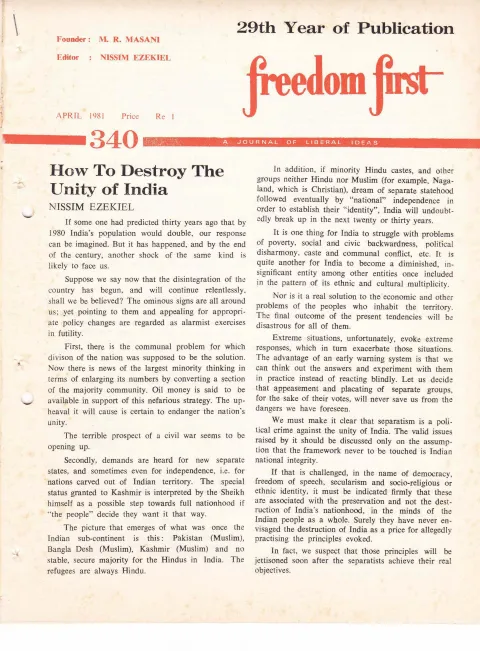
Nissim Ezekiel’s editorial “How To Destroy The Unity of India” warns that separatism, citing Kashmir specifically, and the political appeasement of minority groups for votes threaten India’s national integrity.
-
Arvind Deshpande’s “The Reservation Trap” argues caste-based reservation alone cannot address backward-class deprivation without social acceptance, calling instead for job creation and invoking Ambedkar’s emphasis on self-respect over legislative remedy.
-
An unsigned piece, “The dead cannot protest,” accuses politicians who opposed Rajaji and JP in life of opportunistically claiming affinity with them in death, singling out the invitation of socialist James Callaghan to a Rajaji memorial lecture as a stark irony.
-
Smita Bankeshwar’s “Gandhian Socialism” argues the phrase is a contradiction in terms, criticising Rajaji’s trusteeship doctrine as intellectually evasive since it rests on an untested wish that the rich will behave altruistically.
-
A three-part “Voices” column covers intellectuals’ responsibility in the nuclear age, a review of a Gujarati anthology on singer-composer Pankaj Mullick, and a review of a Cambridge Theatre Company production of Macbeth in Bombay.
-
Mehra Masani’s polemic against the government’s control of All India Radio and Doordarshan argues genuine broadcasting professionalism is impossible so long as civil-service staffing and bureaucratic budget control override independent editorial judgement.
-
Book reviews cover a critical study of Nirad C. Chaudhuri and Dilip Chitre’s debut English poetry collection Travelling in a Cage.
-
Pratima Asher interviews sociologist Dr. Neera Desai of S.N.D.T.’s Women’s Studies Research Unit, who distinguishes women’s studies from an “anti-man” feminism and describes an action programme in nine South Gujarat villages.
Essays
How To Destroy The Unity of India
By NISSIM EZEKIEL
In the lead editorial, Nissim Ezekiel warns that India’s unity is under threat from communal conflict, separatist demands (citing Kashmir specifically), and the political appeasement of minority groups for votes. He argues that separatism is a ‘political crime’ against national integrity and that principles like democracy, free speech, and secularism are being invoked disingenuously by separatists who will abandon them once their ‘real objectives’ of separate statehood are achieved.
- Predicts continued disintegration pressures on India through the end of the century.
- Cites the communal problem, and the possibility of a minority community converting members of the majority community to increase its numbers.
- Flags Kashmir’s special status as a possible stepping stone to full nationhood if ‘the people’ so choose.
- Warns that appeasement of separatist groups for votes will not avert the dangers foreseen.
- Frames separatism as a political crime against Indian unity, arguing democratic and secular principles are invoked only instrumentally by separatists.
The Reservation Trap
By ARVIND DESHPANDE
Arvind Deshpande’s ‘The Reservation Trap’ argues that caste-based reservation is not by itself a solution to backward-class deprivation, since laws cannot succeed without social and moral acceptance, and that the burden of social conflict falls disproportionately on the rural poor rather than the urban policymaking elite. He calls for job creation and education rather than reservation alone, invoking Ambedkar’s emphasis on self-respect over legislative remedy and comparing the needed struggle to the American civil rights movement.
- Argues no law succeeds without social and moral acceptance of it.
- Contrasts the urban intelligentsia’s ‘world of policies’ with the raw deprivation faced by villagers.
- Calls for a national programme creating a million jobs a year for scheduled castes/tribes over the next decade.
- Invokes a lineage of Indian reformers — Ram Mohan Roy, Vivekananda, Ranade, Gokhale, Phule, Gandhi, Nehru, JP, Ambedkar — as builders of a shared social conscience.
- Cites Ambedkar’s view that self-respect and dignity cannot be conferred by legislation, likening the needed struggle to Martin Luther King’s civil rights movement.
The dead cannot protest
By A CORRESPONDENT
An unsigned piece by ‘A Correspondent’ titled ‘The dead cannot protest’ accuses Indian politicians — naming Mrs. Gandhi, Sanjiva Reddy, Yeshwantrao Chavan, B. D. Jatti and S. B. Chavan — of opportunistically claiming affinity with the late Rajaji and Jayaprakash Narayan (JP) despite having opposed their ideas and treated them poorly in life. It singles out the invitation of lifelong socialist James Callaghan to deliver a memorial lecture honouring Rajaji, a lifelong opponent of socialism, as a particularly stark example of this political opportunism.
- Questions why politicians who opposed Rajaji’s philosophy in life now participate in centenary/memorial events honouring him.
- Notes Mrs. Gandhi’s proposed role heading a memorial panel for JP despite her historical treatment of him.
- Highlights the irony of inviting socialist James Callaghan to a lecture endowed in memory of Rajaji, who devoted his last two decades to opposing the ‘myth of socialism’.
- Contrasts this with the near-total absence of Rajaji’s and JP’s actual close associates from these commemorative events, citing Achyut Patwardhan as one rare inclusion on JP’s side.
- Concludes that this political exploitation of dead men is ‘hypocrisy of the worst kind’ reflecting the broader lack of values in Indian politics.
Gandhian Socialism
By SMITA BANKESHWAR
Smita Bankeshwar’s ‘Gandhian Socialism’ argues that the phrase is a contradiction in terms, since Gandhi himself opposed socialism as ordinarily understood. She contends Rajaji’s advocacy of Gandhian trusteeship as an alternative to both capitalism and communism is intellectually evasive, resting on an untested wish that the rich will behave altruistically rather than on any examined theory of human nature, and calls the whole approach anti-intellectual.
- Argues 25 years of Indian ‘socialism’ have driven 50% of the population below the poverty line.
- Quotes Gandhiji’s own statements that economic control by the state would extinguish freedom of thought and culture.
- Quotes Rajaji’s claim that total economic control leads inevitably to control of thought, opinion, and soul.
- Criticises the trusteeship doctrine for not explaining why or how the rich would behave altruistically, or who among them qualifies as trustees.
- Contrasts Hobbes’s view of humans as naturally selfish with Gandhi’s view of human nature, framing trusteeship as resting on unexamined premises.
- Concludes that no ideology solves problems — only reason, science and technology are reliable.
Voices 1: Crucial Roles
By C. RAJU
No summary was extracted for this article. Listed for completeness.
Voices 2: On Pankaj Mullick
By YASHVANT TRIVEDI
No summary was extracted for this article. Listed for completeness.
Voices 3: Macbeth in Bombay - Audience Response
By INDU SARAIYA
Under the ‘Voices’ rubric, three short contributed pieces appear. C. Raju’s ‘Crucial Roles’ (Voices 1) reflects on the historic tension between intellectuals/artists and their times, arguing intellectuals have a special responsibility in the nuclear age to remain dispassionate and defend true values. Yashvant Trivedi’s ‘On Pankaj Mullick’ (Voices 2) reviews a Gujarati anthology, Guzar Gaya Wah Zamana, compiling autobiographical material and tributes to the singer-composer Pankaj Mullick, compiled by Ajit Sheth. Indu Saraiya’s ‘Macbeth in Bombay — Audience Response’ (Voices 3) reviews a Cambridge Theatre Company production of Macbeth at the Homi Bhabha Auditorium, noting an audience partly unfamiliar with Shakespeare, and assessing Brian Cox’s and Gemma Jones’s performances.
- Raju: intellectuals have historically been at odds with their times, and modern civilisation’s nuclear risk gives them a distinctively crucial, dispassionate role.
- Raju: cites ‘Partisan Review’ and ‘Encounter’ as venues that gave intellectuals space to express dissenting views against Soviet-style state control of art.
- Trivedi: Guzar Gaya Wah Zamana is an anthology (not a strict autobiography) assembled by Ajit Sheth from Pankaj Mullick’s own Bengali writings, letters, interviews, and tributes from contemporaries.
- Saraiya: the Cambridge Theatre Company’s Macbeth suffered from an audience split between those familiar and unfamiliar with Shakespeare, producing mistimed laughter at serious moments.
- Saraiya: praises Brian Cox’s Macbeth and Gemma Jones’s Lady Macbeth, though feels the production could have built a stronger crescendo of desperation across the murders.
WANTED: A new broom for the Ministry of Information and Broadcasting
By MEHRA MASANI
Mehra Masani’s ‘WANTED: A new broom for the Ministry of Information and Broadcasting’ criticises Information & Broadcasting Minister Mr. Sathe and Mrs. Gandhi’s government for treating All India Radio and Doordarshan as organs of the state rather than independent public broadcasters. She argues genuine professionalism in broadcasting is impossible so long as the media remain under direct government control, detailing how civil-service staffing, bureaucratic budget control, and lack of a protective charter prevent objective news coverage, and criticises the government’s underfunded, urban-biased radio and unrealistic Colour TV ambitions.
- A new Advisory Panel under G. Parthasarathy has been appointed despite the pre-existing Chanda Committee and Verghese working group recommendations already covering the needed reforms.
- Argues broadcasters cannot set or maintain professional standards when instructions from government can override them at any time, citing the treatment of PM speeches as ‘feature items’ rather than news.
- Notes only roughly 25 million radio receivers exist, concentrated in cities, effectively one receiver per 100 rural persons; community listening has collapsed due to poor maintenance of village sets.
- All 700,000 TV sets are in cities, mostly bought by the rich to watch Hindi films; the government’s ambitions for a colour TV set in every village have been scaled back for cost reasons.
- Concludes broadcasting reform requires the government to relinquish control, not merely inject professionalism rhetoric.
Essay 7
A short unsigned announcement introduces Free Inquiry, a new quarterly journal published by the Council for Democratic and Secular Humanism (Buffalo, New York), edited by Paul Kurtz. The notice describes the journal’s mission to defend freedom and secularism against a perceived global resurgence of religious fundamentalism and irrational doctrines, listing V. M. Tarkunde as a member of its editorial board.
- Free Inquiry aims to analyse religious inconsistencies and their social consequences from a secular humanist viewpoint.
- Cites the growth of Christian fundamentalism, Chasidic Judaism, Islamic sects, Asian cults, and paranormal beliefs as evidence of a global retreat from Enlightenment values.
- V. M. Tarkunde, former Indian Supreme Court judge and President of the Radical Humanist Association, India, is named on the editorial board.
- Subscription rate given as $12.00 per year for the quarterly publication.
Essay 8
‘The World of Books’ carries two reviews. K. Balasubramaniyan reviews Chetan Karnani’s Nirad C. Chaudhuri (Twayne Publishers, 1980), describing it as a thorough but critical look at Chaudhuri’s contempt for Hindu culture, his views on Indian women and marriage, and his dismissive attitude toward regional-language writers, while noting Karnani finds him no liking for Gandhi’s methods despite nationalist sympathies. Zerin Anklesaria reviews Dilip Chitre’s Travelling in a Cage, the poet’s first English-language poetry volume, finding the U.S.A.-themed opening section flaccid and prone to hortatory statement, but praising the later Bombay poems for their concrete, bare, non-descriptive style.
- Balasubramaniyan: Karnani criticises Chaudhuri for a ‘defective literary sensibility’, cavalier attitude to Indology, and inconsistent standards between British and Indian publishers.
- Balasubramaniyan: notes Chaudhuri’s series ‘Why I Hate Indians’ and his claims about Hindu marriage and sexuality are discussed critically in the book.
- Balasubramaniyan: Karnani also calls Chaudhuri’s portrait of Max Muller (Scholar Extraordinary) a painstaking but dull piece of research.
- Anklesaria: finds the collection’s USA section marred by vague cosmic imagery, overstatement, and unpoetic hortatory tone (‘I will teach you…’).
- Anklesaria: praises the Bombay-themed poems (e.g. ‘The View from Chinchpokli’) for grounding the collection in concrete, self-deprecating, sardonic observation rather than abstraction.
The World of Books: Nirad C. Chaudhuri by Chetan Karnani (review)
By K. BALASUBRAMANIYAN
Pratima Asher interviews Dr. Neera Desai, Professor and Head of Sociology and Director of the Research Unit on Women’s Studies at S.N.D.T. Women’s University, Bombay — the first such unit in India, founded in 1974. Desai discusses the unit’s origins, funding sources (ICSSR, UNICEF, CSIR), completed research projects, and a three-pronged action programme (education, health, income generation) in nine villages of South Gujarat run in partnership with a local women’s organisation in Udhwada. She distinguishes women’s studies from feminism, arguing feminism has become ‘anti-man’ whereas women’s studies takes a total-system perspective, and reflects on her own largely non-sexist upbringing and family life, including her lawyer son’s voluntary work on rape cases.
- The Women’s Studies Research Unit began in 1974 as the first of its kind in India; the ICSSR’s own women’s studies cell followed only in 1975.
- The unit runs a time-bound (Dec ‘80-Dec ‘81) action programme in nine South Gujarat villages focused on education, health, and income generation, partnering with a 25-year-old local women’s organisation in Udhwada.
- Desai argues women’s studies and feminism differ: feminism has a definite thrust on the woman’s viewpoint and is increasingly ‘anti-man’, while women’s studies requires considering the whole system including men.
- She argues patriarchal social attitudes, imprinted on boys from childhood, must change, and envisions a co-educational women’s studies curriculum.
- S.N.D.T. is described as the only university offering a full undergraduate course on the Sociology of Women.
- Desai’s son, a lawyer, has voluntarily taken up rape-related legal cases, which she credits partly to his non-sexist upbringing.
Generated by the v1.5 extraction pipeline. Awaiting editorial review.
Metadata and summary are AI-extracted from the source PDF and reviewed for editorial accuracy. The original work is available via the Read PDF tab above (where present); paragraph-level citation inside the PDF is deferred to a future engagement.