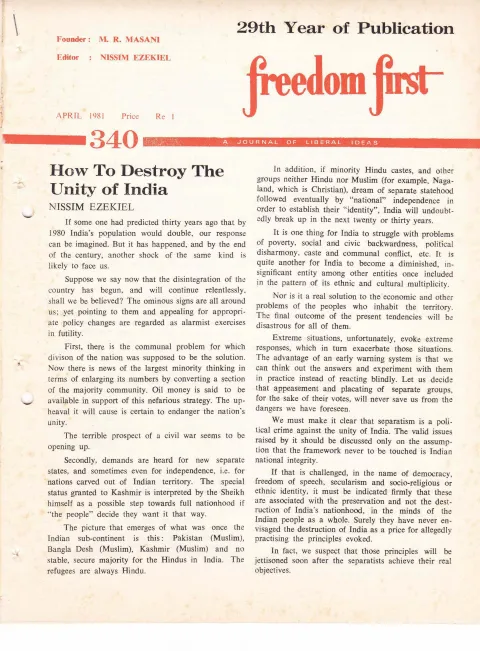
periodical issue
Freedom First
A Journal of Liberal Ideas
By NISSIM EZEKIEL, B. P. ADARKAR, ARVIND A. DESHPANDE, INDU SARAIYA, M. A. RANE, PREETH I. BIDDAPA, HAVOVI ANKLESARIA, ATTAR CHAND
Published for the Democratic Research Service by J. R. Patel, Associate Editor, Freedom First, at 127, Mahatma Gandhi Road, Bombay 400 023 (Phone: 273914) and printed by him at The Bombay Chronicle Press, Bombay 400 001. · Bombay · 1981
16 pages
Freedom First
Summary
Freedom First No. 342 (June 1981), the monthly journal of liberal ideas edited by Nissim Ezekiel and founded by M. R. Masani, opens with Ezekiel’s own polemic against Rajiv Gandhi’s entry into politics as an extension of Indira Gandhi’s dynastic control. The issue mixes foreign-affairs commentary (on Sino-Indian relations and Soviet religious policy toward Muslims), an economic-philosophy essay revisiting Gandhian trusteeship against common ownership, a reprint of the Indian Liberal Group’s 1975 statement condemning the Emergency, reader-contributed ‘Voices’ pieces on apartheid South Africa and a Citizens for Democracy resolution on electoral corruption, a books page reviewing works on press freedom and poetry, and a syndicated piece on population control and economic growth. Contributors include B. P. Adarkar, Arvind A. Deshpande, Indu Saraiya, M. A. Rane, Preeth I. Biddapa, Havovi Anklesaria, and Attar Chand, alongside the journal’s regular subscription and advertising pages.
Key points
-
Nissim Ezekiel attacks Rajiv Gandhi’s entry into politics as a stage-managed extension of Indira Gandhi’s dynastic control, resting on maternal patronage rather than independent achievement.
-
B. P. Adarkar’s “The Chinese Conundrum” argues Nehru’s non-alignment was internally contradictory, blaming Khrushchev for misleading Nehru into the 1962 border war over the strategically worthless Aksai Chin.
-
A reprint of the Indian Liberal Group’s 1975 statement condemns the Emergency’s censorship and MISA detentions as exceeding colonial-era repression, calling for free elections and restored press freedom.
-
Arvind A. Deshpande defends Gandhian trusteeship over common ownership, invoking Maslow and Schumacher on self-actualisation and describing a common-ownership model from England and Spain with capped wage differentials.
-
A report on Soviet policy toward Islam describes suppressed mosques and restricted seminaries in Bokhara and Tashkent despite a 1981 Soviet Muslim delegation sent to South Yemen to counter accusations of anti-Islamic policy.
-
Two “Voices” pieces cover a review of Arun Gandhi’s book on apartheid South Africa, A Patch of White, and a report on Citizens for Democracy resolutions endorsing JP-committee electoral reforms including state funding of elections.
-
Book reviews cover a seminar booklet on Indian press freedom constraints and Keki Daruwalla’s poetry collection Winter Poems, while a companion essay surveys global population growth and its strain on food and employment in developing nations.
Essays
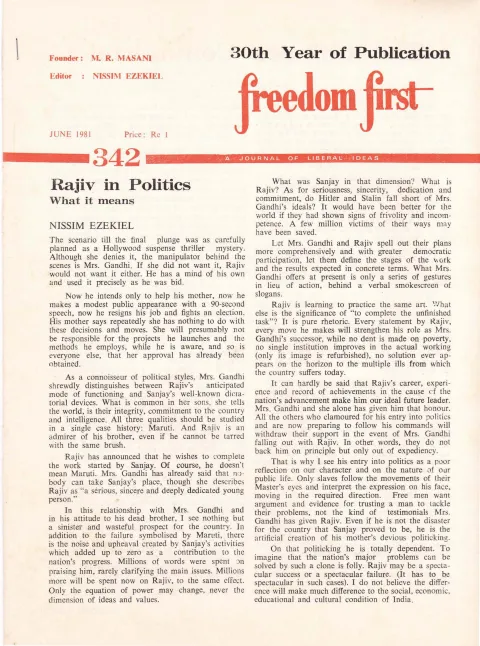
Rajiv in Politics: What it means
By NISSIM EZEKIEL
In this editorial-style piece, Nissim Ezekiel attacks Rajiv Gandhi’s move into politics as a stage-managed production directed by Indira Gandhi, comparing it to a Hollywood suspense plot. He argues Rajiv’s ascent rests entirely on his mother’s patronage rather than any independent record of achievement, and that his rhetoric of completing Sanjay Gandhi’s ‘unfinished task’ is empty sloganeering that does nothing to address the country’s poverty or institutional decay. Ezekiel concludes that the episode reflects poorly on India’s political culture, since supporters back Rajiv out of expediency and deference to Mrs. Gandhi rather than conviction.
- Ezekiel frames Rajiv Gandhi’s political entry as entirely engineered by Indira Gandhi, not his own initiative.
- He contrasts Rajiv’s untested public role with the disruptive legacy of Sanjay Gandhi, invoking the Maruti project as a case study of failure.
- He argues Mrs. Gandhi asks for public trust in her sons based on personal loyalty rather than concrete achievements or plans.
- The piece criticizes supporters who back Rajiv only out of political expediency rather than principle.
- Ezekiel predicts Rajiv’s political fate depends wholly on his continued alignment with his mother’s favour.
The Chinese Conundrum
By B. P. ADARKAR
B. P. Adarkar surveys the unresolved ‘Chinese Conundrum’ in Indian foreign policy, arguing that Nehru’s non-alignment doctrine was always internally contradictory and that the 1962 border war stemmed from India being misled by Khrushchev into contesting Aksai Chin, a territory of negligible worth. He traces how the Sino-Soviet split, the Sino-Pakistani alignment, and shifting Indian diplomacy (including Subramaniam Swamy’s visit and Vajpayee’s 1979 Beijing trip) have left India without a coherent China policy. Adarkar urges renewed government-to-government negotiations, prioritizing the border question, and warns that continued deference to Moscow’s preferences undermines any settlement with Beijing.
- Adarkar argues India’s non-alignment policy was ‘schizophrenic’, neither genuinely neutral nor coherent.
- He blames Khrushchev’s USSR for pushing Nehru into confronting China over the strategically worthless Aksai Chin region.
- He traces the post-1962 Sino-Pakistani alignment as a consequence of India’s alienation of China.
- He criticizes the lack of sustained government-to-government negotiation with China since 1962, citing Subramaniam Swamy’s and Vajpayee’s visits as isolated exceptions.
- He calls for resolving the border question first and warns against continued deference to Soviet interests in shaping India’s China policy.
A Statement to Remember: The Indian Liberal Group on the Emergency
By Indian Liberal Group
This is a reprint of a 1975 statement by the Indian Liberal Group condemning the imposition of the Emergency, framed under the heading ‘A Statement to Remember.’ It traces Indian liberalism’s nineteenth-century roots through figures like Gopal Krishna Gokhale and Srinivasa Sastri, argues the Emergency’s censorship, MISA detentions, and suspension of civil liberties represent a slide toward authoritarianism worse than colonial-era repression, and calls for a free and fair general election with restored press freedom and release of political detainees as the only legitimate path back to constitutional government.
- The statement situates the Indian Liberal Group within a nineteenth-century liberal tradition tracing to Gokhale and Sastri.
- It condemns the Emergency’s censorship, MISA detentions, and suspension of civil liberties as exceeding even British colonial repression.
- It warns that authoritarian measures risk leaving permanent scars on Indian democracy.
- It calls for a free and fair general election with restored freedom of expression and release of detainees as the route back to legitimacy.
- It expresses hope that the authoritarian regime is not yet irreversible.
Trusteeship and Common Ownership
By ARVIND A. DESHPANDE
This unsigned piece, sourced from the Swiss Press Review and News Report, examines Soviet policy toward Islam, focusing on the 1981 delegation of Soviet Muslims to South Yemen and Moscow’s broader propaganda effort to portray religious tolerance across its Muslim-majority regions. It reports on suppressed mosques, restricted seminaries in Bokhara and Tashkent, state-controlled religious leadership, and the gap between Soviet claims of religious freedom and the lived reality of surveillance, indoctrination, and limited seminarian training under close state supervision.
- Soviet authorities sent a delegation of Muslims to South Yemen to counter accusations of anti-Islamic policy, following criticism over the Afghanistan invasion.
- Daily prayers were reportedly declared illegal in South Yemen, with mosques converted to military use.
- Only two Muslim seminaries remain in the USSR (Bokhara and Tashkent), training roughly 100 seminarists against a Muslim population exceeding 40 million.
- The article contrasts Soviet propaganda of religious freedom with the reality of atheist indoctrination in schools and restrictions on public religious practice.
- The Communist Party of Turkmenistan’s First Secretary Muhammednazar Gafurov condemned the persistence of religious belief as incompatible with Soviet patriotism.
Voices 1: The Ugly South African Reality
By INDU SARAIYA
Arvind A. Deshpande offers a rebuttal to a previously published article on Gandhian Socialism, arguing for the Gandhian concept of trusteeship over common ownership as a model for reconciling capital and labour. He surveys psychological theories of human motivation (Freud, Maslow, Schumacher) to argue that self-actualisation through service, not mere material redistribution, sustains ethical economic behaviour, and describes a common-ownership model from England and Spain with democratized management, capped wage differentials, and profit-sharing among workers, consumers, and community.
- Deshpande frames trusteeship as the responsibility of the privileged and skilled toward the community, especially the poor and disadvantaged.
- He invokes Jayaprakash Narayan’s view that trusteeship offers an alternative to both unchecked capitalism and communism.
- He draws on Maslow’s hierarchy of needs and Schumacher’s ideas on meaningful work to argue self-actualisation drives ethical economic conduct.
- He describes a common-ownership model (from England and Spain) featuring elected management, a 1:6 maximum wage differential, and equal profit-sharing among workers, community, and self.
- He contrasts this ‘realistic’ industry-society relationship with Indira Gandhi’s narrower view of corporate obligation limited to quality standards and tax compliance.
Voices 2: Recent Resolutions of Citizens for Democracy
By M. A. RANE
Indu Saraiya reviews Arun Gandhi’s book ‘A Patch of White’ (Thackers, Bombay, 1969), describing its portrait of apartheid-era South Africa through the eyes of the author, a journalist and grandson of Mahatma Gandhi. The review traces the book’s account of the colonial origins of South African racial division, the entry of indentured Indian labour, and the entrenched Pass Laws, segregation, and imprisonment of African leaders like Luthuli and Mandela, praising the book’s factual, dispassionate treatment of a highly charged subject.
- Saraiya reviews Arun Gandhi’s ‘A Patch of White’, which examines apartheid South Africa from a journalist’s perspective.
- The review recounts the book’s history of Dutch and British colonization and the racialized origins of South Africa’s social order.
- It describes the entry of indentured Indian labour into Natal’s sugar-cane economy and subsequent Indian community tensions.
- It highlights the book’s account of Pass Laws, segregated transport and public facilities, and imprisonment of African nationalists on Robben Island.
- The reviewer credits the book for even-handedness, criticizing both white apartheid policy and some Asian commercial conduct.
The World of Books (reviews of Freedom of the Press, and Winter Poems by Keki Daruwalla)
By PREETH I. BIDDAPA; HAVOVI ANKLESARIA
M. A. Rane reports the recent resolutions of the Citizens for Democracy (Bombay), which express concern over political corruption, black money in elections, and inflation harming the poor. The resolutions endorse electoral reforms proposed by a committee appointed by Jayaprakash Narayan, including state funding of a substantial part of election expenses, and call for decentralisation of power, repeal of preventive detention laws, and greater grassroots involvement in governance.
- The Citizens for Democracy resolution highlights alarm over political corruption and black money’s role in elections.
- It endorses electoral reforms from a committee appointed by Jayaprakash Narayan, including partial state funding of election expenses.
- It argues that poverty, corruption, and law-and-order problems cannot be solved by centralising power in one leader.
- It calls for repeal of preventive detention laws and decentralisation of power to grassroots-level people’s committees.
- The resolution is dated 25 April 1981 and signed by M. A. Rane as Honorary Secretary.
Population Control for Economic Growth
By ATTAR CHAND
The ‘World of Books’ page carries two reviews. Preeth I. Biddapa reviews ‘Freedom of the Press’, a booklet from an Institute of Social Studies seminar featuring excerpts from C. R. Irani, Prof. Sanghavi, and M. V. Kamath, which debates whether Indian press freedom is substantively constrained by economic pressures, urban bias, and government control of newsprint and advertising despite the absence of overt legal censorship outside the Emergency. Havovi Anklesaria reviews Keki Daruwalla’s poetry collection ‘Winter Poems’ (Allied Publishers), finding its unrelenting imagery of decay and despair powerful in individual poems but repetitive across the collection as a whole, while praising its concrete, unsentimental language.
- Biddapa’s review covers a seminar booklet on press freedom, citing arguments from C. R. Irani, Prof. Sanghavi, and M. V. Kamath.
- The reviewed seminar concludes that economic pressures, urban bias, and government control of newsprint/advertising limit real press freedom in India more than formal legal restriction.
- It notes that only a few papers, including The Statesman and Freedom First, resisted press censorship during the Emergency.
- Anklesaria’s review of Daruwalla’s ‘Winter Poems’ finds the poems individually striking but repetitive in their reliance on imagery of deserts and decay across the collection.
- Anklesaria highlights the collection’s monologue sequences and its blend of grotesque and tender imagery as its strongest achievement.
Essay 9
Attar Chand surveys the global population growth challenge and its implications for economic development, contrasting rapid growth rates in developing regions with much lower rates in developed countries. The essay argues that population growth strains food production, employment, and environmental resources in poorer nations, and reviews policy approaches including infant mortality reduction, women’s education, community incentives (citing Indonesia), and family planning services as complementary strategies to reduce fertility alongside economic development.
- Developing regions grow at 2.1 percent annually versus 0.7 percent in developed regions, driving most of projected global population growth to 2000.
- The UN projected world population reaching 6,200 million by 2000, with 90 percent of the increase occurring in developing nations.
- Environmental degradation, unemployment, and stagnant per-capita calorie intake in 23 countries are linked to population pressure.
- Chand identifies reduced infant mortality, women’s education, and delayed marriage age as key levers for lowering fertility.
- The essay reviews policy categories: improved services, information/education, restructural development, incentives/disincentives, and pressures/sanctions, citing Indonesia, Kerala, Sri Lanka, and China as examples.
Generated by the v1.5 extraction pipeline. Awaiting editorial review.
Metadata and summary are AI-extracted from the source PDF and reviewed for editorial accuracy. The original work is available via the Read PDF tab above (where present); paragraph-level citation inside the PDF is deferred to a future engagement.