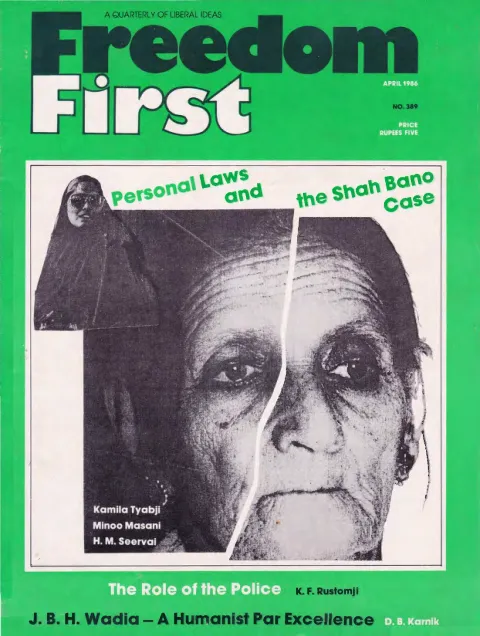
periodical issue
Freedom First
By M. R. Pai, A. Solomon
Published for the Democratic Research Service by J. R. Patel, Associate Editor, Freedom First, at 127, Mahatma Gandhi Road, Bombay 400 023 (Phone: 273914) and printed by him at The Bombay Chronicle Press, Bombay 400 001. · Bombay · 1981
16 pages
Freedom First
Summary
Freedom First No. 343 (July 1981), the 30th-year issue of the Bombay-based liberal monthly edited by Nissim Ezekiel and founded by M. R. Masani, opens with Ezekiel’s own editorial-style essay indicting Western and Indian complacency toward Soviet expansionism, and Rahul Singh’s survey of political assassination and terrorism worldwide following the killing of Bangladesh’s President Zia-ur-Rahman. Domestic politics is covered through S. S. Bankeshwar’s polemic against Y. B. Chavan’s defection to Congress(I) and M. R. Masani’s tribute to the late S. K. Patil. The issue carries a comment piece accusing a Congress(I)-linked Soviet friendship body of enabling covert influence, a book review of R. M. Lala’s pro-Tata, pro-free-enterprise history “The Creation of Wealth,” and a cluster of shorter reports and organisational notices covering population policy, a women’s studies conference, consumer protection advocacy, alleged police brutality in Bihar’s Bhagalpur blindings, and a profile of the Maratha Mandir charitable institution in Bombay. In the rendered pages the volume reads as a mix of geopolitical commentary, partisan domestic political sparring, and civic/NGO reportage characteristic of the magazine’s format, interspersed with period advertising.
Key points
-
Nissim Ezekiel’s “Communist Doctrines — Illusion and Reality” catalogues asymmetries between communist and Western civil liberties, arguing the USSR claims an unchallengeable right of intervention in its “sphere of influence” while denying reciprocal rights to others.
-
Rahul Singh’s “The Rule of the Gun” surveys a spate of 1981 political assassinations and terrorism worldwide, judging India comparatively free of such violence and crediting Indian democracy’s absorption of former extremists like West Bengal’s Marxists and the DMK.
-
S. S. Bankeshwar’s “Chavan: The Lost Leader” attacks Y. B. Chavan’s rejoining of Congress(I) as opportunism dressed as “Home Coming,” coining the term “Chavanism” for political fence-sitting.
-
M. R. Masani’s tribute to the late S. K. Patil recalls his devotion to Bombay’s civic life and his “Live and Let Live” tolerance as a rare liberal trait in Indian politics.
-
A comment piece alleges a new protocol between the Congress(I)-backed Friends of the Soviet Union and its Soviet counterpart enables covert influence, criticising CSIR Vice-President Nurul Hasan’s signing of it and alleged Marxist recruitment at Jawaharlal Nehru University.
-
A review of R. M. Lala’s The Creation of Wealth, a Tata-commissioned defence of free enterprise, cites figures on Tata’s real asset growth and JRD Tata’s 1979 memorandum asserting Board, not family, control.
-
Shorter items cover a multi-signatory statement on India’s population explosion, a Bhagalpur police-blinding cover-up allegedly funded by local businessmen, the launch of the Sarvodaya Press Service for rural news, the inauguration of Ahmedabad’s Consumer Education and Research Centre, and a profile of Bombay’s Maratha Mandir welfare institution.
Essays
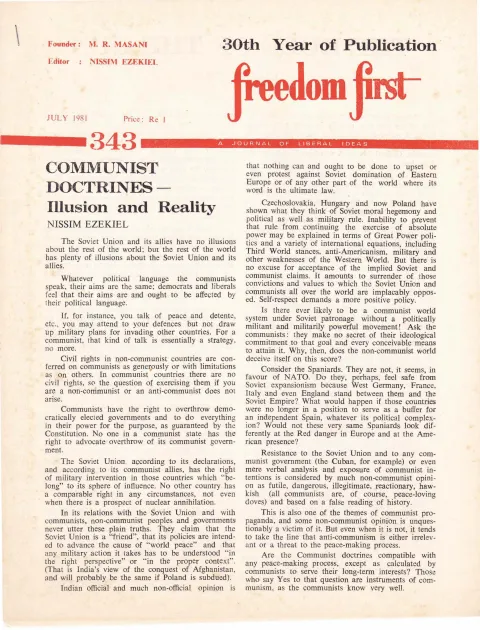
Communist Doctrines — Illusion and Reality
By NISSIM EZEKIEL
Nissim Ezekiel’s lead piece argues that the Soviet Union and its allies harbour no illusions about the non-communist world, while the West and India persistently delude themselves about Soviet intentions. He catalogues asymmetries: communists claim a right to intervene militarily in their ‘sphere of influence’ while granting no reciprocal right to others; they enjoy civil rights in free societies that they deny to dissidents at home; and Western and Indian opinion excuses Soviet actions in Afghanistan, Czechoslovakia, Hungary and Poland as needing to be understood ‘in context.’ He closes by challenging readers to say whether communist doctrines are compatible with any genuine peace process, concluding that those who answer yes are ‘instruments of communism.’
- Communists’ political language (peace, detente) is read by Ezekiel as strategic camouflage, not sincere policy.
- Democracies extend civil rights to communists that communist states deny to their own citizens.
- The USSR claims an unchallengeable right of intervention in its declared ‘sphere of influence.’
- Czechoslovakia, Hungary and Poland are cited as evidence that subject peoples reject Soviet ‘moral hegemony.’
- India’s official framing of the Soviet invasion of Afghanistan is cited as an example of self-deceiving euphemism.
- Spain’s position vis-a-vis NATO is used as a thought experiment about buffer-state complacency.
- The piece ends by branding non-communist accommodationism as itself an instrument of communist interests.
The Rule of the Gun
By RAHUL SINGH
Rahul Singh’s ‘The Rule of the Gun’ surveys a spate of political assassinations and terrorism around 1981 — the killing of Bangladesh’s President Zia-ur-Rahman, the Iranian parliament bombing, the shooting of Bani-Sadr’s government, and the attempts on President Reagan and the Pope — and asks what drives such violence. He distinguishes lone deranged assassins (citing Mark Chapman and John Hinckley) from organised terrorist movements (Palestinian groups, the IRA, Basque nationalists, Italy’s Red Brigades, West Germany’s Baader-Meinhof gang), arguing the latter have identifiable grievances even when their methods are indefensible. Turning to India, he judges the country ‘relatively free’ of such violence apart from dacoity, communalism and the spread of unlicensed guns in Bihar, and credits Indian democracy’s absorption of extremists (citing West Bengal’s Marxists and the DMK) with defusing radicalism, while warning that economic stagnation and corruption could still erode this stability and eventually test military restraint from politics.
- Assassination of Bangladesh’s President Zia-ur-Rahman by General Manzoor frames the essay’s opening.
- Reagan and the Pope’s 1981 shootings are cited as evidence that even stable Western democracies are vulnerable.
- The American gun lobby’s ‘guns don’t kill, people do’ motto is criticized as self-serving.
- South Korea’s assassination of President Park is used as a case study in how a single killing can unravel state stability.
- Organised terrorist groups (Palestinians, IRA, Basques, Red Brigades, Baader-Meinhof) are distinguished from lone deranged assassins.
- India is characterized as comparatively free of political violence, aside from dacoity, communalism, and the proliferation of unlicensed Bihar-made guns.
- Indian democracy’s absorption of former extremists (West Bengal Marxists, DMK) into moderate governance is presented as a stabilizing mechanism.
- The essay closes with a warning that economic stagnation and corruption could still destabilize India and test military non-intervention in politics.
Chavan: The Lost Leader
By S. S. BANKESHWAR
S. S. Bankeshwar attacks Y. B. Chavan’s decision to rejoin Congress(I) as rank opportunism dressed up as principle, mocking his description of the move as ‘Home Coming’ rather than defection. The essay recounts Chavan’s public vows only weeks earlier to hold the Congress flag aloft even if abandoned by all others, contrasts this with his abrupt reversal, and predicts he will be humiliated by Indira Gandhi’s inner circle and denied both cabinet rank and an assured Congress(I) ticket. Bankeshwar broadens the attack into a lament about the decline of Indian political leadership since the era of Tilak, Gandhi, Nehru, Rajaji and Bhagat Singh, coining the term ‘Chavanism’ for opportunistic fence-sitting, and calls for the political retirement of ageing leaders like Jagjivan Ram, Chavan and Charan Singh in favour of constructive social work.
- Chavan’s rejoining Congress(I) is framed as defection dressed up as reconciliation (‘Home Coming’).
- Bankeshwar quotes Chavan’s own recent vow to hold the Congress flag aloft even if left alone, to highlight the reversal’s hypocrisy.
- The essay predicts Chavan will be denied a cabinet post and possibly an electoral ticket by Congress(I) loyalists.
- Congress(I) is described as riven with infighting between post-1977 and post-1980 loyalist factions.
- The essay coins ‘Chavanism’ as a new term for opportunistic political fence-sitting, alongside references to Gerrymandering and Spoonerism.
- A broader lament contrasts contemporary politicians unfavourably with historic leaders like Tilak, Gandhi, Nehru, Rajaji, and Bhagat Singh.
- The piece calls for veteran politicians (Jagjivan Ram, Chavan, Charan Singh) to retire into constructive social work.
‘Live And Let Live’ — S. K. Patil’s Way
By M. R. Pai
M. R. Masani’s short tribute on the death of S. K. Patil recalls him as a patriot whose fierce love for Bombay dominated the city’s civic life for years, comparable to the era of Sir Pherozeshah Mehta. Masani praises Patil’s cosmopolitan devotion to Bombay, which led him to champion a bilingual state and, failing that, a separate city-state rather than allow partition of the city. Despite being Masani’s domestic political opponent within Congress in the pre-independence years, Patil is remembered as unusually tolerant and non-petty by Indian political standards, embodying a ‘Live and Let Live’ philosophy that Masani calls a rare liberal trait in Indian politics today.
- Patil is remembered as a patriot whose devotion to Bombay’s civic life was unmatched since Sir Pherozeshah Mehta’s day.
- Patil championed a bilingual Bombay state and, failing that, a separate City State, to avoid partition of Bombay.
- Masani notes Patil was his domestic political opponent within Congress in pre-independence days, yet was ‘grateful’ for his tolerance.
- Patil is praised as unusually free of pettiness and intolerance compared to most Indian politicians.
- Masani frames Patil’s ‘Live and Let Live’ outlook as a rare example of genuine liberalism in Indian politics.
”Friends of the Soviet Union” — A Comment
By SHAHABUDDIN M. AKHATAR
This unsigned-byline comment piece (signed Shahabuddin M. Akhatar) raises alarm over a proposed protocol between the Congress(I)-sponsored Friends of the Soviet Union (FSU) and the USSR’s Soviet India Friendship Society, drawing a parallel to the earlier CPI-linked Indo-Soviet Cultural Society, which the author claims enabled covert fund flows and Moscow travel. It singles out Professor Nurul Hasan, Vice-President of the Council of Scientific and Industrial Research, for signing the protocol despite governmental rules against officials joining politically sponsored bodies, and links him to Professor Moonis Raza’s alleged installation of Marxist sympathisers at Jawaharlal Nehru University. The piece calls on the Prime Minister to act against what it frames as systematic Communist subversion of India’s premier research institution.
- A new protocol between the Congress(I)-backed Friends of the Soviet Union and the USSR’s Soviet India Friendship Society is criticized as suspiciously timed.
- The piece draws a parallel to the earlier CPI-dominated Indo-Soviet Cultural Society, alleged to have enabled covert subversion.
- Professor Nurul Hasan, CSIR Vice-President, is criticized for signing the protocol despite rules against officials in politically sponsored bodies.
- Nurul Hasan is linked to Professor Moonis Raza’s alleged recruitment of CPI-affiliated faculty into Jawaharlal Nehru University.
- The piece claims at least 40 percent of some JNU faculty are connected to Raza or share his ‘Marxist Philosophy.’
- The author calls on the Prime Minister to intervene to protect the CSIR from Communist subversion.
Voices 2 — A Theatre Triumph
By INDU SARAIYA
A ‘Voices’ notice from the Aditya Vaanprasth Ashram, an organisation for retired people, describes its programmes: a proposed Indian Journal of Gerontology, a free pre-retirement advisory service staffed by already-retired volunteers, an emergency relief service organising local groups to help people in distress, and a project compiling, in collaboration with the Indian Merchants Chamber, a corrective record of Indian businessmen’s social welfare contributions to counter what it calls one-sided public criticism of business.
- The Aditya Vaanprasth Ashram plans an Indian Journal of Gerontology edited by C. P. Gupta.
- A free Pre-Retirement Advisory Service is run by already-retired volunteers who have faced similar problems.
- An Emergency Relief Service organises local groups of retired and younger people to assist people in distress.
- The organisation is compiling, with the Indian Merchants Chamber, a record of business houses’ social welfare work to counter one-sided criticism of businessmen.
The World of Books — review of ‘The Creation of Wealth’ by R. M. Lala
By K. S. VENKATESWARAN
Indu Saraiya reviews Theatre Group’s revival of Arthur Miller’s ‘Death of a Salesman,’ directed by and starring Alyque Padamsee as Willy Loman. She praises Padamsee’s portrayal of Willy’s inner torment as achieved ‘with astonishing ease,’ commends Vijay Crishna’s performance as Biff for capturing desperate, thwarted longing, and finds Dolly Thakore’s Linda slightly short of the emotional complexity Miller’s text demands. Farrokh Mehta’s Charley is singled out as ‘a masterpiece in miniature,’ and Ronnie Screwwalla’s Happy is called fluent, with a minor quibble about excess exuberance in the restaurant scene.
- The review covers Theatre Group’s revival of Arthur Miller’s ‘Death of a Salesman.’
- Alyque Padamsee’s Willy Loman is praised for achieving Miller’s ‘Certain Private Conversations’ with ease.
- Vijay Crishna as Biff is commended for conveying desperate longing but urged to vary his emotional pitch more.
- Dolly Thakore’s Linda is judged to fall slightly short in expressing compounded love, faith, and doubt.
- Farrokh Mehta’s Charley is called ‘a masterpiece in miniature’; Ronnie Screwwalla’s Happy is ‘fluent.’
- A minor criticism is raised about excess exuberance in the restaurant scene relative to the otherwise muted orchestration.
National Conference On Women’s Studies
By SUNAINA SINGH
K. S. Venkateswaran reviews R. M. Lala’s ‘The Creation of Wealth’ (IBH Publishing House, 1981), a House-of-Tata-commissioned history defending free enterprise against ‘redistributionist’ orthodoxy in India. The review praises the book for debunking claims of runaway Tata ‘bigness,’ citing figures showing Tata assets grew only 19% in real terms between 1972-77 once inflation is accounted for, and comparing Tata turnover favourably against General Motors and US Steel. It highlights JRD Tata’s 1979 memorandum to the Janata Party asserting that management control rests with an elected Board, not the Tata family, and closes by praising the book’s account of Tata labour-welfare innovations and philanthropic legacy, while acknowledging Lala’s proximity to the subject invites accusations of being an ‘official’ history.
- The book under review is R. M. Lala’s ‘The Creation of Wealth,’ IBH Publishing House, 1981, pp. 209, Rs. 45.
- The review frames Indian public discourse as gripped by a ‘collectivist fog’ hostile to free enterprise and ‘Big Business.’
- Tata assets grew only 19% in real (inflation-adjusted) terms between 1972-77, versus a nominal 66% figure often cited.
- General Motors’ turnover is cited as 150 times that of Telco; US Steel’s as 30 times that of Tata Steel.
- JRD Tata’s 1979 memorandum to the Janata Party’s National Executive is quoted stating management control rests with an elected Board, not the Tata family.
- TISCO ownership is noted as spread among 80,000 shareholders, with government institutions controlling 45% of voting power.
- The review praises Tata labour-welfare innovations dating to Jamsetji Tata, including an eight-hour day, provident fund, and maternity benefit.
- The reviewer acknowledges the book’s official sponsorship invites suspicion but argues its documentation still serves a valuable public purpose.
Letter to the Editor (euthanasia / ‘mercy killing’)
By A. SOLOMON
A multi-signatory public statement, ‘Our Population Explosion,’ warns that India’s population (given as around 686 million) threatens national stability and that recent slackening in family planning efforts risks reversing earlier gains. It calls for a package of social and economic development, well-structured health measures, and a national consensus above partisan politics to combine population control with family welfare in the forthcoming Sixth Plan. The statement carries a long list of signatories spanning politicians, industrialists, scientists, and cultural figures, and is followed by a short notice on the R. D. Karve Birth Centenary honouring the pioneer of family planning in India, organised by several rationalist and secular societies.
- India’s population is put at approximately 686 million, with nearly half living in abject poverty.
- Only a little over a fifth of 113 million eligible couples are currently effectively covered by family planning.
- The statement calls for combining population control and family welfare within a development strategy targeting the poor, in the new Sixth Plan.
- It urges a ‘minimal national consensus, above partisan politics’ on family planning and welfare.
- The signatory list spans politicians (Charan Singh, Devraj Urs, Vajpayee), industrialists (JRD Tata), scientists, and cultural figures.
- A companion piece marks the R. D. Karve Birth Centenary, honouring Karve as a pioneer of family planning and rationalism in India, with a centenary committee chaired by Prabhakar Padhye and organised jointly by several rationalist and secular societies.
Consumer Centre Inaugurated
By MANUBHAI SHAH, Managing Trustee
A short notice announces the R. D. Karve Birth Centenary, honouring Prof. R. D. Karve as a pioneer of family planning and rationalism in Maharashtra, noting that his name went unmentioned for most of the centenary year (beginning 14 January 1981) until several rationalist and secular societies formed a centenary committee to organise lectures, seminars, and a planned English biography and selection of his writings edited by Professor Y. D. Phadke.
- R. D. Karve is described as a pioneer of family planning in India and a leading rationalist after Gopal Ganesh Agarkar.
- Karve’s monthly Samaj Swasthya and his Bombay family planning clinic are cited as evidence of his lifelong mission.
- The centenary year began 14 January 1981; a committee was formed by the Indian Secular Society and allied bodies to mark it.
- Planned centenary activities include lectures/seminars in Bombay, Pune, and Aurangabad, and an English biography and selection of Karve’s writings edited by Professor Y. D. Phadke.
- A separate Marathi biography by Phadke has been independently commissioned by H. V. Mote Prakashan.
Essay 11
Sunaina Singh reports on a National Conference on Women’s Studies held at SNDT University, describing it as deliberately ‘national’ rather than ‘All-India’ since women’s education is framed as a national, not exclusively feminine, concern. UGC Chairman Mrs. Madhuri Shah and SNDT Vice-Chancellor Mrs. Jyoti Trivedi both called for structural change in attitudes and curricula; the conference recommended new courses across History, Political Science, Legal Studies and Psychology addressing women’s status, but the report notes it left unaddressed reforms at primary/secondary levels and questions of syllabus design authority. A following letter to the editor references M. R. Masani’s proposal for a ‘Society for the Right to Die with Dignity’ and criticises the term ‘mercy killing’ as prejudicial framing of voluntary euthanasia.
- The conference at SNDT University was deliberately framed as ‘National’ rather than ‘All-India’ since women’s education is a national concern.
- UGC Chairman Mrs. Madhuri Shah’s keynote called for addressing women’s ‘shackled’ position of inequality and exclusion from development.
- SNDT Vice-Chancellor Mrs. Jyoti Trivedi urged basic change in the attitudes of men holding power and policymaking roles.
- New recommended courses spanned History (Women in the Russian Revolution, Social History of Women in India), Political Science, Legal Studies (rape, dowry, property law reform), and Psychology.
- The report flags that the conference did not address needed reforms at the primary and secondary education levels, nor who should design the new syllabus.
- A subsequent letter to the editor (A. Solomon) references M. R. Masani’s proposal for a ‘Society for the Right to Die with Dignity’ and objects to the term ‘mercy killing’ as biasing public perception against voluntary euthanasia.
Essay 12
A Sarvodaya Press Service report alleges that Bhagalpur police responsible for blinding numerous under-trial prisoners are being financially supported by local business magnates, who reportedly donated Rs. 5 lakhs toward the police’s legal defence, and notes the Bihar Chief Minister publicly praised the police on a recent visit. It describes eyewitness accounts gathered by a Citizens’ Freedom League film team, including the killing of Brahmadeo Mahato and the blinding of Raman Bind, and criticises the Government of India for denying British filmmakers permission to document the blindings, framing continued suppression as backfiring into greater publicity.
- Business magnates and moneyed interests reportedly donated Rs. 5 lakhs to Bhagalpur police for litigation costs related to the blindings.
- The Bihar Chief Minister is reported to have praised the police during a visit to Bhagalpur, drawing public surprise.
- A Citizens’ Freedom League film team documented testimony from blinded prisoners and villagers in the Shahkund sub-division.
- Specific cases cited include the killing of Shri Brahmadeo Mahato and the blinding of Shri Raman Bind, then undergoing treatment in Aligarh.
- The Government of India is criticized for refusing British filmmakers permission to portray the Bhagalpur blindings.
- The report argues that government suppression is backfiring, drawing more publicity to the scandal.
Essay 13
A short organisational notice describes the newly launched Sarvodaya Press Service (SPS), a Sarvodaya-activist-run news and features agency aimed at covering rural India and neighbouring countries (Afghanistan, Bangladesh, Bhutan, Burma, India, Nepal, Pakistan, Sri Lanka) for a press otherwise poorly served by rural correspondents. It outlines subscription pricing, plans for an annual yearbook on agrarian youth, students, workers and women’s movements from 1981, and frames its mission as bridging the communication gap between remote rural regions and the urban press.
- Sarvodaya Press Service (SPS) is a new feature agency run by Sarvodaya activists to cover under-reported rural news.
- SPS covers Afghanistan, Bangladesh, Bhutan, Burma, India, Nepal, Pakistan, and Sri Lanka.
- Services are priced at Rs. 500 annually for non-exclusive access and Rs. 250 per exclusive dispatch.
- SPS plans an annual yearbook from 1981 covering agrarian youth, students, workers, and women’s movements.
- The notice frames rural India’s isolation as a communication-gap problem, not merely a terrain problem.
Essay 14
Manubhai Shah, Managing Trustee, reports on the inauguration of a new Consumer Centre by the Consumer Education and Research Centre (CERC), Ahmedabad, following a settlement of a repudiated LIC death claim. He details the Centre’s staffing, facilities (including a planned milk and edible-oil testing laboratory, a large library, and imported book holdings costing about a lakh of rupees), and its funding history, then recounts CERC’s litigation record against LIC, the Gujarat State Road Transport Corporation, the Gujarat Electricity Board, Ahmedabad Telephones, and Indian Airlines, including a landmark Gujarat High Court ruling on the right of reply. The piece closes by announcing CERC’s own forthcoming monthly periodicals, Consumer Confrontation (English) and Grahak Suraksha (Gujarati).
- The new Consumer Centre was inaugurated following the settlement of a repudiated Rs. 5,000 LIC death claim.
- CERC’s Centre has nine full-time staff, a 1900 sq. ft. facility, and is setting up a testing laboratory for milk and edible oil.
- Its library subscribes to 80 journals from the USA, Canada, Australia, UK, Malaysia and elsewhere.
- CERC’s funding history includes an initial Rs. 250 corpus in 1978, growing to Rs. 6.50 lakhs collected and Rs. 4.25 lakhs spent in 1980-81, with the Gujarat Government alone contributing Rs. 1,15,000.
- CERC has litigated against LIC, Gujarat State Road Transport Corporation, Gujarat Electricity Board, Ahmedabad Telephones, and Indian Airlines.
- A landmark Gujarat High Court decision (under appeal to the Supreme Court) directed LIC to publish a reply by Prof. Manubhai Shah in its journal Yogakshema.
- CERC is launching its own monthly periodicals: Consumer Confrontation (English) and Grahak Suraksha (Gujarati).
Essay 15
An institutional profile introduces the Maratha Mandir, Bombay, describing its nine constituent organisations dedicated to spreading education and combating religious and caste bigotry, poverty and ignorance across seven schools in Bombay and Sholapur. It details the Mandir’s programmes for women (Vanita Vishwa’s Home Science, tailoring and dance classes), cultural promotion (Kala Kendra), healthcare (Arogya Kendra with free family planning services), social work training (Pragati Sangh), and employment assistance for the destitute (Bekari Nirodhan Sangh), presenting the Mandir as a broad civic and welfare institution serving Bombay’s lower-middle and working classes.
- The Maratha Mandir runs nine organisations and seven schools in Bombay and Sholapur serving about 5,000 students across all castes and communities.
- Vanita Vishwa, the women’s branch, runs Home Science, tailoring, and dance (Kathak, Manipuri) classes for women.
- Kala Kendra promotes Marathi-stage singers and actors and has awarded over Rs. 20,000 in competition prizes over ten years.
- Arogya Kendra provides free consultation in gynaecology, ENT, orthopaedic surgery and cardiology, alongside a Family Planning Centre.
- Pragati Sangh trains social workers, conducts seminars, and runs a book bank.
- Bekari Nirodhan Sangh assists destitute men and women on the premise that work is a fundamental right, and provides famine/flood relief.
Generated by the v1.5 extraction pipeline. Awaiting editorial review.
Metadata and summary are AI-extracted from the source PDF and reviewed for editorial accuracy. The original work is available via the Read PDF tab above (where present); paragraph-level citation inside the PDF is deferred to a future engagement.