periodical issue
Freedom First
A Journal of Liberal Ideas
By NISSIM EZEKIEL, K. S. VENKATESWARAN, RAMA SWARUP, RASHMI TANEJA, GEETA DOCTOR, K. V. PADMANABHAN, SANDHYA HARIHARAN, N.I. in The Radical Humanist, Jan. 1982
Published for the Democratic Research Service by J. R. Patel, Associate Editor, Freedom First at 127, Mahatma Gandhi Road, Bombay 400023 (Phone: 273914) and Printed by him at Commercial Printers & Stationers, 525 S. B. Marg, Dadar, Bombay-400 028. · Bombay · 1982
16 pages
Freedom First
Summary
Freedom First issue 349 (February/March 1982) is a monthly issue of the Bombay-based liberal journal, in its 30th year of publication, founded by M. R. Masani and edited by Nissim Ezekiel. The issue opens with Ezekiel’s own editorial lambasting Maharashtra’s Chief Minister Babasaheb Bhosale and his predecessor A. R. Antulay as symptomatic of a broader decay of political seriousness in the state. It continues with K. S. Venkateswaran’s regular “A Variety of Comment” column (on Reagan and Third World aid, the Bombay High Court’s verdict against Antulay, and Western sanctions over Poland and South Africa), Rama Swarup on Soviet and Chinese disinformation strategies against the U.S., and Rashmi Taneja’s report on martial-law Turkey under General Kenan Evren. The book review section, “The World of Books,” covers Minoo Masani’s memoir Against the Tide, Dhananjay Keer’s biography of B. R. Ambedkar, and a collection of Khushwant Singh’s editorials. Two shorter pieces reprinted from other publications close out the substantive content: a critique of Satya Sai Baba’s controversially awarded “Deemed University” status (from The Radical Humanist) and a sardonic editorial on the Supreme Court’s Judges Case ruling and its implications for judicial independence (from OPINION).
Key points
-
Nissim Ezekiel’s “A Chief Minister as Clown” argues Maharashtra’s Babasaheb Bhosale and his predecessor A. R. Antulay reveal usually concealed Indian political attitudes, citing Bhosale’s public deification of Indira Gandhi as a goddess.
-
K. S. Venkateswaran’s “A Variety of Comment” defends Reagan’s Cancun message on aid self-sufficiency, praises the Bombay High Court’s ruling against Antulay as proof of judicial independence, and calls Western sanctions on Poland symbolically warranted despite socialist-bloc hypocrisy on the issue.
-
Rama Swarup’s “Red Disinformation” argues the US has fallen behind Soviet and Chinese propaganda efforts, describing a two-pronged Soviet campaign on NATO missile deployment and a Chinese campaign offering an illusory anti-Soviet partnership.
-
Rashmi Taneja’s “Turkey in Turmoil” surveys Turkey seventeen months after the 1980 military coup, crediting Finance Minister Turgut Ozal’s reforms with falling inflation while noting tens of thousands detained and dozens of death sentences.
-
Book reviews cover Minoo Masani’s memoir Against the Tide, dwelling on his adversarial relationship with Nehru and the Swatantra Party’s rise and decline, and Dhananjay Keer’s biography of B. R. Ambedkar, recounting his campaigns against untouchability and 1956 conversion to Buddhism.
-
A reprinted piece from The Radical Humanist criticises the UGC’s grant of “Deemed University” status to Satya Sai Baba’s college at Puttaparthi as an abdication of secular, scientific standards.
-
A reprinted OPINION editorial condemns the Supreme Court’s Judges Case ruling as a “gift” to Mrs. Gandhi establishing executive supremacy over the judiciary.
Essays
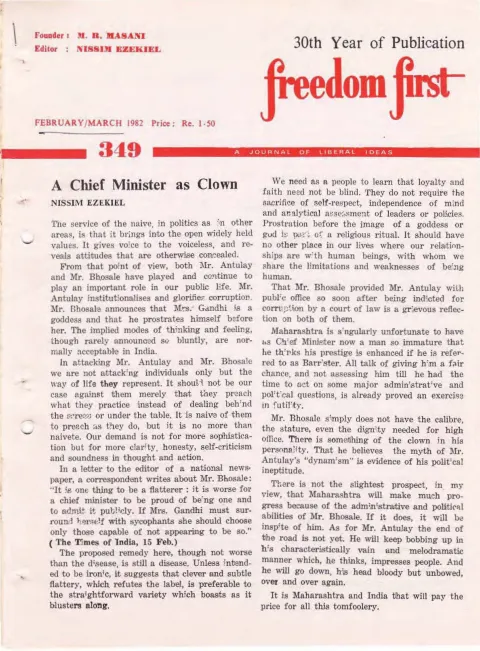
A Chief Minister as Clown
By NISSIM EZEKIEL
In this editorial, Nissim Ezekiel argues that Maharashtra Chief Minister Babasaheb Bhosale and his corruption-tainted predecessor A. R. Antulay are useful precisely because their naivety exposes attitudes usually concealed in Indian public life: Antulay’s institutionalisation and glorification of corruption, and Bhosale’s public deification of Indira Gandhi as a goddess before whom he prostrates himself. Ezekiel insists the objection is not that these men fail to practice what they preach, but that Indian public culture too readily accepts flattery, blind loyalty, and uncritical deference to leaders as normal. He concludes that Bhosale lacks the calibre, stature, and dignity required of high office, calling him “something of the clown,” and predicts continuing political and administrative drift in Maharashtra under both men.
- Ezekiel frames Antulay and Bhosale as revealing widely-held but usually concealed Indian political attitudes, not as isolated bad actors.
- Bhosale’s public claim that Indira Gandhi is a goddess before whom he prostrates himself is cited as evidence of his political immaturity.
- Antulay is described as having institutionalised and glorified corruption in public office.
- A Times of India letter-writer’s proposed remedy (surrounding Mrs. Gandhi only with subtler flatterers) is itself criticised as no real remedy.
- Ezekiel predicts no administrative progress in Maharashtra under Bhosale and expects Antulay to continue seeking a political comeback.
A Variety of Comment (1. The Limits of Aid; 2. Antulay and the Law; 3. American Sanctions)
By K. S. VENKATESWARAN
K. S. Venkateswaran’s regular column offers three short items of comment. The first defends Ronald Reagan’s blunt message at the Cancun summit that no amount of foreign aid can substitute for a nation putting its own economic house in order, framing this as an unfashionable but valid point against Third World economic mismanagement and centralised planning. The second praises the Bombay High Court’s judgment against Antulay as demonstrating the value of a fearless judiciary and establishing that an ordinary citizen can hold even powerful officeholders to account. The third turns to American sanctions on Poland following martial law, noting the irony of socialist-camp countries objecting to sanctions they themselves demand against South Africa and Israel, and arguing that despite the practical ineffectiveness of sanctions in general, endorsing at least the symbolic value of the American response to Poland is warranted.
- Reagan’s Cancun remarks on aid are defended as candid rather than as Western insensitivity, stressing individual initiative and open markets over state planning.
- The Bombay High Court’s ruling against Antulay is presented as proof that judicial independence and citizen action can check abuse of public office.
- Locus standi in the Antulay case is highlighted as a significant win even though the underlying petition was dismissed on merits.
- Socialist-bloc criticism of American sanctions on Poland is called hypocritical given those countries’ own support for sanctions against South Africa and Israel.
- The column questions whether sanctions of any kind (against Poland or South Africa) produce real benefit for the populations they target.
Red Disinformation
By RAMA SWARUP
Rama Swarup argues that the United States has fallen badly behind the Soviet Union and China in the propaganda and “disinformation” war. Citing the director of the U.S. International Communications Agency, the piece describes a two-pronged Soviet disinformation campaign portraying Europeans as peace-loving and Americans as warmongers over missile deployments, and a parallel Chinese campaign offering the U.S. an illusory anti-Soviet partnership while giving nothing on Taiwan. The author calls for the U.S. to mount a vigorous counter-disinformation campaign and expresses cautious hope that Reagan, unlike Carter, will not be as easily played by Beijing.
- Communist states are described as unencumbered by truth or pledges, giving them an advantage in propaganda warfare.
- Soviet disinformation among Europeans casts NATO’s Pershing/cruise missile deployment as provocative while downplaying Soviet military buildup.
- China is accused of running a disinformation campaign suggesting cooperation against the USSR while giving no real concessions on Taiwan.
- The U.S. International Communications Agency (successor to USIS) and its “Dateline America” project are cited as the main U.S. counter-propaganda vehicles.
- The author calls for aggressive, persuasive U.S. counter-disinformation rather than passive fact-based responses.
Turkey in Turmoil
By RASHMI TANEJA
Rashmi Taneja surveys Turkey seventeen months after the September 1980 military coup led by General Kenan Evren. She describes a country still under martial law, with tens of thousands detained, dozens of death sentences, and continuing restrictions on trade unions and political parties, but notes that the military regime enjoys majority public support because it ended the civil-war-like violence of the late 1970s between left- and right-wing extremists. The piece credits Finance Minister Turgut Ozal’s economic reforms, adopted by the junta, with a partial recovery (falling inflation, rising exports), though experts doubt its durability. Taneja closes by describing a slow build-up of dissent among politicians, journalists, and academics, and notes NATO’s and the U.S.’s continued strategic and financial support for the regime despite its human-rights record.
- 40,000 detained and roughly 30,000 indicted since the coup; 85 death sentences passed, 11 carried out; torture reported in jails.
- Public support for the junta is attributed to relief after years of gang warfare between left- and right-wing extremists that killed 5,000 in 1980 alone.
- Finance Minister Turgut Ozal’s economic measures (adopted by the military government) are credited with falling inflation (120% in 1980 down to 40%) and a 55% rise in exports in 1981.
- The National Security Council, headed by General Kenan Evren, disbanded all 18 political parties on October 16 and formed a handpicked consultative assembly to draft a new constitution.
- Former PM Bulent Ecevit received a 3-month jail term for publicly censuring the regime; journalists and academics also face restrictions.
- The U.S. has pledged $900 million in military and economic aid for 1982, and Turkey’s strategic value to NATO has grown given Greece’s new anti-NATO government under Andreas Papandreou.
The World of Books: Look Back With Candour (review of ‘Against the Tide’ by Minoo Masani)
By GEETA DOCTOR
In the “World of Books” section, Geeta Doctor reviews Minoo Masani’s memoir Against the Tide, the sequel to his earlier Bliss Was It in That Dawn, covering the decades since independence. She describes the book’s device of inviting readers to imagine alternate historical choices, and praises Masani’s clarity, wit, and unwavering liberal conviction even while acknowledging its self-justificatory tone. The review dwells at length on Masani’s complicated, often adversarial relationship with Nehru, on his account of the Swatantra Party’s rise and decline (including his dedication to “the memory of Rajaji, the great dissenter”), and on Masani’s definition of “Swatantra” as self-propelled, self-determined freedom rather than mere absence of restraint.
- Against the Tide is the sequel to Masani’s Bliss Was It in That Dawn, covering roughly forty years since independence.
- The book uses a ‘choose your own path’ narrative device, inviting readers to consider alternate courses history might have taken.
- Masani is praised as a leader who gave voice, meaning, and character to the idea of a parliamentary Opposition.
- The review highlights Masani’s account of Nehru’s ambivalence — democrat in mind, autocrat in action — as the central indictment of the book.
- Masani’s account of the Swatantra Party’s formation, growth, and decline is discussed, including his dedication of the book to Rajaji, ‘the great dissenter.‘
The World of Books: review of ‘Dr. Ambedkar: Life and Mission’ by Dhananjay Keer
By K. V. PADMANABHAN
K. V. Padmanabhan reviews Dhananjay Keer’s biography Dr. Ambedkar: Life and Mission, drawing on his own recollection of working with Ambedkar during his tenure as Law Minister and Chairman of the Constituent Assembly’s Drafting Committee. The review recounts Ambedkar’s childhood humiliations as a Mahar in the Konkan, his education abroad under the patronage of the Maharaja of Baroda, his rise to become a formidable legal and political figure, and his lifelong campaign against untouchability including temple-entry and well-access movements, culminating in his conversion to Buddhism at Nagpur in 1956. Padmanabhan calls the biography a fair and truthful study of continuing relevance to contemporary debates over the ‘Harijan issue.’
- Ambedkar was born into a Mahar (untouchable) family in the Konkan region and endured humiliations including being denied drinking water as a child.
- The Maharaja of Baroda, Sayaji Rao, sponsored Ambedkar’s higher studies in the U.S. and U.K., enabling his rise as a scholar and lawyer.
- Padmanabhan recalls working closely with Ambedkar while he was Law Minister and Chairman of the Constituent Assembly’s Drafting Committee.
- The biography details Ambedkar’s campaigns for temple entry, access to tanks and wells for Harijans, and education, against orthodox opposition.
- Ambedkar’s conversion to Buddhism at Nagpur on 14 October 1956 is presented as an act of defiance against his inability to eliminate untouchability from Hindu society.
The World of Books: review of Khushwant Singh’s Editor’s Page
By SANDHYA HARIHARAN
Sandhya Hariharan reviews a collection of Khushwant Singh’s editorials from The Illustrated Weekly and Sunday, titled Khushwant Singh’s Editor’s Page. She praises Singh’s versatile, caustic, and irreverent prose, particularly his profiles of eminent personalities, singling out his mixed but admiring portrait of V. K. Krishna Menon. The review highlights Singh’s concern for the poor without condescension and his sharp aphoristic style, quoting his line that ‘Vitriol makes better ink than honey.’
- The reviewed book collects Khushwant Singh’s editorials from The Illustrated Weekly and Sunday (India Book House, Rs. 12).
- Hariharan singles out Singh’s personality profiles as the strongest material in the collection.
- Singh’s piece on Krishna Menon is cited as an example of criticism balanced with grudging admiration.
- The review notes Singh’s discomfort with charity to beggars and his self-described ‘complex about whites.‘
Satya Saibaba’s “Deemed” University
By N.I. in The Radical Humanist, Jan. 1982
This reprinted piece (originally from The Radical Humanist, January 1982) criticises the Indian University Grants Commission’s decision to grant “Deemed University” status to Satya Sai Baba’s three-year-old degree college at Puttaparthi, Andhra Pradesh, without the college first establishing a post-graduate program as is normally required. The author, identified only as “N.I.”, notes that Chief Justice Y. V. Chandrachud inaugurated the institution and publicly praised its claim to impart “integral education,” and criticises the UGC chairman’s and Chandrachud’s remarks as an abdication of secular, scientific standards in favour of religious sentiment, warning that other religious organisations will now demand similar university status for their own institutions.
- Satya Sai Baba’s degree college at Puttaparthi was declared a ‘Deemed University’ on 20 November 1981, reportedly the first degree college to gain this status without a postgraduate college.
- Chief Justice Y. V. Chandrachud inaugurated the deemed university and praised its ‘integral education’ concept.
- UGC Chairman Dr. Mrs. Madhuri Shah is described as having gone out of her way to grant this recognition.
- The Andhra Pradesh state education minister and department were not consulted or invited to the inauguration.
- The author warns that Anand Marg, Jamat-e-Islami, Christian missionary groups, and others may now demand similar university status for their own institutions.
- The piece argues Hinduism, spiritualism, and yoga already permeate Indian life and that religious institutions have failed to solve the country’s real problems, which require the scientific spirit.
A Gift for Mrs. Gandhi
By OPINION, Jan 5, 1982
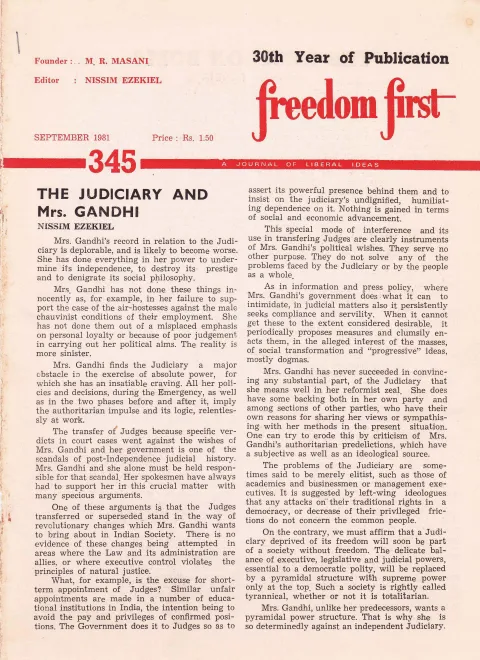
Reprinted from OPINION (5 January 1982), this sardonic editorial condemns the Supreme Court’s ruling in the Judges Case as a ‘gift’ to Mrs. Gandhi that establishes executive supremacy over the judiciary. It argues the ruling makes the Law Minister the effective arbiter of judges’ transfers and fates, reducing judicial independence to a fiction and leaving judges as, at best, ‘a lion beneath the throne.’ The piece closes with a defiant but mournful affirmation that the spirit of freedom, though battered, remains unconquerable.
- The piece frames the Supreme Court’s ruling in the ‘Judges Case’ as establishing the Executive’s supremacy over the Judiciary.
- It argues the Law Minister effectively becomes arbiter of a judge’s fate through the power of transfer.
- The editorial predicts the distinction between an independent judge and an ordinary obedient government servant will progressively disappear.
- It closes with an appeal to the unconquerable spirit of man despite the apparent triumph of executive power over judicial independence.
Generated by the v1.5 extraction pipeline. Awaiting editorial review.
Metadata and summary are AI-extracted from the source PDF and reviewed for editorial accuracy. The original work is available via the Read PDF tab above (where present); paragraph-level citation inside the PDF is deferred to a future engagement.