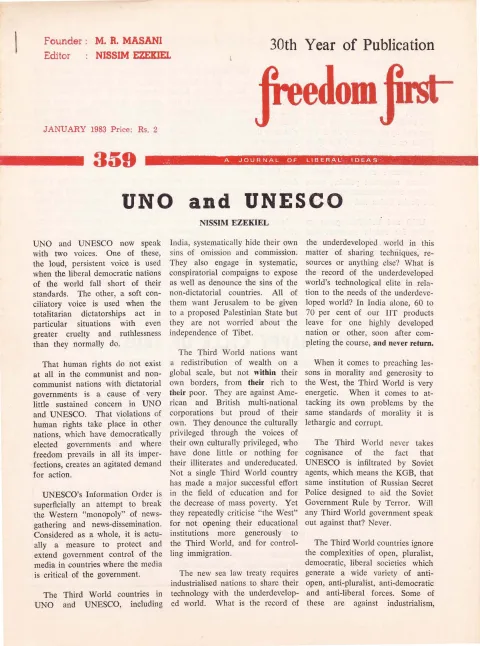
periodical issue
Freedom First
A Journal of Liberal Ideas
By Sumant Bankeshwar, K. S. Venkateswaran, Nirmala Joshi, Bhuchung K. Tsering, Nissim Ezekiel, K. S. Venkateswaran
Published for the Democratic Research Service by J. R. Patel, Associate Editor, Freedom First at 127, Mahatma Gandhi Road, Bombay 400 023 (Phone: 273914) and Printed by him at The Popular Press (Bom.) Pvt. Ltd., 35C Tardeo Road, Bombay 400 034 · Bombay · 1982
16 pages
Freedom First
Summary
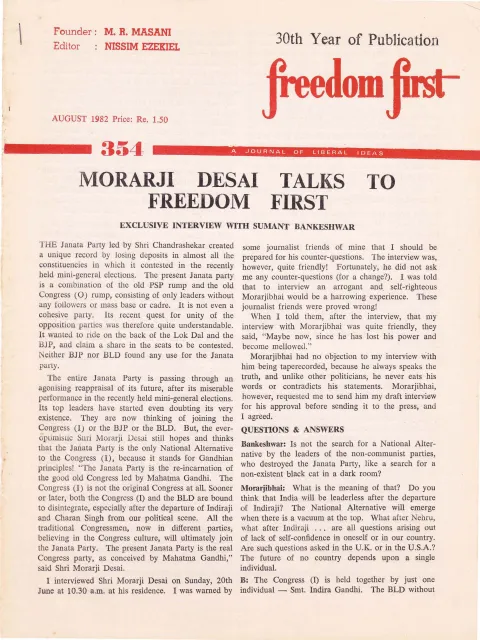
This is issue No. 354 of Freedom First (August 1982, Rs. 1.50), the Bombay-based monthly journal of liberal ideas founded by M. R. Masani and edited by Nissim Ezekiel, marking its 30th year of publication. The issue leads with an exclusive interview in which former Prime Minister Morarji Desai defends the Janata Party’s Gandhian credentials, dismisses talk of a ‘National Alternative’ realignment as premature, and offers combative views on Pakistan, Israel, democracy in Islamic countries, and the political scene after Indira Gandhi and Charan Singh. The remaining pages cover Soviet unease over an India-Pakistan No-War Pact, an uncertain new round of Tibetan-Chinese ‘bureau’ diplomacy, Nissim Ezekiel’s defence of Israel’s 1982 invasion of Lebanon against the PLO, a review of Shashi Tharoor’s book on Indira Gandhi-era foreign policy, a topical comment column on Lord Denning’s retirement and spurious drugs in India, and the regular ‘With Many Voices’ quotations feature.
Key points
-
In an exclusive interview, Morarji Desai defends the Janata Party as the true “National Alternative” and Gandhian heir to Congress, argues democracy has failed in Pakistan and Bangladesh because Islam is a “dictatorial religion,” and rejects a proposed India-Pakistan No-War Pact.
-
K. S. Venkateswaran’s “A Variety of Comment” criticises Lord Denning’s forced retirement as a capitulation to public bias and argues India’s plan to abolish pharmaceutical brand names for generic prescribing will worsen, not solve, the spurious-drugs problem.
-
Nirmala Joshi’s “Moscow-Islamabad-New Delhi” details Soviet objections to India-Pakistan normalisation, fearing it would downgrade the 1971 Indo-Soviet Treaty and free Pakistan to act against Baluchis, Pathans and Afghanistan.
-
Bhuchung K. Tsering’s “Sino-Tibetan Relations” surveys secretive delegation diplomacy between the Tibetan government-in-exile and China, culminating in a 1982 Beijing visit and a Chinese offer to let Tibetans open a “Bureau” there.
-
Nissim Ezekiel’s “The War in Lebanon” defends Israel’s 1982 invasion as aimed at restoring Lebanese sovereignty rather than conquest, contrasting Israeli internal debate with the PLO’s declared aim of destroying Israel.
-
A review of Shashi Tharoor’s Reasons of State endorses its account of Indian foreign policy as incoherent and rooted in contradictory Nehru-era ideological premises.
Essays
Morarji Desai Talks to Freedom First (Exclusive Interview with Sumant Bankeshwar)
By Sumant Bankeshwar
Sumant Bankeshwar’s exclusive interview with Morarji Desai, conducted at Desai’s residence on 20 June, opens the issue. Desai argues that the post-1977 Janata Party split has left it a rump of leaders without cadre, yet still insists the Janata Party is the true ‘National Alternative’ and the ‘re-incarnation’ of Mahatma Gandhi’s Congress, since Congress (I) and the BLD are bound to disintegrate once Indira Gandhi and Charan Singh leave the scene. He defends bringing Charan Singh back into his cabinet as a decision forced by unanimous cabinet advice, criticizes Haryana’s MLAs as being ‘for sale,’ and argues democracy is ‘in India’s blood’ but has failed in Pakistan and Bangladesh because Islam is inherently dictatorial, while dismissing Pakistan’s F-16 acquisition and nuclear ambitions as no threat. He also rejects a proposed India-Pakistan No-War Pact as meaningless and accuses Indira Gandhi of being unduly influenced by the USSR. The interview closes with Desai contrasting India’s historic freedom leaders (Tilak, Gokhale, Gandhi, Nehru, Patel, Subhas Chandra Bose, Lala Lajpat Rai, Savarkar, Bhagat Singh, Udham Singh, Madanlal Dhingra, the Chapekar brothers) with what he calls the venal, defection-prone politicians of the present day.
- Desai calls the post-split Janata Party a leadership-only rump but still the sole genuine ‘National Alternative’ to Congress (I)
- He frames the Janata Party as the true ideological heir of Mahatma Gandhi’s Congress
- He defends readmitting Charan Singh to his cabinet as a decision he personally opposed but accepted under unanimous cabinet pressure
- He argues democracy has failed in Pakistan and Bangladesh because Islam is a ‘dictatorial religion,’ contrasting this with democracy’s survival in Christian Europe/America and even Israel
- He dismisses the F-16 and Pakistani nuclear developments as non-threats and rejects a proposed No-War Pact as unnecessary between India and Pakistan
- He accuses Indira Gandhi of USSR-driven foreign policy
- He contrasts pre-independence leaders with contemporary politicians he characterizes as defectors (‘Ayarams and Gayarams’)
A Variety of Comment (1. Lord Denning; 2. Spurious Drugs)
By K. S. Venkateswaran
K. S. Venkateswaran’s regular ‘A Variety of Comment’ column covers two topics: Lord Denning’s forced retirement from the English bench following controversy over his book ‘What Next in the Law?’, which the columnist frames as a troubling capitulation to public bias against a celebrated jurist; and the Indian government’s plan to abolish pharmaceutical brand names in favour of generic prescribing, which the column argues is an ideologically driven, counterproductive move that will invite an influx of poor-quality generic drugs without lowering prices, given existing multi-tier price controls. A short filler item reports a Soviet official blaming ‘huge losses’ of petrol on carelessness, theft, and administrative disorganization.
- Criticizes the campaign that forced Lord Denning’s retirement as a victory for public bias over freedom of expression
- Calls the Indian government’s plan to abolish pharmaceutical brand names an ideologically driven and counterproductive policy
- Argues generic-only prescribing will not lower drug prices because of existing multi-tier price controls, and will worsen the problem of spurious drugs
- Notes a Soviet official’s admission that petrol losses stem from carelessness, theft, and poor labour organization
Moscow-Islamabad-New Delhi
By Nirmala Joshi
Nirmala Joshi’s article examines Soviet anxiety over prospective India-Pakistan normalization, whether through Pakistan’s proposed No-War Pact or India’s counter-proposal of a Treaty of Friendship and Peace. Drawing on discussions with Soviet Indologists in Moscow, Joshi lays out Soviet objections: skepticism about Pakistani sincerity given its alignment with the US-China ‘Strategic Consensus,’ concern that a friendship treaty would downgrade the 1971 Indo-Soviet Treaty, and fear that a settled Pakistan would be freer to act against Baluchis, Pathans, and Afghanistan. She argues the Soviets view South Asia through a superpower lens and stand to lose both strategic leverage and arms sales if India-Pakistan tensions ease, while India increasingly rejects viewing regional developments through that Soviet prism.
- Soviet Indologists argued against both a No-War Pact and a Treaty of Friendship and Peace between India and Pakistan
- Soviets view Pakistan’s No-War Pact offer as insincere, aimed at persuading the US Congress of Pakistan’s peaceableness to secure F-16 military assistance
- A friendship treaty is seen by Moscow as automatically downgrading the 1971 Indo-Soviet Treaty of Peace, Friendship and Co-operation
- Moscow fears a Pakistan free from tension with India could act more forcefully regarding Baluchis, Pathans, and Afghanistan
- Normalization would reduce India’s reliance on Soviet arms, cutting into Soviet strategic and commercial interests
- India is moving away from viewing regional developments through a Soviet-defined superpower lens
Sino-Tibetan Relations - A New Turn
By Bhuchung K. Tsering
Bhuchung K. Tsering surveys the on-again, off-again ‘delegation diplomacy’ between the Tibetan government-in-exile and China since 1979, culminating in a high-ranking Tibetan delegation’s April 1982 visit to Beijing and a Chinese press note offering to let the Tibetans open a ‘Bureau’ there. Tsering criticizes the secrecy surrounding these negotiations on both the Tibetan and Chinese sides, reviews the history of earlier Tibet-related offices in China (some dating to the 1930s-50s), and speculates that the new Bureau might end up with a status no better than India’s own unofficial Bureau for Tibetans in Delhi. He calls on the Tibetan administration in Dharamsala to disclose the facts of these negotiations to the exile community rather than keeping them as ‘state secrets.’
- Traces a series of Tibetan delegations to China/Tibet since 1979, several cut short or shrouded in secrecy
- Reports the April 1982 visit of three senior Tibetan officials to Beijing and China’s offer to allow a Tibetan ‘Bureau’ there
- Notes that neither the Tibetan Kashag nor Chinese officials have confirmed details, fueling speculation
- Reviews historical precedents for Tibetan offices in China dating to the 1930s-1950s
- Speculates the new Bureau might receive a status resembling Sikkim House or Arunachal Bhavan rather than genuine diplomatic recognition
- Calls for the Tibetan government-in-exile to be transparent with its own people about the negotiations
The War in Lebanon
By Nissim Ezekiel
In this signed editorial-style piece, Nissim Ezekiel mounts a defence of Israel’s June 1982 invasion of Lebanon, arguing it aims at restoring Lebanese sovereignty rather than conquest, and was welcomed by many Lebanese who saw it as liberation from PLO tyranny. He contrasts Israeli policy, which he says an open society freely debates and criticizes, with the PLO’s stated aim of destroying Israel and its practice of killing Palestinian moderates, and with Syria’s mass killing of its own civilians. Ezekiel rejects equating the invasion with genocide or comparing Zionism to fascism, and argues that any future Palestinian state must accept Israel’s existence and abandon the goal of Israel’s destruction; he closes by describing the rhetorical double standards he sees in condemnations of Israel that ignore Arab aggression.
- Frames the Israeli invasion of Lebanon as aimed at restoring Lebanese independence, not conquest, citing the welcome given by many Lebanese
- Argues Israeli society tolerates and expresses internal dissent over the invasion, unlike Arab states or the PLO/Syria
- Contrasts PLO’s declared aim of destroying Israel and its killing of Palestinian moderates with characterizations of Israel as the aggressor
- Cites Syria’s killing of 25,000 of its own civilians in Homs in 1982 as context for regional violence
- Rejects comparisons of Israeli policy to genocide or Zionism to fascism
- Argues any Palestinian state must be conditioned on accepting Israel’s existence, ruling out a state built on the goal of Israel’s destruction
Book Review: Our Foreign Policy (review of Shashi Tharoor, Reasons of State: Political Developments and India’s Foreign Policy under Indira Gandhi, 1966-1977)
By K. S. Venkateswaran
K. S. Venkateswaran reviews Shashi Tharoor’s ‘Reasons of State: Political Developments and India’s Foreign Policy under Indira Gandhi, 1966-1977’ (Vikas, 1982). The review endorses Tharoor’s account of Indian foreign policy as incoherent and ad hoc, rooted in contradictory Nehru-era premises (anti-imperialism, liberal internationalism, neutralism, neo-Marxism, Gandhism, Hindu nationalism) applied selectively rather than pragmatically. It highlights Tharoor’s account of India’s inconsistent application of anti-imperialism (criticizing the US but not the Soviets over Czechoslovakia), Mrs. Gandhi’s antipathy toward America and obsession with alleged CIA subversion, and a relatively more favorable assessment of Janata-era foreign policy professionalism under Vajpayee, despite Desai’s failure to build rapport with ASEAN.
- Reviews Shashi Tharoor’s ‘Reasons of State’ on Indian foreign policy 1966-1977 under Indira Gandhi
- Praises the book’s diagnosis of foreign-policy incoherence rooted in Nehru’s contradictory ideological premises
- Cites Tharoor’s examples of selective anti-imperialism: silence on Soviet actions in Czechoslovakia versus criticism of the US
- Highlights Mrs. Gandhi’s antipathy toward the US and her 1975 remarks about a CIA-driven ‘danger’ as reflecting insecurity
- Notes the review’s relatively favorable view of Janata-era foreign policy professionalism under Vajpayee, alongside criticism of Desai’s ASEAN diplomacy
- Concludes the book is a valuable, non-doctrinaire addition to writing on Indian foreign policy
With Many Voices
The issue’s regular ‘With Many Voices’ feature collects short quotations from world figures and publications on politics, conviction, objectivity, and other topics, drawn from June 1982 issues of the Sunday Times, National Review, The Times, The Guardian, Herald Tribune, The Economist, and the Indian Express, among others.
- Quotes Margaret Thatcher describing herself as ‘a conviction politician’ rather than a consensus or pragmatic one
- Quotes an Economist item likening the Congress party’s permit system to a ‘monumental system of extortion’
- Includes quotations from Bismarck, Joshua Nkomo, Mark Twain, and others on politics, courage, and habit
Generated by the v1.5 extraction pipeline. Awaiting editorial review.
Metadata and summary are AI-extracted from the source PDF and reviewed for editorial accuracy. The original work is available via the Read PDF tab above (where present); paragraph-level citation inside the PDF is deferred to a future engagement.