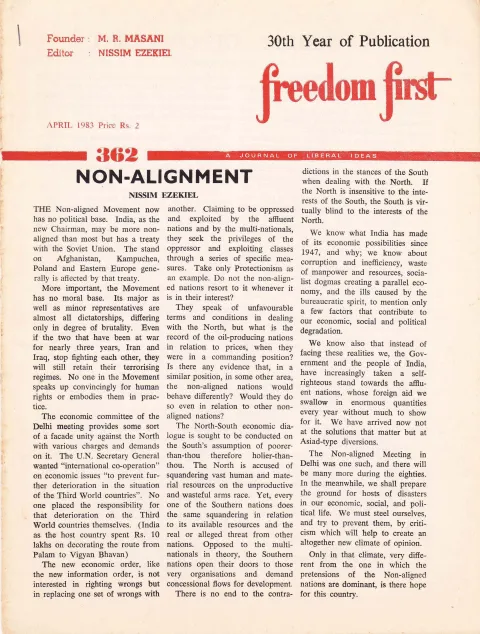
periodical issue
Freedom First
Are Human Rights Divisible?
By Minoo Masani
Published for the Democratic Research Service by J. R. Patel, Associate Editor, Freedom First at 127, Mahatma Gandhi Road, Bombay 400 023 (Phone: 273914) and Printed by him at The Popular Press (Bom.) Pvt. Ltd, 35C Tardeo Road, Bombay 400 034 · Bombay · 1983
16 pages
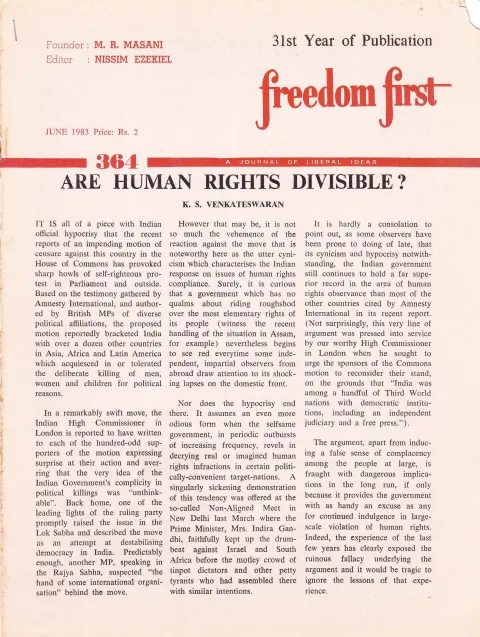
Freedom First
Summary
Freedom First issue 364 (June 1983), a monthly journal of liberal ideas founded by M. R. Masani and edited by Nissim Ezekiel, opens with K. S. Venkateswaran’s lead essay questioning the Indian government’s hypocrisy in decrying human rights abuses abroad (South Africa, Israel) while tolerating and committing rights violations at home (citing Assam). Editor Minoo Masani’s regular column ‘As I See It’ argues that India is not constitutionally a secular state but a multi-religious democratic republic, attacks the conflation of secularism with Marxist egalitarianism, and defends Sir Richard Attenborough’s right to premiere the film Gandhi in South Africa. Other contributions cover a seminar on the ethics and legal status of voluntary euthanasia (‘The Right to Die’ by Aziz Madni), the rehabilitation of paraplegics in India (Homai Jal Moos), two book reviews (H. W. R. Wade’s Administrative Law, and P. R. Brahmananda’s Productivity in the Indian Economy), a first-person account of a Hungarian Christian judge’s nineteen-and-a-half years of imprisonment under Communist rule (Laszlo Varga), a letter from the Citizens for Democracy on abolition of state Legislative Councils and elected representatives’ pensions (M. A. Rane), and the recurring ‘With Many Voices’ quotations column.
Key points
-
K. S. Venkateswaran’s lead article “Are Human Rights Divisible?” argues that India’s outrage over a British parliamentary censure motion exposes its own hypocrisy in tolerating rights violations in Assam while selectively condemning abuses in South Africa and Israel.
-
Minoo Masani’s “As I See It” argues India is a democratic republic respecting all faiths rather than a secular state, blames Krishna Menon and Nehru for popularising “secular democratic republic,” and defends Sir Richard Attenborough’s right to premiere Gandhi in South Africa.
-
Aziz Madni’s “The Right To Die” reports on a Bombay seminar on voluntary euthanasia at which M. R. Masani framed the right to die with dignity as on a par with free expression, citing Vinoba Bhave’s and Arthur Koestler’s deaths.
-
Homai Jal Moos’s “Paraplegia and Society” describes the Society for the Rehabilitation of Paraplegics’ work since 1968 and the construction of the “Sharan” rehabilitation centre at Vashi, whose foundation stone Indira Gandhi laid in 1980.
-
K. S. Venkateswaran reviews H. W. R. Wade’s “Administrative Law,” praising its account of the revival of judicial oversight of executive discretion while regretting it omits comparable Indian Supreme Court decisions such as Maneka Gandhi’s Case.
-
Laszlo Varga recounts the story of Dr. Ferenc Matheovits, a Hungarian judge imprisoned for nineteen and a half years across three terms under Communist rule for his Christian faith, contrasting his fate with rehabilitated Marxists like Janos Kadar.
-
M. A. Rane of Citizens For Democracy reports resolutions from the organisation’s Ahmedabad conference calling for abolition of state Legislative Councils and condemning legislators who vote themselves pensions and housing plots.
Essays
Are Human Rights Divisible?
By K. S. VENKATESWARAN
Venkateswaran’s lead article argues that the Indian government’s outraged reaction to a proposed British parliamentary motion of censure (based on Amnesty International testimony bracketing India with other countries tolerating political killings) exposes its own hypocrisy. The government denounces human rights violations in politically convenient target-nations such as South Africa and Israel while riding roughshod over its own citizens’ rights, as in Assam. The author warns that pointing to India’s comparatively better human-rights record, as officials do, breeds dangerous complacency and gives the government an excuse to continue large-scale violations.
- A British parliamentary motion of censure, based on Amnesty International testimony, bracketed India with other countries tolerating political killings.
- Indian officials and MPs reacted with sharp, self-righteous protest, with one MP calling it an attempt to destabilise Indian democracy.
- The author argues the government’s own record includes serious domestic rights violations, citing the situation in Assam.
- The government selectively condemns human rights abuses in ‘politically-convenient target-nations’ like South Africa and Israel, exemplified by Indira Gandhi’s rhetoric at the Non-Aligned Meet in New Delhi.
- India’s High Commissioner in London argued India has a superior human rights record versus other Third World nations with democratic institutions.
- The author calls this comparative defence dangerous, since it fosters complacency and excuses continued violations.
As I See It
By MINOO MASANI
In his regular column, Minoo Masani commends Ramkrishna Bajaj for distinguishing ‘Sarva Dharma Samabhava’ (equal respect for all religions) from anti-religious secularism, arguing India is not a secular state but a democratic republic respecting all faiths equally, and blaming V. K. Krishna Menon and Jawaharlal Nehru for popularising the misleading label ‘secular democratic republic.’ He criticises P. N. Haksar for conflating secularism with egalitarianism, and separately rebuts Guha Thakurta’s charge that Masani unfairly blamed Karl Marx for the horrors of Soviet Russia and Communist China, insisting Marx’s theories, whatever his intentions, bear responsibility for the totalitarian states built in his name. He closes by defending Sir Richard Attenborough’s right to attend the South African premiere of Gandhi against a campaign to shame him into abstaining, invoking Rajaji’s 1970 defence of cricket ties with apartheid South Africa and Arun Gandhi’s public criticism of hate-filled anti-apartheid campaigning as a betrayal of Gandhian philosophy.
- Distinguishes Sarva Dharma Samabhava (equal respect for religions) from secularism, which Masani defines as anti-religious per the Concise Oxford Dictionary.
- Argues India’s Constitution enjoins equal respect for all religions, not secularism in the anti-religious sense; blames Krishna Menon and Nehru for popularising ‘secular democratic republic.’
- Criticises P. N. Haksar’s 20 April 1983 Bombay speech conflating ‘egalitarianism’ and ‘secularism.’
- Responds to S. Guha Thakurta’s letter to The Statesman, doubling down on the claim that Marx bears responsibility for the totalitarian outcomes of Soviet Russia and Communist China, quoting Bernard Levin’s Times column on Lenin, Stalin, Brezhnev, Mao and Castro as ‘the most perfect flowers’ of Marxism.
- Defends Sir Richard Attenborough against a campaign pressuring him not to attend the Gandhi premiere in South Africa, drawing a parallel to Rajaji’s 1970 defence of a cricket tour of apartheid South Africa.
- Cites Arun Gandhi’s Sunday Observer column arguing that hate-filled anti-apartheid campaigning betrays Gandhian principles of love and non-violence.
The Right To Die
By AZIZ MADNI
Aziz Madni reports on a seminar, ‘Implications and Limits of Voluntary Euthanasia,’ held by the Society For The Right To Die With Dignity at the Indian Merchants’ Chamber, Bombay, on 30 April. The first session, chaired by Dr. B. N. Colabawalla, addressed care of terminally ill patients and a draft bill protecting physicians who assist such patients; the second, chaired by M. R. Masani, addressed ‘The Right To Die Of Others.’ Colabawalla distinguished mercy killing (ending life without the patient’s express wish) from voluntary euthanasia (acting on the patient’s wish). Masani framed the right to die with dignity as on a par with free expression, invoking Voltaire and Tennyson, and cited Vinoba Bhave’s and Arthur Koestler’s deaths as models of dying by choice.
- Seminar held 30 April 1983 at the Indian Merchants’ Chamber, Bombay, under the auspices of the Society For The Right To Die With Dignity.
- Session one, chaired by Dr. B. N. Colabawalla, covered care of terminally ill/injured patients and a Draft Bill protecting physicians and surgeons who treat them.
- Colabawalla distinguished mercy killing from voluntary euthanasia, the latter resting on the patient’s express wish.
- Session two, chaired by M. R. Masani, addressed the intellectual dimension: the terminally ill patient’s freedom to choose between life and death.
- Masani cited Vinoba Bhave, who ended his own life by stopping intake of nourishment, and Arthur Koestler’s suicide as acts of courage and conviction rather than cowardice.
- The seminar announced a Bombay premiere of Whose Life Is It Anyway? on 1 September 1983 in aid of the Society.
Paraplegia and Society
By HOMAI JAL MOOS
Homai Jal Moos, PRO of the Society for the Rehabilitation of Paraplegics, describes the plight of paraplegics in India — mostly from lower economic strata, permanently paralysed by spinal injury — and the Society’s work since 1968, run in collaboration with the J. J. Group of Hospitals’ Orthopaedic Department. It covers the physical and social rehabilitation needed, the importance of sport (citing the 1972 All-India Federation for Sports and Rehabilitation of Paraplegics and national and international games), and the ongoing construction of the ‘Sharan’ rehabilitation centre at Vashi, whose foundation stone was laid by Prime Minister Indira Gandhi in October 1980, at an estimated cost of Rs. 40 lakhs. The piece closes with an appeal for donations.
- The Society for the Rehabilitation of Paraplegics was founded in 1968, working with the J. J. Group of Hospitals’ Orthopaedic Department since a Paraplegic Unit was set up in 1969.
- Rehabilitation requires both physical treatment (preventing bed-sores, infections) and social/vocational retraining.
- Sports (swimming, wheelchair races, javelin, archery, table-tennis, etc.) are framed as key to regaining mental and physical well-being; the All-India Federation for Sports and Rehabilitation of Paraplegics was formed in 1972.
- National Paraplegic Games were first held in 1978 and again in 1980 at the Paraplegic Home, Kirkee, Poona.
- A plot at Vashi was purchased in 1979 for a dedicated rehabilitation centre, ‘Sharan’, with its foundation stone laid by Indira Gandhi on 11 October 1980, estimated to cost Rs. 40 lakhs.
- The article appeals for donations, noting tax exemption under Section 80G.
Twenty Years In A Communist Jail: Agony of Dr. Matheovits—Convicted for Christian Beliefs
By LASZLO VARGA
K. S. Venkateswaran reviews the 5th edition of H. W. R. Wade’s Administrative Law (Oxford University Press, 1982), praising it as an indispensable, historically-grounded reference tracing the growth of administrative law in England, including the post-war decline and later revival of judicial oversight of executive discretion, culminating in Ridge v. Baldwin (1963). The review notes the book’s relevance to India, where a written constitution and fundamental rights chapter have driven similarly innovative Supreme Court decisions (Maneka Gandhi’s Case, Kasturilal’s Case, The International Airports Authority Case), regrets that none of these Indian cases are mentioned in Wade’s book, and highlights Wade’s warning about the dangers of unchecked parliamentary/executive supremacy, especially relevant in India given the weakening of parliamentary control by party dominance.
- Reviews H. W. R. Wade’s Administrative Law, 5th edition (OUP, 1982, 892pp, Rs. 175), calling it an indispensable classic first published two decades earlier.
- Notes the post-WWII decline in vigour of administrative law and its revival in the 1960s, marked by the landmark House of Lords decision Ridge v. Baldwin (1963).
- Argues Indian Supreme Court decisions (Maneka Gandhi’s Case, Kasturilal’s Case, International Airports Authority Case) mirror English developments but are not referenced in Wade’s book.
- Highlights Wade’s warning that the party system has progressively weakened parliamentary control over the executive, calling this ‘the malaise’ remediable only by a strengthened judiciary.
Book Reviews: Administrative Law by H.W.R. Wade
By K. S. Venkateswaran
K. Balasubramanian reviews P. R. Brahmananda’s Productivity in the Indian Economy: Rising Inputs for Falling Outputs (Himalaya Publishing House, Bombay, 280pp), Brahmananda’s twelfth book, describing it as an erudite treatise on the transition of the Indian economy away from older, now-irrelevant theories, offering a new growth theory and comparative studies with the UK, Japan, USA, Germany, the Soviet Union, China and Latin America. The review notes the book’s advocacy of Gandhian trusteeship, its emphasis on research and development and population control, and its concluding appraisal of smuggling and political corruption in the Indian politico-economic system.
- Reviews P. R. Brahmananda’s Productivity in the Indian Economy: Rising Inputs For Falling Outputs, his twelfth book.
- The book offers a new theory of growth after tracing the ills of the Indian economy and the causes of a ‘Productivity Fade-Out.’
- Comparative studies span the UK, Japan, USA, Germany, the Soviet Union, China and Latin America.
- Advocates Trusteeship in the Gandhian spirit and stresses boosting research and development and population control.
- Appendices, interspersed with sayings from the Koran and Upanishads, conclude with an appraisal of smuggling and political corruption in the Indian system.
Book Reviews: Productivity in the Indian Economy: Rising Inputs for Falling Outputs by P. R. Brahmananda
By K. Balasubramanian
Laszlo Varga recounts the story of Dr. Ferenc Matheovits, a Hungarian judge and 1947 Democratic People’s Party MP, who was imprisoned by the Stalinist-Rakoski regime in 1949 for his Christian beliefs and outspoken parliamentary defence of human rights, and who ultimately spent nineteen and a half years in Communist prisons across three separate detentions (1949-56, 1956-63, and 1964-c.1970s). The article contrasts his treatment with that of rehabilitated Communist-era Marxists like Janos Kadar, who were welcomed as heroes, compensated, and given jobs and pensions after Stalin’s death, while Matheovits, now 68 and fluent in five languages, remains branded a ‘convict,’ denied any job, pension, or exit visa to the West despite the regime’s official human-rights guarantees.
- Dr. Ferenc Matheovits, a judge in Pecs, Hungary, and 1947 Democratic People’s Party MP, was arrested by the Stalinist-Rakoski regime in 1949 for his Christian beliefs and defence of human rights, tortured, and imprisoned for 7 years.
- After a brief release, he was re-imprisoned for 6 years following the 1956 Hungarian Revolution, and again for six and a half years from 1964 ‘for absolutely nothing’ — nineteen and a half years total.
- The article contrasts his treatment with rehabilitated Marxists such as Janos Kadar and Gyorgy Marosan, who were welcomed as heroes, compensated, and given jobs and pensions after Stalin’s death.
- Matheovits consistently rejected the ‘Communist bargain’ to renounce his Christian faith in exchange for better treatment.
- Despite the Hungarian Communist Constitution and the 1948 UN Declaration of Human Rights nominally guaranteeing basic rights, Matheovits, now 68, is denied any job (beyond mine work his health can’t support), any pension, and an exit visa to travel to Rome or the West.
- The piece is credited at the end to ‘Antar Sanchar’ though the byline is Laszlo Varga.
A Letter (on Fifth Bi-Annual All-India Conference of Citizens For Democracy)
By M. A. Rane, General Secretary, CFD Bombay
M. A. Rane, General Secretary of Citizens For Democracy (CFD), Bombay, reports resolutions passed at the Fifth Bi-Annual All-India CFD Conference in Ahmedabad (27-28 March 1983): congratulating the Andhra Pradesh Legislative Assembly for moving to abolish its Upper House and the state government for withdrawing pensions for former legislators (worth nearly Rs. 35 lakhs annually), calling for abolition of Legislative Councils in other states as anachronistic, and condemning legislators voting themselves pensions, housing plots, and other largesse as a form of political corruption that swells ‘an ever-increasing army of parasites on the public treasuries.’
- CFD’s Fifth Bi-Annual All-India Conference was held in Ahmedabad on 27-28 March 1983.
- Resolutions congratulated Andhra Pradesh for moving to abolish its Legislative Council and for withdrawing pensions to former legislators (nearly Rs. 35 lakhs annually).
- CFD called for abolition of Legislative Councils across all states where they exist, terming them anachronistic and used to reward defeated or discredited politicians.
- CFD condemned legislators voting themselves pensions and housing plots as a form of political corruption creating ‘an ever-increasing army of parasites on the public treasuries.’
- CFD appealed to citizens and voluntary organisations to mobilise public opinion on these issues.
Generated by the v1.5 extraction pipeline. Awaiting editorial review.
Metadata and summary are AI-extracted from the source PDF and reviewed for editorial accuracy. The original work is available via the Read PDF tab above (where present); paragraph-level citation inside the PDF is deferred to a future engagement.