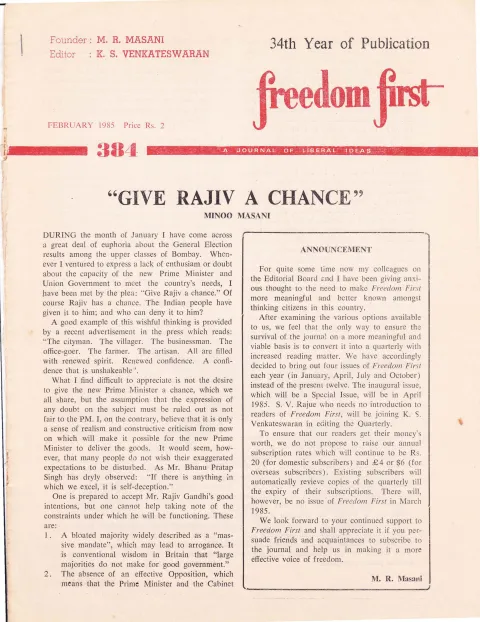
periodical issue
Freedom First
A Journal of Liberal Ideas
By Minoo Masani
Published for the Democratic Research Service by J. R. Patel, Associate Editor, Freedom First at 127, Mahatma Gandhi Road, Bombay 400 023 (Phone: 273914) and Printed by him at The Popular Press (Bom.) Pvt. Ltd., 35C Tardeo Road, Bombay 400 034 · Bombay · 1984
16 pages
Freedom First
Summary
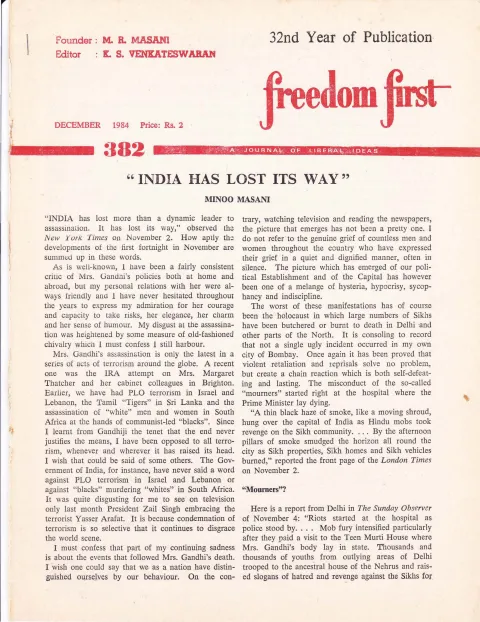
Issue 382 of Freedom First (December 1984, 32nd year of publication; Founder M. R. Masani, Editor K. S. Venkateswaran) is dominated by the assassination of Prime Minister Indira Gandhi on October 31, 1984, and its violent aftermath. Masani’s lead editorial condemns both the assassination and the anti-Sikh pogrom that followed in Delhi, criticises President Zail Singh’s handling of Rajiv Gandhi’s succession as unconstitutional, and surveys press and broadcast failures during the crisis. A reprinted Sunday Times piece by Simon Freeman and Barrie Penrose imagines, via Attorney General Sir Michael Havers, how Britain’s constitutional machinery would have coped had the IRA’s Brighton bomb killed Margaret Thatcher’s whole cabinet — offered as an implicit contrast to India’s messier transition. A reprinted South African Beeld editorial addresses an open letter to Thatcher equating the ANC with the IRA and PLO. The book review section covers Sarvepalli Gopal’s third volume of his Nehru biography, the published Yes, Minister diaries, M. Hidayatullah’s Right to Property and the Indian Constitution, and Ralph Miliband’s Capitalist Democracy in Britain. The issue closes with a page of quotations (‘With Many Voices’) from world leaders and commentators, and the standard subscription order form.
Key points
-
Minoo Masani’s editorial “India Has Lost Its Way” condemns both Indira Gandhi’s assassination and the anti-Sikh pogrom that followed, criticising the Government of India for selective condemnation of terrorism and All India Radio and Doordarshan for suppressing news of the assassination for six hours.
-
Masani argues President Zail Singh acted unconstitutionally by installing Rajiv Gandhi as PM without awaiting the Congress Parliamentary Party’s choice, following “the Moscow model and not that of Westminster.”
-
Simon Freeman and Barrie Penrose’s reprinted Sunday Times piece has Attorney General Sir Michael Havers describe how Britain’s constitutional machinery would have smoothly absorbed the shock had the IRA’s Brighton bomb killed Thatcher’s entire cabinet.
-
A reprinted South African Beeld editorial, cast as “An Open Letter to Mrs. Thatcher,” argues there is no meaningful difference between the IRA, the ANC and the PLO as terrorist organisations.
-
S. S. Bankeshwar reviews Sarvepalli Gopal’s third volume of his Nehru biography, calling it hagiographic and disputing its claim that C. Rajagopalachari supported southern secession.
-
A short notice on the “Yes, Minister” diaries calls Doordarshan’s broadcast of the satire an unlikely bonanza given the network’s reputation for governmental servility.
-
A review of M. Hidayatullah’s “Right to Property and the Indian Constitution” praises his historical defence of property rights while criticising his newer, softer stance on the issue.
-
A review of Ralph Miliband’s “Capitalist Democracy in Britain” dismisses his claim that Britain’s political system prevents rather than facilitates popular power as a “highly debatable leftist lament.”
Essays
”India Has Lost Its Way”
By Minoo Masani
Minoo Masani’s editorial ‘India Has Lost Its Way’ opens by quoting the New York Times’ verdict on Indira Gandhi’s assassination, then recounts his own ambivalent relationship with her — a consistent policy critic who nonetheless admired her personally. He condemns terrorism uniformly (citing the IRA’s Brighton attack, PLO and Tamil Tiger violence, and anti-apartheid killings in South Africa) and faults the Government of India for selective condemnation of terrorism abroad while failing to prevent the anti-Sikh massacres in Delhi. He details mob violence against Sikhs, including the burning of a Sikh taxi driver and an attack on Lok Dal MP Ram Vilas Paswan’s house, quotes The Times of India’s admission that the Youth Congress harbours violent ‘lumpens’, and criticises All India Radio and Doordarshan for suppressing news of the assassination for hours and then indulging in ‘a paroxysm of hyperbole’. The piece continues into a critique of President Zail Singh’s failure to follow constitutional convention (naming a caretaker PM and awaiting the Congress Parliamentary Party’s choice of leader) before swearing in Rajiv Gandhi, contrasted with a reprinted Sunday Times account of how Britain would have managed a comparable crisis.
- Masani frames Indira Gandhi’s assassination as part of a global pattern of terrorism (IRA, PLO, Tamil Tigers, anti-apartheid violence) and criticises selective condemnation of terrorism by the Government of India.
- Details the anti-Sikh violence in Delhi following the assassination, including mob attacks reported by the London Times and Sunday Observer.
- Credits Bombay with avoiding any ‘ugly incident’ during the unrest.
- Criticises All India Radio and Doordarshan for suppressing the news for six hours and then over-dramatising coverage; cites Amita Malik’s critique of ‘TV’s Dismal Failure’.
- Argues President Zail Singh acted unconstitutionally by directly installing Rajiv Gandhi as PM rather than awaiting the Congress Parliamentary Party’s election of a leader, following ‘the Moscow model and not that of Westminster’.
- Credits Rajiv Gandhi personally with decent instinct (ordering state leaders back to their posts, threatening police over complicity in the massacre) despite the flawed process that installed him.
- Uses a reprinted Sunday Times report (Sir Michael Havers’ hypothetical scenario for a decapitated Thatcher cabinet) as a foil, arguing Britain’s constitutional machinery would have coped smoothly where India’s did not.
How Britain Would Have Coped If the Cabinet Had Been Killed
By Simon Freeman and Barrie Penrose
A reprint from The Sunday Times (by Simon Freeman and Barrie Penrose) in which Attorney General Sir Michael Havers describes, hour by hour, how Britain’s government would have functioned had the IRA’s October 1984 Brighton bomb killed Margaret Thatcher and her entire cabinet. Havers walks through the constitutional mechanics: the Cabinet Secretary alerting surviving ministers, the Queen (on holiday in America) being recalled, Lord Whitelaw taking temporary control pending a Tory leadership election, and the likelihood that Britain would have had a new Prime Minister within roughly 24 hours. He stresses there would have been no need for a state of emergency and expresses confidence that British constitutional tradition would have ensured continuity ‘business as usual within a day or two.’
- Havers’ scenario assumes all eleven cabinet ministers present at the Grand Hotel died in the bombing.
- Cabinet Secretary Sir Robert Armstrong would have called surviving ministers and alerted permanent secretaries.
- The Queen, on holiday in America, would have returned; Lord Whitelaw (deputy PM) would have taken interim control without automatically becoming PM.
- A Tory leadership election would likely have concluded within about ten days, with a fully constituted government by the Friday evening after the bombing.
- Havers argues no state of emergency would have been necessary and that British democratic tradition would have absorbed the shock without panic.
An Open Letter to Mrs. Thatcher
A reprinted editorial from the South African daily Beeld, cast as ‘An Open Letter to Mrs. Thatcher’ after the Brighton bombing, argues there is no meaningful difference between the IRA and the African National Congress (ANC), both alleged to seek the violent overthrow of legitimate governments in favour of Marxist systems, both linked to a wider terrorist network including the PLO. The editorial presses Thatcher to recognise the inconsistency of Britain’s criticism of apartheid-era South Africa’s dealings with the IRA compared to Britain’s own hosting of ANC representatives.
- Argues the IRA and ANC share tactics, aims (Marxist overthrow of legal governments), and terrorist networks including links to the PLO.
- Claims the ANC and PLO cooperated during Israel’s 1982 Lebanon campaign.
- Presses Thatcher on the inconsistency of Britain hosting ANC representatives while itself facing IRA terrorism.
- Concludes there is ‘no difference between terrorist organisations, whether the ANC, the IRA, the PLO.‘
a sycophant with utter disregard for objectivity
Book review of Jawaharlal Nehru: A Biography, Vol. III by Sarvepalli Gopal (Oxford University Press). The reviewer is highly critical, calling Gopal ‘a sycophant with utter disregard for objectivity’ who exonerates Nehru of blame for the failures of aides like V. K. Krishna Menon and M. O. Mathai. The review highlights Gopal’s charge that C. Rajagopalachari (Rajaji) supported southern secessionism — which the reviewer disputes, saying Nehru’s actual complaint concerned Rajaji’s advocacy of free enterprise, not secession — and praises Rajaji’s integrity in contrast to contemporary politicians. It also flags revelations about Mathai’s CIA-linked wealth, US U-2 flights and a nuclear-powered sensing device near Nandadevi, and Krishna Menon’s plans to manufacture ‘mechanical toys’ during the 1962 Chinese aggression, alongside a broader argument that developed nations have prospered by rejecting socialism for competitive free enterprise. Byline: S. S. Bankeshwar.
- Reviewer condemns Gopal’s Nehru biography as hagiographic, faulting Nehru’s own admission that he ‘failed practically in everything he attempted’ while blaming aides.
- Disputes Gopal’s claim that Rajaji supported southern secession, arguing Nehru’s real objection was to Rajaji’s free-enterprise advocacy.
- Praises Rajaji’s personal integrity, contrasting him with politicians who ‘groom’ sons or amass wealth.
- Cites revelations: CIA access to Nehru’s secretariat correspondence (1946-59), US U-2 flights permitted from Indian soil, a nuclear-powered sensing device near Nandadevi to monitor Chinese missile development, and Krishna Menon’s mechanical-toy manufacturing scheme during the 1962 war.
- Closes with an argument that Western Europe, the US and Japan prospered by rejecting socialism for competitive free enterprise while communist and socialist states ‘stagnated or slid downhill.’
s broadcast of the TV series. The reviewer calls the show
Short review (‘In Brief’) of the Yes, Minister book series (Vols. 1-3, ed. Jonathan Lynn and Antony Jay, BBC, 1981-83), occasioned by Doordarshan’s broadcast of the TV series. The reviewer calls the show’s airing on state television an unlikely bonanza given Doordarshan’s reputation for servility, praises the diaries for their portrait of civil-service manoeuvring (personified by Sir Humphrey Appleby) against inept ministers (Jim Hacker), and notes the series has won awards and is recommended reading for politicians and civil servants.
- Notes the irony of Doordarshan — known for governmental servility — airing a satire lampooning bureaucratic and ministerial dysfunction.
- Describes the show as depicting ‘collusion and collision in the corridors of power’ between civil service and ministers.
- Notes the series has won ‘nearly half a dozen prestigious awards’ and is recommended reading for politicians and civil servants.
Book Reviews (Jawaharlal Nehru: A Biography by Dr. Sarvepalli Gopal, Vol. III; Right to Property and the Indian Constitution by M. Hidayatullah; Capitalist Democracy in Britain by Ralph Miliband)
By S. S. Bankeshwar
Review of Right to Property and the Indian Constitution by M. Hidayatullah (Arnold-Heinemann, 1983). The reviewer credits Hidayatullah as one of few Indian judges to openly disapprove of repeated governmental efforts to whittle down the Right to Property, citing his stance in the Golak Nath case upholding the primacy of fundamental rights, but criticises his more recent view that property is ‘the weakest’ of fundamental rights and needing protection ‘in a different way’ without specifying how. Calls the book illuminating overall and recommends it to students of constitutional law.
- Praises Hidayatullah’s historical record of defending property rights, including his position in the Golak Nath case.
- Criticises his newer, softer stance that property rights need protection ‘in a different way’ without concrete proposals.
- Recommends the book to students of constitutional law and politics despite this reservation.
In Brief… (Yes, Minister: Vols. 1, 2 & 3, ed. Jonathan Lynn and Antony Jay)
Review of Capitalist Democracy in Britain by Ralph Miliband (Oxford, 1984). The reviewer is dismissive, characterising Miliband as echoing ‘the highly debatable leftist lament’ that Britain’s political system serves to prevent rather than facilitate popular power, and faults his reliance on Marxian class-conflict concepts as naive or ludicrous, framing the book as one more addition to anti-capitalist literature.
- Characterises Miliband’s central claim — that the British political system prevents rather than facilitates popular power — as a ‘highly debatable leftist lament.’
- Criticises reliance on Marxian class-conflict concepts as naive or ludicrous.
- Dismisses the book as one more addition to ‘the growing body of anti-capitalist literature in contemporary Britain.‘
With Many Voices
‘With Many Voices’ is a recurring back-page column of quotations from public figures and editorials on current affairs, drawn from international press in September-October 1984: The Economist on ageing world leaders and on America’s capital inflows and Unesco, President Reagan on age in the 1984 US election, M. Hidayatullah on disliking elections, a Daily Telegraph joke about Soviet symphony orchestras, Lord Shinwell on turning 100, Zubin Mehta on his affinity for Israel, and others.
- Quotes The Economist on aged world leaders (Reagan, Chernenko, Deng Xiaoping, Khomeini, Pertini) needing ‘to get into training.’
- Quotes M. Hidayatullah (‘I hate elections’) from The Indian Express, October 28, 1984.
- Quotes President Reagan’s famous age/experience line from the 1984 debate.
- Includes an Economist observation on America attracting $100 billion in foreign capital during a ‘non-inflationary boom.’
- Includes Zubin Mehta’s remark on his musical and personal ties to Israel.
Generated by the v1.5 extraction pipeline. Awaiting editorial review.
Essay 7
No summary was extracted for this article. Listed for completeness.
Essay 8
No summary was extracted for this article. Listed for completeness.
Metadata and summary are AI-extracted from the source PDF and reviewed for editorial accuracy. The original work is available via the Read PDF tab above (where present); paragraph-level citation inside the PDF is deferred to a future engagement.