periodical issue
Freedom First
A Journal of Liberal Ideas
Published for the Democratic Research Service by J. R. Patel, Associate Editor, Freedom First at 127, Mahatma Gandhi Road, Bombay 400 023 (Phone: 273914) and Printed by him at The Popular Press (Bom.) Pvt. Ltd., 35C Tardeo Road, Bombay 400 034 · Bombay · 1985
16 pages
Freedom First
Summary
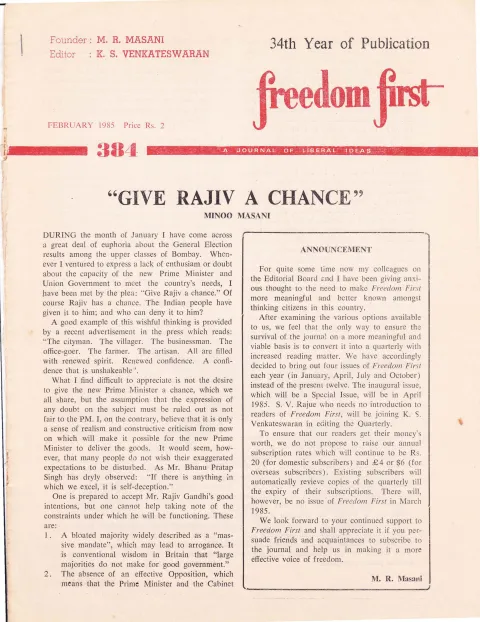
This is issue no. 384 of Freedom First (February 1985, Bombay), the 34th year of publication, edited by K. S. Venkateswaran with M. R. Masani as founder. The issue opens with Minoo Masani’s editorial “Give Rajiv a Chance,” written in the immediate aftermath of the December 1984 general election, which examines the new Prime Minister’s mandate with guarded skepticism, sets out Masani’s own reform priorities (economic “U-turn,” tax cuts, dismantling of the Planning Commission, restoration of states’ rights, non-alignment reform), and argues that the scale of the Congress victory was an electoral “overkill” produced by first-past-the-post arithmetic rather than genuine consensus. An editorial announcement in the same pages informs readers that Freedom First will convert from a monthly to a quarterly (January/April/July/October) from April 1985, with S. V. Raju joining Venkateswaran as co-editor. The rest of the issue carries a reprinted address by Gregory Newell (US Assistant Secretary of State) defending the American withdrawal from UNESCO, a reprinted UK news report by Charles Laurence on a Social Affairs Unit study opposing “positive discrimination”/reverse racism, three book reviews (of R. M. Lala’s history of the Sir Dorabji Tata Trust, Myron Weiner’s edited volume on the 1980 Lok Sabha elections, and Shakuntala Jagannathan’s primer on Hinduism), a reader’s letter objecting to the magazine’s earlier reprint of an anti-Thatcher “open letter” on South Africa and the ANC, and a closing page of ideologically pointed quotations (“With Many Voices”) drawn from the British press on Thatcher-era politics.
Key points
-
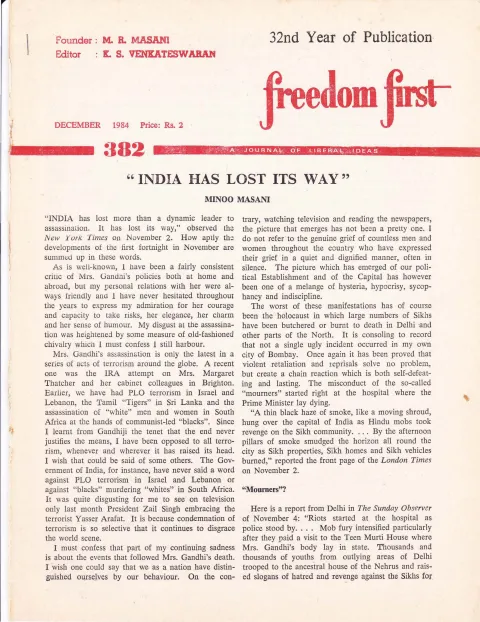
Minoo Masani’s editorial “Give Rajiv a Chance” sets out reform priorities including an economic “U-turn,” winding up the Planning Commission, and restoring states’ rights, while calling the scale of the Congress landslide an electoral “overkill” from first-past-the-post arithmetic.
-
Gregory Newell, US Assistant Secretary of State, defends America’s withdrawal from UNESCO as a response to two years of policy review finding the body chronically politicised and hostile to press freedom.
-
Charles Laurence’s reprinted report on a Social Affairs Unit study, “Reversing Racism: Lessons from America,” argues American racial quotas backfired and that Britain should reject “positive discrimination.”
-
S. V. Raju reviews R. M. Lala’s “The Heartbeat of a Trust,” on fifty years of the Sir Dorabji Tata Trust’s role founding TIFR, the Tata Memorial Hospital and TISS.
-
M. V. Kamath reviews Myron Weiner’s edited “India at the Polls, 1980,” noting that lower voter turnout correlated with bigger Congress(I) wins.
-
K. S. Venkateswaran reviews Shakuntala Jagannathan’s “Hinduism: An Introduction,” praising its glossary as indispensable for foreign readers.
-
A reader’s letter from Satish J. Shah objects to the magazine’s earlier uncommented reprint of an open letter equating the ANC with the IRA, arguing South Africa’s system is “little short of Nazism.”
Essays
”Give Rajiv a Chance”
By MINOO MASANI
Minoo Masani’s editorial questions the wave of post-election euphoria over Rajiv Gandhi, arguing that constructive criticism, not uncritical goodwill, will help the new Prime Minister “deliver the goods.” He lists constraints facing the new government — a bloated majority that breeds arrogance, a weak opposition, dependence on a corrupt “permit licence raj,” and the absence of genuine two-party competition — and reprints his own December 1984 list of policy priorities for the incoming government: an economic “U-turn” toward removing controls and winding up the National Planning Commission in favour of indicative planning; halving direct and indirect taxes while ending deficit financing; restoring constitutional rights of the states and appointing governors in consultation with chief ministers; and practising genuine non-alignment, including ending the Indo-Soviet Treaty and establishing ties with Israel. He characterises the Congress win as an “overkill” driven by First Past the Post arithmetic (only 51.9% of the vote), the sympathy wave following Indira Gandhi’s assassination, opposition disarray, and a one-sided media campaign via AIR and Doordarshan monopoly, and endorses Rajaji’s view that stable parliamentary democracy needs two roughly balanced blocs — welcoming N. T. Rama Rao’s move to form a federal party (“Bharat Desam”) of regional groups as a step toward that end.
- Masani rejects the premise that any doubt about Rajiv Gandhi’s capacity is automatically ‘unfair to the PM’.
- He lists four constraints on the new government: a bloated majority, a weak opposition, a corrupt permit-licence system, and untested leadership.
- His own reform priorities include an economic ‘U-turn’, tax cuts, winding up the Planning Commission, restoring states’ constitutional rights, and genuine non-alignment.
- He calls the scale of the Congress victory an ‘overkill’ resulting from Britain/US-style FPTP elections rather than genuine popular consensus (51.9% vote share).
- He cites Rajaji’s dictum that stable democracy needs two evenly balanced political blocs.
- He welcomes N. T. Rama Rao’s initiative to build a federal party of regional groups (‘Bharat Desam’) as a step toward that balance.
Perspectives on the U.S. Withdrawal from UNESCO
By GREGORY NEWELL
Gregory Newell, US Assistant Secretary of State, defends the Reagan administration’s December 1983 decision to withdraw the United States from UNESCO, in an address adapted for the magazine. He argues the decision followed a two-year policy review that found UNESCO chronically politicized, hostile to a free press and free markets, and captured by a Soviet-aligned bloc pushing a ‘New World Information and Communication Order’ that would threaten press freedom, alongside wasteful budget priorities (heavy spending on ‘peace and disarmament’ initiatives versus modest sums for literacy). He lists US policy priorities toward UNESCO reform — reasserting American leadership, a zero-net-growth budget policy, equitable staffing, fewer conferences, and a role for the private sector — and warns of a further push within UNESCO for a ‘code of conduct’ regulating multinational media and publishing corporations, which the US opposes.
- Newell frames the US withdrawal from UNESCO as a considered response to two years of policy review, not an impulsive act.
- He argues UNESCO’s programmes are consistently ‘inimical to US interests’ and infected with Soviet-aligned concepts of collective rights.
- He cites UNESCO’s ‘New World Information and Communication Order’ as a threat to First Amendment/press freedoms.
- He gives budget figures: $978,000 spent on ‘peace and disarmament’ initiatives versus $62,000 for eradicating illiteracy among 10 million refugees.
- He lists five US policy priorities for engagement with UNESCO and other multilateral bodies going forward.
- He warns of a UNESCO-backed push for a ‘code of conduct’ over multinational media, publishing, film, and TV industries worth an estimated $3.5 billion annually, which the US opposes.
The Perils of Reverse Racism
By CHARLES LAURENCE
A reprinted news report by Charles Laurence (from the Daily Telegraph) covers a November 1984 report by Britain’s Social Affairs Unit, ‘Reversing Racism: Lessons from America,’ which argues that the growing race-relations lobby’s calls for ‘positive’ or ‘reverse’ discrimination in housing, jobs and education should be rejected. The report holds that American racial quotas backfired and worsened race relations, criticises the Commission for Racial Equality for not condemning reverse racism, and quotes contributors including Prof. Kenneth Holland (University of Vermont), who attributes black underperformance to cultural attitudes rather than discrimination, and Geoffrey Parkins, who distinguishes ‘equal opportunity’ from ‘equal outcome’ policy goals and warns Britain risks following the US down the latter path.
- The Social Affairs Unit report calls on the UK government to reject ‘positive’/‘reverse’ discrimination policies in jobs, housing and education.
- It argues American racial quotas ‘back-fired’ and worsened rather than improved race relations.
- It criticises the Commission for Racial Equality’s £8,000,000 annual public subsidy for not clearly opposing reverse racism.
- Prof. Kenneth Holland argues black underperformance stems from cultural attitudes and values, not discrimination.
- Geoffrey Parkins distinguishes ‘equal opportunity’ from ‘equal outcome’ as the crucial dividing line in race policy.
- The report concludes that government-sponsored ‘positive racism’ is as dangerous as individual ‘negative racism’.
Book Reviews: The Heartbeat of a Trust: Fifty Years of the Sir Dorabji Tata Trust by R. M. Lala
By S. V. Raju
Three book reviews. S. V. Raju reviews R. M. Lala’s ‘The Heartbeat of a Trust: Fifty Years of the Sir Dorabji Tata Trust’ (Tata McGraw Hill, 1984), calling it a story of philanthropic trusteeship in action and praising Lala’s narrative skill in bringing to life the men behind the Trust’s achievements, including the founding of TIFR, the Tata Memorial cancer hospital, and TISS; Raju laments there is a dearth of such men today and asks what will happen to Indian trusts once they are gone. M. V. Kamath reviews Myron Weiner’s edited volume ‘India at the Polls, 1980,’ summarising its six-part structure covering the Janata split, the 1980 campaign, electoral geography, voting patterns among Muslims/Scheduled Castes/Tribes, and India’s 1980s political economy, and highlighting Weiner’s finding that 1980 turnout (57%) was lower than 1977 or 1967, with lower turnout correlating with better Congress (I) results. K. S. Venkateswaran reviews Shakuntala Jagannathan’s ‘Hinduism: An Introduction’ (Vakils, Feffer and Simons, 1984), describing its three-chapter structure covering Hindu philosophy, scriptures, and concepts like Nirguna/Saguna Brahma, Karma and Dharma, and praising its glossary as indispensable for foreign readers.
- S. V. Raju’s review of Lala’s Tata Trust history highlights the Trust’s role in founding TIFR, the Tata Memorial Hospital, and TISS, funded by Sir Dorab Tata’s one-crore bequest.
- Raju notes the bequest is equivalent to roughly Rs. 25 crores in 1984 currency.
- M. V. Kamath’s review of Weiner’s ‘India at the Polls, 1980’ summarises the book’s six-part structure and voter-turnout findings.
- Weiner found 1980 turnout (57%) was lower than in 1977 (60.5%) or 1967 (61.6%), with lower turnout correlating with bigger Congress (I) wins.
- Congress (I) won 351 of 525 seats in 1980 on only 42.7% of the popular vote.
- K. S. Venkateswaran’s review of Jagannathan’s Hinduism primer praises its glossary and simplified treatment of core concepts for a lay/foreign readership.
Book Reviews: India at the Polls, 1980: A Study of the Parliamentary Elections, ed. Myron Weiner
By M. V. Kamath
A reader’s letter from Satish J. Shah criticises Freedom First for having reproduced, without comment, an ‘open letter’ to Mrs. Thatcher from a South African newspaper that urged her to expel the ANC from Britain by equating it with the IRA. Shah argues the comparison is false: Britain is a free society facing IRA terrorism aimed at territorial secession, whereas South Africa is ‘governed by a system that is little short of Nazism’ in which the ANC’s resort to violence, where it occurs, reflects despair at achieving equality by peaceful means. He argues the magazine’s silent reproduction of the letter implied tacit support for a ‘barbaric and despicable form of government.’
- Shah objects to the magazine’s uncommented reprint of an open letter to Thatcher comparing the ANC to the IRA.
- He argues South Africa’s system is ‘little short of Nazism’, unlike Britain, a free society.
- He argues ANC violence, where present, stems from despair at achieving equality through peaceful means, unlike the IRA’s aims.
- He calls on Freedom First to have ignored the letter rather than reprint it without comment.
Book Reviews: Hinduism: An Introduction by Shakuntala Jagannathan
By K. S. Venkateswaran
‘With Many Voices’ is an unsigned closing column of quotations excerpted from the British press (The Economist, The Times, The Sunday Times, The Daily Telegraph) from November-December 1984, on subjects including Konstantin Chernenko, the miners’ strike, Arthur Scargill, US-Commonwealth relations, Nehru’s legacy, Sikh reaction to Rajiv Gandhi’s conduct after Indira Gandhi’s assassination, and NATO-Soviet arms negotiations.
- Quotes The Economist on how to bargain with Konstantin Chernenko.
- Quotes Arthur Scargill (via The Times) on winning ‘on the streets of Britain’ rather than in the Commons, juxtaposed with his claim to be ‘a reasonable and moderate man’.
- Quotes Woodrow Wyatt calling the USA ‘a much more de facto member of the Commonwealth than India’.
- Quotes Trevor Fishlock doubting India would ‘fly apart’ without a Nehru in power.
- Quotes The Economist on Sikh anger at Rajiv Gandhi’s public conduct beside Indira Gandhi’s body while Sikhs faced attacks.
- Quotes a Sunday Times editorial and Neil Kinnock on the Soviet return to nuclear negotiations and Scargill’s handling of the coal strike.
Generated by the v1.5 extraction pipeline. Awaiting editorial review.
Metadata and summary are AI-extracted from the source PDF and reviewed for editorial accuracy. The original work is available via the Read PDF tab above (where present); paragraph-level citation inside the PDF is deferred to a future engagement.