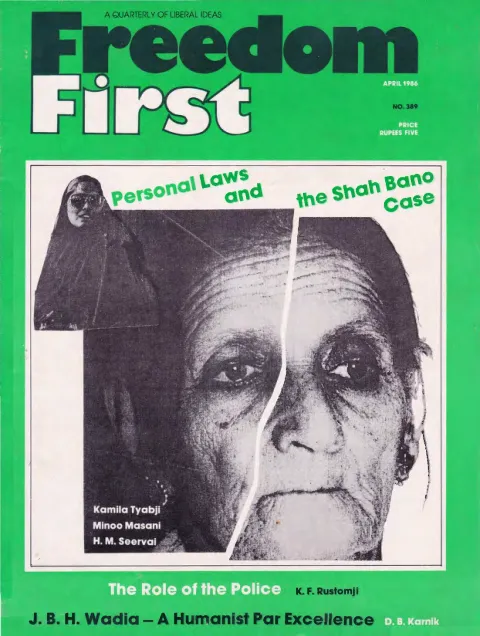
periodical issue
Freedom First
A Quarterly of Liberal Ideas
By Minoo Masani
Published for the Democratic Research Service by J. R. Patel, Associate Editor, Freedom First at 127, Mahatma Gandhi Road, Bombay 400 023 (Phone: 273914) and printed by him at The Popular Press (Bom.) Pvt. Ltd., 35C Tardeo Road, Bombay 400 034 · Bombay · 1985
56 pages
Freedom First
Summary
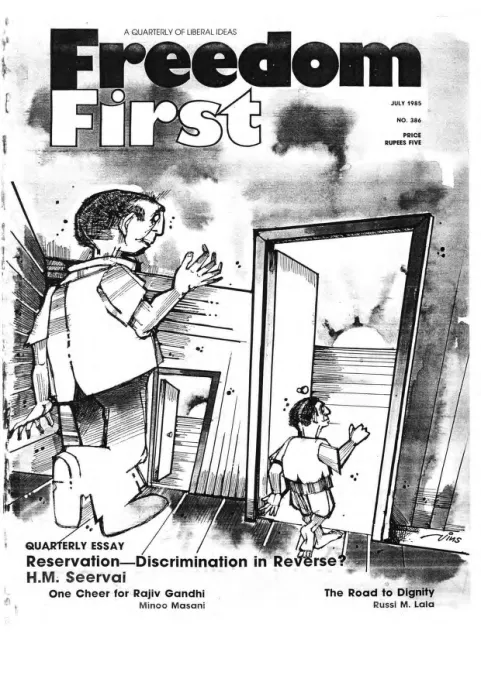
This is the July 1985 issue (No. 386) of Freedom First, the Bombay-based quarterly of liberal ideas founded by Minoo Masani, edited by S. V. Raju and K. S. Venkateswaran. In the rendered pages, the issue opens with editorial notices explaining the journal’s shift from monthly to quarterly frequency, the front-matter miscellany column ‘With Many Voices’ (a collection of quoted aphorisms on politics and the USSR), and ‘Of Cabbages & Kings’, a two-part opinion column criticising both the Indian government’s soft handling of Soviet diplomacy around Gorbachev’s Moscow meetings with Rajiv Gandhi, and, separately, defending the journal’s consistently anti-Soviet editorial stance against a reader’s complaint. The lead pieces surveyed here are Minoo Masani’s ‘One Cheer for Rajiv Gandhi’, a sharply critical assessment of the 1985 Union Budget and of Rajiv Gandhi’s early record as Prime Minister on economic policy, deficit finance, and susceptibility to political pressure; Amal Ray’s ‘Erosion of Fiscal Federalism’, an analysis of centre-state financial relations under the Indian Constitution and the case for restructuring them; Russi M. Lala’s ‘The Road to Dignity’, a reflective essay on caste, dignity, and inter-community relations built around encounters in Japan and rural Bihar; and K. S. Venkateswaran’s ‘The Great Reservation Debate’, a report on a seminar organised by the Indian Liberal Group and the Freedom First Foundation on the reservation policy for Scheduled Castes, Scheduled Tribes, and other backward classes, chaired by M. R. Masani. The quarterly essay by H. M. Seervai, ‘Reservation—Discrimination in Reverse?’, begins later in the issue (from page 23) and was only partially rendered here in a related report context. Later essays in the table of contents (Louella Lobo Prabhu on the budget, K. H. Subramaniam on the Indian consumer, Yogesh Kamdar, R. Srinivasan’s profile of Gazulu Narasu Chetty, Jeri Laber and Barnett Rubin on Afghanistan, Richard Krygier, and Rama Swarup) fall outside the rendered page range and are not summarised here.
Key points
-
Minoo Masani’s “One Cheer for Rajiv Gandhi” attacks the 1985 Union Budget as continuing decades of wasteful, deficit-financed inflation, and criticises Rajiv Gandhi for backtracking on a reformist AICC(I) economic resolution and abandoning J. R. D. Tata’s proposal to regulate migration into Bombay.
-
Amal Ray’s “Erosion of Fiscal Federalism” finds non-statutory transfers have come to dominate over statutory ones between 1951 and 1984, diluting the constitutionally intended role of the Finance Commission relative to the Planning Commission.
-
Russi M. Lala’s “The Road to Dignity” contrasts civic order in Japan with caste-driven resource-grabbing in Bihar, linking a Yadav family’s refusal to share well water to a recent mass killing of children attributed to caste conflict.
-
K. S. Venkateswaran’s “The Great Reservation Debate” reports on a seminar tracing reservation policy from the 1932 Poona Pact through a failed 1970 Swatantra Party push to cap reservations by 1980.
-
The seminar report surveys Subramaniam Swamy’s proposed income ceiling and three-generation rule for reservations, and Rajni Iyer’s and R. Srinivasan’s argument that reservation has become an abused “unemployment guarantee scheme.”
-
The issue’s front matter includes a two-part column, “Of Cabbages & Kings,” criticising the government’s soft handling of Soviet diplomacy around Gorbachev’s meetings with Rajiv Gandhi.
Essays
One Cheer for Rajiv Gandhi
By Minoo Masani
In the rendered pages, Minoo Masani’s ‘One Cheer for Rajiv Gandhi’ attacks the Union Budget presented in March 1985 as continuing a pattern, unbroken since 1955, of wasteful expenditure, deficit-financed inflation, and excessive taxation. Masani argues the budget’s income-tax relief benefits only a small minority of taxpayers while indirect taxes rise on everyone else, and mocks Finance Ministry denials of inflationary effect by recalling his own predictions from decades of Lok Sabha budget debates. He then criticises Rajiv Gandhi personally for two instances of political capitulation: backtracking on a reformist AICC(I) economic policy resolution under pressure from Congress traditionalists invoking Nehru-era socialism, and abandoning J. R. D. Tata’s proposal (publicly taken up by Bal Thackeray and the Shiv Sena) to regulate migration into Bombay. Masani contrasts Rajiv Gandhi unfavourably with Margaret Thatcher’s resolve and closes (in the seen portion) with the nursery-rhyme image of the Duke of York to characterise the Prime Minister’s vacillation.
- Frames the 1985 budget as the latest in an unbroken line of wasteful, deficit-financed, inflationary budgets going back to 1955.
- Notes only about 4 million Indians pay income tax, so touted tax relief benefits a small class while indirect taxation rises for everyone else.
- Recounts a personal history of warning Nehru-era officials about inflation from deficit finance, invoking Acharya Kripalani’s phrase ‘legalised counterfeiting’.
- Criticises Rajiv Gandhi for backtracking on a reformist AICC(I) draft economic resolution under pressure from Congress old guard.
- Criticises Rajiv Gandhi for abandoning J. R. D. Tata’s/Shiv Sena’s proposal to regulate the influx of outsiders into Bombay.
- Contrasts Rajiv Gandhi’s perceived weakness with Margaret Thatcher’s resolve despite his larger parliamentary majority.
Erosion of Fiscal Federalism
By Amal Ray
Amal Ray’s ‘Erosion of Fiscal Federalism’, in the rendered pages, lays out the constitutional architecture of centre-state financial relations in India (drawing on the Government of India Act 1935 and Articles 268-282 of the Constitution) and argues that resource allocation has increasingly centralised in favour of the Union government. Ray shows that non-statutory transfers have come to dominate over statutory ones (59.6% versus 40.4% of resources transferred between 1951-84), that plan grants and loans have outstripped statutory grants, and that this has diluted the intended role of the Finance Commission. He calls for a wider divisible pool of taxes, a narrower central excise ambit, greater use of state taxing powers under Article 269, and routing more transfers through the Finance Commission rather than the Planning Commission, citing his recent discussions with the Sarkaria Commission on centre-state relations.
- Traces the constitutional basis of centre-state fiscal relations to the Government of India Act 1935 and Articles 268-282.
- Finds statutory transfers (40.4%) have been vastly outstripped by non-statutory/plan transfers (59.6%) between 1951-84.
- Argues loan-heavy plan assistance (70% of the total) has diluted the constitutionally intended role of the Finance Commission relative to the Planning Commission.
- Proposes enlarging the divisible tax pool, narrowing central excise duties, and greater state use of Article 269 taxing powers.
- References his own recent discussions with the Sarkaria Commission on centre-state relations as informing the analysis.
A ‘Swatantra’ Budget?
By Louella Lobo Prabhu
No summary was extracted for this article. Listed for completeness.
The Road to Dignity
By Russi M. Lala
Russi M. Lala’s ‘The Road to Dignity’, in the rendered pages, opens with reflections on cleanliness and civic order observed in Japan and contrasts this with poverty and social division in Bihar. Lala recounts an anecdote of an adivasi companion being addressed condescendingly by a company official, and a story from Arrah district in which a Yadav landowning family initially refused to share well water with villagers during a drought, framing this as illustrative of caste-driven resource-grabbing that he links to a recent mass killing of children in Bihar attributed to caste conflict. He argues exploitation is anti-growth, invoking the historical argument against William Wilberforce that abolishing slavery would ruin England’s economy, and closes (in the seen portion) with an anecdote about a Muslim factory worker in Pune who restored a neglected temple, prompting local Hindus to reciprocate by funding the repainting of a dargah, as an example of communal harmony achieved without any official ‘Integration Council’.
- Contrasts civic cleanliness and order observed in Japan with poverty and social division encountered in Bihar.
- Recounts an adivasi companion being addressed condescendingly (‘Aap Kahase Aya?’) by a company executive despite the same official’s courtesy toward Lala.
- Tells a story of a Yadav landowning family in Arrah district initially denying villagers well water during a drought, illustrating caste-based resource control.
- Links this caste dynamic to the recent murder of 13 children in Bihar attributed to caste war.
- Invokes the historical argument that abolishing slavery would ruin England’s economy as a parallel to arguments defending exploitative caste practices.
- Closes with an anecdote of a Muslim worker restoring a Hindu temple in a Pune village, prompting Hindus to fund repainting a dargah in turn, as a model of organic communal harmony.
The Great Reservation Debate
By K. S. Venkateswaran
K. S. Venkateswaran’s ‘The Great Reservation Debate’ reports on a seminar organised by the Indian Liberal Group and the Freedom First Foundation in Bombay, chaired by M. R. Masani, on the reservation policy for Scheduled Castes, Scheduled Tribes, and other backward classes, held against the backdrop of violent anti-reservation unrest in Gujarat. The report traces the constitutional history of reservations from the 1932 Poona Pact between Gandhi and Ambedkar through the original ten-year sunset clause (extended repeatedly, including a failed 1970 Swatantra Party push by Masani and N. Dandeker to cap reservations at 1980), and surveys seminar participants’ views: Subramaniam Swamy’s call to distinguish SC/ST reservations from those for ‘other backward classes’ and to add an income ceiling and three-generation rule; Rajni Iyer’s and R. Srinivasan’s arguments that reservations have become a corrupting, abused ‘unemployment guarantee scheme’ benefiting a political elite rather than the poorest; and Usha Mehta’s aspiration for an eventual end to reservation in all fields. The piece includes a boxed excerpt from Mahatma Gandhi opposing communal quotas in government employment in favour of appointment by merit through impartial boards.
- Reports on an Indian Liberal Group / Freedom First Foundation seminar on reservation policy, chaired by M. R. Masani, held amid anti-reservation violence in Gujarat.
- Traces the history of reservations from the 1932 Poona Pact (Gandhi-Ambedkar) through repeated extensions of an original ten-year sunset clause.
- Notes a 1970 Swatantra Party attempt (Masani and N. Dandeker) to cap reservations by 1980, which was rejected by the ruling party.
- Surveys Subramaniam Swamy’s proposed reforms: income ceiling, three-generation rule, and distinguishing SC/ST reservation from ‘other backward classes’ reservation.
- Presents Rajni Iyer’s and R. Srinivasan’s arguments that reservation has become an abused ‘unemployment guarantee scheme’ serving a political elite rather than SCs/STs themselves.
- Includes a Mahatma Gandhi excerpt opposing communal proportional representation in government jobs in favour of merit-based selection by impartial boards.
Generated by the v1.5 extraction pipeline. Awaiting editorial review.
Metadata and summary are AI-extracted from the source PDF and reviewed for editorial accuracy. The original work is available via the Read PDF tab above (where present); paragraph-level citation inside the PDF is deferred to a future engagement.