periodical issue
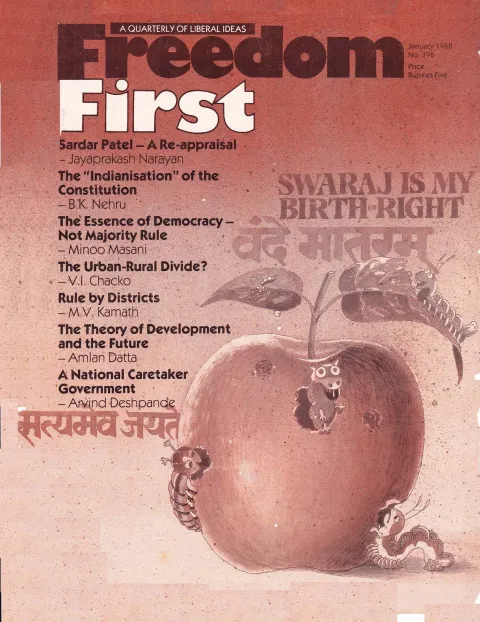
Freedom First
A Quarterly of Liberal Ideas
By Sharad Joshi, Minoo Masani, D. V. Gundappa, Bhanu Pratap Singh
Democratic Research Service, 4th floor, Maneckji Wadia Bldg., 127, Mahatma Gandhi Road, Bombay 400 001. Published by J.R. Patel for the Democratic Research Service and printed by him at Parsiana Publications Pvt. Ltd., 300 Perin Nariman Street, Bombay 400 001 · Bombay · 1987
52 pages
Freedom First
Summary
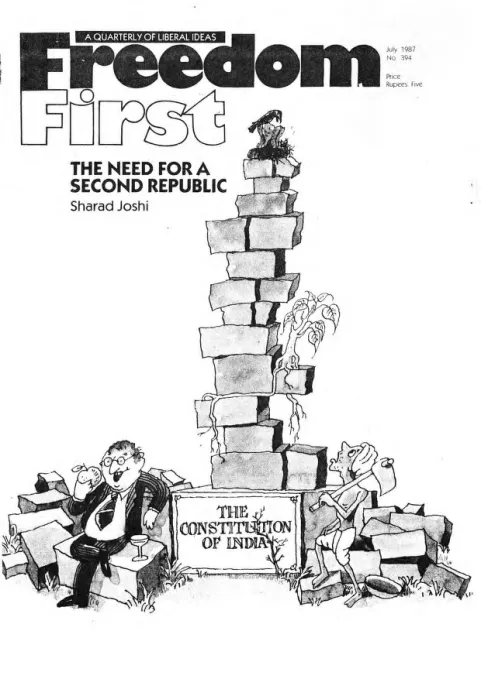
This is the July 1987 issue (No. 394) of Freedom First, “A Quarterly of Liberal Ideas,” published in Bombay by the Democratic Research Service under founder Minoo Masani, with S.V. Raju and R. Srinivasan as editors. The cover story is Sharad Joshi’s speech-based essay arguing that India’s post-independence Republic is failing and that a Second Republic is needed. The issue also carries Minoo Masani defending the largely dormant constitutional powers of the President against the Prime Minister, and D. V. Gundappa’s essay (reprinted to mark his birth centenary) tracing Indian liberalism to the concept of Dharma and to the reformist lineage of Rammohan Roy and Mahadev Govind Ranade. The regular “Of Cabbages and Kings” column comments on political scandals, the Radical Humanist journal’s fiftieth anniversary, the Uniform Civil Code debate, sugarcane/paddy agricultural policy in Maharashtra, and the death of former Prime Minister Charan Singh. A separate box reprints a statement by the Dalai Lama on Tibet, and the issue also honours the late administrator A. D. Gorwala. Based on the rendered pages (1-20 of 52), the volume centers on constitutional crisis, the erosion of republican institutions, the historical roots of Indian liberal thought, and Congress-era political controversy.
Key points
-
Sharad Joshi’s “The Need for a Second Republic” argues the 1950 Republic is dying as power has concentrated in the Prime Minister at the expense of the states, judiciary and Parliament, tracing Punjab’s crisis to economic exploitation of Sikh farmers and calling for radical decentralisation and a two-term cap on the premiership.
-
Minoo Masani’s “The President’s Powers” defends the President’s genuine constitutional checks on the Prime Minister, quoting Articles 74, 75 and 111, and criticises the Emergency-era 42nd Amendment for supporting an anti-pluralist reading of majority rule.
-
D. V. Gundappa’s “Liberalism in India,” reprinted for his birth centenary, argues Indian liberalism grew as a re-articulation of the Hindu concept of Dharma rather than a European import, tracing its modern genealogy from Rammohan Roy through Mahadev Govind Ranade.
-
The regular “Of Cabbages and Kings” column comments on political scandals, the Radical Humanist journal’s fiftieth anniversary, the Uniform Civil Code debate, and the death of former Prime Minister Charan Singh.
-
The issue reprints a statement by the Dalai Lama on Tibet and honours the late administrator A. D. Gorwala.
Essays
The Need for a Second Republic
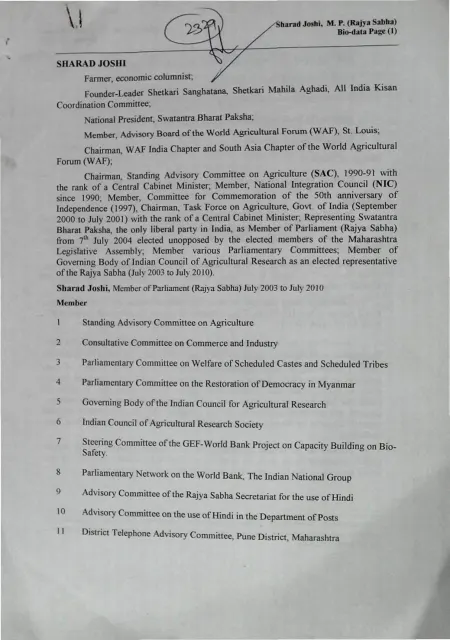
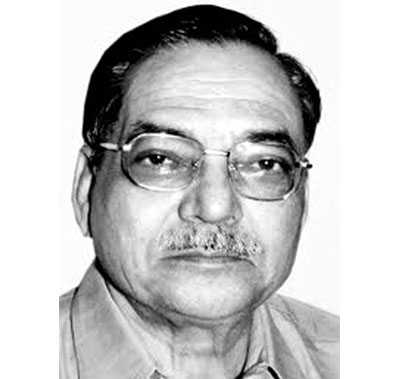
By Sharad Joshi
Sharad Joshi, founder of the Shetkari Sanghatana (farmers’ organisation), argues in the rendered pages that the Indian Republic born in 1950 is dying because its founding structures have been eroded and its unifying spirit is disappearing. He traces the ‘euphoria’ of 1947-50 through the drafting of the Constitution, then argues that over forty years power has been concentrated in the Prime Minister at the expense of the states, the judiciary, Parliament, and the Cabinet, turning the states into a ‘fiefdom’ of Delhi. He rejects moral-decline explanations for India’s troubles in favour of an economic one: parochial and communal conflict (Punjab, the Hindu-Muslim problem, caste and Dalit alienation) flares up in periods of stagnation and is fundamentally rooted in economic exploitation of agriculture and the lower classes by a ‘dualistic’ urban-biased economy, citing national income statistics comparing agricultural and non-agricultural per capita product. He gives an extended historical account of the Punjab and Sikh farmers’ grievances (BKU agitation, Operation Bluestar, Indira Gandhi’s assassination) as evidence of this economic dualism curdling into political crisis, and argues that a new elite of ‘Dada-Goondas’ (urban slumlords/smugglers/license-permit beneficiaries in collusion with rural power-brokers) has effectively captured the state in a ‘silent coup.’ He argues the Constitution itself is not to blame (quoting Ambedkar) and that a genuine Second Republic requires decentralised, federal government, subordination of state and religion, term limits on the Prime Minister, and above all treating the economic interests of the nation as a whole rather than favouring one sector over another.
- Argues the Indian Republic, founded in 1950, is dying because its institutions (judiciary, Parliament, Cabinet, Presidency) have been progressively subjugated to a single concentrated executive.
- Attributes India’s parochial, communal, and caste conflicts to periods of economic stagnation rather than moral decline, citing Bhagat Singh and Babu Genu as evidence against a ‘moral decadence’ thesis.
- Gives detailed economic data contrasting per-capita product in the agricultural vs non-agricultural sector (1951 vs 1983) to argue the state has systematically disadvantaged agriculture.
- Traces the Punjab crisis to the agrarian economic grievances of Sikh farmers under the green revolution, arguing traders (mostly Hindu) captured gains meant for farmers (mostly Sikh).
- Describes a new ruling combination of urban ‘Dadas’ (slumlords, smugglers, license-permit beneficiaries) and rural ‘Goondas’ as having captured political power in a bloodless coup.
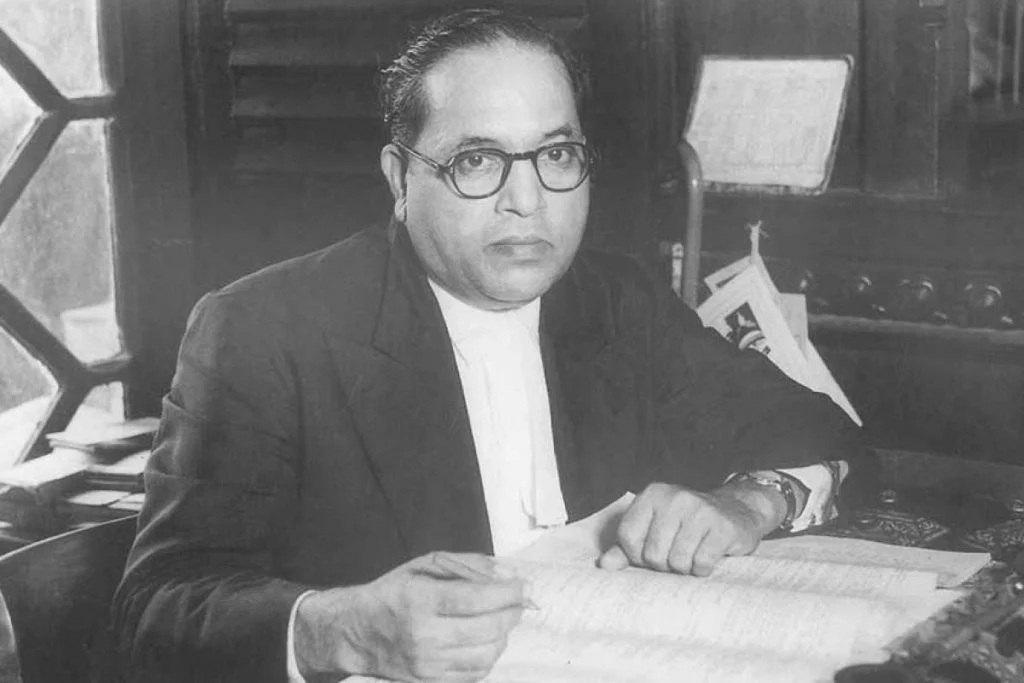
- Quotes Ambedkar to argue the Constitution is workable and not the source of the Republic’s failure — the failure lies in the men who wield it and in an economy that was never actually integrated.
- Proposes remedies for a Second Republic: radical decentralisation, a genuinely federal constitution, a two-term cap on the Prime Minister, rotation of the premiership, and a state confined to defence, external affairs, currency and inter-state coordination.
- Frames the argument in language borrowed from Jyotirao Phule, calling for the creation of an ‘integrated nation’ as the precondition for a genuine Republic.
The President’s Powers
By Minoo Masani
Minoo Masani responds to critics of his earlier Times of India article on the President-Prime Minister relationship, restating his argument that the Constitution deliberately gives the President real checks-and-balances power (not merely nominal, rubber-stamp authority), quoting Articles 74, 75, and 111 of the Constitution at length. He argues it is illogical to claim the President must act solely on the Prime Minister’s advice while also claiming the Cabinet holds office only ‘during the pleasure’ of the President, since both cannot be literally true at once. Masani insists democracy is not the same as unconstrained majority rule — ‘the tyranny of a brute majority can be as undemocratic and oppressive as the tyranny of a minority or an individual’ — citing Hitler’s rise via majority vote as evidence, and endorses power-sharing devices such as the Swiss Confederation’s proportional-representation-based executive. He criticizes the 42nd Amendment (pushed through during the Emergency) for supporting an anti-pluralist reading of majority rule, laments that the Janata Government failed to repeal it despite promising to, and closes by quoting Dicey via a Statesman excerpt on the constitutional propriety of the Crown/President dismissing a government that has lost the confidence of the electorate.
- Restates and defends an earlier Times of India piece arguing the President has genuine constitutional checks on the Prime Minister, not merely ceremonial powers.
- Quotes Articles 74(1), 75(1), 75(2) and 111 of the Constitution verbatim to support the claim that Ministers hold office ‘during the pleasure of the President.’
- Argues that critics’ logic (that the President can never act except on PM’s advice) is self-contradictory given the plain constitutional text.
- Distinguishes democracy from majority rule, arguing unchecked majoritarianism can itself become tyrannical, citing Hitler’s ‘one man one vote’ ascent to power.
- Criticizes the 42nd Amendment (passed during the Emergency) and faults the Janata Government for not repealing it in full despite its manifesto promise.
- Cites the Swiss Confederation’s proportional-representation cabinet as a model for accommodating minorities within majority governance.
- Closes with a quotation (via The Statesman) invoking Dicey on the legitimate grounds for the Crown to dismiss a ministry and dissolve Parliament.
Liberalism in India
By D. V. Gundappa
D. V. Gundappa’s essay, reprinted (with permission from the Gokhale Institute of Public Affairs, Bangalore) to mark his birth centenary, defines liberalism as faith in the free working of human intelligence and conscience, opposed to dictatorship by any person, group, or institution, and committed to reasoned persuasion and inviolable individual/minority rights. In the pages rendered, Gundappa first lays out a general theory of liberty and authority — authority exists to protect liberty but must be restricted to the limits of proven necessity — and then argues that Indian liberalism, unlike Europe’s, did not arise from conflict with an aggressive king or church, but instead represents a re-articulation of the ancient Hindu concept of Dharma under the stimulus of British-introduced enlightenment. He expounds a threefold philosophy of Dharma (one’s own nature/function; the sustaining order of righteousness and justice; and self-renunciation toward the highest self-fulfillment) as the philosophical bedrock from which modern Indian liberalism grew. He then traces the modern genealogy of Indian liberalism beginning with Rammohan Roy (1774-1833), a cosmopolitan reformer who championed press freedom, women’s rights, and opposed Sati, and continues into Mahadev Govind Ranade (1842-1900), described as having given Indian liberalism its ‘distinctive physiognomy’ through decades of work in education, economic development, women’s status, and reform of depressed classes, alongside collaborators including Dadabhai Naoroji, Telang, and Bhandarkar. The rendered pages end partway through the discussion of Ranade’s liberal doctrine, including his view that state action has a legitimate role in supporting education, social reform, and economic development, contra a narrow laissez-faire reading of liberalism.
- Defines liberalism as faith in free intelligence and conscience, opposed to dictatorship of persons, groups or institutions, upholding inviolable rights of individuals and minorities.
- Argues Indian liberalism did not emerge (as in Europe) from conflict against an aggressive king or church, since India’s history recorded no comparable systemic abuse of established rights.
- Presents Indian liberalism as a re-articulation of the ancient concept of Dharma, stimulated by the new knowledge and enlightenment introduced by British rule, rather than a European import.
- Expounds a threefold definition of Dharma: one’s own function/nature, the sustaining order of justice, and self-renunciation toward spiritual self-fulfillment.
- Credits Rammohan Roy (1774-1833) as the starting point of modern Indian liberalism — reformer of Sati, advocate of press freedom and women’s rights to property and education.
- Credits Mahadev Govind Ranade (1842-1900) with giving Indian liberalism its distinctive character across education, economic development, social reform and women’s status.
- Argues Ranade rejected a doctrinaire laissez-faire liberalism, holding that the state has a legitimate duty to support education, social reform, and economic development where individual effort is insufficient.
Generated by the v1.5 extraction pipeline. Awaiting editorial review.
Metadata and summary are AI-extracted from the source PDF and reviewed for editorial accuracy. The original work is available via the Read PDF tab above (where present); paragraph-level citation inside the PDF is deferred to a future engagement.