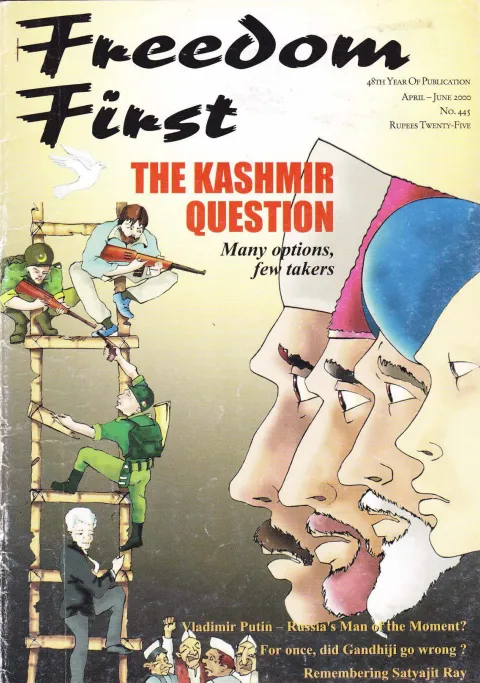
periodical issue
Freedom First
A Quarterly of Liberal Ideas
By S. V. Raju, Bhanu Pratap Singh
Democratic Research Service, 4th floor, Maneckji Wadia Bldg., 127, Mahatma Gandhi Road, Bombay 400001; Published by J.R. Patel for the Democratic Research Service and printed by him at Parsiana Publications Pvt. Ltd, 300 Perin Nariman Street, Bombay 400001 · Bombay · 1990
64 pages
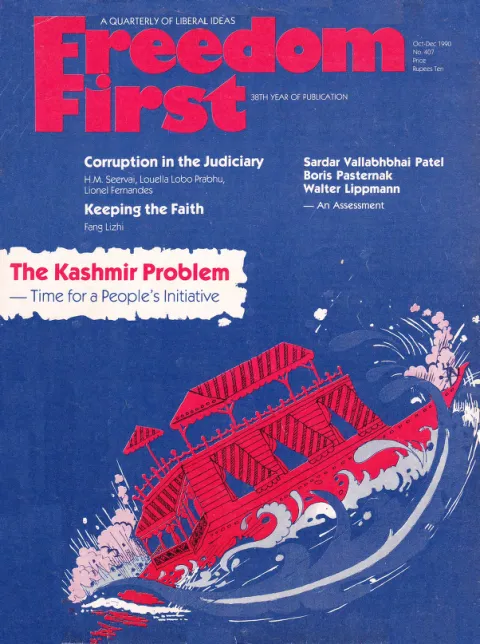
Freedom First
Summary
This is No. 407 of Freedom First, Bombay’s quarterly of liberal ideas, covering October-December 1990 (the journal’s 38th year of publication). The issue is dominated by two urgent domestic concerns: the deadlock over Kashmir and the erosion of the judiciary’s integrity. The lead feature, drawn from a Rajaji Foundation seminar held in Bombay on July 14, 1990, argues that decades of broken promises on a plebiscite, over-centralisation from Delhi, and militant repression have alienated Kashmiris, and calls for a ‘people’s initiative’ — restoring genuine autonomy and letting Kashmiris themselves negotiate their future — rather than continued reliance on the army. Founder Minoo Masani, in his own remarks reprinted from the seminar, goes further, calling ‘integral part of India’ a hollow slogan and urging India to offer Kashmir a real choice, including outright independence if that’s what its people want. A three-part symposium (H.M. Seervai, Louella Lobo Prabhu, and Lionel Fernandes) examines corruption in the higher judiciary in unusually blunt terms, cataloguing bribery, politically motivated transfers and appointments, decrepit court infrastructure, and the practical impossibility of disciplining a corrupt judge given the cumbersome impeachment process. Other pieces in the rendered pages include S.V. Raju’s editorial ‘The Liberal Conspiracy,’ a housewife’s perspective blaming Congress for India’s ills (Rani Sircar), guidelines for a national agricultural policy (Bhanu Pratap Singh), Chinese dissident-astrophysicist Fang Lizhi on ‘Keeping the Faith,’ and the regular ‘With Many Voices’ and ‘Of Cabbages and Kings’ editorial-notes sections, which mourn the deaths of associates Farrok Mulla and Aloo Dalal and industrialist Naoroji Godrej, and reflect (via Bruno Bettelheim’s posthumous unmasking) on the fallibility of intellectual heroes. The cover also previews an assessment of three recently deceased or newly reassessed twentieth-century figures — Sardar Patel, Boris Pasternak, and Walter Lippmann — to be treated later in the issue.
Key points
-
A Rajaji Foundation seminar report, “The Kashmir Problem — Time for a People’s Initiative,” argues decades of broken plebiscite promises and militant repression have alienated Kashmiris, and calls for a “people’s initiative” letting Kashmiris themselves negotiate their future.
-
Minoo Masani’s seminar remarks go further, calling “integral part of India” a hollow slogan and urging India to offer Kashmir a genuine choice, including independence, drawing an analogy to Gorbachev’s stance on Baltic sovereignty.
-
H. M. Seervai’s “The Crisis in the Judiciary” argues judicial corruption is especially corrosive because it removes society’s last institutional defence, insisting a corrupt judge deserves no special leniency from ordinary criminal prosecution.
-
Louella Lobo Prabhu’s “Corruption in the Higher Judiciary” catalogues specific scandals — a bag of currency in a judge’s ante-chamber, a no-confidence motion by Bar members — and traces politicised appointments to Indira Gandhi’s “committed judiciary” doctrine.
-
The issue also carries S.V. Raju’s editorial “The Liberal Conspiracy,” Rani Sircar’s housewife’s-perspective critique of Congress, Bhanu Pratap Singh’s agricultural-policy guidelines, and Chinese dissident Fang Lizhi’s “Keeping the Faith.”
Essays
The Kashmir Problem — Time for a People’s Initiative
A report on a Rajaji Foundation seminar (Bombay, July 14, 1990) on the Kashmir problem, tracing the 1947 accession, the broken promise of a plebiscite by Nehru and Mountbatten, the dilution of Article 370, and the descent into militancy following the 1989-90 crackdown and Sheikh Abdullah’s jailing. The report argues the idea that Kashmiris freely chose to integrate with India is a fiction maintained since independence, and that continued reliance on the army has turned a ‘docile people’ into an insurgency. It closes by summarising a call for a ‘people’s initiative’: treat the notion of forced national unity as a colonial-era myth, restore real autonomy to the states (not just Kashmir), and let the Kashmiri public — not politicians — decide whether to stay in the Union, on the understanding that India will respect their choice either way.
- Traces the 1947 accession of Jammu & Kashmir, the Pakistani-backed tribal invasion, and Nehru’s promise (reinforced in a November 1947 broadcast) of a UN-supervised plebiscite that was subsequently ‘quietly frozen’
- Reports Jayaprakash Narayan’s 1964 argument (reprinted from The Hindustan Times) that treating Kashmiri accession as settled is ‘a mockery of the Indian nation’
- Includes Minoo Masani’s seminar remarks proposing genuine autonomy or independence for Kashmir, drawing an analogy to Gorbachev’s stance toward Baltic sovereignty claims
- Lists the full roster of seminar participants, including J.R.D. Tata, Nissim Ezekiel, Usha Mehta, and S.V. Raju
- Concludes that the issue should be ‘taken out of the hands of government and politicians’ and decided through a people’s initiative on both sides of the border
Corruption in the Judiciary: The Crisis in the Judiciary
By H.M. Seervai
H.M. Seervai’s ‘The Crisis in the Judiciary’ argues that judicial corruption, though rarer than corruption among ministers or civil servants, is especially corrosive because it removes society’s last line of institutional defence. He surveys historical precedents of judicial corruption (citing 1930s U.S. federal judges forced to resign under threat of impeachment) and insists corrupt judges deserve no special leniency: a judge who takes bribes should face criminal prosecution like anyone else. He closes by invoking Lord Devlin’s observation that judges are no better or worse than the society producing them, and warns that any remedy devised against corrupt judges could just as easily be turned into a tool of executive intimidation against an honest judiciary.
- Cites the 1937 mass resignation of fifty-four Federal Court of Appeals judges in the US under threat of impeachment, and one judge later jailed for two years and fined $10,000 for corruption
- Insists a corrupt judge is not immune from ordinary criminal prosecution any more than someone who commits murder or forges documents
- Confines his allegations of judicial corruption to Maharashtra specifically, noting Chief Justice Chandrachud’s remark about ‘total darkness’ and pervasive corruption
- Quotes Lord Devlin’s dictum that judges as a class are no better or worse than the society they live in
- Warns that any anti-corruption remedy devised for the judiciary could be abused by the Executive against the judiciary generally
Corruption in the Judiciary: Corruption in the Higher Judiciary
By Louella Lobo Prabhu
Louella Lobo Prabhu’s ‘Corruption in the Higher Judiciary’ catalogues specific recent scandals — a bag of currency found in a judicial ante-chamber, a judge frequenting a hotel with a femme fatale, a no-confidence motion by Bar members against designated judges — and traces the politicisation of judicial appointments back to Indira Gandhi’s era, when a ‘committed judiciary’ concept and supersession of judges for gallantry to the ruling party corroded merit-based selection. She also documents the physical decrepitude of lower courts (courts held in garages in Uttar Pradesh, a Karnataka rural judge’s chamber only 10 by 10 feet) and rejects the excuse that poor judicial pay explains corruption, arguing a judge knows his likely emoluments before accepting the post.
- Documents concrete recent scandals: a bag of currency notes in a Bombay High Court judge’s ante-chamber, a judge frequenting a hotel with a ‘femme fatale’, a no-confidence motion by Bar members against certain judges
- Traces politicisation of appointments to Indira Gandhi’s era and the ‘committed judiciary’ doctrine, including the supersession of Justice Subba Rao’s line
- Describes dire physical conditions of lower courts: proceedings held in garages in Uttar Pradesh, a 10x10 foot rural court chamber in Kanakapura, Karnataka, and courts with no toilets or chairs
- Rejects low judicial pay as an excuse for corruption — ‘he knows his likely emoluments when he accepts the job’
- Notes judicial salaries were frozen from 1950 to 1986, feeding a longer-term culture of corruption, but says things have improved since revision, with High Court judge compensation now roughly Rs. 27,000-30,000/month including perquisites
Generated by the v1.5 extraction pipeline. Awaiting editorial review.
Metadata and summary are AI-extracted from the source PDF and reviewed for editorial accuracy. The original work is available via the Read PDF tab above (where present); paragraph-level citation inside the PDF is deferred to a future engagement.