periodical issue
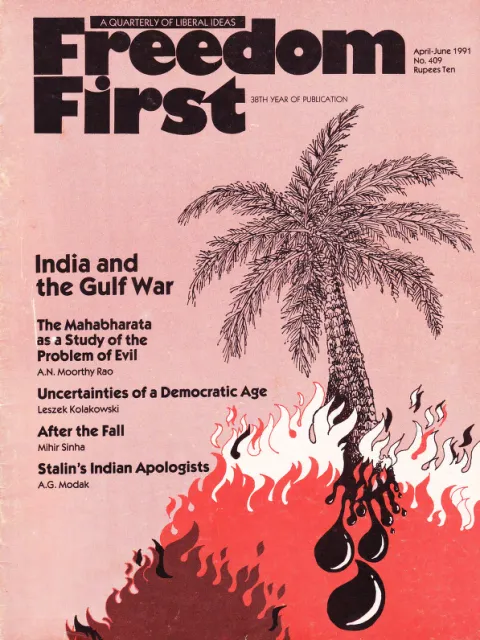
Freedom First
A Quarterly of Liberal Ideas
By J. M. Lobo Prabhu, J. R. D. Tata
Democratic Research Service, 4th floor, Maneckji Wadia Bldg., 127, Mahatma Gandhi Road, Bombay 400 001. Published by J.R. Patel for the Democratic Research Service and printed by him at Parsiana Publications Pvt. Ltd., 300 Perin Nariman Street, Bombay 400 001 · Bombay · 1991
52 pages
Freedom First
Summary
This is issue No. 409 of Freedom First, “A Quarterly of Liberal Ideas,” covering April-June 1991 (38th year of publication), published by the Democratic Research Service for the Freedom First Foundation, Bombay, and edited by S.V. Raju and R. Srinivasan. In the rendered pages (1-20 of 52), the issue opens with front matter (masthead, editorial note, contents), a “Twenty Questions to Ask Your Candidate” election checklist from the Freedom First Foundation, the recurring “With Many Voices” page of quoted press excerpts, the “Of Cabbages and Kings” notes column (on the decline of parliamentarians and the closure of the British weekly The Listener), and a tribute by Minoo Masani to J.R.D. Tata on his retirement as Chairman of Tata Sons. The bulk of the rendered material is the issue’s cover feature, “India and the Gulf War,” a report on a Freedom First Foundation seminar held in Bombay on March 16, 1991, which assembles a long list of named seminar participants alongside extensive compiled press excerpts (from The Times of India, The Economic Times, Indian Express, Guardian Weekly, and others) on India’s ambivalent, non-aligned response to the 1991 Gulf War, the conduct and consequences of the war itself, the debate over Indian intellectuals’ pro-Saddam sympathies, and the erosion of national sovereignty and non-alignment as organising principles of foreign policy. The rendered pages close with three individual written submissions from seminar participants: “Strengthen the United Nations” by M.A. Rane, “Rethinking India’s Foreign Policy” by Nitin G. Raut, and the opening of “NAM Has a Role to Play” by V.S. Sheth, arguing respectively for a strengthened UN role, a fundamental reorientation of Indian foreign policy away from non-alignment, and a continued (if reduced) role for NAM in reordering international economic relations.
Key points
-
The cover feature reports on a March 1991 Freedom First Foundation seminar on “India and the Gulf War,” criticising India’s confused diplomatic response, including the refuelling controversy, and pro-Saddam sympathies among sections of the Indian intelligentsia.
-
The seminar’s consensus recommendations include rejecting the “unipolar world” thesis, strengthening the UN and Security Council, reorienting non-alignment away from anti-Americanism, building SAARC on an ECM model, and dropping India’s one-sided Palestine position in favour of ties with Israel.
-
M. A. Rane’s “Strengthen the United Nations” distinguishes criticising pro-Saddam sympathisers from endorsing US conduct, and argues the war’s near-unanimous Security Council backing reflected shared oil interests rather than principle.
-
Nitin G. Raut’s “Rethinking India’s Foreign Policy” argues Nehruvian non-alignment tilted toward Moscow made India a “voluntary satellite of the USSR,” crediting Chandrashekhar’s restraint over Rajiv Gandhi’s “immature” freelance peace diplomacy.
-
V.S. Sheth’s “NAM Has a Role to Play” argues the Non-Aligned Movement, though politically weakened, retains a role in brokering a fairer international arrangement for Gulf oil resources.
-
Minoo Masani pays tribute to J.R.D. Tata on his retirement as Chairman of Tata Sons, and the issue carries a “Twenty Questions to Ask Your Candidate” election checklist from the Freedom First Foundation.
Essays
India and the Gulf War
The cover feature reports on a Freedom First Foundation seminar on “India and the Gulf War” held in Bombay on March 16, 1991. It opens with a narrative account of the causes of the war (Iraq’s invasion of Kuwait, UN Security Council resolutions, the economic and diplomatic costs to India of the embargo and war), followed by a long compilation of press excerpts and commentary addressing India’s confused and ambivalent diplomatic response, the refuelling controversy involving Rajiv Gandhi, the pro-Saddam sympathies of sections of the Indian intelligentsia and press (contrasted with what the piece frames as a more sensible “ordinary Indian” reaction), the environmental and demographic toll of the war, criticism of the conduct of the US-led coalition, the debate over whether the world is moving toward a unipolar order, and the erosion of non-alignment and national sovereignty as organising principles for Indian foreign policy. The piece lists a large roster of seminar participants (academics, retired officials, businessmen, and civil society figures) and ends with S.V. Raju’s summary of points of seminar consensus: rejecting the unipolar-world thesis, strengthening the UN and Security Council, reviewing non-alignment so it does not become anti-American, building SAARC on an ECM-like model, and abandoning a one-sided position on Palestine in favour of diplomatic relations with Israel.
- The five-and-a-half month embargo and the war cost India heavily: oil price shocks, dwindling foreign exchange, lost NRI remittances, stranded expatriate labour, and unpaid Iraqi debts to Indian contractors (estimated over Rs. 900 crores owed).
- India’s diplomatic conduct was widely criticised as confused and ambivalent, including the then-foreign minister’s embrace of Saddam Hussein in Baghdad and the controversy over refuelling US military aircraft.
- Sections of the Indian intelligentsia and left press were accused of pro-Saddam bias and intellectual dishonesty, while the ‘ordinary Indian’, informed by satellite TV and cable news, was described as having a more sensible, less ideologically captured view.
- The war is characterised as an unprecedented environmental and demographic catastrophe: hundreds of burning Kuwaiti oil wells, oil slicks, and Iraqi casualties compared against the earlier Iran-Iraq war.
- Contributors debated whether the war signalled a shift to a ‘unipolar world’ dominated by the US, with several arguing this reading was premature given Japan, Germany, and other emerging power centres.
- The seminar produced a consensus list of five foreign-policy recommendations: reject the unipolar-world thesis; strengthen the UN and reconstruct the Security Council; reorient non-alignment away from anti-Americanism; build up SAARC on an ECM model; and drop the one-sided Palestine position in favour of ties with Israel.
- Extensive attention is given to the Israel-Palestine dimension, with several excerpts arguing that Arab and Palestinian intransigence, not just Israeli occupation, complicated a resolution, and that India’s automatic pro-PLO tilt should be reconsidered.
- Named participants at the underlying seminar span academia (Bombay University), civil society (Radical Humanist Association, Indian Secular Society), industry, and retired government/police officials, reflecting Freedom First’s habitual convening of a broad liberal-minded audience.
Headless India
By The Economist editorial
M.A. Rane’s written submission, ‘Strengthen the United Nations,’ argues that criticising uncritical Indian support for Saddam does not amount to condoning the United States or its role in the war, noting the US had earlier helped build up Saddam’s war machine against Iran before he became inconvenient. Rane contends the Gulf War was fought over oil interests common to the US, European powers, and OPEC producers like Saudi Arabia, and that this shared interest, not disinterested principle, is what secured near-unanimous Security Council backing, including from the USSR and China who declined to exercise their veto.
- Rane distinguishes between criticising pro-Saddam sympathisers and endorsing US conduct, noting the US’s earlier role in arming Saddam against Iran.
- He argues the Gulf War’s near-unanimous Security Council support (barring Cuba and Yemen) reflected shared oil interests among major and developing powers rather than principle.
The Mahabharata as a Study of the Problem of Evil
By A.N. Moorthy Rao
Nitin G. Raut’s ‘Rethinking India’s Foreign Policy’ argues that India’s self-image as the world’s conscience-keeper on peace and morality was never backed by economic or military clout, and that Nehruvian non-alignment, tilted toward the Soviet Union, reduced India to a ‘voluntary satellite of the USSR.’ Raut contends the Gulf crisis exposed India’s marginal standing internationally, criticises Rajiv Gandhi’s freelance peace diplomacy as one-upmanship against Chandrashekhar, credits Chandrashekhar’s restraint on the refuelling issue and on delinking Kuwait from Palestine, and calls for India to strengthen SAARC, seek full diplomatic ties with Israel, and abandon NAM’s now-irrelevant framing.
- Raut argues India’s self-styled role as global conscience-keeper on peace lacked the economic and military backing to be taken seriously, and that non-alignment tilted toward Moscow made India a de facto Soviet satellite.
- He credits Prime Minister Chandrashekhar’s statesmanship in holding out on the refuelling issue and refusing to link the Kuwait crisis to the Palestinian question, while criticising Rajiv Gandhi’s unsolicited peace initiative as immature grandstanding.
- He calls for India to build up SAARC toward an ECM-like arrangement, establish full diplomatic relations with Israel, and abandon the now largely symbolic non-aligned movement.
The Masani Viewpoint
V.S. Sheth’s ‘NAM Has a Role to Play’ opens by noting that Indian press commentary during the war, including The Times of India’s ‘Pax Americana’ editorial, was written under exceptional circumstances and should be judged with the benefit of hindsight regarding how the US ultimately conducted the war in consultation with allies. In the rendered portion, Sheth argues NAM, though politically weakened, retains a role in reordering international economic relations, particularly around a fairer, internationally guaranteed arrangement for exploiting and distributing Gulf oil resources, and regrets that NAM failed to seize this opportunity, leaving the field to a Western-proposed regional security arrangement instead.
- Sheth argues Indian press criticism of the US written during the war should be reassessed with hindsight, since US conduct (consulting allies, constraining its own action) diverged from wartime expectations.
- He contends NAM, while politically weakened, still has a role in brokering a fair international arrangement for the exploitation and distribution of Gulf oil resources, and regrets that NAM countries missed this opportunity, ceding ground to a Western-proposed regional security arrangement instead.
Generated by the v1.5 extraction pipeline. Awaiting editorial review.
Metadata and summary are AI-extracted from the source PDF and reviewed for editorial accuracy. The original work is available via the Read PDF tab above (where present); paragraph-level citation inside the PDF is deferred to a future engagement.